Recipe · Indirect · Advanced
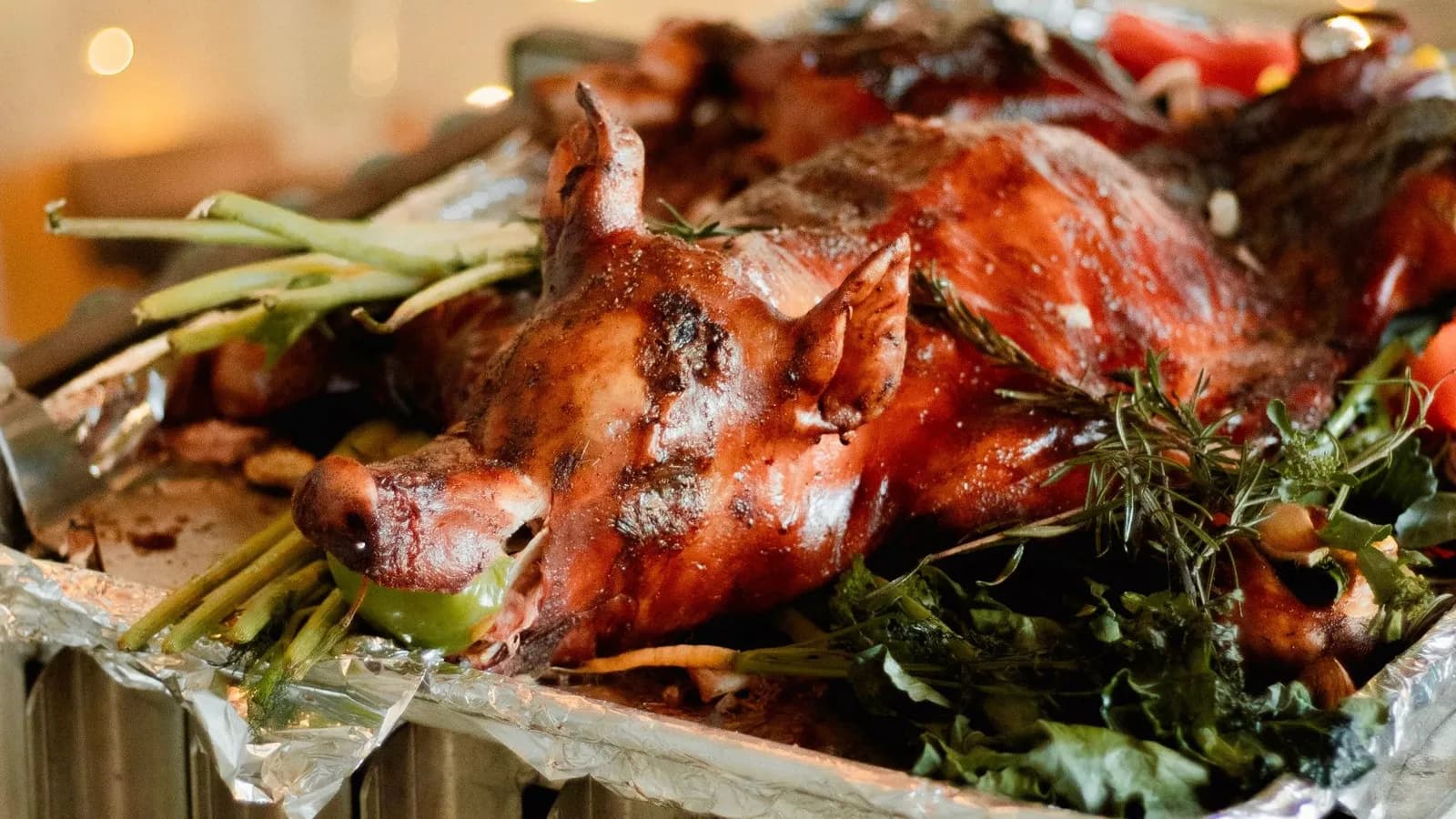
Suckling pig (cochinillo) roasted in a kamado, by the quarter, with crackling skin
This is the Christmas roast done in a kamado, with the truth up front: a whole one will not fit. Two quarters, indirect at 150 °C with water under the meat, then a 250 °C finish so the skin blisters and crackles.
Quick answer
Air-dry the skin of two suckling pig quarters in the fridge for 12-24 hours, prick it only on the surface and rub with lard. Roast skin up, indirect at 150 °C, with water trays over the deflector, for 2-2.5 hours to 85-88 °C in the leg (never below 75 °C). Raise to 250 °C for 20-30 minutes, burping the lid. Cut with shears.
- Prep
- 30 min
- Cook
- 210 min
- Servings
- 4 servings
- Temperature
- 150 °C
Ingredients
- suckling pig quarters (cochinillo), one front and one rear (half an animal, about 2.4 kg in total)2 ud
- coarse salt25 g
- lard (manteca de cerdo), at room temperature40 g
- water for the pans (and a little more for topping up)600 ml
- bay leaves3 ud
- cos lettuce (lechuga romana), for the salad1 ud
- spring onion (cebolleta), in thin rings1 ud
- extra virgin olive oil3 cda
- white wine vinegar1 cda
The gear for this recipe
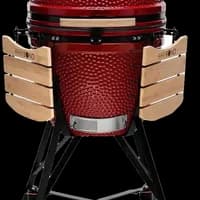 Kamado Bono Grande XXL 59 cmThis recipe depends on space on the grate, which is why it asks for a large kamado. The **Kamado Bono Grande XXL** measures 59 cm across the body and, according to retailer listings, around 49-50 cm of usable grate: just enough for two suckling pig quarters laid head to tail, with no skin touching the ceramic at the edge. It comes with a ceramic deflector as standard, which is the basis of the indirect roast at 150 °C and the support for the water pans, so nothing else needs buying to set it up. Its ceramic mass takes longer to heat, 30-40 minutes to stabilise, but it then holds the temperature through the two and a half hours of roasting with very little adjustment of the vents.
 NaturBraza marabu charcoal, pack of two 5 kg bags (10 kg)Between the slow roast and the finish, this suckling pig asks for more than three hours of burn and a final rise to 250 °C without reloading halfway. **NaturBraza marabú charcoal** is very dense wood: it burns slowly, with a short flame and little ash, the profile that sustains a long cook with the vents almost closed and still has reserve when you open them to go up to 250 °C without reloading. That is why the firebox is loaded to the brim from the start: reloading mid-roast would mean lifting out the grate with the quarters on it.
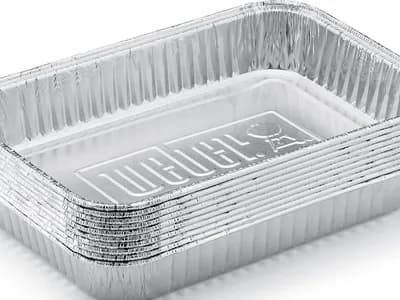
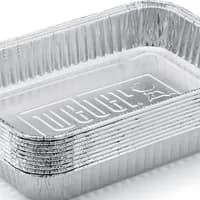 Weber 6415 — small aluminium drip pans, 22 × 15 cm, pack of 10They are the Segovian oven moved into the kamado. The **Weber drip pans** measure 22 × 15 cm, so two or three fit on the Bono's deflector under the two quarters. With a centimetre of water they do two jobs: they keep the chamber moist during the roast at 150 °C, like the shallow water in the earthenware dish, and they catch the fat the skin releases. While they still hold water, the base stays at around 100 °C and that fat does not scorch or send acrid smoke to the meat, even in the 250 °C finish. As disposable aluminium, they are thrown away at the end and the deflector stays free of carbonised fat. They are thin: lift them cold and full, resting on something rigid.
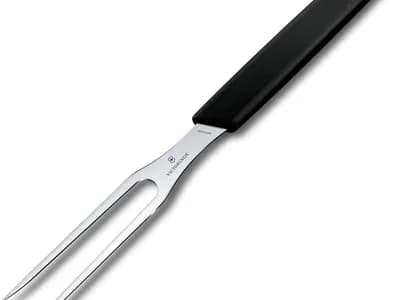
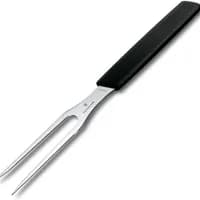 Victorinox Swiss Classic 5.2103.15B: carving fork, 15 cm bladeIt works twice in this recipe, always outside the kamado. Before roasting, the tip of the **Victorinox Swiss Classic carving fork** pricks the skin on the surface, which is the gesture of the Segovian recipe: about a dozen angled pricks per quarter, without reaching the meat, so the fat underneath has an exit and the skin blisters instead of puffing into pockets. At the end, with the roast rested on the board, it holds each quarter while the shears cut the portions, so the hand does not press the crisp skin. It has a 15 cm forged blade and a plastic handle, so it stays away from the embers: its place is the board.
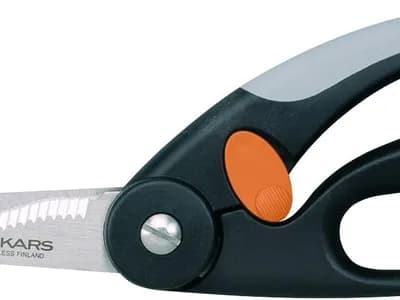
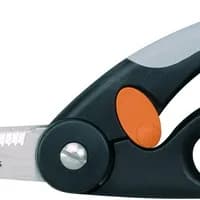 Fiskars Functional Form 1003033: 25 cm poultry shearsThe **Fiskars poultry shears** are designed for chicken and turkey, and here they work for the same reason: the bones of a milk-fed animal are thin and soft, about the calibre of a large bird's. Their 9.5 cm serrated blade goes through the toasted skin and the ribs of the suckling pig in one clean cut, with the piece skin up, without the downward pressure of a knife that crushes the crust that took so much effort to achieve. With two quarters, regular portions come out without changing tools. To split the backbone of half an animal raw, though, the butcher's saw is the better tool, and these short blades would need several passes.
Method
- 01
Dry the skin the day before
Pat both quarters dry with kitchen paper, the skin above all. Spread the coarse salt over the inner side and rub a thin layer onto the skin. Place them skin up on a rack set over a dish and leave them uncovered on the bottom shelf of the fridge, away from anything that will be eaten uncooked, for 12 to 24 hours: the cold air dries the skin, and dry skin is what blisters later instead of turning leathery. Take them out 45 minutes before roasting.
- 02
Light the charcoal and set up indirect
Empty the ash and fill the firebox to the brim with the NaturBraza marabú charcoal: reloading with the meat inside means lifting out grate, quarters and deflector. Light in one or two spots and leave the lid open for 10 minutes. Fit the Bono's ceramic deflector and, on top, two or three Weber pans, as many as fit without overhanging the deflector, with a centimetre of water and the bay leaves. Set the grate, close up and stabilise at 150 °C at grate height: allow 30-40 minutes.
- 03
Prick and rub
With the tip of the Victorinox carving fork, prick the skin about a dozen times per quarter, at an angle and without reaching the meat: you want an exit for the fat underneath, not for the juices. Blot away any moisture that has appeared. Rub the whole skin with the lard in a thin layer, without forgetting the edges and the trotters, which are the first parts to brown.
- 04
Roast at 150 °C
Set the quarters skin up, head to tail: the leg of one next to the shoulder of the other, clear of the ceramic. Push the probe into the thickest part of the leg, away from the bone, and hold 150 °C for 2 to 2.5 hours. After 45 minutes, burp the lid and top up the pans that still hold water with hot water, slowly and at the edge, from a spouted jug through a gap in the grate. If one is dry and holds fat, add no water: it spits.
- 05
Check doneness
The leg decides. The slow phase ends when it reads 85-88 °C in its thick part and the shoulder does not drop below 75 °C at any point: check by inserting the probe in two or three places, always away from the bone. The physical sign agrees: the leg bone turns with a tug and the meat gives way between the ribs. If the leg stalls at 80 °C, give it another 15-20 minutes; this roast forgives extra time better than haste.
- 06
Finish the skin at 250 °C
Before raising the heat, top up to a centimetre, slowly and at the edge, the pans that still hold water. Open both vents fully and, past 235 °C, close the bottom vent halfway: the ceramic keeps climbing by inertia and settles at 250 °C. Count 20-30 minutes from 250 °C. After 15, burp the lid, with gloves on and your face turned away; check the skin and close again. If an edge darkens, cover it with foil.
- 07
Rest and carve
Close both vents, burp the lid and take the quarters out with gloves. Rest them for 10 minutes on a board, skin up and uncovered: foil traps steam and softens the skin. Hold each quarter with the fork and cut it into portions with the Fiskars poultry shears, skin side up: they go through the skin and the soft ribs of a milk-fed animal without crushing the crust. Serve with the lettuce and spring onion salad dressed at the last moment.
About this recipe
Roast suckling pig (cochinillo asado) is the Christmas roast of half of Spain, and in a kamado it works on one condition that is best stated up front: by the quarter. A Cochinillo de Segovia PGI piglet weighs between 4 and 5.8 kg dressed and, head included, will not lie flat on any home cooking grate. Half an animal does fit, split into two quarters: the front one, with the shoulder (paletilla) and the ribs, and the rear one, with the leg and the loin. The method copies the logic of the Segovian oven, gentle heat with water underneath, and ends with a burst of heat for the skin alone.
Which kamado, and how many quarters
A kamado is measured by the diameter of its cooking grate, not of its body (size guide). The Kamado Bono Grande XXL is sold as a 59 cm model, which is the body; retailer listings give a usable grate of around 49-50 cm, and that holds two quarters from a 4-5 kg animal laid head to tail, the leg of one next to the shoulder of the other. In a 46 cm kamado (Large or Classic) plan on one quarter: two only fit squeezed against the edge, and skin that touches the ceramic does not brown like the rest. With the ceramic deflector the Bono includes as standard, indirect cooking needs no further accessory.
Water below, dry skin above
The Cochinillo de Segovia association's recipe puts the piglet in a dish with a shallow layer of salted water, a centimetre or so deep, at 180 °C, skin side down first and then turned over. The water keeps the air moist while the connective tissue melts. In the kamado, two or three Weber drip pans with a centimetre of water on the deflector do that job: they catch the fat and, while they still hold water, the base of the pan stays at around 100 °C, so the fat does not scorch or smoke the way it would on bare ceramic. In the finish the water stays: with the vents open the steam escapes through the top, and its job is no longer moisture but keeping the fat from burning on dry aluminium. The chamber drops to 150 °C, the ceiling for gentle indirect roasting in the temperature table, because a quarter is thinner than the whole animal and at 180 °C it would dry out at the edges. And the skin stays on top from the start: turning it over on a grate tears it.
For the skin to crackle it has to go in dry, hence the uncovered night in the fridge. And it has to be pricked with judgement: a few shallow pricks with the tip of a fork give the fat underneath a way out without opening a path for the juices. Pricking deep and everywhere does the opposite, because the liquid that escapes boils under the skin and softens it.
Why 85 °C and not 71
The rule for pork in a single piece on this site is 71-75 °C, and safety is amply covered: the USDA sets 62.8 °C (145 °F) with a three-minute rest for whole cuts of pork. Suckling pig goes past that on purpose. It is a milk-fed animal, slaughtered at 35 days at most under the PGI, with little meat among a lot of bone, skin and connective tissue. That young collagen has weakly cross-linked bonds and melts sooner than the collagen in an adult shoulder, which needs 93-96 °C to pull apart. Between 85 and 88 °C in the thick part of the leg, away from the bone, the meat comes off the bone with a tug and stays juicy, wrapped in its own gelatine. Below 75 °C at any point, it does not leave the kamado: that is the minimum.
The finish raises the chamber to 250 °C with the vents open, and every time you open the lid at that heat you burp it, as the temperature problems guide explains: lid up about 5 cm, wait about 5 seconds, then open fully, with gloves on and your face turned away. If you want another winter roast with less risk, the smoked leg of lamb, Levante style runs at 130 °C with no hard finish, and the Alicante-style baked rice uses the same kamado as a domed oven.
In 30 seconds
Two quarters of suckling pig (half an animal) in a kamado with a grate of about 49-50 cm; in a 46 cm one, a single quarter. Skin dried 12-24 h in the fridge and pricked only on the surface. Indirect at 150 °C with water pans under the meat, 2-2.5 h until 85-88 °C in the leg and never below 75 °C. Finish at 250 °C, burping the lid, until the skin blisters. Cut with shears, skin side up.
Editor's tips
- Ask the butcher for the half piglet already split into front quarter and rear quarter: the butcher's saw cuts the backbone cleanly, and the poultry shears are kept for the portions, which is where they earn their place.
- In a 46 cm kamado, make a single quarter. The time barely changes, because what sets the roast is the thickness of the leg and not the kilos on the grate.
- For Christmas Eve, count back about four and a half hours from when you sit down: 40 minutes of lighting, 2-2.5 hours of roasting, the climb to 250 °C, 20-30 minutes of finishing and 10 of resting. If you are ahead of schedule, the 150 °C phase tolerates a little longer.
- Never wet the skin during the roast or pour water over it, as is done with other roasts. The water goes only in the pans; the skin stays dry and rubbed with lard.
Gear for this recipe
As an Amazon Associate, mikamado.es earns from qualifying purchases. At no extra cost to you.
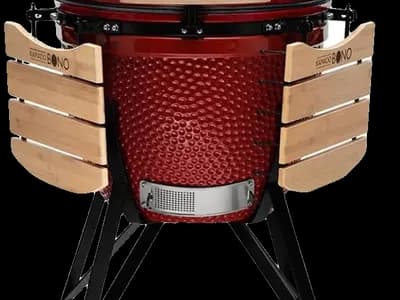
Kamado Bono Grande XXL 59 cm
This recipe depends on space on the grate, which is why it asks for a large kamado. The **Kamado Bono Grande XXL** measures 59 cm across the body and, according to retailer listings, around 49-50 cm of usable grate: just enough for two suckling pig quarters laid head to tail, with no skin touching the ceramic at the edge. It comes with a ceramic deflector as standard, which is the basis of the indirect roast at 150 °C and the support for the water pans, so nothing else needs buying to set it up. Its ceramic mass takes longer to heat, 30-40 minutes to stabilise, but it then holds the temperature through the two and a half hours of roasting with very little adjustment of the vents.
€1,084
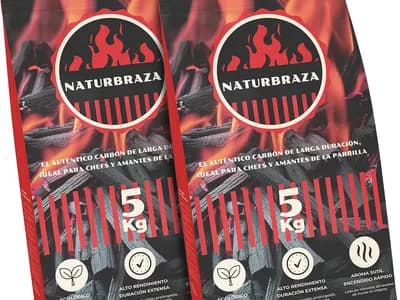
NaturBraza marabu charcoal, pack of two 5 kg bags (10 kg)
Between the slow roast and the finish, this suckling pig asks for more than three hours of burn and a final rise to 250 °C without reloading halfway. **NaturBraza marabú charcoal** is very dense wood: it burns slowly, with a short flame and little ash, the profile that sustains a long cook with the vents almost closed and still has reserve when you open them to go up to 250 °C without reloading. That is why the firebox is loaded to the brim from the start: reloading mid-roast would mean lifting out the grate with the quarters on it.
€47
Weber 6415 — small aluminium drip pans, 22 × 15 cm, pack of 10
They are the Segovian oven moved into the kamado. The **Weber drip pans** measure 22 × 15 cm, so two or three fit on the Bono's deflector under the two quarters. With a centimetre of water they do two jobs: they keep the chamber moist during the roast at 150 °C, like the shallow water in the earthenware dish, and they catch the fat the skin releases. While they still hold water, the base stays at around 100 °C and that fat does not scorch or send acrid smoke to the meat, even in the 250 °C finish. As disposable aluminium, they are thrown away at the end and the deflector stays free of carbonised fat. They are thin: lift them cold and full, resting on something rigid.
€5
Victorinox Swiss Classic 5.2103.15B: carving fork, 15 cm blade
It works twice in this recipe, always outside the kamado. Before roasting, the tip of the **Victorinox Swiss Classic carving fork** pricks the skin on the surface, which is the gesture of the Segovian recipe: about a dozen angled pricks per quarter, without reaching the meat, so the fat underneath has an exit and the skin blisters instead of puffing into pockets. At the end, with the roast rested on the board, it holds each quarter while the shears cut the portions, so the hand does not press the crisp skin. It has a 15 cm forged blade and a plastic handle, so it stays away from the embers: its place is the board.
€23
Fiskars Functional Form 1003033: 25 cm poultry shears
The **Fiskars poultry shears** are designed for chicken and turkey, and here they work for the same reason: the bones of a milk-fed animal are thin and soft, about the calibre of a large bird's. Their 9.5 cm serrated blade goes through the toasted skin and the ribs of the suckling pig in one clean cut, with the piece skin up, without the downward pressure of a knife that crushes the crust that took so much effort to achieve. With two quarters, regular portions come out without changing tools. To split the backbone of half an animal raw, though, the butcher's saw is the better tool, and these short blades would need several passes.
€26
FAQ
How long do you roast a suckling pig and at what temperature?
In an oven, the Cochinillo de Segovia association's recipe gives 180 °C for about three hours for the whole animal, 90 minutes skin down and 90 skin up. In a kamado and by the quarter, which is thinner, it works better at 150 °C indirect for 2-2.5 hours, until 85-88 °C in the leg, then 20-30 minutes at 250 °C for the skin. Time is a guide; the probe decides.
Does a whole suckling pig fit in a kamado?
Not in a domestic one. A Segovian piglet weighs between 4 and 5.8 kg dressed and, whole with its head, it is longer than any home cooking grate. The practical answer is to split it into quarters: in a kamado with about 49-50 cm of usable grate, such as the Bono Grande XXL, two quarters fit head to tail, which is half an animal. In a 46 cm one, plan on a single quarter.
What internal temperature should roast suckling pig reach?
Never less than 75 °C at any point, and ideally 85-88 °C in the thick part of the leg, away from the bone. It goes beyond the 71-75 °C of adult pork in a single piece because suckling pig is nearly all bone, skin and connective tissue, and that young collagen melts at those temperatures. There the meat comes off the bone and stays juicy, wrapped in its own gelatine.
How do you get suckling pig skin crisp?
With three moves. Dry it the day before, uncovered in the fridge for 12 to 24 hours. Prick it sparingly and only on the surface, so the fat comes out without the juice. And finish with a burst of heat: in a kamado, 20-30 minutes at 250 °C once the meat is already cooked. Rubbing it with a thin layer of lard helps it brown evenly.
Can you cook suckling pig with potatoes in the kamado?
Yes, with caveats. The grate is taken up by the quarters, so the potatoes go inside the pans, sliced half a centimetre thick and with the water: they cook in the juices and fat that drip down and come out soft and tasty, but not browned. Check the water level after 45 minutes, because the potatoes absorb some of the liquid.
More kamado recipes
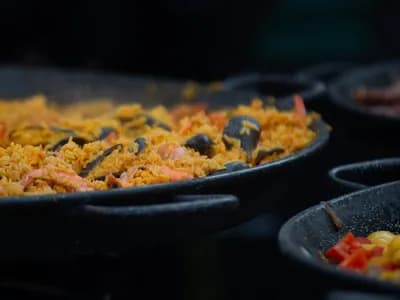
Alicante-style baked rice on the kamado in a clay cazuela
Traditional Alicante baked rice —chickpeas, pork rib, blood sausage, potato and tomato, with a whole garlic head in the centre— baked in a clay cazuela at 220°C indirect.
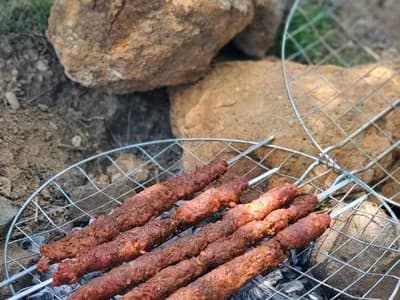
Lamb Lyulya Kebab on the Kamado
The question is never how to season it, but why it falls off the skewer. The answer is fat, a hand-chopped grain and real kneading: juicy lamb that holds together over direct fire.
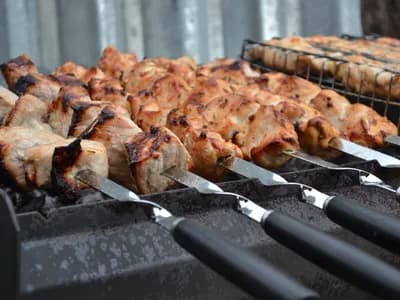
Pork Neck Shashlik on the Kamado, Onion Marinade
The skewer of the Russian-speaking world, cooked as I make it on my Big Green Egg Large: pork neck in 3 cm cubes, a grated onion marinade with not a drop of vinegar, and twenty minutes of steady direct fire.
KEEP READING
Go deeper on this dish
- Recommended kamado
Kamado Bono Grande XXL 59 cm
This recipe depends on space on the grate, which is why it asks for a large kamado. The Kamado Bono Grande XXL measures 59 cm across the body and, according to retailer listings, around 49-50 cm of usable grate: just enough for two suckling pig quarters laid head to tail, with no skin touching the ceramic at the edge. It comes with a ceramic deflector as standard, which is the basis of the indirect roast at 150 °C and the support for the water pans, so nothing else needs buying to set it up. Its ceramic mass takes longer to heat, 30-40 minutes to stabilise, but it then holds the temperature through the two and a half hours of roasting with very little adjustment of the vents.
- Editorial guide
How to light a kamado: the step-by-step method
No petrol, no weird tablets and no 45-minute waits. The cone method, airflow control and the mistakes that prevent 80% of the frustration.
- Glossary term
Heat deflector
Ceramic plate placed between the coals and the grate to turn direct fire into indirect cooking.
- Related comparison
big green egg large vs kamado joe classic iii
The classic kamado matchup: the Big Green Egg Large, the indestructible pioneer with the widest accessory network, agai…