TÉCNICA
Kamado cooking temperatures and times: a cheat-sheet by cut
The four heat zones, the technique-to-temperature table and the cut-to-internal-temp-to-time cheat-sheet. Why the probe beats the clock, every time.
Quick answer
In a kamado, internal temperature rules over the clock: a brisket is done at 90-95 °C in the core, not at exactly ten hours. Work in four zones — smoking 90-120 °C, indirect 150-180 °C, roasting 180-250 °C and direct 250-350 °C — always with a probe in the thickest part of the piece.
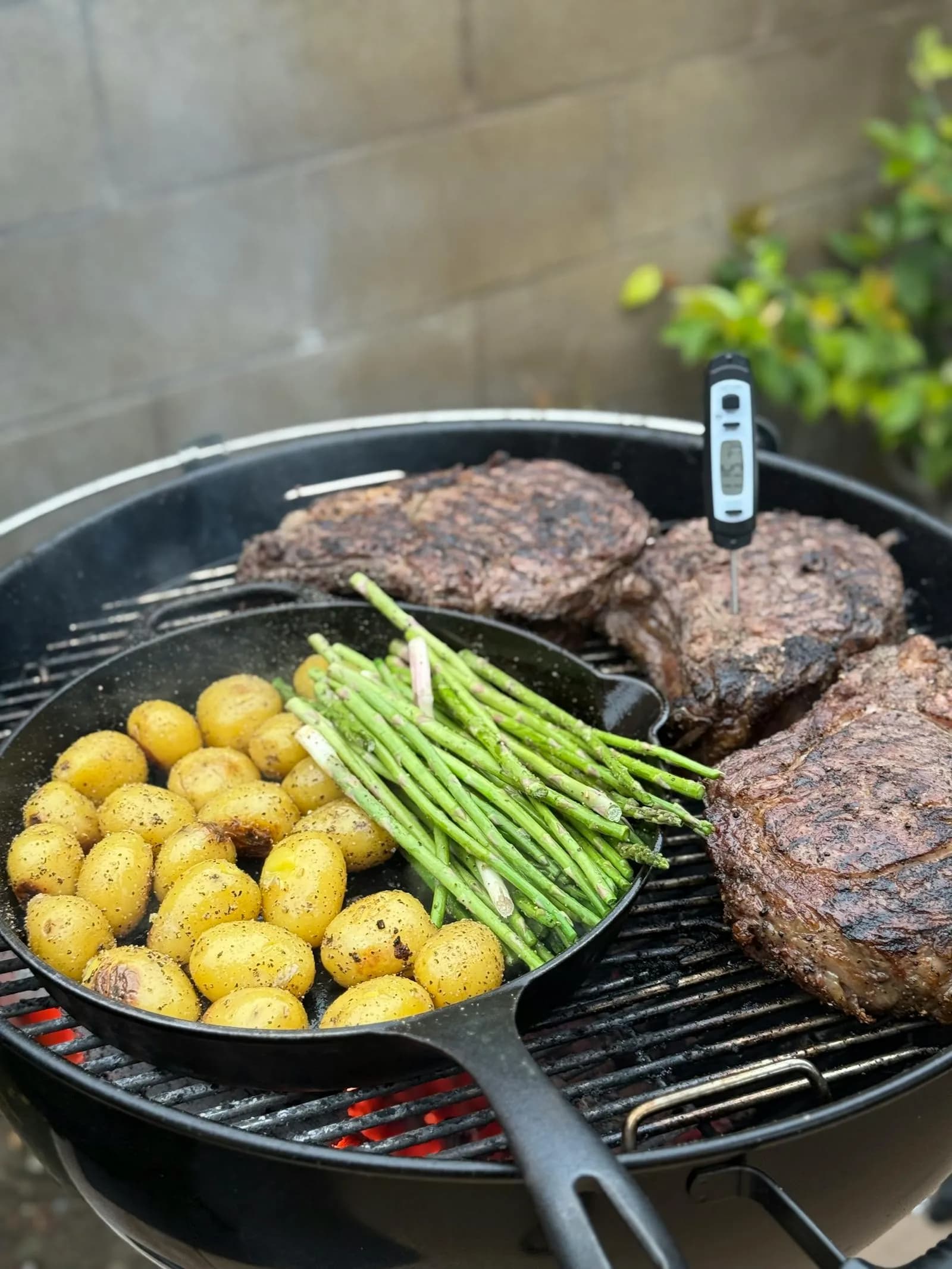
In a kamado, the meat's internal temperature outranks time: a brisket is done at 90-95 °C in the core, not at exactly ten hours. We work in four zones — smoking 90-120 °C, indirect 150-180 °C, roasting 180-250 °C and direct 250-350 °C+ — always with a probe. The two tables below are your cheat-sheet.
The kamado's four temperature zones
Almost everything we cook falls into one of four zones, and learning them by heart is what turns the table further down into something instinctive.
Low smoking, 90-120 °C: the home of tough, large cuts — brisket, pulled pork, ribs — where collagen melts slowly into gelatine and smoke has hours to work its way in. Strictly indirect, with a deflector.
Indirect roasting, 150-180 °C: the comfortable middle ground for whole chicken, duck breast, pork belly or bread. It cooks through by convection without scorching; keep the deflector in so the base doesn't burn.
Roasting and baking, 180-250 °C: vegetables, grilled ribs, focaccia, a chicken we want with crisper skin. Here we can start removing the deflector depending on the dish.
Searing and direct pizza, 250-350 °C and beyond: live fire over the grate, no deflector. Ribeye, the final sear on a fillet, a Neapolitan pizza on stone in 90 seconds. This is the zone where the kamado pulls away from any gas grill.
Table 1 — Technique → kamado temperature → examples
This is the table we check before lighting up: you decide what you want to do, and it tells you which chamber temperature to aim for. The temperature is the chamber temperature, measured at grate level with an ambient probe; these are the values we use on our terrace with the Big Green Egg Large. To hit and hold those numbers, read our temperature-control guide.
| Technique | Kamado temperature | Deflector | Typical examples |
|---|---|---|---|
| Low smoking (low & slow) | 90-120 °C | Yes | Brisket, pulled pork, ribs, smoked salmon |
| Gentle indirect roasting | 130-150 °C | Yes | Pork belly, shoulder, salmon, suckling pig |
| Medium indirect roasting | 160-180 °C | Yes | Whole chicken, duck breast, bread, rib rack |
| Baking / hot roasting | 190-230 °C | Depends on dish | Vegetables, focaccia, grilled ribs, crisp chicken |
| Direct searing | 250-300 °C | No | Ribeye, fillet, burger, final sear |
| Pizza / live fire | 320-400 °C+ | No (stone) | Neapolitan pizza, naan, open-fire sear |
A rule we keep repeating: ceramic climbs easily and falls very lazily. Close the vents 30-40 °C before your target and let inertia do the rest.
Table 2 — Cut → internal temperature → approximate time
This is the real cheat-sheet, the one taped up on our terrace. The column that rules is internal temperature: time is only a planning guide. Always measure in the centre of the thickest part with a probe. Times assume the chamber temperatures shown and our Levante climate.
| Cut | Chamber temp. | Target internal temp. | Approx. time |
|---|---|---|---|
| Whole brisket (5-6 kg) | 110 °C | 90-95 °C | 10-14 h |
| Pulled pork / pork butt (3 kg) | 110 °C | 90-92 °C | 8-12 h |
| Pork ribs (2-2-1, 3-2-1 or 2-1-1) | 110-120 °C | 90-93 °C | 4-6 h depending on cut |
| Lamb shoulder (2 kg) | 130 °C | 88-90 °C | 5-6 h |
| Whole chicken (1.6 kg) | 170 °C | 75 °C in the thigh (breast at least 74 °C) | 2-3 h |
| Chicken quarters | 180 °C | 75 °C | 45-60 min |
| Duck breast | 160 °C | 54-58 °C | 25-35 min |
| Ribeye / sirloin (3-4 cm) | 250 °C + sear | 52-55 °C (medium-rare) | 8-12 min |
| Whole fillet | 120 °C → sear | 52-55 °C | 35-45 min |
| Salmon fillet | 130 °C | 50-52 °C | 20-30 min |
In poultry, the safety minimum is 74 °C in the thickest part, breast included: it is the figure from Spain's food safety agency (AESAN) for poultry meat (74 °C at the centre) and from the USDA (165 °F). With long cuts, expect the stall: a brisket sticks around 70 °C internal for hours as moisture evaporates. It is not a fault in the cooker; it is physics. Wrapping in paper (the Texas crutch) shortens it.
Why internal temperature beats the clock
The clock lies; the probe doesn't. Two briskets of the same weight can take three hours apart depending on fat, thickness, the day's humidity and how many times you opened the lid. The times in the tables are an average so you know whether you're running late for lunch, not an order.
What really happens inside is biochemistry with a trigger temperature. Collagen starts turning to gelatine around 70 °C and finishes melting near 90-95 °C: that's why a brisket or pulled pork isn't "done" until that band, however many hours it has been on. In poultry, 75 °C is food safety, not opinion. And in a medium-rare ribeye, 52-55 °C is the line between juicy and shoe-leather.
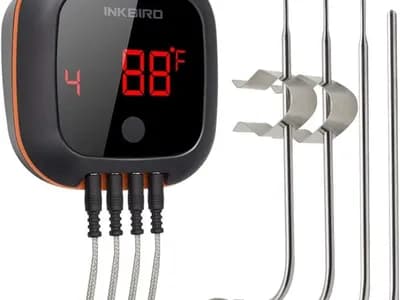
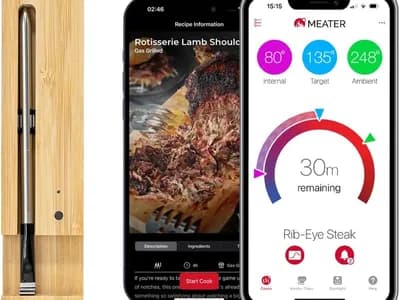
Our advice is simple: one chamber probe to know the air temperature and one core probe sunk into the centre of the cut. With that, you stop guessing. The factory dome thermometer, besides, with the deflector in, can differ by 10-25 °C from the grate, where the food sits — another reason not to trust it alone. We unpack this in the temperature-control guide.
Adjusting for weather, wind and the size of the cut
The tables are our starting point in Torrevieja, but no number survives the real world intact. Three variables change everything.
Cold and wind: on a 6 °C winter morning with an easterly, the ceramic bleeds heat and the chamber is harder to settle. Allow 15-25 % more time on a low & slow and shield the kamado from the wind — a gust straight onto the air intake spikes combustion and sends you up 40 °C without touching a thing. We cover this in depth in our kamado-in-winter guide.
Size and shape: a 6 kg brisket doesn't take twice as long as a 3 kg one, but it does take noticeably longer, and a flat, wide cut cooks faster than a thick one of the same weight. What matters is thickness, not kilos: that's why the probe in the centre is non-negotiable.
Fridge-cold meat starts at a disadvantage. We pull large cuts 30-45 minutes ahead to temper; a chicken or a ribeye straight from the fridge needs a few extra minutes and risks staying cold in the centre while the surface is already browning.
The most common time and temperature mistakes
These are the mistakes we see most, and nearly all of them come from trusting the clock or the dome instead of the internal probe.
| Mistake | What happens | How to avoid it |
|---|---|---|
| Cooking to the clock, not the probe | Dry or raw brisket; underdone chicken | Measure internal temp and pull within its band |
| Opening the lid too often | You lose 20-30 min per opening and stretch everything | If you're looking, you're not cooking: keep it shut |
| Overshooting on the way up | You hit 250 °C when you wanted 110 | Close the vents 30-40 °C before target |
| Trusting the factory thermometer | With the deflector in, it can be 10-25 °C off the grate | Calibrate it and use a chamber probe at food level |
| Ignoring the stall | You think it's broken and crank the heat needlessly | Be patient or wrap in paper around 70 °C |
| Skipping the rest | Juices run out the moment you cut | Rest small cuts 10 min, a brisket 30-60 min |
| Poorly placed probe | False reading from touching bone or fat | Sink it into the centre of the thickest muscle |
The rest deserves its own line: slicing a brisket fresh off the cooker is throwing half an hour of work onto the knife. Internal temperature keeps rising a few degrees off the kamado (carry-over) and the juices redistribute. That final patience matters as much as the ten hours before it.
If you take one sentence from this guide, take this: in a kamado you cook to internal temperature, not to the clock. Time is a useful estimate for planning when everyone sits down; the probe is the only thing that knows when the cut is truly ready. We have cross-checked these numbers cook after cook on our terrace in Torrevieja with the Big Green Egg Large, and even so each brisket asks for its own extra while. Start with the table, sink the probe into the centre of the thickest part, and let the collagen do its work without lifting the lid every ten minutes. To nail the chamber temperatures that make all of this possible, read our temperature-control guide; and when you want to take the theory to the plate, the smoked brisket, the grilled ribs and the beer-can chicken are waiting for you.
Gear featured in this guide
Recipes to get started
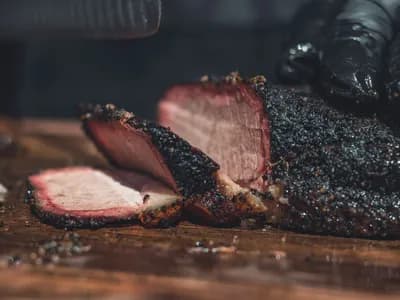
Low-and-slow smoked brisket
The kamado acid test. Ten hours at 110°C, a deep bark, a pink smoke ring and a texture that gives way under the weight of a fork.
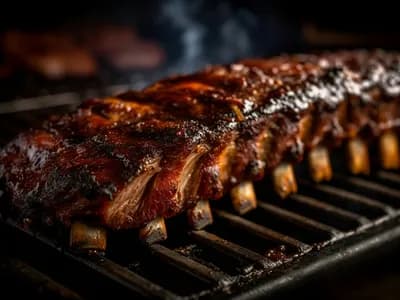
St. Louis-style ribs on the kamado
St. Louis-cut ribs (no rib tips), cooked reverse-sear: four hours at 130°C with light smoke, then a final blast of direct heat to caramelise the glaze.
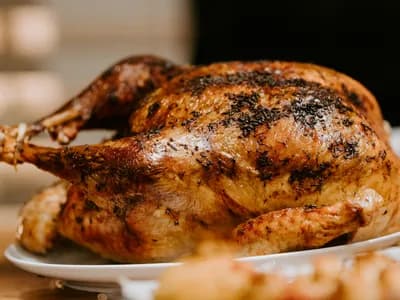
Beer-can chicken with crackling skin
The American beer-can chicken classic, taken to the kamado: the beer steams from within, the ceramic concentrates the heat and the skin finishes like crisp parchment.
GO DEEPER
Continue with these
- Related guide
Kamado Temperature Control: The Pitmaster's Guide
The dual airflow system, the rookie mistake of overshooting, and why the dome thermometer lies. This is the skill that separates a beginner from a pitmaster.
- Related guide
How to light a kamado: the step-by-step method
No petrol, no weird tablets and no 45-minute waits. The cone method, airflow control and the mistakes that prevent 80% of the frustration.
- Related guide
Your first kamado: the complete pre-purchase guide
Size, materials, brand and budget. Everything you have to decide before clicking Buy, told by someone who has made enough mistakes.
- Recipe to practice
Low-and-slow smoked brisket
The kamado acid test. Ten hours at 110°C, a deep bark, a pink smoke ring and a texture that gives way under the weight of a fork.
- Recipe to practice
St. Louis-style ribs on the kamado
St. Louis-cut ribs (no rib tips), cooked reverse-sear: four hours at 130°C with light smoke, then a final blast of direct heat to caramelise the glaze.
- Recipe to practice
Beer-can chicken with crackling skin
The American beer-can chicken classic, taken to the kamado: the beer steams from within, the ceramic concentrates the heat and the skin finishes like crisp parchment.
- Editorial comparison
big green egg large vs kamado joe classic iii
The classic kamado matchup: the Big Green Egg Large, the indestructible pioneer with the widest accessory network, again
- Glossary term
Heat deflector
Ceramic plate placed between the coals and the grate to turn direct fire into indirect cooking.
- Glossary term
Low & slow
Cooking at low temperature (95-130 °C) for many hours to tenderise tough cuts and develop deep smoke.
- Glossary term
Texas crutch
Wrapping meat in butcher paper or foil mid-cook to push through the stall and speed up cooking.
Frequently asked questions
What internal temperature is a brisket done at in a kamado?
A brisket is done at 90-95 °C internal, not by the hour. We cook it at 110 °C chamber for 10-14 hours, but we pull it by the probe: in that band the collagen has melted into gelatine and the meat pulls apart. Always measure in the centre of the thickest part.
How long does a whole chicken take in a kamado and at what temperature?
A 1.6 kg whole chicken takes 2-3 hours at 170 °C chamber, cooked indirect. The key is internal temperature: 75 °C in the thigh and at least 74 °C in the breast, the poultry minimum set by Spain's food safety agency (AESAN, 74 °C at the centre) and by the USDA (165 °F). At those numbers it is safe and juicy. For crisper skin, push the chamber to 180-200 °C in the final minutes.
What is the 2-2-1 method for ribs?
The 2-2-1 method splits about 5 hours at 110-120 °C into three phases: 2 hours bare in the smoke, 2 hours wrapped in paper with a little liquid to tenderise, and 1 hour unwrapped with sauce to set the bark. The target internal temperature is around 90-93 °C. It's the reliable route to ribs that are tender but still have bite. Times change with the cut: loin (baby back) ribs take about 4-5 hours and belly (spare) ribs, 5-6. The detail by cut is in the smoked ribs guide.
Why does internal temperature matter more than time?
Because the same cut takes different times depending on fat, thickness, weather and how often you open the lid. What defines doneness is internal temperature: 75 °C is safety in poultry, 52-55 °C is a medium-rare ribeye and 90-95 °C is a fall-apart brisket. Time is only for planning; the probe decides when you pull.
How do cold and wind affect cooking times?
Cold and wind make the ceramic lose heat and the chamber harder to hold. On a winter low & slow we allow 15-25 % more time. And watch wind blowing straight onto the air intake: it feeds combustion and can lift you 40 °C without touching the vents. Shield the kamado and watch the probe, not the clock.