TÉCNICA
Direct vs Indirect Cooking in a Kamado: The Deflector
When to cook over the coals and when with surrounding heat, what the ceramic deflector does, and how to build the indirect zone without getting it wrong.
Quick answer
In a kamado, direct cooking puts the food right over the embers to sear and brown in minutes; indirect cooking interposes the ceramic deflector, turning the unit into a convection oven for large cuts and long smokes. The practical rule: if the cook takes more than twenty minutes, it almost certainly goes indirect with the deflector.

A kamado offers only two ways to cook, and almost everything that goes wrong comes from confusing them. Direct cooking places the food right over the coals: dry, intense heat to mark, sear and brown in minutes. Indirect cooking slips a ceramic piece — the deflector — between the fire and the food, turning the kamado into a convection oven: surrounding, gentle, steady heat, ideal for large cuts and long smokes.
The deflector is what separates the two worlds. Without it, everything is direct; with it, you turn your kamado into an oven. Knowing when to use each is the difference between a steak with a perfect crust and a chicken charred outside and raw within.
This guide explains what each method is, when to use it, how the deflector works, and how to build the indirect zone step by step. With real numbers measured on our terrace in Torrevieja.
Direct cooking: coals in your face, intense and fast heat
Direct cooking is the most primal: the food sits on the grate with the coals right underneath, nothing in between. Heat rises by radiation and hits the food head-on, so it's dry, aggressive and very high — easily 250-350 °C at the grate. It does one thing, but does it better than anything else: browning and searing the surface in a few minutes.
This is the method for a thin steak, a burger, vegetables, prawns, a duck breast. Anything that cooks fast and benefits from a toasted crust from the Maillard reaction. The mental rule: if the piece is cooked through inside before the outside burns, it goes direct.
The risk is obvious. At that heat, a thick cut chars on the outside long before the center reaches temperature. That's why a whole chicken, ribs or a brisket NEVER go direct: they're ruined in minutes.
Indirect cooking: the kamado turned into an oven
In indirect cooking you slip the deflector between the coals and the food. The fire no longer touches the food: the deflector blocks the direct radiation, heats up and spreads the warmth throughout the closed dome. The result is convection heat, surrounding and even, like a wood-fired oven — between 110 and 200 °C depending on how you open the vents.
This is the method for almost anything that spends more than twenty minutes in the kamado: whole chickens, ribs, briskets, pulled pork, breads, focaccias, large roasts. Since nothing burns from below, the piece cooks evenly from the outside in and can sit for hours without risk.
It's also the foundation of smoking. With the deflector in and the vents nearly closed, you hold a steady 110-120 °C for hours (we cover this in our temperature control guide). Without the deflector, that same fire would spike the dome and char the piece. The deflector is what makes low & slow possible in ceramic.
What the deflector is and how it works
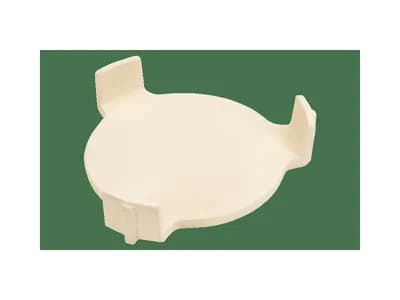
The deflector — called a plate setter, conveggtor, heat deflector or "heat shield" depending on the brand — is a piece of refractory ceramic that sits above the charcoal basket, between the coals and the grate. Its job is twofold: to block the fire's direct radiation, and to re-emit that heat gently and spread it evenly through the dome.
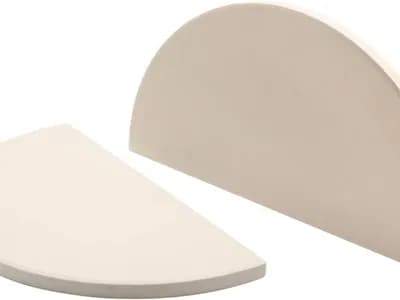
There are two formats. The full or disc deflector (like the Big Green Egg conveggtor) covers the whole base: pure indirect, even heat across the grate. And the half-moon, which covers only half the kamado and leaves the other half with live coals beneath: it enables two-zone cooking — one indirect side to roast, one direct side to sear — without switching grills.
The ceramic isn't a gimmick: thanks to its mass and inertia, once hot it stabilizes the temperature and holds it even if the fire fluctuates. It is, literally, what sets a kamado apart from a sheet-metal barbecue.
How to build the indirect zone step by step
Setting up the indirect zone well has a knack to it, and almost every failure comes from leaving no air between the deflector and the grate. The steps we follow on our terrace:
1. Light the charcoal and let the basket come up to temperature: for roasting, up to 160-180 °C; for smoking, the Minion method and close down toward 110-120 °C.
2. Place the deflector on the basket or its legs, curved face or legs down depending on the model. Keep it centered and stable.
3. Leave an air gap between the deflector and the grate. This is the critical point: if the food touches the hot ceramic, it burns by contact. Lift it with the raised supports.
4. For extra protection, set an aluminum tray on the deflector to catch the drippings and stop them from burning and turning the smoke bitter.
5. Fit the raised grate, close the lid and wait for the temperature to stabilize before putting the food in. Never load food while the dome is still climbing.
Zoning: cooking in two zones at once
This is where the kamado becomes a precision instrument. With a half-moon deflector you cover only half the base: half the dome is indirect, the other half has live coals beneath. You have two cookers in one without touching the charcoal.
The star technique this unlocks is the reverse sear, our favorite for thick cuts. You cook the steak or the tomahawk in the indirect zone, slowly, until the center reaches about 48-50 °C; then you move it to the direct zone and sear it 60-90 seconds a side to build the crust. The result: even pink edge to edge and a perfect crust, without the gray band of a traditional sear.
It also helps you manage several things at different paces: sausages and vegetables direct while a chicken roasts indirect, all at once. Move from one side to the other with the tongs and you've multiplied what your kamado can do in a single cook.
Comparison table and the typical mistakes
This is the cheat sheet we have pinned in our heads every time we light up:
| Direct cooking | Indirect cooking | |
|---|---|---|
| Typical temperature | 250-350 °C | 110-200 °C |
| Deflector position | Removed, no deflector | In place, between coals and food |
| Distance to coals | Close, in your face | Far, surrounding heat |
| Typical foods | Thin steak, burger, vegetables, prawns, duck breast | Whole chicken, ribs, brisket, pulled pork, bread |
| Recipe example | Galician steak on the kamado | Low-temperature smoked brisket |
The two mistakes we see most. First: cooking direct what wants indirect. A chicken or ribs over the coals char outside and stay raw inside — always, no exception; those cuts want a deflector. Second, the opposite: leaving the deflector in to sear a steak. With ceramic in the way you never reach the heat blast that builds the crust, and you end up boiling the meat instead of browning it. Pull the deflector to sear. And a third, silent one: resting the food on the deflector with no raised grate, and scorching the base by contact.
The rule is simple and sums up the whole guide: thin, fast cuts go direct; thick, slow cuts go indirect with a deflector. Searing wants live coals on the surface; smoking and slow roasting want surrounding heat and no fire beneath. When in doubt, think about cook time: if it runs past twenty minutes, it almost certainly goes indirect.
Our practical advice to begin: master the indirect zone first, because it forgives mistakes and covers most of what you'll cook — chickens, ribs, briskets, breads. Direct searing comes with practice. And get a half-moon deflector as soon as you can: it opens the door to two-zone mixed cooking, which is where the kamado becomes unbeatable.
Gear featured in this guide
Recipes to get started
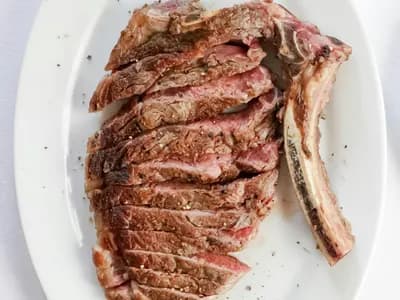
Galician ribeye on the kamado, direct sear
A one-kilo Galician ribeye, Maldon salt, embers at 350°C and not a thing more. The shortest recipe of the year and the hardest to mess up if you respect the timings.
Low-and-slow smoked brisket
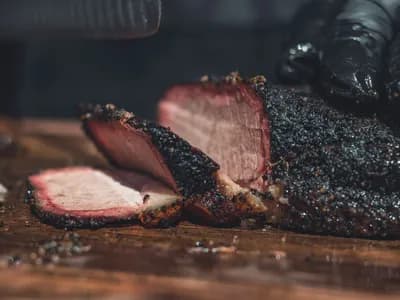
The kamado acid test. Ten hours at 110°C, a deep bark, a pink smoke ring and a texture that gives way under the weight of a fork.
Beer-can chicken with crackling skin
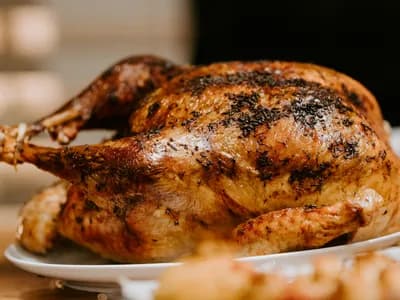
The American beer-can chicken classic, taken to the kamado: the beer steams from within, the ceramic concentrates the heat and the skin finishes like crisp parchment.
GO DEEPER
Continue with these
- Related guide
Kamado Temperature Control: The Pitmaster's Guide
The dual airflow system, the rookie mistake of overshooting, and why the dome thermometer lies. This is the skill that separates a beginner from a pitmaster.
- Related guide
How to light a kamado: the step-by-step method
No petrol, no weird tablets and no 45-minute waits. The cone method, airflow control and the mistakes that prevent 80% of the frustration.
- Related guide
What Is a Kamado: The Complete Guide
What a kamado is, how it works and what it's for: the honest guide to understanding the ceramic grill before you buy.
- Related guide
5 essential accessories to get started with your kamado
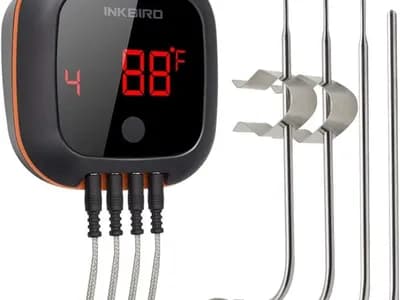
Heat deflector, probe, lighter, cover and cast iron: what truly earns its price on day one, and what is just hot air.
- Recipe to practice
Galician ribeye on the kamado, direct sear
A one-kilo Galician ribeye, Maldon salt, embers at 350°C and not a thing more. The shortest recipe of the year and the hardest to mess up if you respect the timings.
- Recipe to practice
Low-and-slow smoked brisket
The kamado acid test. Ten hours at 110°C, a deep bark, a pink smoke ring and a texture that gives way under the weight of a fork.
- Recipe to practice
Beer-can chicken with crackling skin
The American beer-can chicken classic, taken to the kamado: the beer steams from within, the ceramic concentrates the heat and the skin finishes like crisp parchment.
- Editorial comparison
big green egg large vs kamado joe classic iii
The classic kamado matchup: the Big Green Egg Large, the indestructible pioneer with the widest accessory network, again
- Glossary term
Refractory ceramic
High-density ceramic that absorbs, stores and radiates heat between 70 and 400 °C without cracking.
- Glossary term
Heat deflector
Ceramic plate placed between the coals and the grate to turn direct fire into indirect cooking.
- Glossary term
Plate setter
Big Green Egg's name for its three-legged ceramic deflector, equivalent to the modern ConvEGGtor.
Frequently asked questions
When do I use direct cooking and when indirect?
The quick rule is time: if the cut is done in under twenty minutes and benefits from a crust — thin steak, burger, vegetables, prawns — it goes direct, no deflector. If it runs longer or is thick — whole chicken, ribs, brisket, bread — it goes indirect, deflector in. When in doubt, choose indirect: it forgives far more mistakes.
What exactly is the deflector and what is it for?
It's a piece of refractory ceramic that sits between the coals and the grate. It blocks the fire's direct radiation and spreads the heat in a surrounding way, turning the kamado into a convection oven. Without it, you cook direct over the coals; with it, indirect. It's the piece that makes it possible to roast large cuts and smoke at low temperature without burning the food.
Full or half-moon deflector?
The full one covers the whole base and gives pure indirect, with even heat across the entire grate: ideal if you'll only roast or smoke. The half-moon covers half the kamado and leaves the other half direct, which lets you cook in two zones and do a reverse sear without switching grills. If you'll buy only one and want versatility, the half-moon opens up more possibilities.
Why does my food burn even with the deflector in?
Almost always it's by contact: the food touches the hot ceramic directly. The deflector needs an air gap and a raised grate above it, not the piece resting on it. The other cause is excess temperature: even with a deflector you can overshoot if you open the vents too much. Raise the grate and control the dome temperature.
Can I sear a steak with the deflector in?
No, and it's a very common mistake. The deflector's ceramic blocks exactly the radiant heat blast that builds the crust, so the meat steams instead of browning and you never get a good Maillard reaction. To sear, remove the deflector and cook direct over live coals. If you want the best of both, use a half-moon and do a reverse sear.
Does the deflector also work for smoking?
Yes, it's essential for smoking. Smoking calls for a steady 110-120 °C for hours, and that's only achievable with indirect heat: the deflector blocks the fire and spreads gentle warmth through the dome. Without it, that same charcoal would spike the temperature and char the piece. An aluminum tray on top of the deflector catches the drippings and keeps them from burning and turning the smoke bitter.