GUÍA DE COMPRA
Second-hand kamado: what to check before you buy (and how much to pay)
Ceramic lasts for decades and people move house: that is why Spain's used kamado market is a good one. Here is the ten-minute inspection, the questions to ask the seller and the price bands that keep you from overpaying.
Quick answer
A second-hand kamado is worth it if the outer ceramic has no through-cracks, the bands and hinge are sound and the price sits clearly below a new entry-level model. The gasket, charcoal basket and thermometer are cheap replacement parts. The manufacturer's warranty does not transfer to the second owner.
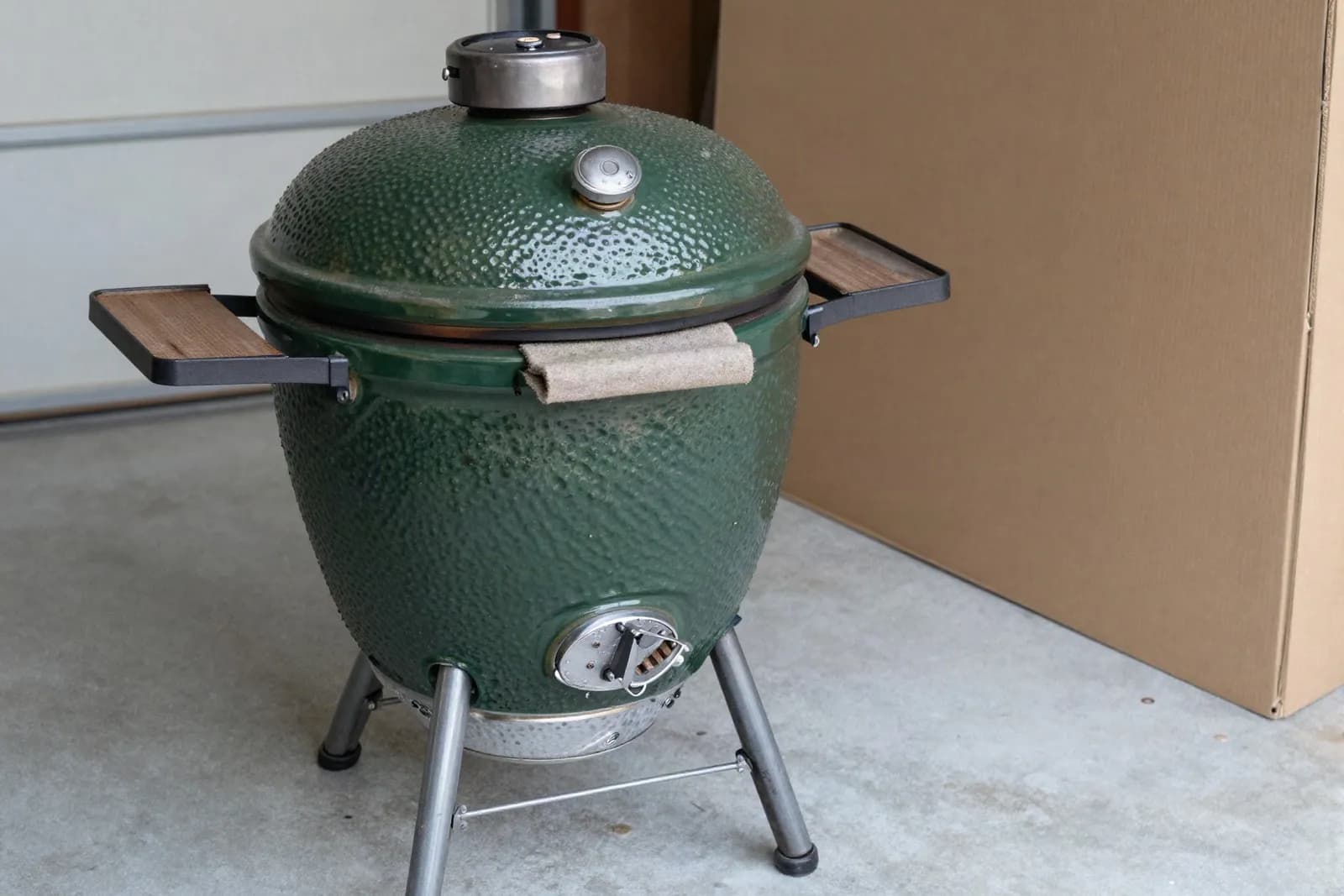
A second-hand kamado is worth it if the ceramic is sound, the price sits clearly below a new entry-level model and you can get it home without breaking it. Almost everything else is cheap to fix: the gasket, the charcoal basket and the thermometer are replacement parts.
At mikamado we have cooked for six years on a Big Green Egg Large in Torrevieja and have seen up close how a kamado ages: what wears out, what cracks harmlessly and what turns a bargain into a 70 kg paperweight.
This guide follows the order of a purchase: why the used market is good and what you give up, the ten-minute inspection, what to ask and which photos to request, how much to pay by model, which models are worth buying used, what happens to the warranty, how to move it and what to look for if it has lived by the sea.
| What to check | How | Warning sign | Cost to fix |
|---|---|---|---|
| Outer ceramic | Low-angle torch, fingernail and knuckles | Crack through the wall or with offset edges | No cheap fix: walk away |
| Fire ring and firebox | Open the dome and check they sit flat | Missing pieces or a rocking ring | Dealer part; price varies |
| Gasket | Banknote between dome and base at 4 points | Slides out freely or the felt crumbles | About 30-40 € for a universal kit |
| Hinge and bands | Open and close several times | Dome that slams, band thinned by rust | Adjustment free; a new band costs far more |
| Charcoal basket | Inspect it out of the kamado | Deep rust or broken rods | About 70-90 € for Classic and Large |
| Vents and chimney | Slide them and close them fully | Seized or will not close | Cleaning; a new chimney if seized |
| Thermometer | Ask whether it reads true | Stuck needle or absurd reading | Under 20 € |
Why buying a used kamado makes sense (and what you give up)
A kamado is, above all, a thick piece of ceramic. It has no burners to rust and no electronics to go obsolete, and the expensive part —dome and base— can last for decades if nobody drops it. What wears with use is cheap and designed to be replaced: the felt gasket, the grates, the charcoal basket.
That makes for a fairly healthy second-hand market. Most kamados for sale are not broken: they are sold because the owner is moving to a flat without a terrace, because the thing is too heavy to move house with, or because they found out they only barbecue three times a year. In September 2026, going through listings on Wallapop and Milanuncios, the names that come up most are Kamado Joe, Monolith, Big Green Egg and plenty of generic ceramic cookers with no clear brand, from 33 to 53 cm.
In exchange, you give up three things. The first is the warranty: Kamado Joe, Big Green Egg and Monolith cover only the original purchaser, so the second owner starts without one. The second is the protection of buying from a shop: buying from a private seller, you do not get the legal guarantee a retailer would give you. The third is transport, which is on you and is where most kamados get broken. If those three trade-offs are worth the discount, read on.
The ten-minute inspection
Go and see it in person, in daylight. Start with the outer ceramic: run your hand over dome and base and sweep your phone torch across them at a low angle. Very fine lines in the glaze, like a surface spider web, are crazing and do not affect use. What matters is a crack you can catch with a fingernail, with offset edges or running through the wall. Tap gently with your knuckles in several places: sound ceramic rings clear; a spot that sounds dull or broken deserves a second look.
Open the dome. The inner fire ring and firebox are almost always cracked on kamados with some years on them: they take direct heat, usually keep working cracked and are sold as spares. Check that no pieces are missing and that the ring sits without rocking. Inspect the charcoal basket and the grate for deep rust.
Then the mechanics: open and close the dome several times. The hinge should hold it without letting it slam, and the metal bands should not have rust that has thinned them or stripped bolts. Slide a banknote between dome and base at four points: if it comes out with no resistance, the gasket is worn (the procedure is in how to replace the gasket). Move the bottom and top vents: they should slide and close fully. And ask whether the thermometer reads true; if not, it is a cheap spare. Leak and draught symptoms are covered in temperature problems.
What to ask the seller and which photos to request
Before driving anywhere, ask for specific photos. One of the dome and base from the outside in good light, from all four sides. One of the inside with the dome open, showing the fire ring and firebox. A close-up of the hinge and bands, which is where rust shows. Another of the gasket at the front, the part that gets crushed most. And, if there is one, a photo of the maker's label or serial number, usually on the base or the hinge, which helps you confirm model and generation.
Then the questions. How old is it and where was it bought? An authorised dealer's invoice does not bring back the warranty, but it confirms the unit is genuine and not a copy. Where has it lived: covered terrace, garden, by the sea? Has it had a cover? Has any ceramic part, the gasket or the fire ring been replaced? Has it been dropped or suffered thermal shock, for instance from being lit very hot from cold? Which accessories are included in the price: cart, side shelves, deflector, pizza stone?
Accessories change the value a lot. An original deflector or a cart in good condition cost real money bought separately, so factor them in when comparing two listings. If the seller refuses to show you the inside or let you open the dome, be wary.
How much to pay: indicative bands by model and condition
There is no official table, so we use our own yardstick. For brands with good resale (Kamado Joe, Big Green Egg, Monolith), a kamado under three years old in very good condition is reasonably priced at 55 to 70 % of what it costs new today with the same accessories. Between three and eight years, with signs of use and some cracked inner part, 40 to 55 %. Generic ceramic cookers lose value faster: above 50 % of their new price they rarely make sense.
As a reference for what shows up in listings in Spain in September 2026, with no single listing as the rule: a premium-brand 46 cm Classic (Kamado Joe Classic II, Big Green Egg Large) goes for roughly 800 to 1,100 € with a cart; a Monolith Classic, around 700-850 €; small branded sizes such as the Joe Jr or Monolith Icon, between 350 and 550 €; and generic 46 to 53 cm ceramics, between 300 and 550 €. These are asking prices, not closing prices: there is almost always room to negotiate, especially if parts need replacing.
Subtract what it will cost to get it ready: gasket, basket or fire ring. And make the final comparison against a new entry-level model: if the used generic costs nearly the same as a new one with a warranty, go for the new one. Buying used makes sense when it gets you a brand and size you could not afford new.
Which models are worth buying used (and which are not)
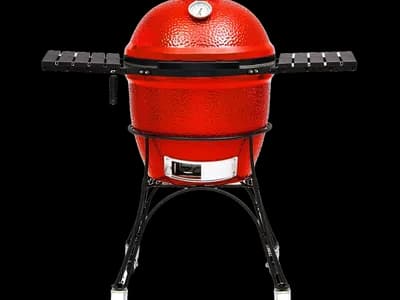
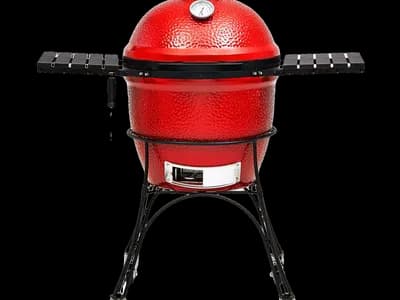
The Kamado Joe Classic II is probably the best used buy on the market: 46 cm ceramic, an assisted hinge that makes the dome easy to lift, a multi-level grate system and easy-to-find spares. The Classic I is the same base with a simpler hinge and gasket; if the price reflects that, it is a good buy. The Joe Jr only if you want a small kamado for two.
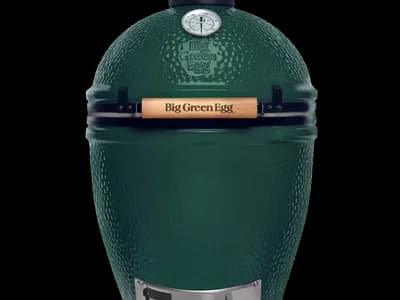
The Big Green Egg Large is our test bench and ages well. It has the widest accessory ecosystem, which makes spares easy to find. Its downside second-hand is that resale prices stay high: do not expect bargains.
The Monolith Classic is a solid alternative to both and usually comes a little cheaper used. Kamado Bono models have thick ceramic and good standard kit; used, check bands and hinge with extra care.
Where you need to be careful is with generic ceramics that have no brand, identifiable maker or spares: if an inner part cracks, you may not find a replacement. And with steel kamados such as the Akorn, the problem is rusting sheet metal, not cracks. To settle the size before you start looking, read what size kamado you need or compare them in the comparison tool.
Warranty and spares: what they cover and where to find them
Assume the warranty does not pass to the second owner. We checked the published terms. Kamado Joe gives a lifetime warranty on ceramics, 5 years on metal and cast iron, 3 years on deflectors and stones, and 2 years on thermometer and gaskets, but states explicitly that it covers only the original purchaser, and requires an authorised dealer and product registration. Big Green Egg offers a limited lifetime warranty on ceramics and 5 years on metal, also only for the original purchaser who registered and bought from an authorised dealer, and claims go through the country of purchase. Monolith advertises a limited lifetime warranty personal to the first buyer, which lapses if the kamado changes hands. For Kamado Bono we could not find official published terms; some shops advertise an unlimited warranty on the ceramic, but we could not confirm whether it transfers, so assume it does not.
The good news is that the parts that wear out are cheap. A universal fibreglass gasket runs about 30-40 €. A charcoal basket with divider for Classic and Large, about 70-90 €. A lid thermometer, under 20 €. If the deflector is missing, there are half-moon deflectors for the Kamado Joe Classic and the ConvEGGtor for the Large. These are indicative Amazon prices; the real one is whatever it is when you buy. Original ceramic fire rings and fireboxes are ordered through the brand's dealers, and price and availability vary: ask before you close the deal.
Transport and getting it ready
A 46 cm kamado comfortably exceeds 70 kg, and with a cart it gets close to 100. Never lift it by the dome or move it by pulling on the hinge: the hinge is designed to open the lid, not to carry the weight of the base. The safe way is to take it apart: remove grates, deflector, basket, fire ring and firebox and wrap them separately. If the model allows it, take the dome off too by loosening the bands; that way each piece weighs half as much.
Loading it takes two people and, ideally, a hand truck or a ramp. In the van or the boot, the base travels upright, wedged with blankets so it cannot roll and held with straps that do not bite on unprotected ceramic. Never lay it on its side with the inner parts inside: when you brake, they hit the wall from within.
At home, start with a thorough clean: empty the old ash, brush the inside dry and do a burn-off at about 300 °C for half an hour to burn off grease and residue. No water or detergent on the ceramic. If you have replaced the gasket, respect the adhesive's curing time before lighting. For the first cook, bring the temperature up slowly and patiently, following how to light a kamado, and use it to check that the vents respond and no smoke escapes round the rim.
Coast and salt air: what to check if it has lived by the sea
A good share of used kamados in Spain come from the coast, and salt air is unforgiving on metal. The ceramic barely notices, but the bands, hinge, bolts, chimney and cart do. Here in Torrevieja we see it every winter.
Look first at the band bolts: if their heads are rusty, ask whether they can be loosened; a seized one complicates any future adjustment. Check the inside of the bands, where moisture builds up against the ceramic, and the underside of the cart and the wheels. Surface rust can be cleaned and protected; a band that has thinned or pitted needs replacing, and that is no longer a 20 € spare.
Also check the cast-iron top chimney: if it is heavily rusted, it is hard to turn and draught control loses finesse. In a marine climate the gasket hardens and comes unstuck sooner, so plan on replacing it. And smell the inside: a kamado that has spent months shut and damp may have mould; a burn-off gets rid of it, but it tells you it had no cover or ventilation.
If everything else is fine, a coastal kamado is not a bad buy: just knock the price of the metal parts you will need to renew off the price. To look after it from then on, see our guide on how to protect a kamado from salt air and humidity.
A used kamado is one of the most sensible buys in the barbecue world, as long as you check what cannot be fixed cheaply: the outer ceramic, the bands and the hinge. The rest —gasket, basket, thermometer, even the fire ring— are consumables you can knock off the price. Accept that the maker's warranty does not travel with you, work out transport before you negotiate and always compare against a new entry-level model. If the discount does not make up for those trade-offs, buy new. If it does, take it apart calmly, do a burn-off and start cooking. If you are still unsure whether a kamado is for you, read our kamado barbecue guide.
Gear featured in this guide
GO DEEPER
Continue with these
- Related guide
Replacing a kamado gasket: when it is due and how to fit it
The banknote test, which fibre to choose, how to strip the old adhesive and the cure that stops a new gasket peeling off on the first hot fire.
- Related guide
How to maintain and clean a ceramic kamado
Ceramic almost cleans itself: burn-off, grates, gaskets and rust, explained with no miracle products and no needless chemicals.
- Related guide
Kamado barbecue: what it is, how it works and which one to buy in Spain (2026)
The kamado barbecue, plainly: how the ceramic works, which types and sizes exist, what it really costs and which models deserve your money in Spain this year.
- Related guide
Kamado won't heat, keeps dying or overshoots: fixes by symptom
Why it won't climb, why it dies, why it runs away, and how to bring a runaway temperature back down without ruining the cook. Diagnosis by symptom, step by step.
- Editorial comparison
big green egg large vs kamado joe classic iii
The classic kamado matchup: the Big Green Egg Large, the indestructible pioneer with the widest accessory network, again
- Glossary term
Heat deflector
Ceramic plate placed between the coals and the grate to turn direct fire into indirect cooking.
- Glossary term
Fire ring
Ceramic ring that sits on top of the firebox and raises the cooking chamber to the gasket line.
- Glossary term
Firebox
Lower ceramic part inside the kamado that holds the charcoal and contains combustion.
Frequently asked questions
How much does a second-hand kamado cost?
It depends on brand, size and condition. As an indicative reference from listings in Spain in September 2026, a premium-brand 46 cm Classic is advertised at 800 to 1,100 €, a Monolith Classic around 700-850 €, small branded models between 350 and 550 € and generic 46 to 53 cm cookers between 300 and 550 €. There is almost always room to negotiate.
Does a Kamado Joe or Big Green Egg warranty transfer?
No. Kamado Joe's terms state explicitly that the warranty covers only the original purchaser and require an authorised dealer and registration. Big Green Egg also limits its warranty to the original purchaser who registered it. Monolith does the same: the warranty lapses when the kamado changes hands. As a second owner, you buy without a manufacturer's warranty.
Is a crack in a kamado serious?
It depends where it is. Cracks in the inner fire ring or firebox are normal over the years and the part usually keeps working. Fine crazing in the outer glaze is cosmetic. What is serious is a crack that runs through the wall of the dome or base, catches a fingernail or has offset edges: that one has no cheap fix.
How do you move a kamado?
Taken apart and with two people. Remove all inner parts and wrap them separately, take the dome off if the model allows it and never lift it by the hinge. The base travels upright, wedged with blankets and held with padded straps. A hand truck or a ramp saves both backs and ceramic.
Is a second-hand Lidl kamado worth it?
Rarely. The Grillmeister ceramic kamado sold by Lidl has cost between 99.99 and 139.99 € new depending on the promotion, with a 26.5 cm grate. At those prices, a used one only makes sense if it is almost free and intact. If you want to cook for more than two people, you are better off saving for a 46 cm kamado.
Where are used kamados sold in Spain?
Mainly on Wallapop and Milanuncios, where Kamado Joe, Monolith, Big Green Egg and generic ceramic cookers show up often. Search by model name too, not just «kamado», and widen the radius: moving a kamado is work, but a good unit 100 km away is usually worth it over a mediocre one in your own city.