MANTENIMIENTO
Replacing a kamado gasket: when it is due and how to fit it
The banknote test, which fibre to choose, how to strip the old adhesive and the cure that stops a new gasket peeling off on the first hot fire.
Quick answer
Replace the gasket when a banknote slides out with no resistance between dome and base, the felt crumbles, or the kamado will no longer drop below 180 °C with the vents almost shut. Strip the old one cold, clean the adhesive off the seat, bed the new one without stretching it and let it cure for 24 hours before lighting.
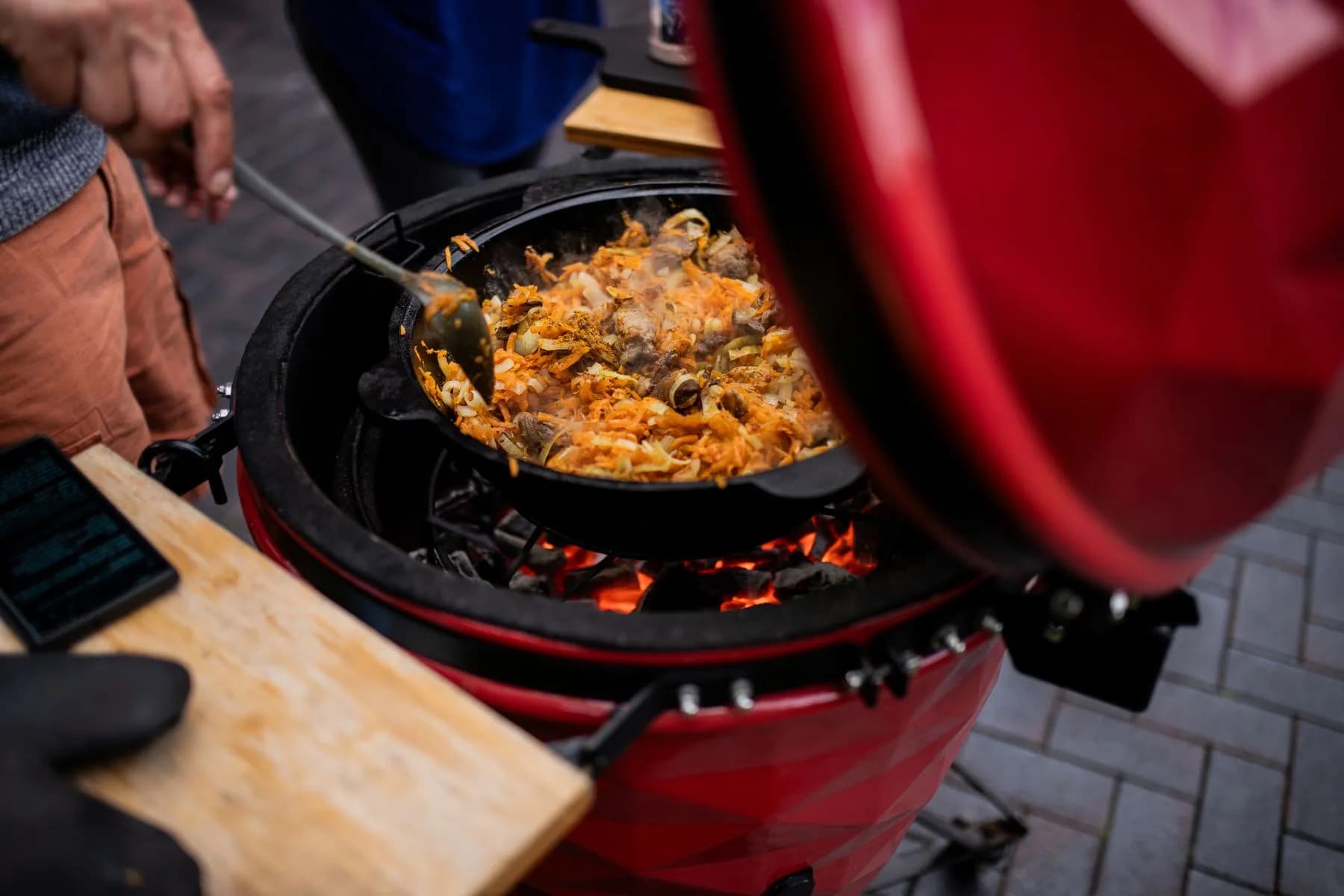
The gasket is the only part of a kamado designed to wear out. The ceramic lasts decades and the bands can be tightened, but the cord of fibre that seals dome to base is consumed by definition: it is crushed every time you close the lid and baked every time you go past 300 °C.
The problem is that its death announces itself with no noise and no broken part, but with a symptom most people put down to something else. Suddenly the kamado will not drop below 180 °C however much you close, or it drifts out of range halfway through a long smoke. Before spending on a kit it is worth being sure the culprit is the fibre and not a slack bolt, because three of the usual causes of that symptom are fixed in ten minutes and without buying anything.
This guide goes in order: what exactly the gasket seals, how to check whether yours still does, what to rule out before ordering a replacement, what each type of fibre claims on its spec sheet — and why the adhesive, not the fibre, is the real ceiling of the assembly — how to remove the old one without chipping the rim, and how to glue and cure the new one so it is still there in three years.
| Type | Stated temperature | Usual sizes | Adhesive it needs | What it is recommended for |
|---|---|---|---|---|
| Wool felt (older OEM) | 250-260 °C continuous | 25 mm × 3 mm | High-temperature RTV | Medium use, up to 250 °C |
| Nomex (aramid) | 370-425 °C depending on the seller | 19-25 mm × 2 mm | High-temperature RTV | Mixed use with high peaks |
| Fibreglass mesh | 500-550 °C for the fibre | 25 mm × 3 mm | High-temperature RTV | Frequent pizza and burn-offs |
| Kit with self-adhesive backing | The fibre holds; the glue does not | 25 mm × 3 mm | Already fitted, 150-200 °C | A stopgap, not a season |
| The RTV adhesive | 260 °C continuous, 315 °C in peaks | Bead of 3-4 mm | — | It is the real limit of any kit |
What the gasket seals, and why fine control depends on it
The gasket is a cord of fibre glued to the seat of the dome and to the seat of the base. Its job is not to hold in smoke: it is to hold in air. A kamado holds 110 °C for twelve hours because every bit of oxygen that gets in passes through two places you decide on, the bottom vent and the chimney. The moment a third, unregulated way in appears around the rim, the chimney draws from there, and closing the bottom vent stops meaning what it used to mean.
It is worth understanding where it fails, because that explains the symptoms. Air that comes in at the rim does so above the charcoal, not through it, so it does not feed the embers as efficiently as the bottom draught. That is why a worn gasket almost never stops you reaching 250 °C to sear a chuletón (a thick bone-in rib steak), and yet wrecks the low range. The first thing you lose is a brisket at 110 °C that holds itself all night; the last, the hot fire.
The gasket felt has a second job as well, one almost nobody mentions: it is the cushion between two pieces of ceramic weighing several kilos. Without it, the dome lands on the base with hard contact and the rim ends up chipping at points, almost always at the front. Cooking one afternoon without a gasket does no harm; doing it for months is the cheap way to ruin the part of the kamado that is not a consumable.
It is also worth dropping the idea that a kamado has to be airtight. It is not, and it should not be: there is always a small leak at the hinge axis and where the pins pass through. What you are after is not zero air, but that the air getting in is the air you opened.
How to tell yours is dead: banknote, smoke at the rim and feel
The banknote test is the standard diagnosis and it works well. With the kamado cold, slip a banknote or a strip of paper halfway between dome and base, close the lid and pull. If the paper drags and takes some effort to free, it seals there. If it comes out clean, it does not. The key is to repeat it at six or eight points around the rim, because gaskets do not die whole: they go in patches, and usually the front half first, since that takes the most pressure on closing.
The second test is smoke, and it is the most graphic. Light a little charcoal, settle at 130-150 °C and look at the rim against the light, ideally at dusk. With a healthy gasket, practically all the smoke leaves by the chimney. If you see wisps escaping around the perimeter, you have the leak mapped without dismantling anything, and you will also know whether it is a short stretch or half the kamado.
Then there is what you can see and touch, always cold. A finished gasket is black and hard, has lost half its thickness, crumbles between your fingers and leaves stretches of bare seat. Watch out for a very common false positive: a new fibreglass gasket goes black too, within two cooks, and it compresses a little as well. Black is not dead. Dead is not recovering thickness, offering no resistance to the paper and letting smoke through.
The indirect symptom, the one that brings almost everyone here, is not being able to get below 170-180 °C with the bottom vent open a finger's width and the chimney nearly shut. It is a good clue, but it is not proof: there are half a dozen other causes, and several of them cost nothing to fix.
Before buying anything: bands, dome centring and dirt on the seat
The number-one cause of a kamado that does not close flush is not the gasket: it is the metal bands. The bolts give with heat cycles, the dome drops forward a couple of millimetres and then the back does not even make contact. It is corrected in ten minutes with the kamado cold: loosen the bolts on both bands a little, close the lid, let the dome settle on the base by itself and then tighten, alternating sides, firmly but without forcing. The bands are holding ceramic; overtightening cracks it.
With the lid closed, crouch down and look along the rim at eye level. The gap between dome and base has to be the same at the front, at the back and on both sides. If there are two millimetres at the front and none at the back, what is off-centre is the assembly, not the fibre. Check the hinge too: on sprung ones, a slack or badly adjusted spring leaves the lid resting falsely on the front and the weight never reaches the back.
The third cause is the silliest and the most common. A lump of carbonised fat or a piece of ash on the seat holds the lid half a millimetre open along a whole quadrant. Run a dry cloth over both rims with the kamado warm and repeat the banknote test before concluding anything.
And one check that saves on spares: the dome thermometer. Analogue ones drift over the years and many read high. Put the probe in boiling water — 100 °C at sea level — and look at the deviation before you believe your kamado will not go below 180 °C. The temperature troubleshooting guide has the full diagnosis, symptom by symptom.
Wool felt, Nomex or fibreglass mesh: what each spec sheet claims
Wool felt is what the ceramics of a few years back came with, and it is still sold as a replacement. The spec sheets for these kits claim continuous use of around 250-260 °C. It is soft, it seals very well under little pressure and so it forgives a dome that does not sit perfectly, but it cooks away quickly if you make pizza or run back-to-back burn-offs.
Nomex — an aramid — is the middle step. Read the small print here: sellers advertise it at anywhere between 370 and 425 °C depending on the shop, while the material's own data sheets put the onset of degradation at around 370 °C. It is thinner and firmer than wool, so it needs a seat in better condition to seal as well. Fibreglass mesh or woven tape is what dominates the universal kits you find in spares today: the fibre itself tolerates 500 °C comfortably and the sheets usually claim between 500 and 550 °C.
And here is what no shop pitch will tell you: the fibre is almost never what fails. What fails is the adhesive. The high-temperature RTV silicone used to stick it down claims of the order of 260 °C continuous and about 315 °C in peaks, and kits that arrive with a factory self-adhesive backing carry an acrylic that rarely goes beyond 150-200 °C. A 550 °C mesh stuck down with 150 °C tape is, in practice, a 150 °C gasket, and it peels off on the first hot fire.
On sizes, the standard is 25 mm wide and 2-3 mm thick, in strips of 3 to 3.5 m, enough for both rims of a Large or a Classic. Measure yours before ordering: a band wider than the seat overhangs and the flame licks at it; a narrower one leaves the outer edge bare.
Removing the old gasket and cleaning off the adhesive without chipping the rim
Kamado cold, empty and in the shade. Take out the grates and the deflector so they do not get covered in fibre, and put gloves on: old fibreglass tape sheds threads that itch on your hands for a couple of days. If you work with the dome open, secure it or prop it, because you are going to pull hard upwards and you do not want it coming down on its own.
Pulling it off is the easy part. Pull diagonally in stretches of ten or fifteen centimetres: if it is woven tape it comes away in long strips; if it is old felt it crumbles and comes off in pieces. What stays stuck to the seat is the real problem: a hard layer of carbonised silicone that will not rub away. Scrape with a plastic or nylon spatula and a great deal of patience. No blade scrapers held edge-on against the glaze, because the enamel flakes off and that mark cannot be put right afterwards.
If the residue will not give, soften it with gentle heat. A small fire up to 100-120 °C for fifteen minutes softens old silicone; then shut it down, wait until you can touch the rim with your hand and scrape it warm, which is when it comes off best. Not a heat gun at full power: that local thermal jump at one spot on the glaze is not worth the time it saves. For the last film, isopropyl alcohol on a cloth, sparingly and without soaking. Ceramic is porous and drinks whatever you pour on it; caustic oven cleaners are out altogether.
The seat has to end up dry, matt and free of lumps. A millimetre of residue lifts the new gasket ten centimetres either side, and you will not see it: run a fingertip right round the rim with your eyes shut, because touch finds what sight forgives. Let it air for half an hour before gluing.
Fitting the new gasket and curing it: order of work, pressure and waiting
Work with the kamado cold and one piece at a time: the base first, and once that is done, the dome. RTV starts to skin in five or ten minutes, so have the strip measured and cut before you open the tube. Start gluing at the back, on the hinge axis, which is the area that works least and where the join is the least of a nuisance.
Lay a thin, continuous bead of three or four millimetres down the centre of the seat, never along the outer edge, and bed the fibre without stretching it. This is the mistake that ruins most new gaskets: whatever tension you put into it as you fit it turns into memory, and two weeks later the strip lifts by itself on the curves. Press down every five centimetres with your thumb as you go, following the run, and close the circle with a square cut so that the two ends meet butt to butt. No overlaps: a bump of double thickness opens up the rest of the rim.
When both pieces are done, lower the lid and leave it shut for twenty-four hours, because the weight of the dome is the press you need. Put a sheet of baking paper between the two gaskets so that any adhesive squeezing out does not stick them to each other. Clamps or grips, no: they crush the new fibre to half its thickness and that seal never comes back.
Curing is 24 hours at room temperature as a minimum. One-part RTV cures with the moisture in the air, so in a dry January it may ask for forty-eight hours, while in August on the coast it has plenty. After that, a gentle first fire: 120-150 °C for half an hour with the lid closed, then cool right down. The second session can go to 250 °C. The vinegar smell in the first hours is normal with acetic silicone.
How long it lasts, and what eats it before its time
No manufacturer states a service life for the gasket: they treat it as a wear part. The long warranty on the ceramic normally does not cover the gasket, which usually has a much shorter term of its own, or none at all. Before claiming, read your brand's small print. As for timescales, people who cook every weekend report one to three years with wool felt and three to five with fibreglass tape, with an enormous spread depending on what gets cooked.
Because what kills it is not the hours, it is the temperature. The burn-off at 280-320 °C is the kamado's native cleaning tool and there is no need to give it up, but doing it every week instead of every eight or ten cooks shortens the life of the fibre measurably. And pizza at 350-400 °C is the other great consumer: the glass mesh copes easily there, but the adhesive is working right at its limit. If you make pizza often, go straight to fibreglass tape with RTV and forget felt.
There are two habits that cost little and add months. The first is always opening with burping: raise the lid two fingers' width, wait a second or two, then open it fully. The flashback flare licks right at the rim. The second is running a cloth or a cleaning sponge over the seat while the kamado is still warm, especially after an oily fish: fat that carbonises stuck to the fibre hardens it in patches. On my Big Green Egg Large it is the only thing I do for the gasket between seasons.
On the coast there is one more factor. Salt air does not attack fibreglass, but it does attack the bands and the bolts that keep the dome centred, and a cover that does not breathe leaves the gasket damp for weeks. It is all in the guide on protecting the kamado from salt air.
Changing a gasket is a quiet afternoon, not a repair. The order matters more than the dexterity: first you rule out slack bands, an off-centre dome and dirt on the seat; then you choose your fibre knowing that the real ceiling is set by the adhesive and not by the tape; then you leave the seat dry and free of lumps, glue without stretching and wait the full twenty-four hours. Most new gaskets that come unstuck after three cooks did not fail on the material: they failed because somebody lit the kamado the same day.
What you get back when it seals again is the low range, which is where a kamado earns its keep: 110 °C all night without watching it. And the routine that preserves it is short: a cloth on the rim while warm, burn-offs with judgement and a cover that breathes.
Gear featured in this guide

Recipes to get started
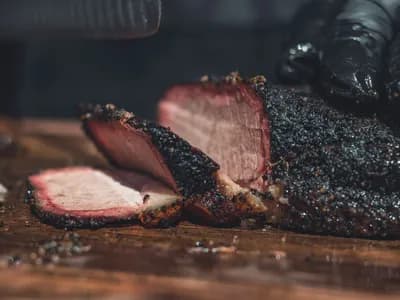
Low-and-slow smoked brisket
The kamado acid test. Ten hours at 110°C, a deep bark, a pink smoke ring and a texture that gives way under the weight of a fork.

Carolina-style smoked pulled pork
Eight hours of patience, a five-and-a-half-kilo pork shoulder and North-Carolina vinegar — this is what a kamado does better than any other fire.

Neapolitan pizza on the kamado
At 350°C the base puffs in 90 seconds and the cornicione comes out leopard-spotted and pillowy. One pizza, three minutes, zero margin for error.
GO DEEPER
Continue with these
- Related guide
How to maintain and clean a ceramic kamado
Ceramic almost cleans itself: burn-off, grates, gaskets and rust, explained with no miracle products and no needless chemicals.
- Related guide
Kamado won't heat, keeps dying or overshoots: fixes by symptom
Why it won't climb, why it dies, why it runs away, and how to bring a runaway temperature back down without ruining the cook. Diagnosis by symptom, step by step.
- Related guide
Protecting Your Kamado from Salt and Sea Air on the Coast
Living by the Mediterranean takes a toll on your kamado's steel. Which parts suffer from salt air, how to stop rust, and how to keep it pristine for years.
- Recipe to practice
Low-and-slow smoked brisket
The kamado acid test. Ten hours at 110°C, a deep bark, a pink smoke ring and a texture that gives way under the weight of a fork.
- Recipe to practice
Carolina-style smoked pulled pork
Eight hours of patience, a five-and-a-half-kilo pork shoulder and North-Carolina vinegar — this is what a kamado does better than any other fire.
- Recipe to practice
Neapolitan pizza on the kamado
At 350°C the base puffs in 90 seconds and the cornicione comes out leopard-spotted and pillowy. One pizza, three minutes, zero margin for error.
- Editorial comparison
big green egg large vs kamado joe classic iii
The classic kamado matchup: the Big Green Egg Large, the indestructible pioneer with the widest accessory network, again
- Glossary term
Heat deflector
Ceramic plate placed between the coals and the grate to turn direct fire into indirect cooking.
- Glossary term
Bottom vent (damper)
Air-intake vent at the kamado's base; controls how much oxygen reaches the coals.
- Glossary term
Gasket
Fibre band that seals the join between the ceramic base and lid, ensuring the kamado is airtight.
Frequently asked questions
How often does a kamado gasket need changing?
There is no fixed term, there is a test. As long as the banknote drags all the way round the rim and no smoke escapes at the edge, the gasket is doing its job, however black it looks. With weekend use, people report between one and three years on wool felt and between three and five on fibreglass tape. High-heat pizzas and weekly burn-offs shorten that considerably.
Will a universal kit do, or do I have to buy my brand's original gasket?
A universal fibreglass kit works on almost any ceramic as long as you respect the width and the thickness of the seat: the standard is 25 mm wide and 2-3 mm thick. The factory gasket saves you the measuring and comes cut to the exact length for the model. What you should not change lightly is the thickness, because a thicker strip throws the closure off-centre and a thinner one never quite makes contact.
How long do I have to wait before lighting it after gluing it on?
Twenty-four hours of curing at room temperature with the lid closed, and longer if the air is very dry, because one-part RTV silicone cures with the moisture in the air. After that, the first fire goes gently: 120-150 °C for half an hour, then cool right down before using it normally. Lighting it the same day vaporises the volatiles in the adhesive and leaves a porous bond that comes away by itself.
Can I cook without a gasket while the replacement is on its way?
Occasionally yes, and for a hot fire you will barely notice, because the air coming in at the rim hardly feeds the embers. What you lose is the low range: holding 110 °C for hours becomes impossible. The reason not to stretch it over months is a different one: with no fibre to cushion them, dome and base make hard contact every time you close and the rim ends up chipping at points.
Why has my new gasket come unstuck after only a few cooks?
Almost always for one of four reasons. There was old adhesive left on the seat and the strip was stuck down on top of it. It was fitted stretched and the fibre lifted by itself on the curves. The kamado was lit before the silicone had fully cured. Or the kit came with a factory self-adhesive backing, which rarely holds above 150-200 °C and gives way on the first hot fire.