BUYING GUIDE · BEST VALUE
Best Value Kamado 2026: the most grill per euro
We have compared the kamados in this band in depth —manufacturer specs, datasheets and what the community reports (Naked Whiz, AmazingRibs)— looking for where thick ceramic, a long warranty and a real accessory network all line up below €1,300. Our favourite is rated to hold a steady 110 °C for around 14 hours on a single basket of charcoal, and it is not the priciest one here.
QUICK PICK
If you only want to know which one to buy
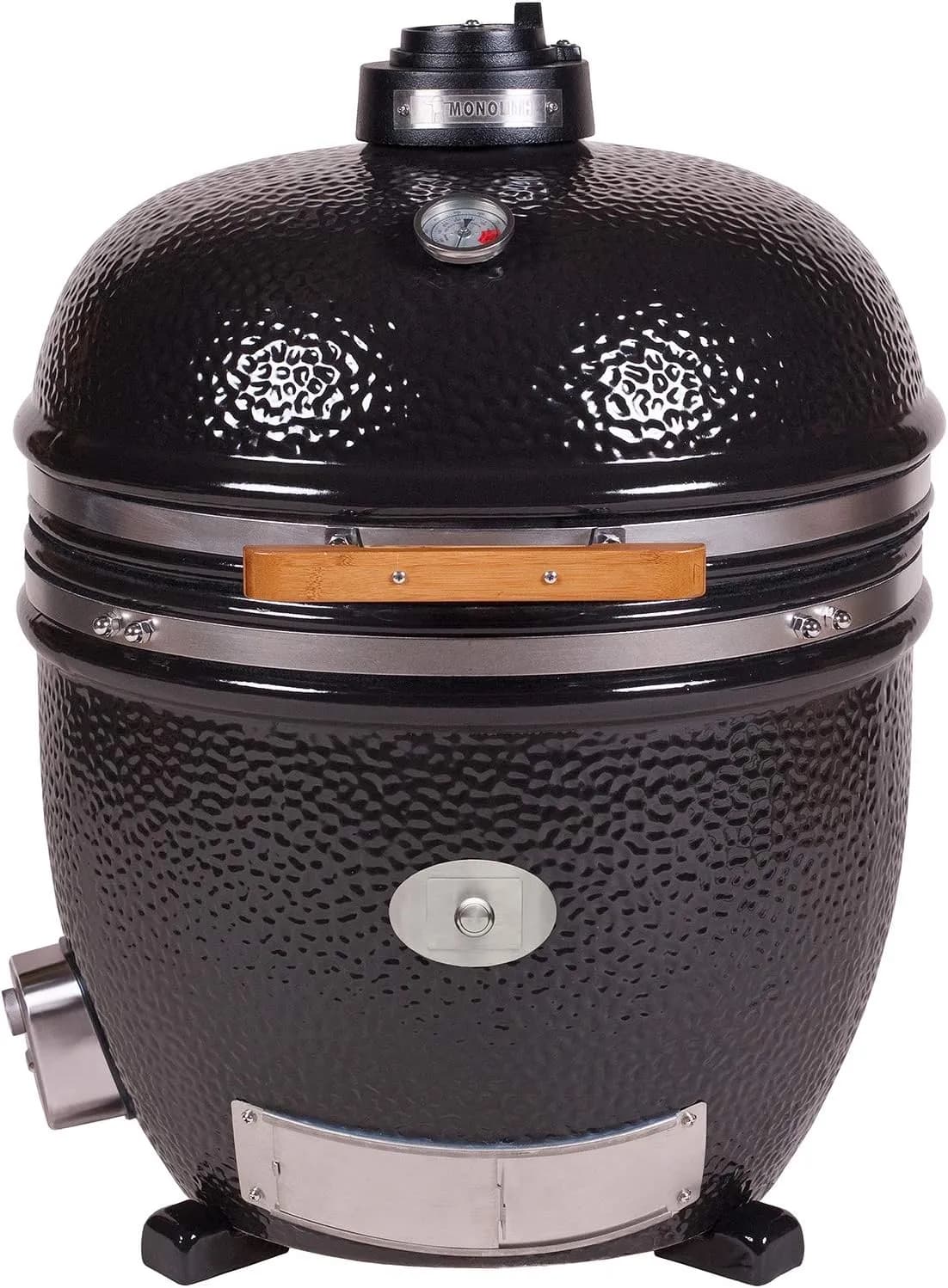
Monolith Classic Pro Series 1.0
The Monolith Classic Pro 1.0 is our overall best value: thick ceramic, a 25-year warranty and the most complete accessory ecosystem under €1,150.
As an Amazon Associate, mikamado.es earns from qualifying purchases. At no extra cost to you.
Value does not mean cheap. It is the most expensive trap in the kamado world: a €200 unit with thin ceramic walls that looks identical in the photo, until January's first frost or a badly handled thermal shock cracks it from side to side. It is a well-documented failure pattern across the kamado community. That is why this guide starts where durable ceramic starts: thick walls, a decent gasket fibre and, above all, a warranty the brand is genuinely willing to honour.
Our criteria for this list are simple and measurable, and they rest on manufacturer spec sheets and what the community reports (Naked Whiz, AmazingRibs). We compare the weight of each kamado (more kilos almost always means more ceramic and better thermal inertia), how long a single charcoal load lasts at low temperature according to that data, and which accessories actually exist on the market for each model. A kamado with a poor ecosystem forces you into expensive improvising; one with a broad network (deflectors, height-adjustable grates, pizza stones) grows with you for years. We also read the warranty line by line: 25 years on the ceramic is worth far more than the typical "2 years" of white-label brands.
We set the ceiling at around €1,300. Above that you enter the premium tier (those models have their own guide); below €900 things get tricky and only two or three honest options survive. Everything that follows we would recommend to a friend without blinking, and we say it as people who cook on ceramic and have seen up close what a badly handled thermal shock can do to a thin piece.
The full ranking
#1
Monolith Classic Pro Series 1.0
For anyone who wants the maximum return per euro, no debate. The Classic Pro 1.0 packs what usually only shows up in €1,500+ kamados: dense ceramic, a stainless top vent that does not jam with soot, and precise airflow control. Per the manufacturer and community reports, it holds a steady 110 °C for around 14 hours on a single basket. It is the model we recommend to people who genuinely want to smoke without taking out a mortgage, and whose Monolith accessory ecosystem lets you set up smoker, griddle or pizza with no improvising.
Pros
- 25-year ceramic warranty, the longest in this price band
- 14 hours at 110 °C on a single load, per manufacturer and community
- Complete Monolith ecosystem: deflector, smoker, griddle and pizza stone all in stock
Cons
- Cart and side shelves are sold separately, raising the initial outlay
- Heavy (around 90 kg assembled): not one you move around often
#2
Kamado Joe Classic II 18"
For the cook who stretches the budget to the limit chasing the best day-to-day experience. At €1,699 it goes over the guide's ceiling, but the Classic II brings the Divide & Conquer system (two independent grate heights) that transforms cooking two dishes at once. Note: this version does not include the SlōRoller diffuser, so for competition smoking the Monolith beats it on heat evenness. We pick it for the versatile cook who values the assisted hinge, felt gasket and included cart over the last euro saved.
Pros
- Divide & Conquer system as standard: two independent cooking levels
- Spring-assisted hinge: the dome feels half as heavy to open, great ergonomics
- Rolling cart with side shelves included, no extra cost
Cons
- This version ships without the SlōRoller: long smokes are less even than the Monolith's
- Above the guide's value ceiling; any add-on pushes it further out of range
#3
Big Green Egg MiniMax
For couples and small terraces who refuse to give up Big Green Egg's legendary ceramic. The MiniMax is one of the brand's most compact and accessible kamados and still shares the same ceramic and lifetime warranty on the ceramic component. By spec it reaches 300 °C for pizza with room to spare and, thanks to its Carry Handle, it is one of the few you can carry to the beach without strain. It is not for big cuts, but for density and brand backing it is among the most cost-effective small-format premium ceramic kamados.
Pros
- Lifetime ceramic warranty, backed by the BGE network in Spain
- 300 °C for pizza with margin per the manufacturer; ceramic that holds the heat
- Genuinely portable: integrated handle and manageable weight for travel
Cons
- Small grate (33 cm): falls short for big gatherings
- Official BGE accessories are pricey; full kit pushes total cost up
#4
Kamado Bono Grande XXL 59 cm
For anyone who wants the largest grate diameter for the least money. The 59 cm Bono Grande XXL is the euro-per-square-centimetre champion of this list: a huge surface for just over €1,000. Kamado Bono's ceramic is honest and the warranty decent, though the finish and accessory network do not match Monolith or Kamado Joe. We recommend it to the large family or the weekend host who prioritises capacity over refinements.
Pros
- 59 cm grate: the most capacity per euro in the whole selection
- Entry price into the large class without dropping to risky thin ceramic
- Cart and basic accessories usually come included in the bundle
Cons
- Finish and hardware below the premium brands on this list
- Its size burns more charcoal: less efficient for small cooks
#5
Pit Boss K24 24"
For the beginner on a tight budget who still wants serious ceramic. The Pit Boss K24 is our recommendable floor: under €1,000 it delivers a 24-inch kamado with thick ceramic, steel hardware and a usable dome thermometer. It lacks the gasket finesse and ecosystem of the models above, and fine temperature control takes more skill, but it will not crack in its first winter like bargain-bin clones. It is the honest entry point to real kamado cooking.
Pros
- Thick 24-inch ceramic for under €1,000
- Sturdy steel hardware and bands for its price bracket
- Safe entry point: not a fragile thin-ceramic clone
Cons
- Gasket and fine control are inferior: long smokes need more watching
- Limited accessory network versus Monolith, Kamado Joe or BGE
How to choose between these models
Decide by your real priority, not by the price tag. If you are going to smoke seriously and want the kamado to last decades, the Monolith Classic Pro 1.0 is the safe bet: the densest ceramic, the longest warranty and the broadest ecosystem under €1,150. If what you value is the everyday cooking experience —two heights, assisted hinge, included cart— and you can stretch to the ceiling, the Kamado Joe Classic II justifies it, knowing you give up the SlōRoller.
For a small terrace or a couple, the Big Green Egg MiniMax delivers brand ceramic with a lifetime warranty in a format that fits any corner. If your thing is feeding a large family, the 59 cm Kamado Bono Grande XXL offers the most grate per euro, accepting a simpler finish. And if you are starting on a tight budget but do not want to gamble on fragile ceramic, the Pit Boss K24 is our honest floor. Golden rule: never go below €900-1,000 on ceramic; down there the cheap one cracks and ends up costing a fortune.
The ones we dismissed (and why)
We analysed these in depth for this list too. They missed the cut for specific reasons — and one of them might still be the right fit for you:
- Kamado Bono Grande Limited 64 cm — It wins our under-€1,000 guide on sheer price per centimeter, but variable factory consistency and weak resale make it a gamble — for pure value we'd rather pay slightly more for less risk.
- Klarstein Kingsize Kamado — Its 51 cm of ceramic at clearance money looks unbeatable, but spotty stock and mid-grade accessories explain the tag — buy it with eyes open if you find it in stock.
- Vision Grills Diamant 50 — Good ceramic at a fair price, but distributor-routed support and a limited accessory ecosystem erode long-term value next to a Monolith or a discounted Classic II.
- Char-Griller Akorn E16620 — Probably the best euro-per-result in the catalog, but its steel can't match this list's ceramics for longevity or heat retention — its throne is in the beginners guide, which it wins.
- Kamado Joe Classic I 18" — Discontinued from official distribution and saddled with the older firebox that cracks sooner, it only makes sense heavily discounted — at going rates the Classic II is the better buy.
Frequently asked questions
Why don't you recommend the cheapest kamados at €150-300?
Because most of them use thin ceramic that cracks under thermal shock or the first frost. We have watched several die in a single season. A cheap kamado you replace after two years costs more than a mid-range one that lasts twenty. The value sweet spot starts around €900-1,000, where the ceramic is thick and the warranty actually backs it.
Which is the overall best value on the list?
The Monolith Classic Pro 1.0. It packs what usually only comes in €1,500+ kamados: dense ceramic, a 25-year warranty on the ceramic component and a complete accessory ecosystem (deflector, smoker, griddle, pizza stone), all under €1,150. Per the manufacturer and community reports, it holds a steady 110 °C for around 14 hours on a single charcoal load.
Does the Kamado Joe Classic II include the SlōRoller diffuser?
No, this version does not include it; the SlōRoller belongs to the Classic III and up. The Classic II does bring the two-tier Divide & Conquer system, a spring-assisted hinge and a cart with shelves. For very even long smoking the Monolith on this list beats it; for everyday versatility, the Kamado Joe is among the most comfortable.
What kamado size do I need based on how many I cook for?
As a reference from our tests: the Big Green Egg MiniMax (33 cm) comfortably covers a couple or three people; a Pit Boss K24 or a Monolith Classic (grate around 46-47 cm) serves a family of four to six; and the 59 cm Kamado Bono Grande XXL is for large families or weekend hosts. If in doubt, size up: you gain spare capacity without much fuel penalty on small cooks if you manage the vents.
Is it worth paying more for the accessory ecosystem?
Yes, if you plan to use the kamado for years. A model with a broad network (diffusers, height-adjustable grates, pizza stones, rib racks) grows with you and saves expensive improvising or incompatible parts. That is why we rank Monolith and Kamado Joe high: their catalogues are huge. Brands like Pit Boss or Kamado Bono do the job but tie you more to generic solutions. If you only grill simply, the upfront saving can be worth it.
Other buying guides
Best kamado 2026: the 5 ceramic grills we recommend without reservations
Editorial comparison of the 5 best kamados of 2026. Kamado Joe Classic III, Big Green Egg Large, Big Joe III, Monolith Classic Pro 2 and Primo Oval XL. No pay-for-coverage.
Best kamado under 1,000 €: 4 honest options that actually cook
Kamado Bono Grande, Klarstein Princesize Pro, Pit Boss K24 and Vision Grills Diamant: the 4 best kamados under 1,000 € reviewed without marketing filters.
Best kamado for beginners 2026: easy to light, control and maintain
The 5 best kamados to start with in 2026: easy to light, manageable weight and a sane entry point. Steel vs ceramic explained without hype. Verdict measured on a real terrace.