Recipe · Direct · Medium
Uzbek Beef Plov in a Dutch Oven on the Kamado, Fluffy Rice and Golden Zirvak
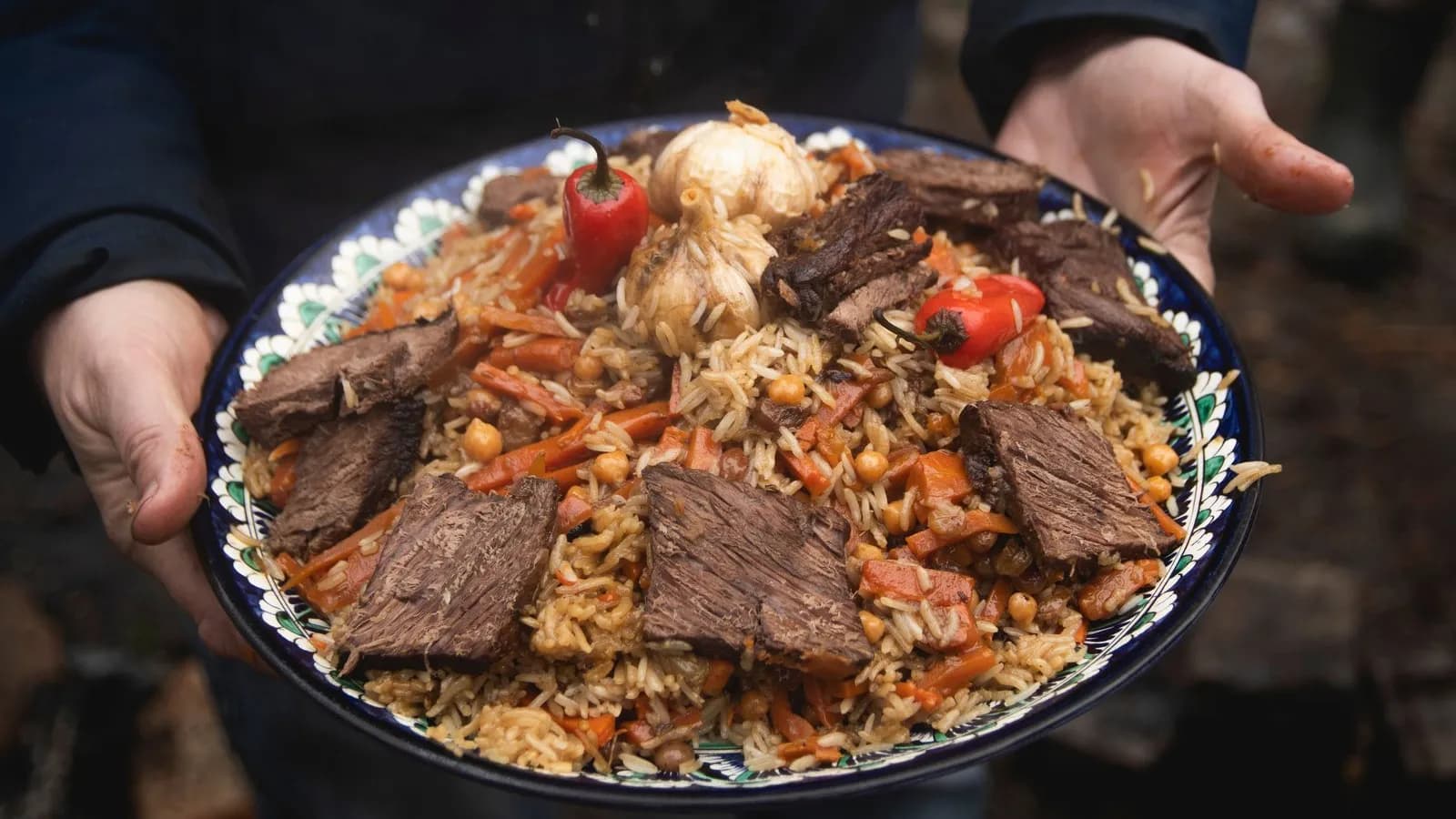
Plov (плов) is the festive rice of Central Asia. Here a dutch oven stands in for the kazan: a beef zirvak over a lively fire, then rice steamed with the vents almost closed and never stirred once.
Quick answer
With no deflector at 200-230 °C, brown cubed beef, onion and thickly cut carrot in a cast-iron dutch oven; add cumin, garlic and water and simmer 45-60 min until the meat is tender. Spread soaked rice on top, add water to 1.5 cm above it, evaporate uncovered, then cover and leave 25-30 min at about 150 °C, without stirring.
- Prep
- 30 min
- Cook
- 150 min
- Servings
- 6 servings
- Temperature
- 150 °C
Ingredients
- beef chuck (aguja de ternera) or shin (morcillo), in 3-4 cm cubes700 g
- devzira rice or, as a substitute, basmati600 g
- carrots, cut into 5 mm sticks600 g
- onion, in half-moons300 g
- sunflower oil150 ml
- whole heads of garlic, outer loose skin removed2 ud
- whole cumin seeds1 cda
- whole coriander seeds1 cdta
- fine salt, plus a pinch for soaking15 g
- whole dried chilli1 ud
- dried barberries (zereshk), optional1 cda
- hot water, approximately (about 600 ml for the zirvak, the rest for the rice)1.8 l
The gear for this recipe
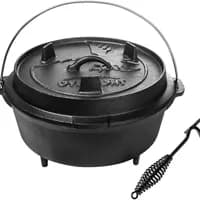 Overmont Dutch Oven-L: 6.3 L, 29.7 cm cast-iron Dutch ovenPlov needs an iron pot that acts as the kazan: mass to brown the beef without the oil cooling, and a thick base so the rice steams without scorching. The Overmont Dutch Oven-L is uncoated cast iron with an iron lid, 6.3 L and 29.7 cm across. The listing rates it to 250 °C; the dome stays at 200-230 °C, but the base sits over direct coals: bare iron copes with that, and it is a reason not to go past 230 °C or stretch the empty preheat. According to its images it measures about 36 cm handle to handle, so it sits centred on a 44.5 cm grate. The real drawback: it is shallow, about 9 cm deep, and that is why the recipe stays at 600 g of rice.
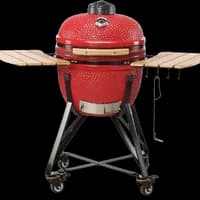 Kamado Bono Media 51 cmThis recipe asks two things of the kamado: room for a pot about 36 cm handle to handle, and a ceramic shell that can go from 200-230 °C to a gentle fire around 150 °C without going out. The Kamado Bono Media has a grate of about 45 cm according to distributor listings (44.5 cm for the replacement grate), so the dutch oven sits centred with about 4.5 cm per side; in a kamado with a 33-34 cm grate it would not fit. Its standard deflectors are not used here: the pot works over the coals, the thick iron base spreads the heat and the liquid of the zirvak cushions the rice above it. And the ceramic mass sustains the second stage with the vents almost closed, which is exactly what the steam requires.
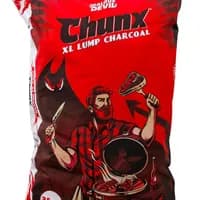 Jealous Devil 100% White Quebracho lump charcoal 15.8 kgThat is close to two and a half hours of lit kamado with no refuelling: an opening stage at 200-230 °C for browning and a long, low-air stage for the stew and the steam. Jealous Devil is quebracho blanco lump charcoal, a very dense wood, and the manufacturer describes it as low in ash with a long burn. Big lumps let air through when the vents are almost closed, which is when fine charcoal chokes in its own ash. With the firebox full at the start there is plenty for the whole recipe, and whatever has not burned goes out when you close the vents and can be reused next time.
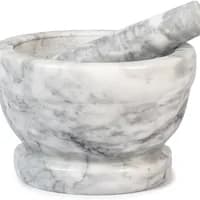 H&H Mortaio: 18 cm white marble mortar with pestleCumin is the signature of plov, and whole seed gives up only half its flavour, while ground cumin from a jar fades in a long stew. What the zirvak wants is cumin and coriander only just cracked open, the grain still recognisable, so they perfume the pot for an hour without turning bitter. The 18 cm H&H marble mortar has enough weight and bowl for two or three strokes per spoonful without the seeds jumping out, and the stone does not hold on to the smell of cumin for the next spice. It is a one-minute job while the iron heats in the kamado.
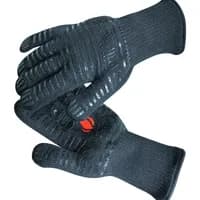 Grill Heat Aid – Heat-Resistant Aramid/Kevlar BBQ GlovesIn this recipe the kamado lid is opened several times with a lively fire: for the oil, the meat, the onion, the carrot, the water and the rice. Every opening means burping the lid, with your hand near the rim and the iron at chamber temperature, handles included. The Grill Heat Aid gloves are aramid and cover hand and wrist for handling the dutch oven lid, adding ingredients next to the hot rim and, at the end, lifting out a pot carrying more than six kilos of iron plus the plov. A folded cloth will not last that long in contact with the handle.
Method
- 01
Wash and soak the rice
Wash the rice in a bowl of cold water, rubbing it between your hands, and change the water until it runs almost clear, five or six times. Cover with lukewarm water, add a pinch of salt and leave to soak for an hour while you prepare everything else. Peel the carrots and cut them into 5 mm sticks: grated, they dissolve into the stew. Cut the meat into 3-4 cm cubes and pat it dry with kitchen paper.
- 02
Light with no deflector
Fill the firebox with Jealous Devil quebracho charcoal, light it and set the grate in place with no deflector. Put the empty, uncovered dutch oven in the centre and bring the kamado to 200-230 °C with the bottom vent open about three fingers and the top vent at three-quarters. Allow 15-20 minutes with the chamber steady so the iron heats right through. Meanwhile crush the cumin and coriander in the H&H mortar, just enough to crack the seeds open.
- 03
Brown the beef
With the Grill Heat Aid gloves on, open by burping the lid: lift it about 5 cm, wait about 5 seconds, then open fully with your face turned away. Pour in the oil with the lid open and wait 1-2 minutes, just until it shimmers; if it starts to smoke, the pot is too hot: add the meat straight away. Lay the meat in a single layer and close the lid. After 5-6 minutes turn it over; in total, 10-12 minutes until well browned on several sides.
- 04
Onion and carrot
Every time you open up, burp the lid and wear the gloves. Add the onion on top of the meat, stir and close the lid for 6-8 minutes, until golden and soft. Spread the carrot over it in a layer, without mixing at first, and close for another 5 minutes. Then stir carefully and leave 5 minutes more: the carrot should soften and turn the oil orange, not toast. If the base starts to darken too much, close the bottom vent a little.
- 05
Simmer the zirvak
Add the crushed cumin and coriander, the salt, the chilli and the barberries. Pour in hot water to cover the meat, about 600 ml, and sink the two heads of garlic. Leave the pot uncovered, close the kamado lid and shut the vents almost completely: the chamber will drift down towards about 150 °C as it simmers. Cook 45-60 minutes, until the meat is tender when pierced; at the half-hour mark top up with water if it shows through.
- 06
Spread the rice
Open by burping the lid (5 cm, about 5 seconds) with gloves on. Take out the heads of garlic. Taste the broth: it should be a little salty, as the rice will absorb some of it. Drain the rice and spread it over the zirvak without mixing. Pour hot water with a ladle onto a slotted spoon, so the layer is not disturbed, until it stands 1.5 cm above the rice. Close the kamado and leave the pot uncovered for 10-15 minutes, until no water shows on the surface.
- 07
Steam, covered
Burping the lid and wearing gloves, gather the rice into a soft mound with the slotted spoon, without reaching the bottom, and sink the heads of garlic back in. Poke five or six holes down to the zirvak with the handle of a wooden spoon to let the steam out. Cover the pot, close the kamado with the vents almost shut, at about 150 °C, and leave 25-30 minutes without opening or stirring.
- 08
Rest and serve
Open by burping the lid (5 cm, about 5 seconds, face turned away) and check one grain from the surface: it should be tender and separate. Lift the pot out with the gloves and both hands, because the handles are at chamber temperature, and leave it covered for 10 minutes on a board. Close both vents fully to put out the coals. Gently mix the rice with the carrot and serve on a large platter with the meat and the heads of garlic on top.
About this recipe
Plov (плов) is the dish of weddings, birthdays and long Sundays in Uzbekistan, and of much of the Russian-speaking community on the Spanish coast too. It is made in a kazan (казан), a deep iron pot over a wood fire, and it has two stages that never mix: first the zirvak (зирвак), a stew of meat, onion and carrot fried in plenty of oil; then the rice, which cooks on top in steam without being touched. The kamado reproduces those two fires in the same ceramic shell, and a cast-iron dutch oven takes the place of the kazan.
A dutch oven standing in for the kazan
A kazan works by mass: thick iron stores heat, browns the meat without the oil cooling when it goes in and, at the end, spreads a gentle heat across the whole base. An uncoated cast-iron pot like the 6.3-litre Overmont does the same and copes easily with the lively fire at the start, as the guide to cast iron and dutch ovens on the kamado explains. It measures 29.7 cm across and about 36 cm handle to handle according to its product images, so it sits centred on the grate of about 45 cm of the Kamado Bono Media (per distributor listings; 44.5 cm for the replacement grate), with about 4.5 cm per side. It will not fit a kamado with a 33-34 cm grate: there you need a smaller pot and smaller quantities. It is also a shallow pot, about 9 cm deep, which is why the recipe stops at 600 g of rice for six: any more and the water spills over.
Two fires in the same ceramic
The first stage goes without a deflector and with the chamber at 200-230 °C: the pot sits right above the coals, the oil really heats up and the beef browns instead of stewing in its own juices. As soon as the water goes into the zirvak, you close the vents almost completely. The ceramic cools slowly, as the temperature control guide describes, so during the simmer it will drift down towards about 150 °C; if it is still a little above that when the rice goes in, no harm done. Precision is not required: as long as there is liquid, the water in the pot stays at around 100 °C, and the chamber only has to hold a soft, even simmer. The difference from classic indirect cooking is covered in the guide to direct versus indirect cooking: there is no deflector here because the zirvak needs the coals underneath to brown and boil; the thick iron base spreads that heat and the liquid of the stew cushions the rice above it, which is why the vents stay almost closed in the steaming stage and the pot is not opened.
The rice: devzira if you can find it
In Uzbekistan plov is made with devzira (девзира), a reddish medium-grain rice that absorbs a lot of fat without breaking. In Spain it is hard to find outside the odd Russian or Central Asian grocery. The sensible substitute is a well-washed, soaked basmati: it comes out loose and flavourful, but it is slimmer and less fatty than devzira, so do not expect the same bite. The technique does not change. The rice is spread over the zirvak without mixing, covered with just enough water, left to evaporate uncovered and finished covered, in steam. No stirring: every turn breaks grains and releases starch. That is why this is not a paella, nor a cousin of the Alicante-style baked rice, which is cooked with stock in an earthenware dish and baked uncovered. If you want another Uzbek classic for the same table, there is the lamb samsa.
In 30 seconds
Cast-iron dutch oven, no deflector, 200-230 °C: brown the beef, then the onion and carrot sticks, add cumin, whole garlic and water, and close the vents. After 45-60 minutes of simmering, put the soaked rice on top, add water to 1.5 cm above it, let it evaporate uncovered and cook 25-30 minutes covered at about 150 °C without stirring. Rest it for ten minutes and serve.
Editor's tips
- The carrot goes in as sticks, never grated: in plov it is half the flavour and it has to reach the plate whole, sweet and soft but still holding its shape. Central Asian shops sometimes stock yellow carrots, which are the traditional ones and give a less sweet base.
- Count how many times you open the lid: each opening in the hot stage lets air in and the coals flare up. Open only to add ingredients, always burping the lid and wearing gloves, and if anything runs away from you, see the temperature problems guide.
- If you use shin (morcillo), stretch the zirvak towards the full hour or a little longer: it has more collagen than chuck and needs time to soften before the rice goes in, because afterwards you cannot check it without breaking the layer.
- The lightly toasted crust that sticks to the base, the kazmak, is part of the dish and is served separately for whoever wants it. If it smells burnt rather than toasted, close the vents sooner next time when the water goes in.
Gear for this recipe
As an Amazon Associate, mikamado.es earns from qualifying purchases. At no extra cost to you.
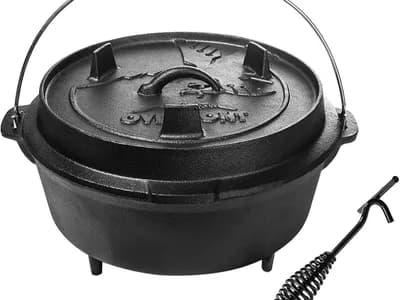
Overmont Dutch Oven-L: 6.3 L, 29.7 cm cast-iron Dutch oven
Plov needs an iron pot that acts as the kazan: mass to brown the beef without the oil cooling, and a thick base so the rice steams without scorching. The Overmont Dutch Oven-L is uncoated cast iron with an iron lid, 6.3 L and 29.7 cm across. The listing rates it to 250 °C; the dome stays at 200-230 °C, but the base sits over direct coals: bare iron copes with that, and it is a reason not to go past 230 °C or stretch the empty preheat. According to its images it measures about 36 cm handle to handle, so it sits centred on a 44.5 cm grate. The real drawback: it is shallow, about 9 cm deep, and that is why the recipe stays at 600 g of rice.
€67
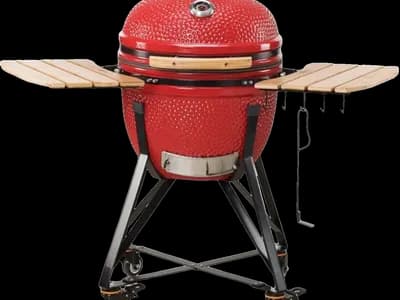
Kamado Bono Media 51 cm
This recipe asks two things of the kamado: room for a pot about 36 cm handle to handle, and a ceramic shell that can go from 200-230 °C to a gentle fire around 150 °C without going out. The Kamado Bono Media has a grate of about 45 cm according to distributor listings (44.5 cm for the replacement grate), so the dutch oven sits centred with about 4.5 cm per side; in a kamado with a 33-34 cm grate it would not fit. Its standard deflectors are not used here: the pot works over the coals, the thick iron base spreads the heat and the liquid of the zirvak cushions the rice above it. And the ceramic mass sustains the second stage with the vents almost closed, which is exactly what the steam requires.
€923
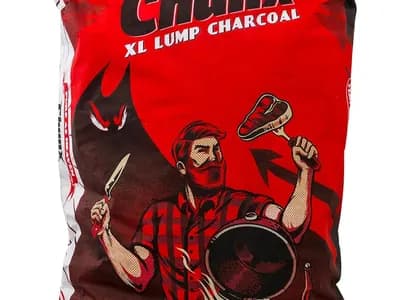
Jealous Devil 100% White Quebracho lump charcoal 15.8 kg
That is close to two and a half hours of lit kamado with no refuelling: an opening stage at 200-230 °C for browning and a long, low-air stage for the stew and the steam. Jealous Devil is quebracho blanco lump charcoal, a very dense wood, and the manufacturer describes it as low in ash with a long burn. Big lumps let air through when the vents are almost closed, which is when fine charcoal chokes in its own ash. With the firebox full at the start there is plenty for the whole recipe, and whatever has not burned goes out when you close the vents and can be reused next time.
€205
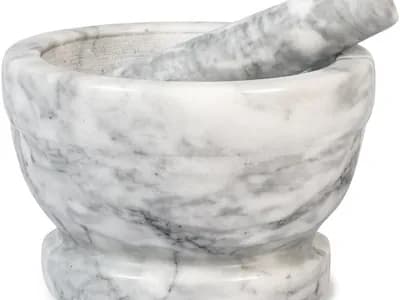
H&H Mortaio: 18 cm white marble mortar with pestle
Cumin is the signature of plov, and whole seed gives up only half its flavour, while ground cumin from a jar fades in a long stew. What the zirvak wants is cumin and coriander only just cracked open, the grain still recognisable, so they perfume the pot for an hour without turning bitter. The 18 cm H&H marble mortar has enough weight and bowl for two or three strokes per spoonful without the seeds jumping out, and the stone does not hold on to the smell of cumin for the next spice. It is a one-minute job while the iron heats in the kamado.
€33
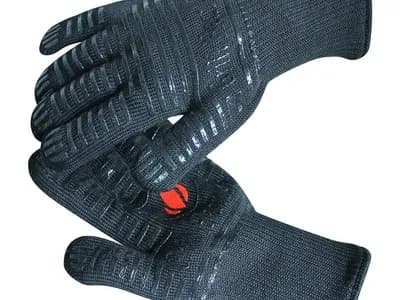
Grill Heat Aid – Heat-Resistant Aramid/Kevlar BBQ Gloves
In this recipe the kamado lid is opened several times with a lively fire: for the oil, the meat, the onion, the carrot, the water and the rice. Every opening means burping the lid, with your hand near the rim and the iron at chamber temperature, handles included. The Grill Heat Aid gloves are aramid and cover hand and wrist for handling the dutch oven lid, adding ingredients next to the hot rim and, at the end, lifting out a pot carrying more than six kilos of iron plus the plov. A folded cloth will not last that long in contact with the handle.
€93
FAQ
Which rice should I use for plov if I cannot find devzira?
Devzira is an Uzbek medium-grain rice that absorbs a lot of fat without breaking, and in Spain it only turns up in some Russian or Central Asian grocery shops. The most practical substitute is basmati, well washed and soaked for an hour: it comes out loose and does not clump. It is slimmer and less fatty than devzira, so the plov turns out a little lighter. Round bomba-type rice absorbs well, but it tends to release more starch.
Can you make plov with beef instead of lamb?
Yes. In Uzbekistan lamb plov is the most traditional, but the beef version is common in Russia and Central Asia. Choose a cut with some fat and collagen, such as chuck (aguja) or shin (morcillo), cut into 3-4 cm cubes. It is stewed in the zirvak until tender, 45-60 minutes, and then keeps cooking under the rice. Very lean beef turns dry and stringy over this length of time.
Why is plov not stirred?
Because the rice cooks in layers: below, the zirvak simmers and gives off steam; above, the grain hydrates and cooks in that steam and in the fat that rises. If you stir, you break grains, release starch and the dish turns into a creamy rice. The only intervention is gathering the rice into a mound and poking holes for the steam before covering. It is mixed at the end, on the platter.
How does plov differ from paella or baked rice?
In the technique. Paella is made in a thin layer with stock that evaporates over an open fire, and baked rice is cooked uncovered in an earthenware dish with stock. Plov starts from a meat stew fried in plenty of oil, the zirvak, over which the rice is spread with just enough water, unmixed, and finished covered in steam. That is why the grain comes out loose and glossy with fat, not creamy.
How much water does plov need?
It is measured by height, not in cups: with the rice spread over the zirvak, hot water is poured in until it stands 1.5 cm above the grain. It is left to evaporate uncovered until no water shows, and only then covered to finish in steam. In this recipe that is about 600 ml in the stew and close to a litre over the rice, 1.6-1.8 litres in total depending on the rice and how much the zirvak evaporates: keep two litres hot.
More kamado recipes
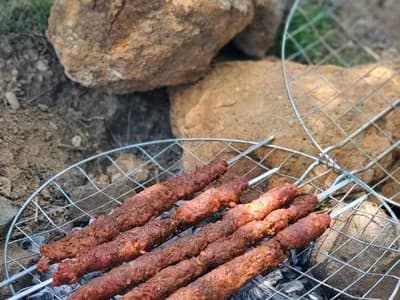
Lamb Lyulya Kebab on the Kamado
The question is never how to season it, but why it falls off the skewer. The answer is fat, a hand-chopped grain and real kneading: juicy lamb that holds together over direct fire.
Pork Neck Shashlik on the Kamado, Onion Marinade
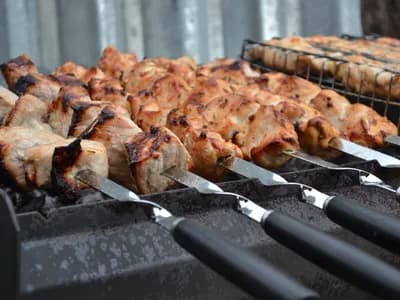
The skewer of the Russian-speaking world, cooked as I make it on my Big Green Egg Large: pork neck in 3 cm cubes, a grated onion marinade with not a drop of vinegar, and twenty minutes of steady direct fire.
Beef Cheeks in Red Wine, Braised in a Dutch Oven on the Kamado
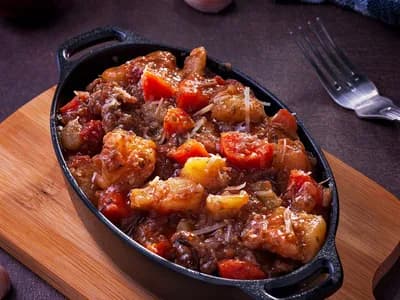
Three hours of red wine, cast iron and a thread of olive-wood smoke your kitchen oven simply cannot make. The braise that justifies lighting the kamado in midwinter.
KEEP READING
Go deeper on this dish
- Recommended kamado
Kamado Bono Media 51 cm
This recipe asks two things of the kamado: room for a pot about 36 cm handle to handle, and a ceramic shell that can go from 200-230 °C to a gentle fire around 150 °C without going out. The Kamado Bono Media has a grate of about 45 cm according to distributor listings (44.5 cm for the replacement grate), so the dutch oven sits centred with about 4.5 cm per side; in a kamado with a 33-34 cm grate it would not fit. Its standard deflectors are not used here: the pot works over the coals, the thick iron base spreads the heat and the liquid of the zirvak cushions the rice above it. And the ceramic mass sustains the second stage with the vents almost closed, which is exactly what the steam requires.
- Editorial guide
How to light a kamado: the step-by-step method
No petrol, no weird tablets and no 45-minute waits. The cone method, airflow control and the mistakes that prevent 80% of the frustration.
- Glossary term
Heat deflector
Ceramic plate placed between the coals and the grate to turn direct fire into indirect cooking.
- Related comparison
big green egg large vs kamado joe classic iii
The classic kamado matchup: the Big Green Egg Large, the indestructible pioneer with the widest accessory network, agai…