Recipe · Indirect · Advanced
Apple tarte Tatin in a dutch oven on the kamado, golden caramel
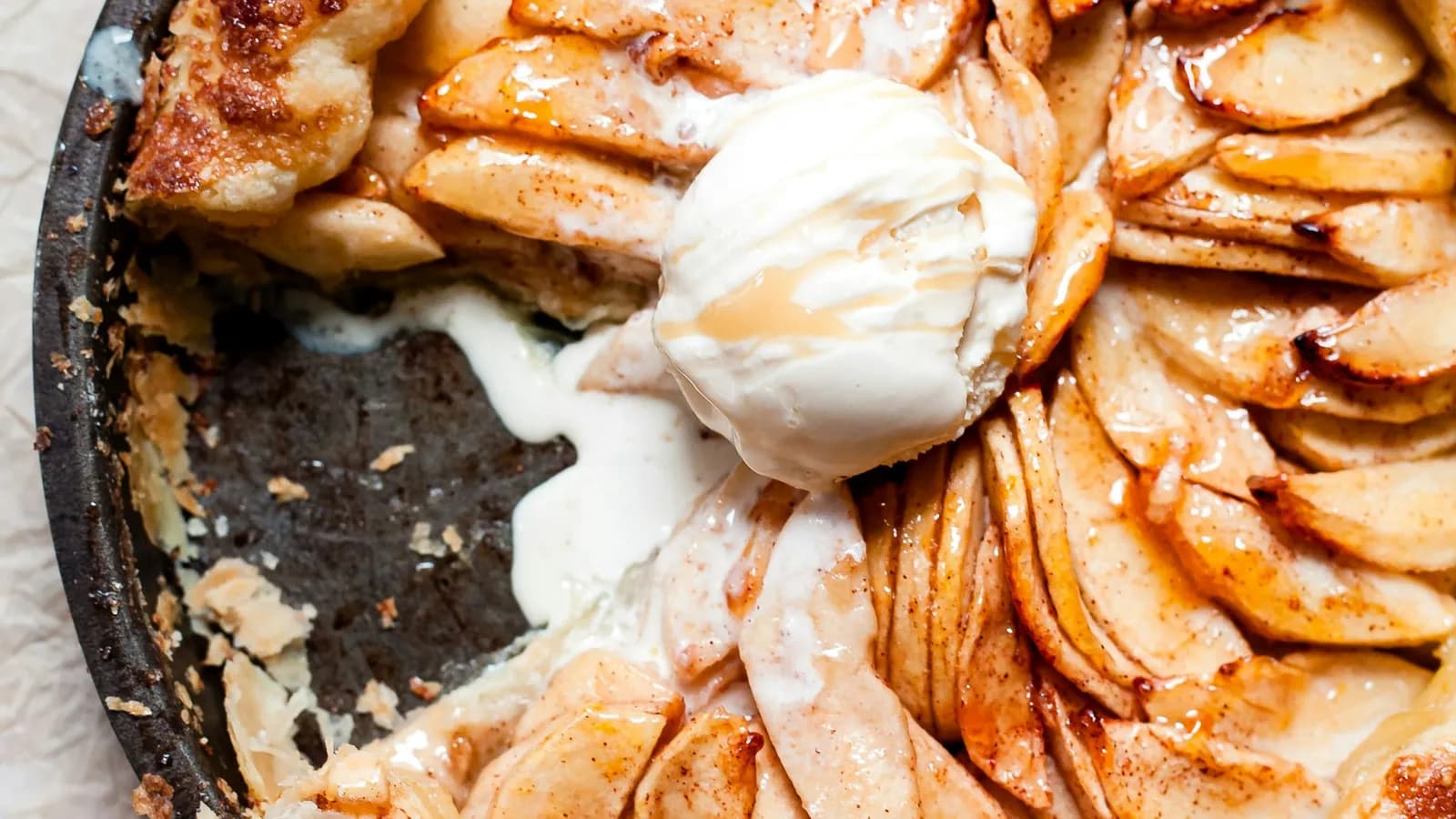
Caramelised apples in a cast-iron dutch oven, golden puff pastry and an amber caramel that runs as you flip it. Indirect at 190°C: the tarte Tatin that earns applause.
Quick answer
Make the caramel in the pot until it's a coppery amber, set the apples curved-side down, cover with cold puff pastry and bake indirect at 190 °C for about 40-45 minutes without lifting the lid. Rest it for 10-15 minutes and flip it out in one firm turn. Serve warm with vanilla ice cream.
One big step at a time, screen kept on and built-in timers.
- Prep
- 30 min
- Cook
- 45 min
- Servings
- 6 servings
- Temperature
- 190 °C
What time do you want to eat?
Pick a time and we'll tell you when to start.
12:05
Start the prep
12:35
Light the kamado
13:05
Onto the kamado
14:00
Serve
Estimate: it includes lighting and settling the kamado plus a margin for large cuts. If the recipe asks you to marinate or salt ahead, add that time.
Fire setupIndirect
- Dome
- 190 °C
- Deflector
- Yes
- Grate
- Standard height
- Setup
- Deflector and enamelled cast-iron Dutch oven
Temperature curve
1:35 h from lighting
Kamado dome
| # | From | Phase | Dome |
|---|---|---|---|
| 1 | 0:00 | Light the charcoalPlate-setter in; 20-25 min up to 190 °C | 20 → 190 °C |
| 2 | 0:25 | StabiliseHold steady before starting the caramel | 190 °C |
| 3 | 0:35 | Put the food inAmber caramel in the cocotte, apples, cold pastry pricked | 190 → 170 °C |
| 4 | 0:45 | Bake40-45 min unopened; golden, puffed and bubbling | 170 → 190 °C |
| 5 | 1:25 | Rest10-15 min then flip in one firm turn; serve warm | 190 → 100 °C |
| 6 | 1:35 | Serve | off |
0:00 is the moment you light the charcoal. Internal temperatures are the ones the recipe gives; without a probe, go by the times. Turn these times into clock times with the planner
For this recipe
Ingredients
- firm apples (Golden or Reineta, they hold up in the caramel)6
- white sugar for the caramel200 g
- salted butter, diced90 g
- orange (zest for the caramel + 1 tbsp juice)1
- sheet of all-butter puff pastry (round or rectangular, about 250 g)1
- ground almond (between the fruit and the pastry)2 tbsp
- vanilla extract (or the seeds of half a pod)1 tsp
- ground cinnamon (optional)1 pinch
- vanilla ice cream or whipped cream to serve1 tub
Allergens
- Gluten
- Milk
- Tree nuts
Some puff pastry and vanilla ice cream may contain egg: check the label.
Based on the recipe's ingredients. Always check the label of every product you buy.
The gear for this recipe
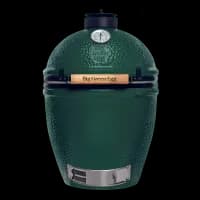 Big Green Egg Large
 Kamado Joe Big Block XL lump charcoal 9.1 kgQuality lump charcoal for clean, steady embers throughout the bake.
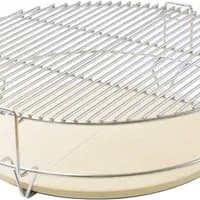 Onlyfire GCG-8552 Cooking System (2 grates + rack + 2 deflectors) for Large Kamado
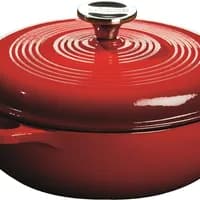 Lodge Enameled Cast Iron Dutch Oven 2.84 L (Red)Cast-iron casserole to caramelise the apples, then bake and turn out the tart.
 Inkbird IBBQ-4T WiFi Thermometer with 4 Probes
Method
- 01
Set the deflector and stabilise 190°C
Light the kamado, set the deflector (plate-setter) and stabilise the chamber at 190°C indirect. It takes 20-25 minutes. Do not start the caramel until the thermometer holds at 190°C for 10 minutes: the pastry must go into an already stable oven, not one still climbing.
- 02
Prep the apples
Peel the apples, quarter and core them; leave the wedges chunky, as they shrink when cooked. Toss them with the tablespoon of orange juice so they do not brown. Take the puff pastry from the fridge and cut a disc a couple of centimetres wider than the inner diameter of the pot; chill it again until assembly, cold pastry puffs better.
- 03
Make the caramel in the dutch oven
Set the pot over the coals with the lid open, add the sugar and butter and, over medium heat, let them melt with little stirring to a coppery amber caramel, 6-8 minutes. Stir in the orange zest and vanilla. The moment it has colour, off the direct heat: the hot iron keeps cooking it and amber to burnt is a matter of seconds.
- 04
Arrange the apples and almond
Carefully (the caramel burns), set the apple wedges over the caramel, packed tight and fanned out, curved side down —that is the face you will see when you flip it. Fill the gaps with small pieces; they shrink as they bake. Scatter the ground almond and a pinch of cinnamon over the fruit: it will toast and give the base depth.
- 05
Cap with the puff pastry
Lay the cold pastry disc over the fruit and tuck the edges down inside, between the apple and the pot wall, as if tucking the fruit in. Prick the pastry 4-5 times with a fork so steam escapes and it does not balloon. Work fast: warm pastry puffs less.
- 06
Bake 40-45 min without lifting the lid
Place the uncovered pot on the grate over the deflector and close the kamado. Bake 40-45 minutes at 190°C without lifting the lid. It is ready when the pastry is golden, puffed and firm, and you can see caramel bubbling at the edges. If the pastry is pale at 40 minutes, push to 200°C for the last 5.
- 07
Rest 10-15 min and flip
Pull the pot with gloves and rest 10-15 minutes: no more (the caramel glues down), no less (the fruit slides and you scald yourself). Run a knife round the edge, set a flat plate upside down on top, grip pot and plate with gloves and flip with one firm, dry turn in a single move. Nudge back any wedge that shifts.
- 08
Serve warm
Serve the Tatin warm, not straight from the flip nor cold: at a gentle room warmth the caramel gleams and the pastry keeps its crunch. Serve each portion with a scoop of vanilla ice cream or a spoon of whipped cream, which melts into the warm caramel as a sauce that is the best part of the dish.
About this recipe
An apple tarte Tatin on the kamado is made in a cast-iron dutch oven and comes out better than in a home oven: you caramelise the sugar and apples right in the pot, cap them with a disc of puff pastry and bake at 190°C indirect with the deflector in until the pastry is golden and puffed. Flip it onto a plate and the fruit lands on top, glossy with amber caramel. The cast iron is what lets you caramelise and bake in one vessel, and the kamado holds the temperature pinned so the caramel never tips from amber to burnt.
The caramel: the point that defines a Tatin
A tarte Tatin is, at heart, apples confit in caramel. Success lives in stopping the caramel at exactly the right moment: sugar and butter to a coppery amber, no darker. I make it in the cast-iron pot directly over the coals with the lid open, stirring little, medium heat, until the sugar melts and turns hazelnut —about 6-8 minutes. Let it go to dark brown and it turns bitter and ruins the dessert. The instant it has colour, off the direct heat and in go the apples: the residual heat of the iron keeps working, so it darkens faster than you think. A firm apple like Golden or Reineta holds up in the caramel without collapsing; soft ones turn to compote.
Why the kamado bakes better than a home oven
Once stabilised at 190°C with the deflector, the kamado behaves like a gentle convection oven and does not swing like a domestic oven every time the element fires. Puff pastry needs even, assertive heat to puff and brown without going greasy, and the kamado's ceramic delivers it. The cast-iron pot adds its own inertia: it keeps caramelising the apple base from below while the deflector's radiant heat browns the pastry on top. The golden rule of all kamado baking: do not lift the lid to peek. Every opening drops the chamber from 190°C to 150°C and adds ten minutes to the bake, and pastry that loses its heat burst halfway through never puffs the same.
A Mediterranean touch and the final flip
I give it a backbone of home with orange zest in the caramel and a pinch of ground almond between fruit and pastry, which toasts and flatters the apple. The flip is daunting but it has a trick: rest 10-15 minutes (no more, no less), run a knife round the edge, plate on top, and one firm, dry turn in a single move. Wait too long and the caramel glues itself down; flip it straight off the heat and you scald yourself and the fruit slides. Serve warm, with a scoop of vanilla ice cream or cream. It is the dessert I bring out when I want to close a meal on the terrace in style.
In 30 seconds
Deflector in, kamado a stable 190°C indirect oven. Caramel of sugar + butter in the cast-iron pot to a coppery amber (6-8 min), orange zest. Firm apples (Golden/Reineta) in wedges over the caramel, a pinch of ground almond, a disc of puff pastry on top tucked in. Bake 40-45 min without lifting the lid until the pastry is golden and puffed. Rest 10-15 min, run a knife round, flip firmly onto a plate. Serve warm with vanilla ice cream. Serves 8.
Will it fit your kamado?
Small
33-40 cm · Joe Jr, MiniMax
Tight
A 2.8 L Dutch oven probably just fits; with a ~22 cm pan you get about 4 servings.
Medium
46-51 cm · Classic, Large
Fits
The Dutch oven fits over the deflector: 6 servings in one batch.
Large
56-61 cm · Big Joe, XL
Fits
Fits with room to spare; a second Tatin could bake at the same time.
What to serve with it
Sides
- Vanilla ice cream
- Thick crème fraîche
- Wine
- Moscatel de Valencia or a sweet Málaga wine
- Beer
- Amber ale or Belgian tripel
- Alcohol-free
- Warm cloudy apple juice with cinnamon
Leftovers and storage
- In the fridge
- 2-3 days in the fridge, covered on its plate or airtight, chilled within 2 h.
- Freezing
- Does not freeze well: the pastry goes soggy and the apples weep when thawed.
- Reheating
- Oven or kamado at 160 °C for about 10 min to loosen the caramel; skip the microwave, it softens the pastry.
- Using them up
- Chop the caramelised apple over porridge or yogurt.
Cool and refrigerate within 2 hours. When in doubt, throw it out.
Leftover embers
You still have embers: what to do with the leftover heat
For 45 min at 190 °C in a classic kamado you load about 800 g of charcoal and burn 400 g: when you serve, about 380 g of live embers remain. Before you shut the vents, that is still enough for:
Without touching the vents
190 °Cdessert while you eat
1 h 20 minof embers
- Cornbread in an Iron Skillet on the Kamado, with Brown Butter45 min · 200 °C
- Kamado-Roasted Potatoes with Cured Pork Fat and Dill1 h · 200 °C
- Apple crumble on the kamado in a dutch oven40 min · 190 °C
No recipe needed
- Yesterday's bread with oil and garlic, on the grate (10 min)
- Corn cobs in their husks (30 min)
- Whole apples with a slit in the skin (45 min)
Closing the vents almost fully and waiting for it to drop
100-130 °Ca short smoke
2 h 25 minof embers
- Hot-Smoked Whole Mackerel on the Kamado45 min · 120 °C
No recipe needed
- Coarse salt on a tray, with a wood chunk: smoked salt for months (1-2 h)
- Almonds or walnuts on a rack (45 min)
- Whole heads of garlic, for spreading (1 h)
Opening the vents almost fully
210-270 °Cgrilled vegetables
30 minof embers
- Olive Oil Ciabatta on the Kamado25 min · 245 °C
- Charred Wild Green Asparagus on the Kamado8 min · 240 °C
- Grilled Watermelon with Feta, Mint and Balsamic Reduction10 min · 250 °C
No recipe needed
- Strips of courgette and aubergine, char-marked (5 min)
- Pita or naan from shop dough, on the grate (3 min each)
- Halved tomatoes, cut side down, for a sauce (10 min)
Before opening the lid, crack it open for a few seconds first; if you raise the heat, stir the ash so the coals can breathe. And if you are not going to use them: once the food is out, close the bottom and top vents. The charcoal that does not burn (about 380 g) can be used next time. Different size of kamado? Work out your load for 1 h 30 min of fire, lighting included.
History of the dish
- Origin
- Lamotte-Beuvron, Sologne (France)
- Period
- Late 19th century; internationally known from the 1950s
- Where it is cooked today
- A classic of French pâtisserie, served in restaurants and bistros in France and abroad.
The tarte Tatin is linked to the Hôtel Tatin in Lamotte-Beuvron (Loir-et-Cher), in the Sologne, run by the sisters Stéphanie, known as "Fanny", and Caroline Tatin. Popular tradition places its creation in the 1880s, although the researcher Kilien Stengel places it in the present hotel, which opened in 1894. The historian Henri Delétang traced the first mention of the speciality to an article by Gabriel Hanotaux published in Le Journal in December 1899.
Historians and gourmets debate whether it was a genuine creation of the "demoiselles Tatin" or an improved version of the tarte solognote, a dish of the region. The sisters never published the recipe nor called it "tarte Tatin"; the first printed recipe appeared in 1921, after their deaths. The famous story of the mishap, the tart accidentally turned over, was spread in 1927 by the magazine Le Bon Gîte et la Bonne Table, and Curnonsky, the "Prince of Gastronomes", embellished it for the press.
The name and the fame came after the sisters' deaths, through Curnonsky and the Parisian restaurant Maxim's, where it is recorded as a house speciality from 1952. In the 1950s its reputation began to spread beyond France.
Sources
- Tarte Tatin — Wikipedia (en.wikipedia.org)
- «Façon Tatin : du geste à la créativité, un outil de transmission», Kilien Stengel (Université de Tours, IEHCA) — Éditions L'Harmattan (editions-harmattan.fr)
Editor's tips
- An independent chamber probe (Inkbird) at grate height is more reliable than the dome gauge, which reads the air under the lid, not next to the pot. Clip it in and tune the vents to that number: puff pastry punishes any drift off 190°C.
- Do not overcook the caramel. It is the number-one mistake: afraid it is too pale, you leave it a minute too long and it turns bitter. Stop it at coppery amber, pull it off the direct heat and let the iron's heat finish it. It always goes darker than you think.
- Smoke has no place here. A Tatin is caramel, butter and apple: the kamado's clean charcoal already lends a faint toasted backdrop. Do not add wood chunks; a caramel dessert with smoke tastes of confusion, not complexity.
Gear for this recipe
As an Amazon Associate, mikamado.es earns from qualifying purchases. At no extra cost to you.

Big Green Egg Large
€2,099
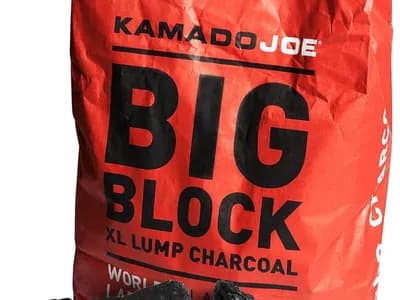
Kamado Joe Big Block XL lump charcoal 9.1 kg
Quality lump charcoal for clean, steady embers throughout the bake.
€67
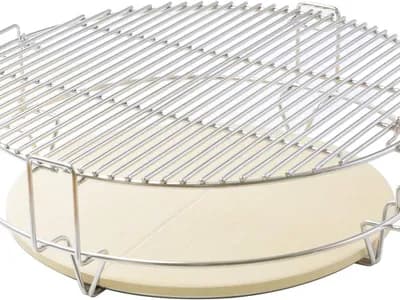
Onlyfire GCG-8552 Cooking System (2 grates + rack + 2 deflectors) for Large Kamado
€95
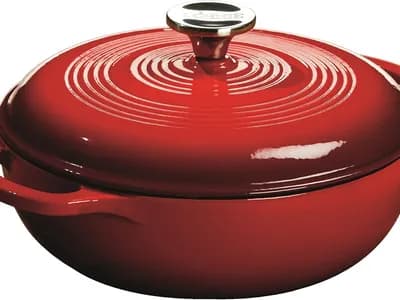
Lodge Enameled Cast Iron Dutch Oven 2.84 L (Red)
Cast-iron casserole to caramelise the apples, then bake and turn out the tart.
€170

Inkbird IBBQ-4T WiFi Thermometer with 4 Probes
€23
Have you made it?
Tell us how it turned out on your kamado. We review every rating before publishing it.
No published ratings yet. Be the first!
FAQ
Which apple holds up best in the caramel without falling apart in a Tatin?
You need a firm, low-juice apple that survives 45 minutes of caramel and oven without turning to compote. In Spain a firm Golden works very well and is everywhere; the Reineta is the most traditional tart apple, with its acidity and tight texture. Elsewhere, Granny Smith holds up beautifully though it is more tart, and Braeburn gives a good balance. Avoid an over-ripe Fuji, a soft Gala or any mealy apple: they release water, collapse, and the Tatin ends up as purée under pastry, without the whole, glossy wedges that are its signature.
How do you make the caramel in the dutch oven without burning it?
Three rules. First: medium heat, not fierce; the kamado's coals are powerful, so open the vents only a little or work with the pot slightly off the centre of the fire. Second: stir as little as possible. Sugar with butter melts on its own; over-stirring crystallises and seizes it. Swirl the pot in a circle rather than stirring with a spoon. Third and most important: stop the caramel at coppery amber, not dark brown, and pull it off the direct heat the instant it has colour. Cast iron holds a lot of heat and keeps cooking the caramel for half a minute after you move it, so if you wait until it looks dark, it is already burnt.
What is the trick to unmoulding the Tatin without the fruit breaking up?
The right rest and a decisive turn. Rest the pot for 10-15 minutes after pulling it: the caramel, runny straight from the oven, thickens just enough to hold the fruit without yet gluing to the base. Flip it fresh out and the caramel is too fluid and the fruit slides (plus you burn yourself); wait until it is fully cold and the caramel hardens and sticks to the iron. Within that 10-15 minute window, run a knife all round the edge to release it, set a flat plate upside down on top, grip firmly with gloves and flip in one firm, dry move, no hesitation. If a wedge stays in the pot, lift it back into place carefully: no one will know.
Shop-bought or homemade puff pastry: which works better on the kamado?
For a Tatin, a good shop-bought all-butter puff pastry (not margarine) is perfectly fine and, for most people, the practical choice: it performs just as well and saves you two hours. The key is not whether it is homemade, but that it is all-butter and goes into the kamado cold —the cold is what makes the layers puff with the 190°C heat burst. Read the label: if it says palm oil or margarine, the flavour drops a lot. Homemade puff gives more layers and better flavour if you fancy the work, but in a dessert where the star is the apple caramel, the difference is marginal. What does matter: prick it so it breathes and do not lift the lid, because that is what decides whether it puffs.
How do you hold a steady 190°C through the whole bake?
Stability over speed. Stabilise the kamado at 190°C with the deflector already in and let it hold steady for 10 minutes before loading the pot; an oven still climbing bakes unevenly. Adjust with the vents alone, in small steps: the bottom damper governs the base temperature and the top vent fine-tunes. A change of a couple of millimetres takes 5-10 minutes to show, so be patient and do not chase the thermometer. An independent chamber probe at grate height gives you the real figure, better than the dome gauge. And the rule that saves the most heat: do not lift the lid. Every time you raise it to check the pastry, the chamber drops from 190 to 150°C and takes ten minutes to recover, which throws off the whole bake.
What do I do with the embers left after making Apple tarte Tatin in a dutch oven on the kamado, golden caramel?
After 45 min at 190 °C in a classic kamado about 380 g of live embers remain: 1 h 20 min more at 190 °C without touching the vents, 2 h 25 min at 100-130 °C closing the vents or 30 min at 210-270 °C opening the vents. If you are not going to use them, close both vents and keep the charcoal for next time.
More kamado recipes



KEEP READING
Go deeper on this dish
- Recommended kamado
Big Green Egg Large
The classic kamado that defined the category
- Editorial guide
How to light a kamado: the step-by-step method
No petrol, no weird tablets and no 45-minute waits. The cone method, airflow control and the mistakes that prevent 80% of the frustration.
- Glossary term
Heat deflector
Ceramic plate placed between the coals and the grate to turn direct fire into indirect cooking.
- Related comparison
big green egg large vs kamado joe classic iii
The classic kamado matchup: the Big Green Egg Large, the indestructible pioneer with the widest accessory network, agai…