Recipe · Indirect · Medium
Uzbek Lamb Samsa on the Kamado, Tandyr Style
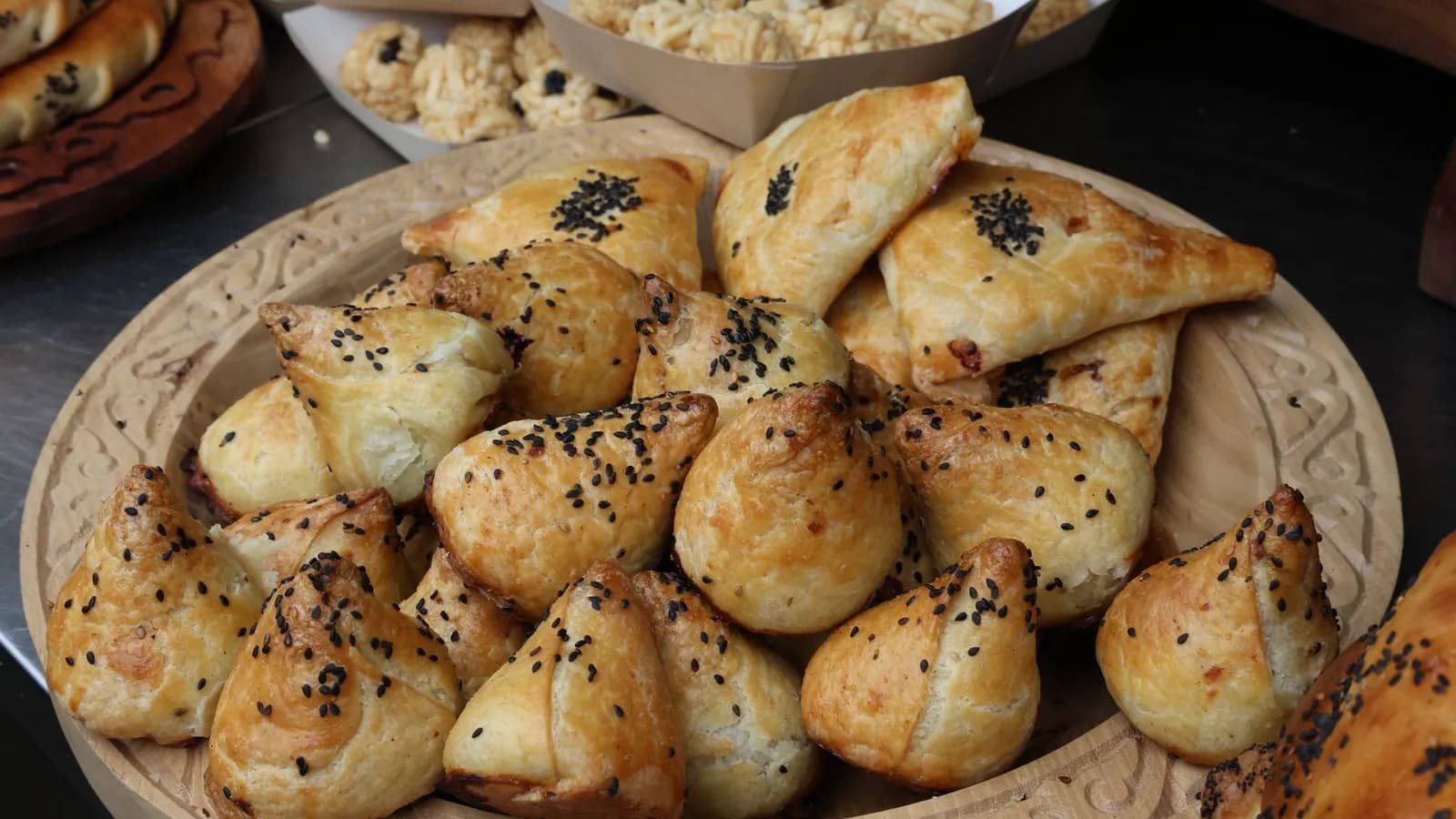
Uzbek samsa bakes in a clay tandyr, and a kamado is thick ceramic with a narrow mouth and radiant heat: the same physics. Here it sits on a stone, not slapped on the wall, filled with knife-cut lamb and plenty of onion.
Season:Autumn ·WinterCuisine:Russia, Caucasus & Central Asia
Quick answer
Samsa bakes in the kamado over indirect heat at 230 °C on a stone preheated for 30 minutes, for 30 to 35 minutes, until the laminated pastry is deep gold and the base firm. The filling goes in raw: knife-cut lamb, fat and almost its own weight in onion, which releases its juice inside the sealed parcel.
One big step at a time, screen kept on and built-in timers.
- Prep
- 60 min
- Cook
- 35 min
- Servings
- 6 servings
- Temperature
- 230 °C
What time do you want to eat?
Pick a time and we'll tell you when to start.
11:45
Start the prep
12:45
Light the kamado
13:15
Onto the kamado
14:00
Serve
Estimate: it includes lighting and settling the kamado plus a margin for large cuts. If the recipe asks you to marinate or salt ahead, add that time.
Fire setupStone or steel
- Dome
- 230 °C
- Deflector
- Yes
- Top vent
- Open
- Setup
- Deflector with a 38×30 cm cordierite stone on top
Temperature curve
1:40 h from lighting
Kamado dome
| # | From | Phase | Dome |
|---|---|---|---|
| 1 | 0:00 | Light the charcoalConvEGGtor legs up with the cordierite stone on top | 20 → 230 °C |
| 2 | 0:30 | StabiliseA good 30 min; the stone should read 210-230 °C on the IR gun | 230 °C |
| 3 | 1:00 | Put the food inThree fingers between samsas, close the lid fast | 230 → 190 °C |
| 4 | 1:01 | BakeClosed for 20 min; then turn once if the base browns faster | 190 → 230 °C |
| 5 | 1:33 | RestOn a rack 5-10 min: the juices are scalding | 230 → 205 °C |
| 6 | 1:40 | Serve | off |
0:00 is the moment you light the charcoal. Internal temperatures are the ones the recipe gives; without a probe, go by the times. Turn these times into clock times with the planner
For this recipe
Ingredients
- plain wheat flour500 g
- warm water280 ml
- salt for the dough10 g
- softened butter120 g
- lamb shoulder600 g
- lamb fat (or pork lard)100 g
- onion500 g
- cumin seed (zira)1.5 tsp
- ground coriander1 tsp
- freshly ground black pepper1 tsp
- salt for the filling1.5 tsp
- egg, for glazing1
- sesame seeds (or nigella)2 tbsp
Allergens
- Gluten
- Eggs
- Milk
- Sesame
If nigella replaces sesame, the recipe no longer contains sesame.
Based on the recipe's ingredients. Always check the label of every product you buy.
The gear for this recipe
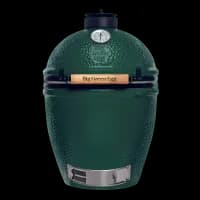 Big Green Egg Large
 Carboext 100% Holm Oak Lump Charcoal, 15 kg SackWith a butter-laminated dough shut inside the dome for half an hour, the aroma of the fuel ends up between the layers. This additive-free holm oak charcoal burns clean and leaves little ash, so the bottom vent doesn't clog and holding 230 °C stops being a fight. Its fifteen kilos cover the stone's long preheat and both baking batches without opening the kamado to refuel.
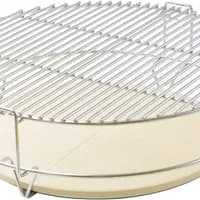 Onlyfire GCG-8552 Cooking System (2 grates + rack + 2 deflectors) for Large Kamado
 Navaris Cordierite Pizza Stone Rectangular XL (38×30×1.5 cm)The filling goes in raw and the onion starts weeping the moment it warms: if the base doesn't set fast, the samsa opens and welds itself to the stone. This rectangular cordierite slab, a centimetre and a half thick, banks heat through the thirty-minute preheat and gives it back all at once on contact, sealing the bottom in the first minutes. Its 38 × 30 cm hold half a dozen triangles a batch, three fingers apart.
 H&H Mortaio: 18 cm white marble mortar with pestle
Method
- 01
Knead and rest
Mix the flour with the salt, add the warm water and knead for 8-10 minutes until you have a smooth, fairly firm dough, much like an unleavened bread dough. Shape it into a ball, cover with cling film and rest it for 40 minutes at room temperature. The gluten relaxes over that time and the dough will then roll out very thin without springing back.
- 02
Chop the filling
Knife-cut the lamb into five or six millimetre dice and chop the fat even finer. Dice the onion small and mix everything with the cumin seed crushed in a mortar, the coriander, the pepper and the salt for the filling. Add no water and no oil: the onion will supply all the liquid. Keep the bowl in the fridge until you are ready to fill.
- 03
Laminate the dough
Roll the dough into a rectangle two or three millimetres thick and spread the softened butter over the whole surface with your hand or a spatula. Roll it up into a cylinder without compressing it too hard, stretch that cylinder with your hands to almost twice its length and chill it for 30 minutes. Then cut it into twelve equal portions.
- 04
Set up the kamado
Light the kamado for indirect cooking, fit the Big Green Egg ConvEGGtor legs up and set the Navaris cordierite stone on top of it. Stabilise the dome at 230 °C with the top vent nearly open and let the stone soak up heat for a good 30 minutes; with the Ooni infrared thermometer the surface should read between 210 and 230 °C.
- 05
Shape the triangles
Stand each portion on end with the spiral facing up, flatten it with your palm and roll it into a disc about twelve centimetres across, slightly thicker in the middle. Spoon on two heaped tablespoons of filling, around eighty grams, and close it into a triangle by folding three sides into the centre. Seal the seams by pinching them hard.
- 06
Glaze and seed
Turn each samsa over so the seams sit underneath and place them on the 14-inch Ooni perforated peel dusted with flour. Brush the tops with beaten egg, keeping it off the edges so it doesn't run, and scatter the sesame seeds, pressing them in lightly with a finger so they don't fly off inside the kamado.
- 07
Bake on the stone
Slide the samsa onto the stone leaving three fingers between them and shut the lid quickly so you don't bleed heat. Bake for 30 to 35 minutes at 230 °C without opening for the first twenty; after that, rotate them once if the back of the stone is colouring faster. They are done when the tops are deep gold and the bases sound dry when you tap them.
- 08
Rest and serve
Lift them off with the peel and rest them for five to ten minutes on a rack: the juice inside is boiling and needs to settle, and meanwhile the base finishes drying rather than sweating on a plate. Serve with quick-pickled red onion or a tomato salad. They are eaten with your hands, as they are in Uzbekistan.
About this recipe
Uzbek samsa is a triangle of laminated pastry stuffed with lamb and onion, baked stuck to the wall of a clay tandyr. A kamado shares with that oven almost everything that matters: thick ceramic that banks heat, a narrow mouth that holds it in, and walls that give back radiant heat rather than hot air. The difference deserves saying out loud: here the samsa bakes on a stone, not slapped onto the wall.
The kamado is a tandyr with a lid
In a tandyr the dough sticks to the clay and takes heat by conduction where it touches and by radiation from the rest of the dome. In the kamado we build those two halves separately: the Big Green Egg ConvEGGtor blocks the direct flame and, sitting on it, the Navaris 38 × 30 cm cordierite stone plays the part of the wall. On my Big Green Egg Large I give the stone a full half hour at 230 °C and check with the Ooni infrared thermometer that the surface is around 220 °C before the first batch.
Onion is half the filling
An honest samsa carries almost as much onion as meat, hand-cut into fine dice and going in raw. Once the triangle is sealed, that onion releases water in the heat and steams the lamb inside its own wrapper, which is why no stock goes in and nothing is fried first. The meat is knife-cut too, into five or six millimetre dice, because a mincer tears the fibre and leaves a paste that sheds its juice too early.
Laminated with butter, not puff pastry
The dough is water, flour and salt, with no yeast. You roll it very thin, spread it with softened butter, roll it up like a Swiss roll and slice it: every portion already holds its layers in a spiral. It isn't puff pastry — there are no folds and no chilling between turns — so it stays short and brittle yet sturdy, able to hold a juicy filling without going soggy. Half an hour in the fridge before rolling the portions keeps the butter where it belongs.
In 30 seconds
Yeast-free dough laminated with butter, a raw filling of knife-cut lamb and almost the same weight of onion, tightly sealed triangles, egg wash and sesame. Stone preheated for 30 minutes, indirect at 230 °C for 30-35 minutes. Five minutes of rest before you bite: there is boiling broth inside.
Will it fit your kamado?
Small
33-40 cm · Joe Jr, MiniMax
Tight
A smaller stone is needed; the 12 samsas probably in three batches.
Medium
46-51 cm · Classic, Large
Fits
The 38×30 stone fits; with spacing between pieces, probably two batches of 6.
Large
56-61 cm · Big Joe, XL
Fits
With a larger stone, probably all 12 samsas in a single batch.
What to serve with it
Sides
- Pickled red onion
- Tomato and cucumber salad with dill
- Wine
- Jumilla Monastrell or Campo de Borja Garnacha
- Beer
- Pilsner-style lager
- Alcohol-free
- Hot green tea or ayran (salted yoghurt drink)
Leftovers and storage
- In the fridge
- Cool within 2 hours; 3-4 days in the fridge, wrapped or airtight.
- Freezing
- Freeze well for 2-3 months, baked or raw; thaw in the fridge.
- Reheating
- Oven at 180 °C for 10-15 minutes until 74 °C inside; avoid the microwave.
- Using them up
- Warm samsa with herby yoghurt as a packed lunch.
Cool and refrigerate within 2 hours. When in doubt, throw it out.
Leftover embers
You still have embers: what to do with the leftover heat
For 35 min at 230 °C in a classic kamado you load about 1 kg of charcoal and burn 800 g: when you serve, about 170 g of live embers remain. Before you shut the vents, that is still enough for:
Closing the vents halfway and waiting for it to drop
140-200 °Cdessert while you eat
20 minof embers
- Kamado-roasted figs with goat cheese and honey7 min · 200 °C
- Smoked Loaded Nachos on the Kamado12 min · 185 °C
No recipe needed
- Yesterday's bread with oil and garlic, on the grate (10 min)
Before opening the lid, crack it open for a few seconds first; if you raise the heat, stir the ash so the coals can breathe. And if you are not going to use them: once the food is out, close the bottom and top vents. The charcoal that does not burn (about 170 g) can be used next time. Different size of kamado? Work out your load for 1 h 30 min of fire, lighting included.
History of the dish
- Origin
- Persia, the Middle East and Central Asia
- Period
- Middle Ages; Arab recipes from the 10th-13th centuries
- Where it is cooked today
- Uzbekistan, Central Asia, Xinjiang, Iran and Turkey; street food and travel fare
Samsa is a triangular pastry filled with meat that in Central Asia is often baked in the tandyr, the clay oven. Its name points to Persia: the Persian word sanbosag means "triangular pastry", and Arab cookery books of the 10th to 13th centuries contain recipes for sanbusak, sanbusaq or sanbusaj.
The earliest known mention of a samosa precursor is attributed to the Abbasid-era poet Ishaq al-Mawsili, who praised the sanbusaj. In Iran the dish remained popular until the 16th century. It was ideal travel food and spread along the Silk Road. Uzbekistan claims it as its own, but its exact origin is almost impossible to pin down.
It also reached the Indian subcontinent: in the 14th century Ibn Battuta describes, at the court of Muhammad bin Tughluq, Sultan of Delhi, a sambusak stuffed with minced meat, almonds, pistachios, walnuts and spices. Today Central Asian samsa, most often filled with lamb and onion, is almost always baked and rarely fried, unlike the South Asian samosa.
Sources
- Samsa: The Silk Road Snack — The Moscow Times (themoscowtimes.com)
- Samsa (food) — Wikipedia (en.wikipedia.org)
- Samosa — Wikipedia (en.wikipedia.org)
Editor's tips
- Seal them properly and set them seam-side down: any juice that escapes caramelises on the stone and welds the base to it within minutes.
- If you can't find lamb fat, add sixty grams of cold diced butter to the filling; without fat, knife-cut meat simply dries out.
- Crush the cumin seed in a mortar just before mixing: pre-ground cumin from a jar carries half the aroma that defines samsa.
- If you bake in two batches, give the stone eight to ten minutes with the lid closed to recover before the second load goes in.
Gear for this recipe
As an Amazon Associate, mikamado.es earns from qualifying purchases. At no extra cost to you.
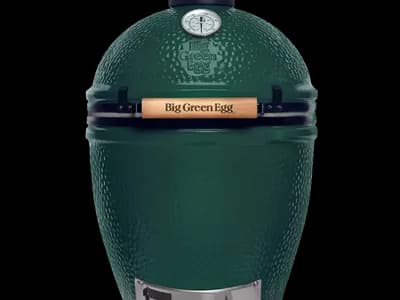
Big Green Egg Large
€2,099

Carboext 100% Holm Oak Lump Charcoal, 15 kg Sack
With a butter-laminated dough shut inside the dome for half an hour, the aroma of the fuel ends up between the layers. This additive-free holm oak charcoal burns clean and leaves little ash, so the bottom vent doesn't clog and holding 230 °C stops being a fight. Its fifteen kilos cover the stone's long preheat and both baking batches without opening the kamado to refuel.
€38
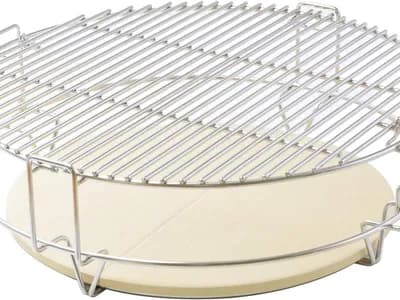
Onlyfire GCG-8552 Cooking System (2 grates + rack + 2 deflectors) for Large Kamado
€90

Navaris Cordierite Pizza Stone Rectangular XL (38×30×1.5 cm)
The filling goes in raw and the onion starts weeping the moment it warms: if the base doesn't set fast, the samsa opens and welds itself to the stone. This rectangular cordierite slab, a centimetre and a half thick, banks heat through the thirty-minute preheat and gives it back all at once on contact, sealing the bottom in the first minutes. Its 38 × 30 cm hold half a dozen triangles a batch, three fingers apart.
€24
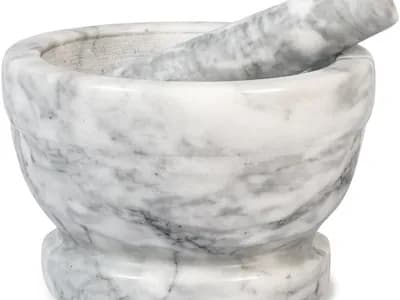
H&H Mortaio: 18 cm white marble mortar with pestle
€33
Have you made it?
Tell us how it turned out on your kamado. We review every rating before publishing it.
No published ratings yet. Be the first!
FAQ
Can I stick the samsa to the kamado wall like in a tandyr?
No, and it is worth saying plainly. A kamado wall is not meant for dough: the mouth is narrow, the lid seals against a fibre gasket, and anything that drops onto the charcoal is a nuisance to clean. Baking on a stone with the ConvEGGtor in place reproduces the same radiant heat with none of those problems.
How long and at what temperature does samsa bake?
Thirty to thirty-five minutes of indirect cooking at 230 °C, with the stone preheated for half an hour. That is the window where the pastry colours without scorching and the raw lamb inside cooks through. Above 250 °C the top browns long before the filling has set.
Why do mine burst and leak their juice?
Nearly always too much filling or a weak seal. Leave a finger's width of clean dough at the edge, free of fat and juice, pinch the three seams hard and set the samsa seam-side down. If the dough ended up too thin at the join it will not hold the steam pressure either.
Can I use beef or chicken instead of lamb?
Beef works well if you pick a fatty cut such as chuck and keep the onion ratio. Chicken turns out dry: use thigh only and add sixty grams of cold diced butter. Lamb is still the flavour that defines Uzbek samsa, especially alongside the cumin.
Can I freeze them unbaked?
Yes, and it is the best way to have samsa on a weeknight. Freeze them shaped and spaced apart on a tray, then bag them once solid. Bake them straight from frozen at 230 °C without thawing: they need eight to ten minutes longer, with the egg wash brushed on just before they go in.
What do I do with the embers left after making Uzbek Lamb Samsa on the Kamado, Tandyr Style?
After 35 min at 230 °C in a classic kamado about 170 g of live embers remain: 20 min at 140-200 °C closing the vents. If you are not going to use them, close both vents and keep the charcoal for next time.
More kamado recipes

KEEP READING
Go deeper on this dish
- Recommended kamado
Big Green Egg Large
The classic kamado that defined the category
- Editorial guide
How to light a kamado: the step-by-step method
No petrol, no weird tablets and no 45-minute waits. The cone method, airflow control and the mistakes that prevent 80% of the frustration.
- Glossary term
Heat deflector
Ceramic plate placed between the coals and the grate to turn direct fire into indirect cooking.
- Related comparison
big green egg large vs kamado joe classic iii
The classic kamado matchup: the Big Green Egg Large, the indestructible pioneer with the widest accessory network, agai…