Recipe · Indirect · Medium
Injected Bone-In Turkey Breast on the Kamado, Juicy for a Small Christmas
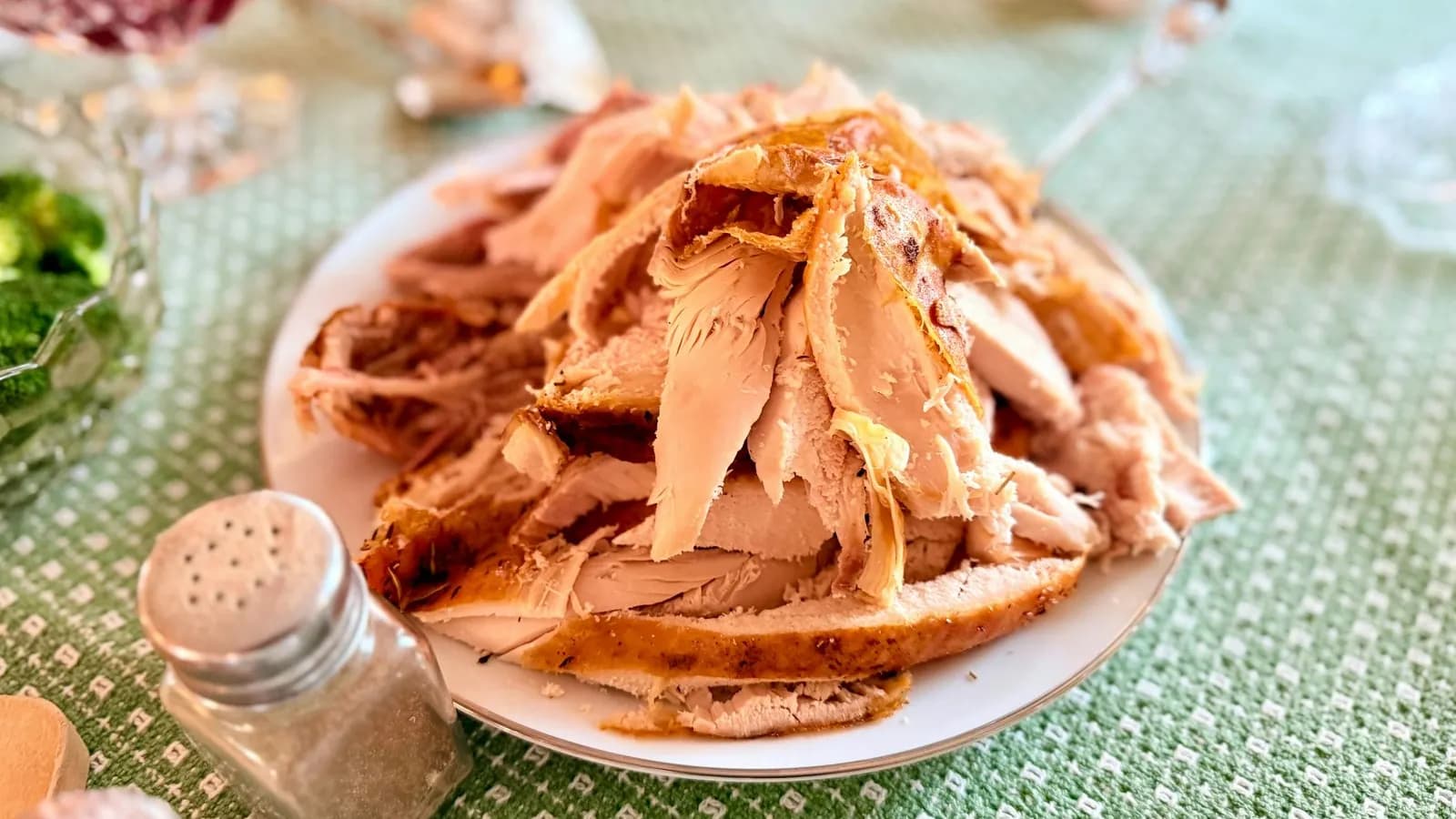
Christmas turkey for four to six: a bone-in breast injected with stock and butter, roasted indirect at 165 °C with no smoke and taken off at 74 °C. Designed for a small kamado, it does not dry out.
Quick answer
Inject a 1.8-2.2 kg bone-in turkey breast with about 100 ml of strained stock, butter and salt. Roast it bone side down, indirect at 165 °C, with the heat deflector and no smoking wood, rising to 175 °C at the end to colour the skin. Take it off at 74 °C in the thickest part, after about 1.5-2 hours, and rest 20 minutes.
- Prep
- 30 min
- Cook
- 120 min
- Servings
- 6 servings
- Temperature
- 165 °C
Ingredients
- whole bone-in, skin-on turkey breast (pechuga de pavo), 1.8-2.2 kg1 ud
- unsalted poultry stock, for the injection120 ml
- unsalted butter40 g
- fine salt (4 g for the injection and 6 g for the skin)10 g
- garlic cloves, sliced, for infusing2 ud
- sprigs of fresh thyme4 ud
- sweet paprika (pimentón dulce)1 cdita
- freshly ground black pepper1 cdita
- extra virgin olive oil2 cda
- onion, quartered, for the tray1 ud
- water for the drip tray400 ml
- dry white wine, for the gravy100 ml
The gear for this recipe
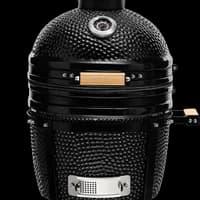 Kamado Bono Minimo 40 cmA breast for four to six does not call for a big kamado, and lighting a large one for two hours wastes charcoal. The **Kamado Bono Minimo** has a 40 cm body and a grate of about 33-34 cm according to the manufacturer: a 1.8-2.2 kg breast should fit centred if it is no longer than about 26 cm (measure it first), and the air left around it is what indirect cooking needs so that the heat rising round the edges of the deflector does not scorch the ends. It comes with a ceramic deflector as standard, so the indirect set-up needs nothing more to buy, and the ceramic mass holds 165-175 °C with very little adjustment of the vents. Its limit is clear: a 3 kg breast or a whole turkey needs more diameter.
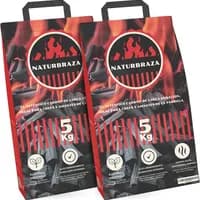 NaturBraza marabu charcoal, pack of two 5 kg bags (10 kg)With no smoking wood, the only flavour the fire can give is that of a clean ember, and that is where the charcoal counts. **NaturBraza marabú charcoal** burns slowly and evenly, enough for two hours of indirect at 165-175 °C with reserve for the final climb that colours the skin, without opening the lid to refuel. Once the white smoke from lighting is gone, nothing is left to mask the flavour of the breast: turkey and butter.
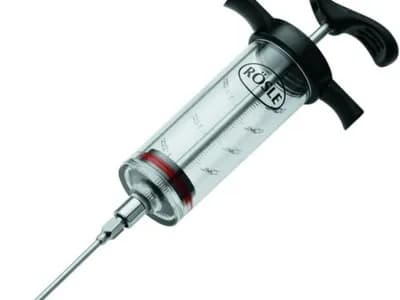
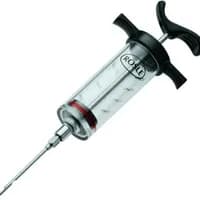 Rösle 25058: 50 ml marinade injector syringe, 18/10 stainless steelThis is the tool that stops this breast drying out. The 50 ml **Rösle injector**, in 18/10 stainless steel and polypropylene, carries the stock and butter to the centre of a muscle that salt would take hours to cross from the outside: two fillings, about 100 ml, are enough for a 2 kg breast. The capacity means refilling, but on a piece this size that is two trips to the glass. The condition is the mixture: strained and lukewarm, with no chopped garlic or peppercorns, because the needle clogs; the product page does not state its gauge. Take it apart and wash it as soon as you have used it; it is dishwasher safe.
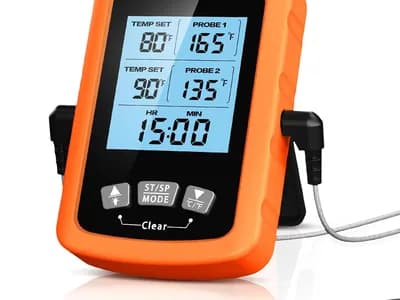
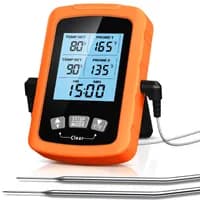 CIRYCASE Dual-Probe Thermometer, 16.3 cm Probes and TimerThis recipe is cooked to two numbers and the **CIRYCASE thermometer** gives both without opening the lid. Its two 16.3 cm wired probes are split like this: one pushed in horizontally to the centre of the thickest lobe of the breast and the other set at grate level, which is the temperature that matters, not the one on the dial in the dome. With them you know when to go from 165 to 175 °C, when the breast reaches 60 °C, and when to open, at 74 °C. The product page states ±1 °C and a ceiling of 300 °C, plenty for an indirect cook. One reservation: the page cites an auto-off after 10 minutes without saying whether it applies with the probes in; test it before the dinner and, if it switches off, turn it on at each glance.
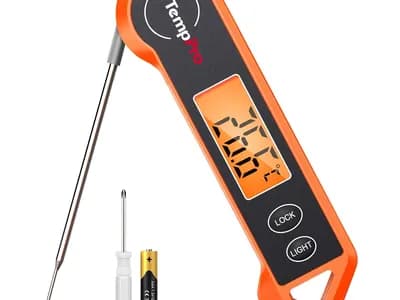
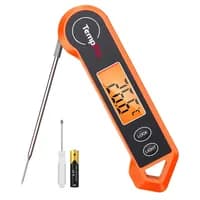 ThermoPro TP19H: instant-read thermometer, folding probe, up to 300 °CA bone-in breast has two lobes that do not always keep pace, and the fixed probe watches only one. The **ThermoPro TP19H** is an instant-read thermometer with a folding probe of about 11 cm, and it serves for the final check: you open with burping, probe the other lobe and the area next to the keel, read and close. The product page states ±0.5 °C and gives the response time as 1 second in one part of the page and 3 in another, so it is best to count on 3. It is not meant to be left in: it is a handheld with a plastic body, used with gloves and kept out of the direct heat of the grate.
Method
- 01
Prepare the injection
Warm the stock with the sliced garlic and two sprigs of thyme, without letting it boil, and leave it to infuse for 10 minutes off the heat. Strain it through a fine sieve into a tall glass, add the butter and 4 g of salt and stir until melted. Use it lukewarm: if it cools, the butter sets in the needle. No peppercorns and no chopped garlic in the mixture, because they would block the needle of the Rösle injector.
- 02
Inject and season
Pat the breast dry with kitchen paper. Fill the Rösle injector (50 ml) and inject each lobe every 3-4 cm, at an angle and along the grain, pushing the plunger as you withdraw the needle. Two fillings, about 100 ml in total. Wipe off any that spills and bin the leftover liquid. Rub the skin with the oil, the 6 g of salt, the pepper and the paprika, and put it back in the fridge. Take it out as you light the charcoal: settling the kamado takes the chill off; if it is not stable after 45 minutes, return the breast to the fridge until it is.
- 03
Light the charcoal
Empty the ash from the Kamado Bono Minimo and fill the firebox with NaturBraza marabú charcoal until the holes are well covered, with some in reserve: this is about two hours at 165-175 °C, not an all-night smoke. Light it in one or two spots and leave the lid open for 10 minutes. Add no wood chunks; wait for the white smoke from lighting to disappear before setting up the indirect.
- 04
Set up indirect at 165 °C
Fit the Minimo's deflector, three balls of foil on top as spacers and on them a tray with 400 ml of water, the onion and the rest of the thyme, leaving 2-3 cm clear to the edge of the deflector: that air gap stops the juices burning. Put the grate in and one CIRYCASE probe at its level, tip in the air, held with a ball of foil (the listing includes no clip), with the cable over the gasket. Close the vents 30-40 °C before the target, as the temperature table explains, and settle at 165 °C for 10 minutes.
- 05
Load it bone side down
Open the lid with burping: lift it about 5 cm, wait about 5 seconds and then open fully, wearing gloves and keeping your face turned away. Place the breast bone side down, centred over the tray, so the rib cage acts as a rack. If the water in the tray is down by half, top it up with hot water. Push the second CIRYCASE probe in horizontally from the side, to the centre of the thickest lobe, without touching the keel. Close the lid: no turning, no basting, and it stays shut until the end.
- 06
Roast and colour the skin
Hold 165 °C at grate level. When the breast reads 60 °C, open the bottom vent a little to take the chamber to 175 °C and close it part way a few degrees before it gets there: ceramic climbs easily and comes down lazily, so do not overshoot. If the skin darkens too early, close the vent a notch and do not open the lid; the chamber will come down slowly. For 1.8-2.2 kg, allow about 1.5-2 hours in total, but the probe decides.
- 07
Check and take out at 74 °C
When the probe reads 74 °C, open with burping, as when loading, wearing gloves and keeping your face turned away. Probe the other lobe and the area next to the keel with the ThermoPro TP19H, without touching bone. If any spot reads under 74 °C, close the lid and measure again in 5-10 minutes. With everything at 74 °C or more, out it comes.
- 08
Rest and make the gravy
Rest the breast for 20 minutes on a board, loosely covered with foil: the centre still gains a few degrees and the juices settle. Meanwhile, strain the liquid from the tray into a saucepan, skim the fat off the surface with a spoon, add the white wine and reduce over a medium heat for about 5 minutes, until the gravy is lightly bound and no longer smells of alcohol.
- 09
Carve
Cut each lobe away from the keel with a long knife, keeping the blade against the bone from top to bottom, and lift off the two pieces whole. Slice them 1 cm thick across the grain, with the skin on top. Serve with the hot gravy separately, in a jug, so it does not soak the skin. Put the carcass in the fridge within two hours: with fresh water and the onion from the tray it makes a stock for the next day.
About this recipe
The smoked Christmas turkey in the collection is a whole 4-5 kg bird, six hours of smoke and ten guests. This recipe is for the other Christmas, the one for four to six: a bone-in turkey breast (pechuga de pavo con hueso) of 1.8-2.2 kg, injected with stock and butter, roasted indirect at 165 °C with no smoking wood and taken off at 74 °C. It is designed for a small kamado, takes about two hours and does not dry out, which is the only thing you ask of a turkey breast.
Why the breast, and why bone-in
A whole bird has a geometry problem: the breast is done well before the thighs, and while you wait for the thighs, the breast dries out. With chicken you solve it by butterflying, as in the spatchcock chicken; with turkey for a small table, you solve it by separating the parts. A breast on its own is a single muscle with a single target temperature. The bone, the rib cage and keel, acts as a natural rack, holds the shape and slows the heat reaching the meat next to it, so the piece cooks more evenly. Ask the butcher or poulterer for a whole bone-in, skin-on breast; at Christmas it is worth ordering ahead. In a kamado with a grate of about 33-34 cm, like the Kamado Bono Minimo, measure it on the board first: it should be no longer than about 26 cm, because there must be air between the piece and the ceramic, and in indirect cooking the heat rises round the edges of the deflector.
Injecting: stock and butter where salt does not reach
Turkey breast is lean muscle with almost no marbling, and whatever you put on the outside takes hours to reach the centre: that is why the whole turkey in the collection spends 12 hours in brine. The injector does that job in five minutes and exactly where it is needed. The mixture is poultry stock, butter and salt, with the garlic and thyme infused in the hot stock and then strained. Strained, yes: the Rösle injector holds 50 ml and its needle clogs on a piece of garlic or a peppercorn, so the flavour goes in dissolved, not in lumps. About 100 ml is enough for a 2 kg breast, two fillings, spread over injection points every 3-4 cm.
There is one consequence that is not negotiable. The needle drags whatever is on the surface of the meat inwards, so an injected breast allows no half measures: the centre has to reach the safe temperature. Any liquid left in the glass has touched the needle and goes in the bin.
74 °C, carry-over heat and two probes
The Scientific Committee of the AESAN (the Spanish food safety agency) recommends 74 °C at the centre of poultry, for at least one second. Measure it in the thickest part of each lobe, without touching bone. When the breast leaves the kamado, the outer layer is hotter than the centre and keeps pushing heat inwards: during the rest the centre still rises a few degrees, more so the bigger the piece and the fiercer the heat. Some recipes pull the breast earlier and count on that carry-over. Not here: the 74 °C is read inside the kamado. What carry-over gives you is a reason not to wait longer; with 74 °C in both lobes the breast comes out, because every degree above that is juice lost. The whole turkey in the collection aims for 75 °C; 74 °C is the AESAN minimum, and in a breast on its own you need no more. To measure without opening the lid, the CIRYCASE has two wired probes: one in the breast and one at grate level, which is where the chamber temperature matters (the guide to thermometers and probes explains why). The instant-read ThermoPro TP19H checks the other lobe before you take it out. The fuel is NaturBraza marabú charcoal (made from marabú, also called sicklebush), with no wood chunks: this turkey tastes of turkey, butter and thyme, not of smoke.
In 30 seconds
Bone-in turkey breast of 1.8-2.2 kg, injected with about 100 ml of strained stock, butter and salt. Indirect at 165 °C with the deflector and no smoking wood, bone side down, and 175 °C at the end for the skin. Out at 74 °C in the thickest part of both lobes, in 1.5-2 hours. Rest 20 minutes, during which it still gains a few degrees, then carve.
Editor's tips
- Order the breast a few days ahead and ask for the weight and the length. The Minimo's grate is about 33-34 cm: for the heat to rise round the edges of the deflector without scorching the ends, the piece should be no longer than about 26 cm on its longest side, with 3-4 cm of air on each side. Measure it on the board before lighting. If you end up with one of 3 kg or more, or a longer one, it works better in a 46 cm kamado.
- An injection and a brine do not add up. If you prefer to brine the breast, then inject only stock and butter, without the 4 g of salt, and season the skin with oil, pepper and paprika, without the 6 g of salt, or the meat will come out salty.
- For Christmas Eve or New Year's Eve, count back about three and a half hours from dinner: injecting, lighting and settling, 1.5-2 hours of roasting and 20 minutes of rest. If you have time in hand, lower the chamber to 160 °C; the breast copes better with a slightly slower cook than with a rush at the end.
- Take the injector apart and wash it as soon as you have used it, running hot water through the needle: cold butter sets inside and leaves it useless until next time.
Gear for this recipe
As an Amazon Associate, mikamado.es earns from qualifying purchases. At no extra cost to you.
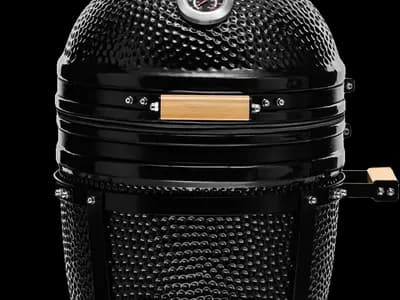
Kamado Bono Minimo 40 cm
A breast for four to six does not call for a big kamado, and lighting a large one for two hours wastes charcoal. The **Kamado Bono Minimo** has a 40 cm body and a grate of about 33-34 cm according to the manufacturer: a 1.8-2.2 kg breast should fit centred if it is no longer than about 26 cm (measure it first), and the air left around it is what indirect cooking needs so that the heat rising round the edges of the deflector does not scorch the ends. It comes with a ceramic deflector as standard, so the indirect set-up needs nothing more to buy, and the ceramic mass holds 165-175 °C with very little adjustment of the vents. Its limit is clear: a 3 kg breast or a whole turkey needs more diameter.
€472
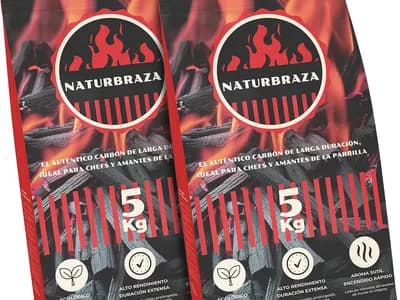
NaturBraza marabu charcoal, pack of two 5 kg bags (10 kg)
With no smoking wood, the only flavour the fire can give is that of a clean ember, and that is where the charcoal counts. **NaturBraza marabú charcoal** burns slowly and evenly, enough for two hours of indirect at 165-175 °C with reserve for the final climb that colours the skin, without opening the lid to refuel. Once the white smoke from lighting is gone, nothing is left to mask the flavour of the breast: turkey and butter.
€47
Rösle 25058: 50 ml marinade injector syringe, 18/10 stainless steel
This is the tool that stops this breast drying out. The 50 ml **Rösle injector**, in 18/10 stainless steel and polypropylene, carries the stock and butter to the centre of a muscle that salt would take hours to cross from the outside: two fillings, about 100 ml, are enough for a 2 kg breast. The capacity means refilling, but on a piece this size that is two trips to the glass. The condition is the mixture: strained and lukewarm, with no chopped garlic or peppercorns, because the needle clogs; the product page does not state its gauge. Take it apart and wash it as soon as you have used it; it is dishwasher safe.
€16
CIRYCASE Dual-Probe Thermometer, 16.3 cm Probes and Timer
This recipe is cooked to two numbers and the **CIRYCASE thermometer** gives both without opening the lid. Its two 16.3 cm wired probes are split like this: one pushed in horizontally to the centre of the thickest lobe of the breast and the other set at grate level, which is the temperature that matters, not the one on the dial in the dome. With them you know when to go from 165 to 175 °C, when the breast reaches 60 °C, and when to open, at 74 °C. The product page states ±1 °C and a ceiling of 300 °C, plenty for an indirect cook. One reservation: the page cites an auto-off after 10 minutes without saying whether it applies with the probes in; test it before the dinner and, if it switches off, turn it on at each glance.
€20
ThermoPro TP19H: instant-read thermometer, folding probe, up to 300 °C
A bone-in breast has two lobes that do not always keep pace, and the fixed probe watches only one. The **ThermoPro TP19H** is an instant-read thermometer with a folding probe of about 11 cm, and it serves for the final check: you open with burping, probe the other lobe and the area next to the keel, read and close. The product page states ±0.5 °C and gives the response time as 1 second in one part of the page and 3 in another, so it is best to count on 3. It is not meant to be left in: it is a handheld with a plastic body, used with gloves and kept out of the direct heat of the grate.
€19
FAQ
What internal temperature is turkey breast done at?
At 74 °C in the centre of the thickest part, without touching bone. It is the figure the AESAN recommends for poultry. In a bone-in breast you measure both lobes, because they do not always keep pace. During the rest the temperature keeps climbing a few degrees through carry-over, but that is margin, not a shortcut: the 74 °C is read before it leaves the kamado.
How long do you roast a bone-in turkey breast?
As a reference, the USDA gives 1.5 to 3.25 hours at 163 °C for breasts of 1.8 to 3.6 kg. One of 1.8-2.2 kg is at the low end of that range: in the kamado, at 165-175 °C indirect, allow about 1.5-2 hours. Thickness and lid openings change it, so treat it as an estimate for planning: the probe decides, with 74 °C in the thickest part.
What do you inject into a turkey breast, and how much?
A liquid base with salt and some fat: poultry stock, melted butter and salt, with the garlic and herbs infused and strained. Injection guides talk about 15-30 ml per half kilo, that is 30-60 ml per kg; for a 2 kg breast, about 100 ml sits within that range. No lumps or whole spices: they clog the needle. Inject lukewarm, in several places, and bin the leftover.
Brine or injection to keep turkey from drying out?
Both put water and salt into the meat, by different routes. Brining works from the outside in and needs hours in the fridge and a container big enough to submerge the piece. Injecting puts the liquid straight into the centre in five minutes, which is the practical choice for a thick breast. You can combine them, but then the injection goes without salt. And neither saves a breast that goes well past 74 °C: what dries it out most is too much heat.
How long should turkey rest before carving?
About 20 minutes for a 2 kg breast, loosely covered with foil so the skin does not soften in the steam. In that time the heat of the outer layer keeps moving in and the centre gains a few more degrees, and the juices settle instead of ending up on the board. Use the rest to strain, skim and reduce the juices from the tray.
More kamado recipes
Crispy chicken wings on the kamado with honey and Pimentón de la Vera (crackling skin, no frying)
Glass-crisp skin without a fryer: dry brine with baking soda, indirect at 200°C with apple smoke and a final sear. Honey and Pimentón de la Vera glaze. Serves 4.
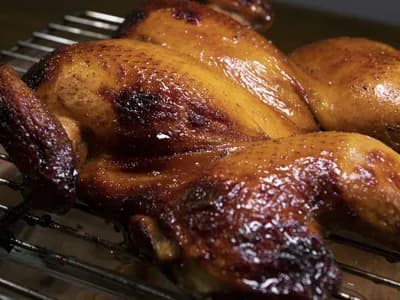
Whole spatchcock chicken on the kamado, even crispy skin
A 1.6 kg chicken butterflied flat, roasted at 180°C indirect over a deflector. Golden crackling skin end to end, juicy meat, ready in an hour: the Sunday roast I actually cook on my Torrevieja terrace.
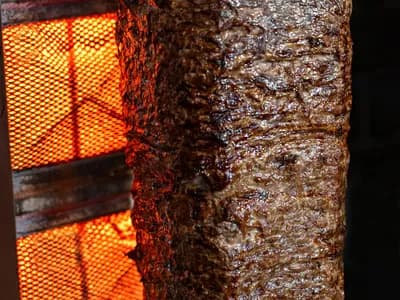
Chicken Gyros on the Rotisserie in a Kamado
A block of chicken thighs marinated in yoghurt, lemon and oregano, turning on the kamado's rotisserie at 180 °C: shave thin slices as the outer face browns, send the block back to the fire, repeat.
KEEP READING
Go deeper on this dish
- Recommended kamado
Kamado Bono Minimo 40 cm
A breast for four to six does not call for a big kamado, and lighting a large one for two hours wastes charcoal. The Kamado Bono Minimo has a 40 cm body and a grate of about 33-34 cm according to the manufacturer: a 1.8-2.2 kg breast should fit centred if it is no longer than about 26 cm (measure it first), and the air left around it is what indirect cooking needs so that the heat rising round the edges of the deflector does not scorch the ends. It comes with a ceramic deflector as standard, so the indirect set-up needs nothing more to buy, and the ceramic mass holds 165-175 °C with very little adjustment of the vents. Its limit is clear: a 3 kg breast or a whole turkey needs more diameter.
- Editorial guide
How to light a kamado: the step-by-step method
No petrol, no weird tablets and no 45-minute waits. The cone method, airflow control and the mistakes that prevent 80% of the frustration.
- Glossary term
Heat deflector
Ceramic plate placed between the coals and the grate to turn direct fire into indirect cooking.
- Related comparison
big green egg large vs kamado joe classic iii
The classic kamado matchup: the Big Green Egg Large, the indestructible pioneer with the widest accessory network, agai…