Recipe · Indirect · Medium
Chicken Gyros on the Rotisserie in a Kamado
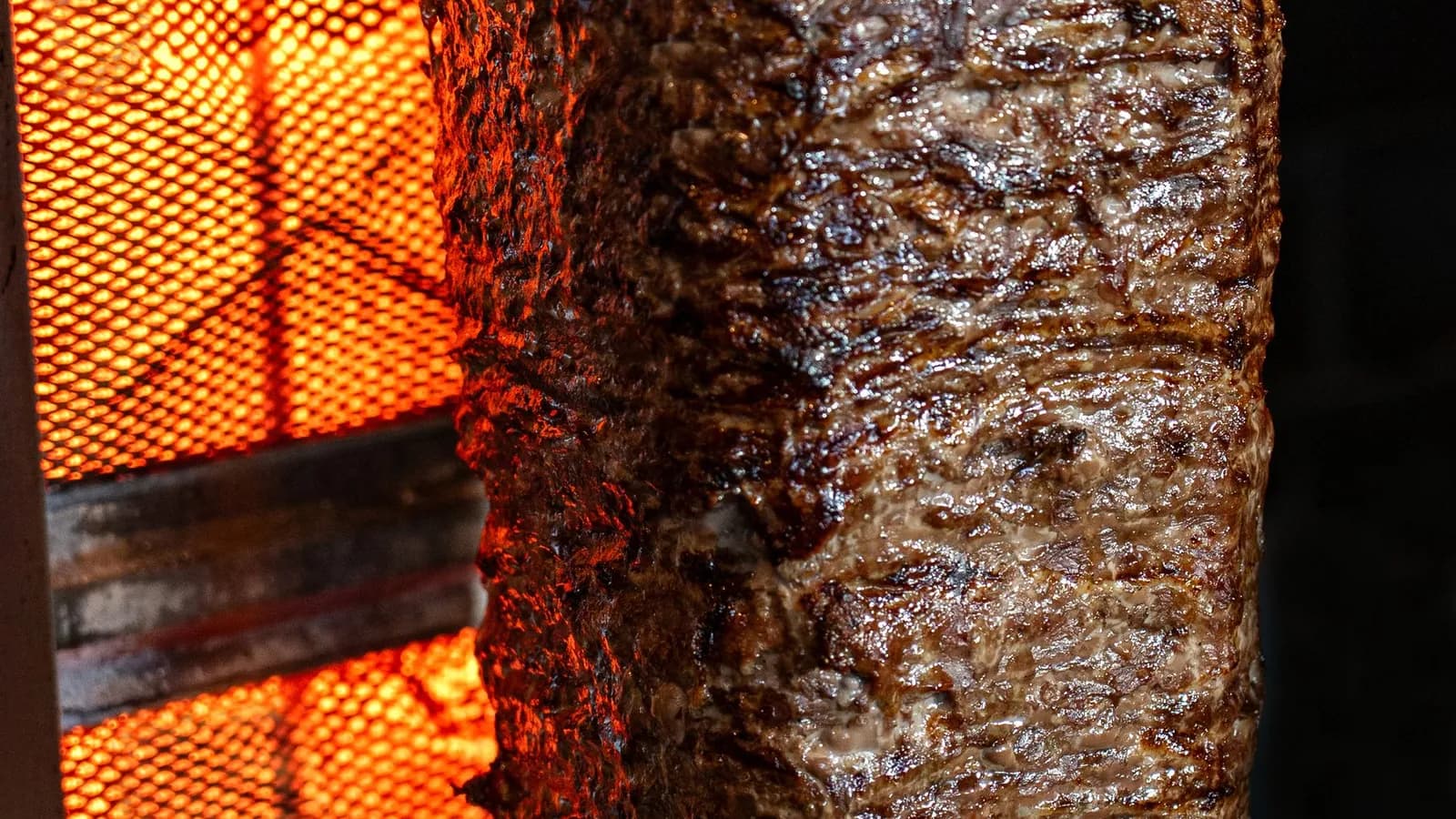
A block of chicken thighs marinated in yoghurt, lemon and oregano, turning on the kamado's rotisserie at 180 °C: shave thin slices as the outer face browns, send the block back to the fire, repeat.
Quick answer
Marinate boneless chicken thighs for 8-12 hours in yoghurt, lemon, garlic and oregano, stack them tightly on the rotisserie spit and cook indirect at 180 °C for about 90 minutes. Once the outer layer is golden and firm, shave thin slices with a long knife, return the block to the fire and repeat every 12-15 minutes.
- Prep
- 30 min
- Cook
- 90 min
- Servings
- 6 servings
- Temperature
- 180 °C
Ingredients
- boneless chicken thighs, skin on1600 g
- plain Greek yoghurt200 g
- lemon juice (about 2 lemons)60 ml
- garlic cloves, grated5 ud
- dried oregano2 cda
- sweet paprika2 cdita
- ground cumin1 cdita
- extra virgin olive oil3 cda
- salt18 g
- freshly ground black pepper1 cdita
- large onions (to cap the ends of the block)2 ud
- pita breads6 ud
- tzatziki (yoghurt, cucumber, garlic and dill)250 g
- ripe tomatoes and 1 red onion, to serve2 ud

Method
- 01
Marinate the night before
Open out the boneless thighs so they are an even 2 cm thick. Mix the Greek yoghurt, lemon juice, grated garlic, oregano, paprika, cumin, oil, salt and pepper. Coat the meat thoroughly, cover and refrigerate for 8 to 12 hours. Under four hours and the flavour falls short; beyond twenty-four the fibres turn pasty.
- 02
Build the block
Drain the pieces without patting them fully dry. Thread half an onion onto the spit as a stop, then the thighs one by one, skin always facing the same way and each layer crossing the one below. Push everything towards the stop as you go: the block must be compact, with no air pockets. Cap with the other onion half, tighten the forks and chill for 1 hour.
- 03
Indirect at 180 °C
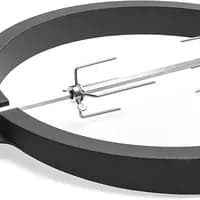
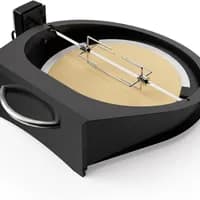
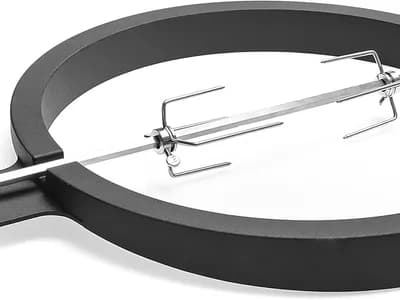
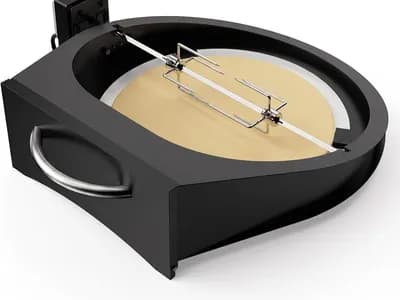
Fill the Onlyfire stainless charcoal basket halfway, light a single spot and set the deflectors in place. Fit the rotisserie ring over the base — the Kamado Joe JoeTisserie if yours is a Classic; Big Green Egg and Monolith have their own equivalent ring — and let the whole thing settle at 180 °C with the lid closed, about 20 minutes. Keep the bottom vent nearly shut: climbing in temperature is easy, coming back down takes half an hour.
- 04
Mount spit and tray
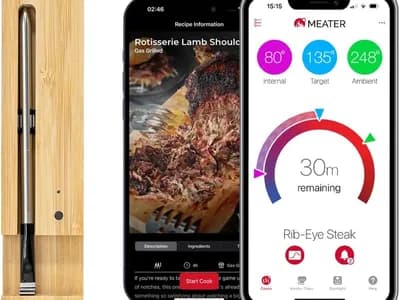
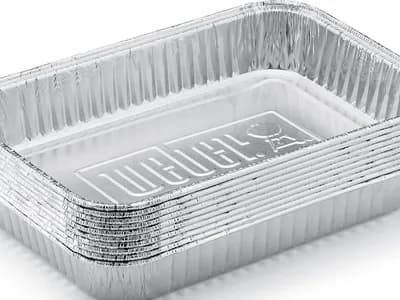
Seat the spit in the motor and check the block turns true; if it wobbles, reposition the forks before closing the lid. Slide a metal tray under the block, sitting on the deflector, to catch the fat: you will want it later. Insert the MEATER+ into the core of the block, parallel to the spit and clear of the metal.
- 05
First hour of turning
Close the lid and leave it shut for 55-60 minutes. The block goes from pale to matt gold, starts to shrink and drips fat steadily into the tray. If the temperature runs above 200 °C, close the bottom vent a little further before touching the top one: the air coming in rules the air going out.
- 06
First round of slices
When the surface is golden, firm and dry to the touch, stop the motor. With the Victorinox Fibrox 25 cm carving knife, shave 3-4 mm slices from top to bottom, laying the edge on and letting the weight do the work. Collect them on a warm tray. Take only the cooked layer: if pink meat shows, you have gone too deep.
- 07
Return and repeat
Start the motor again and give the block 12-15 minutes before the next round. Repeat the cycle to the end: 1.6 kg gives three or four rounds and about 90 minutes in total. Any layer you carve must have passed 75 °C, and for the final round wait until the MEATER+ reads that in the core too.
- 08
Fill and serve
Warm the pita breads for a minute on the grate while you carve. Fill them with the slices, sliced tomato, red onion and a generous spoonful of tzatziki, then spoon over two tablespoons of the fat caught in the tray. Serve at once: gyros is eaten standing up, freshly carved, with the bread still warm.
About this recipe
The rotisserie usually comes out of the cupboard once a year, for the Christmas turkey, then goes back in its box until the following December. Gyros changes that: a block of chicken thighs marinated in yoghurt, lemon and oregano that turns on its own, and from which you shave thin slices as the outer face browns. This is the recipe that turns the kamado's bulkiest accessory into a Saturday tool.
Why a pressed block works
Gyros isn't a roast chicken: it's a compact cylinder of stacked meat in which, at any given moment, only the outer layer is cooking. Press the boneless thighs tightly against one another and the inside behaves like a damp heat store, while the fat rendering at the top soaks down through the layers beneath. That is why the Kamado Joe JoeTisserie does more than spin: it constantly changes which face is exposed, so no area dries out before its turn under the knife.
Indirect at 180 °C, not live coals
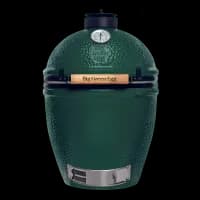
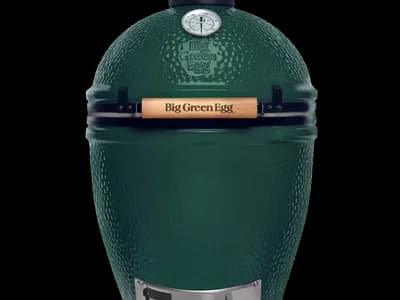
With direct fire under the spit, the outside chars long before the block has warmed through. With the deflectors in and the dome settled at 180 °C, the heat is radiant and wrapping: the surface dries, browns and builds the crust that slices cleanly, while the core climbs slowly. On my Big Green Egg Large, half an Onlyfire stainless charcoal basket of holm-oak lump holds that 180 °C for over two hours with the bottom vent barely a finger open.
The carving is half the recipe
A gyros slice should be thin, almost translucent, and carry a little crust along its edge: that is where the flavour sits. A Victorinox Fibrox 25 cm carving knife cuts top to bottom in a single pass, laying the edge against the block rather than sawing. Carve only what you are about to serve, send the spit back to the fire and give it twelve to fifteen minutes before the next round. The natural home for those slices is a pita freshly puffed on the stone, or a garlic-and-butter naan if you want something to mop up sauce.
In 30 seconds
Boneless thighs marinated 8-12 hours in yoghurt, lemon, garlic and oregano; stacked and pressed on the rotisserie spit; indirect at 180 °C for about 90 minutes. Shave thin slices each time the outer face browns and return the block to the fire. Serve in warm pita with tzatziki, tomato and red onion.
Editor's tips
- Press the block tighter than feels necessary: every air pocket becomes a dry edge you will have to discard when carving.
- If the spit wobbles as it turns, the culprit is almost always a loose fork, not the balance of the meat.
- Keep the fat caught in the tray: with a spoonful of lemon juice it becomes the best sauce for the bread.
- Reheat leftovers in a cast-iron pan over high heat, thirty seconds a side; the microwave turns them rubbery.
Gear for this recipe
As an Amazon Associate, mikamado.es earns from qualifying purchases. At no extra cost to you.
FAQ
Can you make gyros without a rotisserie?
Yes. Press the thighs into a loaf tin, cook indirect at 180 °C until the centre passes 75 °C, then brown the faces of the block directly on the grate before slicing. You lose the continuous self-basting of the turn, but the slices still come out thin and juicy.
What internal temperature should gyros reach?
The layer you carve must pass 75 °C, and thigh meat is even better at 78-80 °C because the collagen melts. The core lags far behind: with the MEATER+ in the centre you will read 50-55 °C when the surface is already ready for the first round, and that is normal.
Can you use breast instead of thigh?
Better not. Breast has little intramuscular fat and, since the exposed layer is always the one cooking, it dries before it browns. If breast is all you have, slip a thin rasher of pancetta between every second layer so the block has something to baste itself with as it turns.
How much charcoal do 90 minutes at 180 °C need?
Half a basket of holm-oak or quebracho lump is plenty. Light a single spot, not three: at 180 °C a kamado burns very little, and starting with too much lit charcoal overshoots the target and costs you half an hour waiting for it to come down before you can mount the spit.
Can the block be built the day before?
Yes, and it improves things. Build the block on the spit, wrap it in cling film and keep it up to 24 hours in the fridge: the meat settles, the salt penetrates evenly and the block holds its shape far better as it turns. Take it out 30 minutes before it goes on the kamado.
More kamado recipes
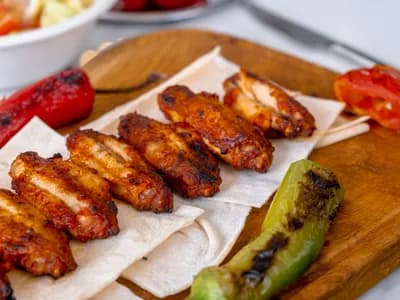
Crispy chicken wings on the kamado with honey and Pimentón de la Vera (crackling skin, no frying)
Glass-crisp skin without a fryer: dry brine with baking soda, indirect at 200°C with apple smoke and a final sear. Honey and Pimentón de la Vera glaze. Serves 4.
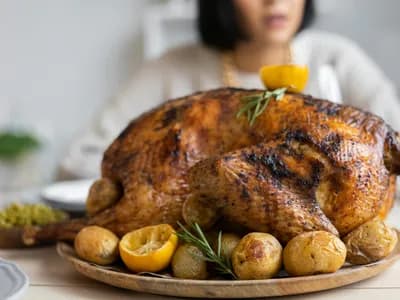
Smoked Christmas turkey on the kamado
The recipe that retires the family oven on December 25th: 12-hour brine, butter under the skin, apple wood smoke and a whole turkey at 120 °C — tender inside, deep gold outside, properly smoked.
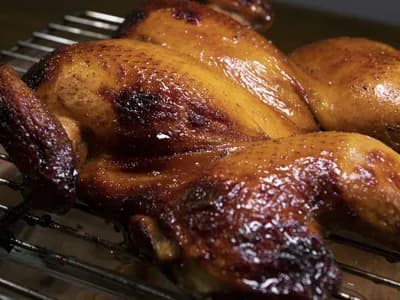
Whole spatchcock chicken on the kamado, even crispy skin
A 1.6 kg chicken butterflied flat, roasted at 180°C indirect over a deflector. Golden crackling skin end to end, juicy meat, ready in an hour: the Sunday roast I actually cook on my Torrevieja terrace.
KEEP READING
Go deeper on this dish
- Recommended kamado
Big Green Egg Large
The classic kamado that defined the category
- Editorial guide
How to light a kamado: the step-by-step method
No petrol, no weird tablets and no 45-minute waits. The cone method, airflow control and the mistakes that prevent 80% of the frustration.
- Glossary term
Heat deflector
Ceramic plate placed between the coals and the grate to turn direct fire into indirect cooking.
- Related comparison
big green egg large vs kamado joe classic iii
The classic kamado matchup: the Big Green Egg Large, the indestructible pioneer with the widest accessory network, agai…