Recipe · Indirect · Medium
Christmas Eve Baked Besugo (Red Seabream) with Panadera Potatoes in the Kamado
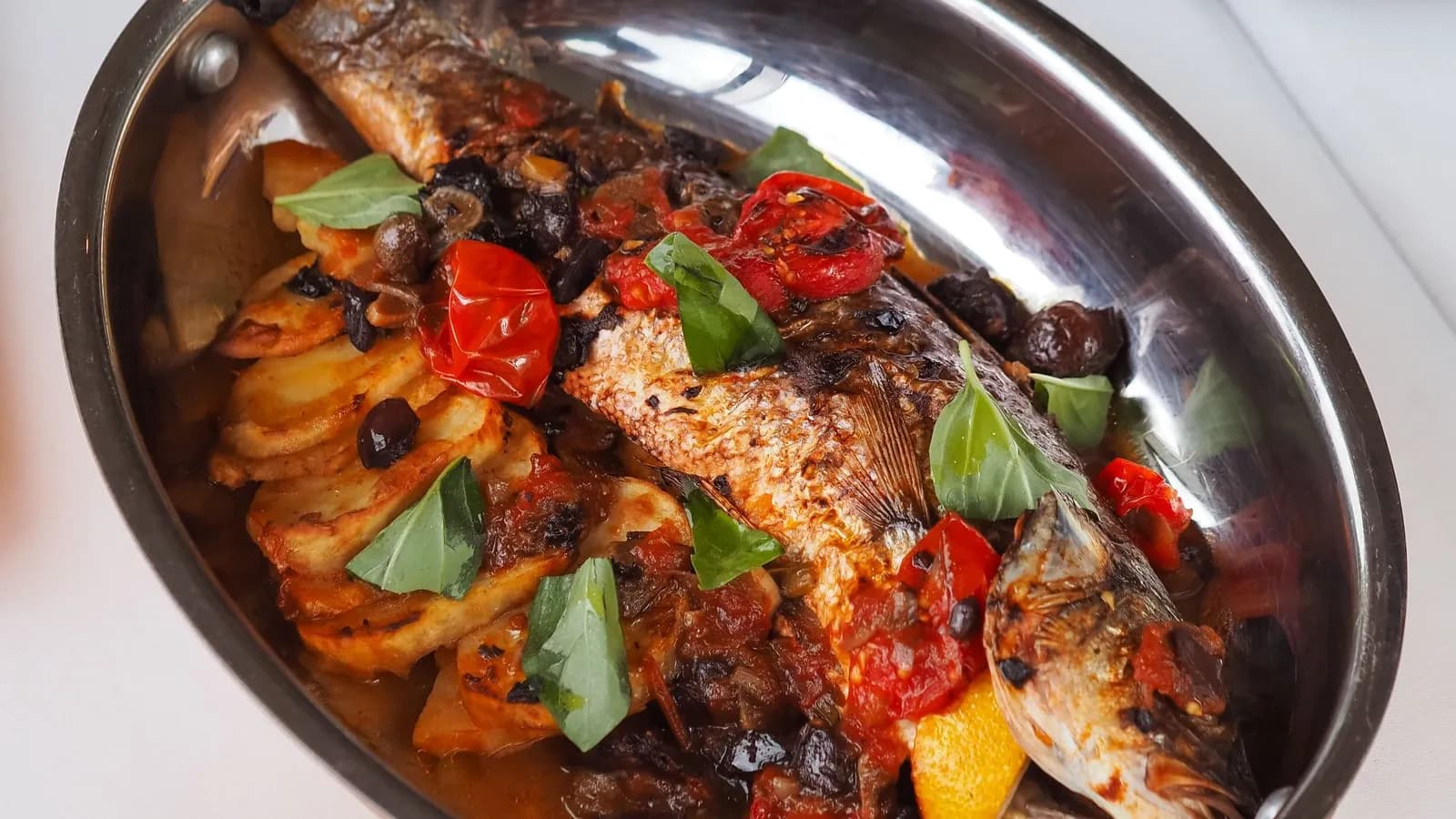
Two portion-sized besugo (red seabream) bake on panadera potatoes in a cast-iron skillet, kamado at 200 °C indirect, and a garlic and lemon refrito goes over at the end. It is the Christmas Eve dish, and it leaves the oven free.
Quick answer
Set the kamado up indirect at 200 °C with a 35 cm cast-iron skillet inside. Bake 1 kg of potatoes sliced 3-4 mm with onion and oil for 35-40 minutes, add white wine, lay two 350-400 g besugo with lemon in the slashes on top and bake 15-20 minutes, to 60 °C by the spine, plus one more minute. Pour over the garlic and lemon refrito.
- Prep
- 25 min
- Cook
- 60 min
- Servings
- 2 servings
- Temperature
- 200 °C
Ingredients
- portion-sized besugo (red seabream) of 350-400 g whole weight, scaled and gutted at the fishmonger's, head on (or portion-sized dorada, gilthead bream)2 ud
- firm-fleshed potatoes1 kg
- medium onions, finely sliced2 ud
- Italian green pepper (long, mild frying pepper), in strips1 ud
- extra virgin olive oil, for the potatoes and the fish100 ml
- dry white wine100 ml
- lemons (one in half-slices for the slashes, one juiced for the refrito)2 ud
- garlic cloves, thinly sliced5 ud
- extra virgin olive oil, for the refrito60 ml
- fresh parsley, chopped1 puñado
- fine salt, for the potatoes and the fish15 g
The gear for this recipe
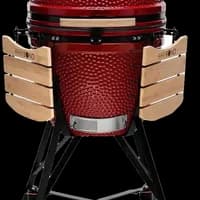 Kamado Bono Grande XXL 59 cmThis recipe depends on one measurement: the skillet has to fit with a gap for the air. The grate of the **Kamado Bono Grande XXL** is around 49-50 cm (the 59 in the name is the diameter of the ceramic) and the Petromax FP35 measures 41 cm with its two handles, so 8-9 cm is left free. That is what the cast-iron guide asks for so that heat rises up the sides and the dome works as an oven over the fish. The kit includes the deflector, which turns the embers into the 200 °C indirect set-up that the potatoes and the besugo need. On a 46 cm grate the same skillet goes in with 5 cm, the minimum, and on a grate of 45 cm or less, as in a kamado with a 51-52 cm body, it falls short.
 NaturBraza marabu charcoal, pack of two 5 kg bags (10 kg)Almost an hour at 200 °C with at least four lid openings along the way (potatoes in, stirring them, wine and fish, thermometer) and no chance of topping up with a 4.4 kg skillet inside. A dense charcoal such as **NaturBraza marabou** suits that use: marabou is a very compact wood and its charcoal burns slowly with a short flame, so the bed carries the whole cook. The maker's page promises long-lasting embers and little ash, and does not publish the origin or the lump size. For this duration it is enough to fill the firebox to the top of the fire ring.
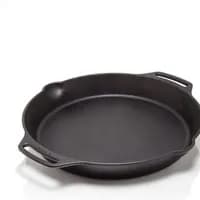 Petromax FP35 Cast Iron Fire Skillet 35 cm with HandlesIt is the vessel for the whole recipe: the potatoes are cooked in it, the fish is finished on top, and the dish goes to the table in it. The **Petromax FP35** is bare cast iron, with a 35 cm rim, a 30 cm base and a weight of 4.4 kg, and that thermal mass browns the potato from below and at the sides while the kamado dome works from above. Its two short handles, instead of one long handle, let the lid close with it inside. Its width also sets the fish: two portion-sized besugo of 350-400 g, not one of a kilo, which runs past 40 cm.
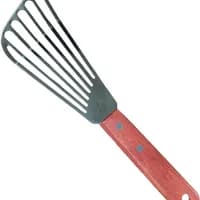 La Cuisine Spatola a fessura: slotted stainless fish slice, 28 cmA roast besugo is not carved: it is taken apart. The **La Cuisine slotted fish spatula** has a thin stainless steel blade 16 cm long with a bevelled edge, which slips between the loin and the spine without tearing the flesh and lifts each half to the plate with the potatoes from underneath. The slots let the oil from the refrito drain away instead of dragging it along. It is short, 28 cm overall, so for stirring the potatoes inside the kamado halfway through you need a glove on; the boning is done at the table, with the skillet out.
Method
- 01
Light and set up indirect
Fill the firebox of the Kamado Bono Grande XXL with NaturBraza marabou charcoal (marabú, a very dense wood) up to the top of the fire ring and light it in a single spot. Once the coals are going, put in the deflector, the grate on top and the empty Petromax FP35 skillet in the centre. Close up and settle at 200 °C with the vents. Allow another 15-20 minutes with the chamber already stable so the iron heats right through.
- 02
Slice the potatoes
Peel the potatoes and slice them 3-4 mm thick, all the same so they cook together; a mandoline helps. Slice the onion finely and the pepper into strips. Dry the slices with a cloth, then mix everything in a bowl with 10 g of salt and 80 ml of the oil. A 1 cm slice would still be raw when the fish is already done.
- 03
Bake the potato bed
Open the kamado with burping: lift the lid about 5 cm, wait about 5 seconds and open it fully, with gloves on and your face turned away. Tip the potatoes into the hot skillet, spread them in an even layer about 3 cm deep and close up. Bake 35-40 minutes at 200 °C and, at the 20-minute mark, open again with burping and stir once with the La Cuisine spatula to free the ones underneath.
- 04
Prepare the besugo
Meanwhile, dry the fish inside and out with kitchen paper. Make three diagonal slashes in each side, down to the spine, and tuck half a lemon slice into each. Salt inside and out with the remaining 5 g and brush the skin with the 20 ml of oil that is left. The slashes let heat into the thick part and bring it into step with the tail.
- 05
Add the wine and lay the fish
When the potato yields to a knife but is still whole, open again with burping and pour the white wine over the bed, at room temperature and never straight from the fridge onto iron at 200 °C. Lay the two besugo on top, head to tail, using the width of the skillet. If a tail touches the wall, let it curve up a little.
- 06
Bake and probe to 60 °C
Close up and bake 15-20 minutes at 200 °C. From minute 12, open with burping and push a thermometer into the thickest part of the loin, next to the spine, without touching bone. When it reads 60 °C, close up for one more minute and lift out the skillet: AESAN asks for 60 °C for at least one minute in the centre to inactivate anisakis, and it is the top of the 55-60 °C range for juicy fish. If it is short, close up and check again after 3 minutes.
- 07
Make the refrito
In the last few minutes, heat the 60 ml of refrito oil in a small pan on the kitchen hob and fry the sliced garlic over medium heat, slowly, until it is barely blond. Take off the heat, add the juice of the second lemon and the chopped parsley: it spits, and that is expected. Garlic toasted too far turns the whole refrito bitter, so stop early.
- 08
Lift out, pour over and serve
Lift out the skillet with long gloves and both hands, with the landing spot decided before you open up: empty it weighs 4.4 kg and it is at 200 °C. Set it on wood or a trivet, never on wet stone. Pour the refrito over the besugo and take it to the table. With the La Cuisine spatula, lift the loins off the spine and serve them with the potatoes from underneath.
About this recipe
On Christmas Eve besugo returns to the Spanish table, though the rest of the year it barely shows up. The classic version is the oven one: the whole fish, a few half-slices of lemon in the slashes, a bed of panadera potatoes (sliced potatoes baked with onion and olive oil, the baker's-oven style) underneath and a garlic refrito (garlic gently fried in olive oil) poured over at the table. In the kamado it is made the same way, with two advantages: the kitchen oven stays free for everything else, and ceramic at 200 °C in indirect cooking gives an enveloping, steady heat. The whole dish is built in a single cast-iron skillet: potatoes first, and the fish is finished on top of them.
Which besugo to buy, and what can be sold to you as besugo
The real besugo is Pagellus bogaraveo (blackspot seabream), the one with the black blotch just above the base of the pectoral fin. It is scarce, the IUCN classes it as near threatened because catches have fallen, and in December the price shoots up. That is why other sea breams turn up at the counter under the same nickname: the aligote (Pagellus acarne, axillary seabream), smaller and with a reddish spot in the axil of the pectoral fin rather than above it, and the pargo (Pagrus pagrus, common seabream). Both are good fish, but neither is besugo. For retail sales, Regulation (EU) No 1379/2013 requires the commercial name and the scientific name to be shown: read the label before you pay. If there is no besugo or it is not worth the money, a portion-sized dorada (gilthead bream) works just as well in this recipe. It is not the dorada a la espalda, opened out like a book and cooked over direct embers: here it goes in whole, baked, on potatoes.
Why two portion-sized besugo and not one big one
The skillet decides. The Petromax FP35 measures 35 cm across the outer rim and 30 cm across the base. By the length-weight relationship FishBase gives for the species, a 400 g besugo is around 32 cm long and a 1 kg one is over 40 cm: that will not lie flat. Two fish of 350-400 g, laid head to tail with a tail curved slightly against the wall if needed, will. They serve two as a main course, or four only if they follow a long spread of starters.
The skillet in turn has to fit in the kamado with air all round it. With its two handles it measures 41 cm, and the grate of the Kamado Bono Grande XXL is around 49-50 cm (the 59 in the name is the ceramic body): that leaves 8-9 cm of gap, which is what the guide to cast iron in the kamado asks for so that hot air can rise towards the dome. On a 46 cm grate it would leave 5 cm, the minimum, and on a 45 cm one not even that. A piece that covers the whole grate turns the kamado into a closed griddle, and the top of the fish does not cook.
Potatoes first, fish second and 60 °C in the loin
Panadera potatoes need 35-40 minutes to soften and a portion-sized besugo needs 15-20. So the potatoes go in first, in thin slices with onion, pepper and oil, with the deflector in place (the difference between direct and indirect cooking is explained separately). When the potato almost gives to the knife, a splash of white wine goes in and the fish goes on top: steam from the bed rises underneath and the loin cooks without drying out. Doneness is measured with a probe thermometer in the thickest part, next to the spine. White fish is juicy between 55 and 60 °C; here the target is the top of that range, 60 °C, because besugo is a wild fish and that is the AESAN reference (the Spanish food safety agency) for inactivating anisakis: 60 °C for at least one minute in the centre of the piece. The lubina a la sal (sea bass baked in a salt crust) uses the same 200 °C chamber with a different technique.
In 30 seconds
Set the kamado up indirect at 200 °C with the cast-iron skillet inside. Bake 1 kg of potatoes sliced 3-4 mm with onion, pepper and oil for 35-40 minutes. Add the white wine, lay two 350-400 g besugo with lemon in the slashes on top and bake 15-20 minutes more, to 60 °C by the spine and one more minute at that temperature. Pour the garlic, parsley and lemon refrito over the top and take the skillet to the table. If there is no real besugo, use portion-sized dorada.
Editor's tips
- Ask the fishmonger to scale and gut the besugo but leave the head on: it releases gelatine into the juices that run down onto the potatoes and keeps the black blotch that identifies the species.
- If the bed dries out before the fish goes on, add a splash of hot water or lukewarm fish stock. Nothing cold on iron at 200 °C: that is the thermal shock the cast-iron guide warns against.
- Inside the kamado the skillet handles are at chamber temperature. Welding gloves or aramid gloves from the moment you open the lid until the skillet is on the table.
- For four guests with a whole besugo each, a second 35 cm skillet will not fit, not even on a 49-50 cm grate. Bake two rounds back to back: the second bed of potatoes goes in while the first is being served.
Gear for this recipe
As an Amazon Associate, mikamado.es earns from qualifying purchases. At no extra cost to you.
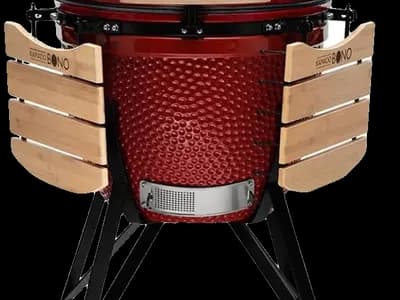
Kamado Bono Grande XXL 59 cm
This recipe depends on one measurement: the skillet has to fit with a gap for the air. The grate of the **Kamado Bono Grande XXL** is around 49-50 cm (the 59 in the name is the diameter of the ceramic) and the Petromax FP35 measures 41 cm with its two handles, so 8-9 cm is left free. That is what the cast-iron guide asks for so that heat rises up the sides and the dome works as an oven over the fish. The kit includes the deflector, which turns the embers into the 200 °C indirect set-up that the potatoes and the besugo need. On a 46 cm grate the same skillet goes in with 5 cm, the minimum, and on a grate of 45 cm or less, as in a kamado with a 51-52 cm body, it falls short.
€1,084
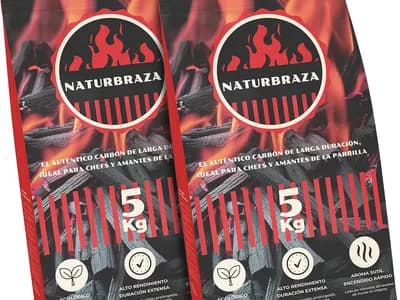
NaturBraza marabu charcoal, pack of two 5 kg bags (10 kg)
Almost an hour at 200 °C with at least four lid openings along the way (potatoes in, stirring them, wine and fish, thermometer) and no chance of topping up with a 4.4 kg skillet inside. A dense charcoal such as **NaturBraza marabou** suits that use: marabou is a very compact wood and its charcoal burns slowly with a short flame, so the bed carries the whole cook. The maker's page promises long-lasting embers and little ash, and does not publish the origin or the lump size. For this duration it is enough to fill the firebox to the top of the fire ring.
€47
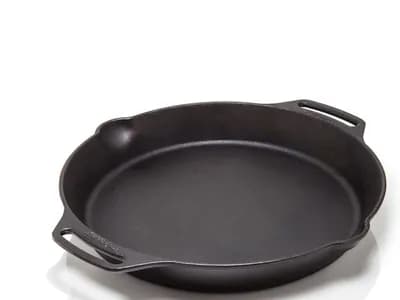
Petromax FP35 Cast Iron Fire Skillet 35 cm with Handles
It is the vessel for the whole recipe: the potatoes are cooked in it, the fish is finished on top, and the dish goes to the table in it. The **Petromax FP35** is bare cast iron, with a 35 cm rim, a 30 cm base and a weight of 4.4 kg, and that thermal mass browns the potato from below and at the sides while the kamado dome works from above. Its two short handles, instead of one long handle, let the lid close with it inside. Its width also sets the fish: two portion-sized besugo of 350-400 g, not one of a kilo, which runs past 40 cm.
€70
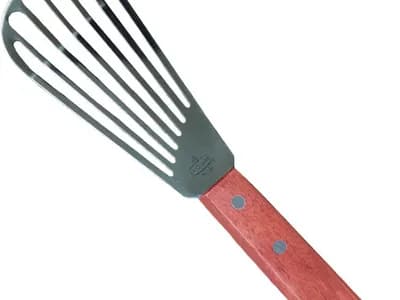
La Cuisine Spatola a fessura: slotted stainless fish slice, 28 cm
A roast besugo is not carved: it is taken apart. The **La Cuisine slotted fish spatula** has a thin stainless steel blade 16 cm long with a bevelled edge, which slips between the loin and the spine without tearing the flesh and lifts each half to the plate with the potatoes from underneath. The slots let the oil from the refrito drain away instead of dragging it along. It is short, 28 cm overall, so for stirring the potatoes inside the kamado halfway through you need a glove on; the boning is done at the table, with the skillet out.
€10
FAQ
How long does besugo take to bake?
The potatoes set the schedule: 35-40 minutes at 200 °C, because they take twice as long as the fish. With them already cooked, a portion-sized besugo of 350-400 g laid on top needs another 15-20 minutes; a large one takes a good deal longer. Juicy is between 55 and 60 °C in the thickest part of the loin, next to the spine, and here it is held for one minute at 60 °C before it comes out, the AESAN reference against anisakis.
How do you tell besugo from aligote or pargo?
Besugo (Pagellus bogaraveo) has a sharply defined black blotch just above the base of the pectoral fin. Aligote (Pagellus acarne) is smaller, and its spot is reddish and sits in the axil of the fin, inside the base, not above it. Pargo (Pagrus pagrus) is another species, even if it looks similar. The safe way is the sign or the label: Regulation (EU) No 1379/2013 requires the commercial name and the scientific name to be shown on retail sales.
What fish can I use instead of besugo?
Portion-sized dorada (gilthead bream) is the easiest substitute: same size, same sea bream family, same technique and the same point by the spine: 60 °C if it is wild, under the same AESAN reference. Pargo and aligote also work, as long as they are sold under their own names and not as besugo. The only condition in this recipe is a physical one: two fish have to fit side by side in a skillet with a 30 cm base, so about 30 cm long each, with the tail curved slightly against the wall.
How do you make panadera potatoes?
Sliced thin, 3-4 mm, with onion in fine strips, green pepper, salt and a generous glug of olive oil, baked at about 200 °C until they give to a knife without falling apart, around 35-40 minutes. All the slices should be the same thickness so they cook together. A splash of white wine at the end and the juices from the fish on top turn them into the bed for the besugo.
Why cook besugo in the kamado rather than the kitchen oven?
Because on Christmas Eve the kitchen oven is usually busy, and the kamado holds 200 °C set up indirect for the whole cook without needing attention. With the lid closed the cast-iron skillet also gets heat from below, from the sides and from the dome, so the potato browns against the wall of the skillet too. It is the same dish, with more toasted surface.
More kamado recipes
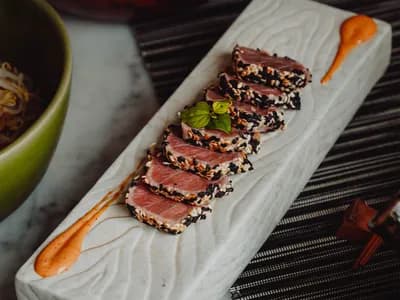
Sesame-Crusted Seared Bluefin Tuna on the Kamado (Tataki)
A bluefin tuna loin rolled in sesame and seared 30-45 seconds per side over a screaming-hot kamado: a toasted crust outside, a raw, juicy core, and a soy, ginger and lime sauce that wakes it all up.
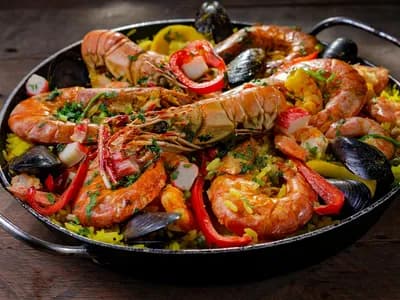
Arroz a banda on the kamado, fisherman's socarrat
Alicante-style arroz a banda in a paella pan over the kamado grate: a rockfish fumet, a long sofrito and a textbook final socarrat.
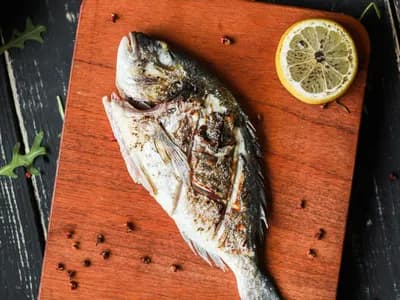
Butterflied sea bream on the kamado, with garlic, chilli and lemon refrito
Sea bream butterflied open over direct coals, skin down first, finished with a hot garlic, chilli and lemon refrito. Mediterranean fish off Torrevieja, ready in 18 minutes. Serves 2.
KEEP READING
Go deeper on this dish
- Recommended kamado
Kamado Bono Grande XXL 59 cm
This recipe depends on one measurement: the skillet has to fit with a gap for the air. The grate of the Kamado Bono Grande XXL is around 49-50 cm (the 59 in the name is the diameter of the ceramic) and the Petromax FP35 measures 41 cm with its two handles, so 8-9 cm is left free. That is what the cast-iron guide asks for so that heat rises up the sides and the dome works as an oven over the fish. The kit includes the deflector, which turns the embers into the 200 °C indirect set-up that the potatoes and the besugo need. On a 46 cm grate the same skillet goes in with 5 cm, the minimum, and on a grate of 45 cm or less, as in a kamado with a 51-52 cm body, it falls short.
- Editorial guide
How to light a kamado: the step-by-step method
No petrol, no weird tablets and no 45-minute waits. The cone method, airflow control and the mistakes that prevent 80% of the frustration.
- Glossary term
Heat deflector
Ceramic plate placed between the coals and the grate to turn direct fire into indirect cooking.
- Related comparison
big green egg large vs kamado joe classic iii
The classic kamado matchup: the Big Green Egg Large, the indestructible pioneer with the widest accessory network, agai…