TÉCNICA
Smoked ribs in a kamado: 3-2-1, 2-2-1 or no wrap
What the numbers mean, why a sealed ceramic cooker calls for less wrapping, which rack to ask the butcher for, and how to tell they are done without trusting the clock.
Quick answer
The 3-2-1 spreads about 6 hours at 110-120 °C: 3 smoked, 2 wrapped and 1 with sauce. It was designed for spare ribs, the belly rack. Baby back (loin) ribs take 2-2-1 or 2-1-1. A kamado holds in more moisture than a smoker, so you can often wrap less or not at all. They are done when they bend and crack, at about 90-93 °C between the bones.
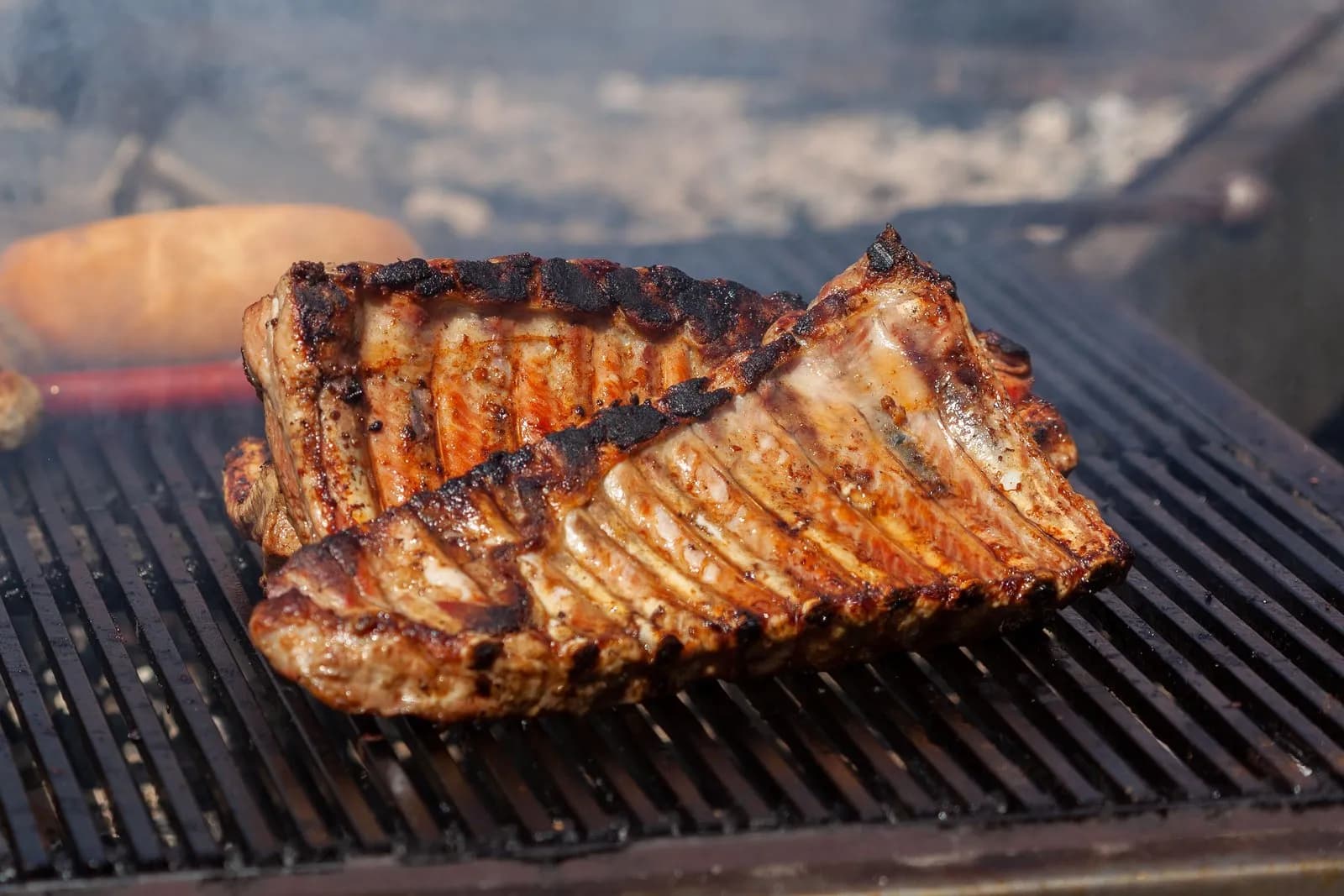
The 3-2-1 is one of the best-known rib recipes and one of the most misunderstood. It is not a technique, it is a timetable written for an American smoker running at 225 °F, about 107 °C. It works, which is why it is famous. But it is a clock, and ribs cannot read it.
Two things change in a kamado. Sealed ceramic holds in far more moisture than a steel smoker, so the wrapped phase, which exists to soften and protect the meat, can often be shortened or dropped. And in Spain a rack of ribs is sold cut into strips unless you ask for it whole, and the local white pork is leaner. The baseline figures are those in the table of temperatures and times by cut.
| Cut | Usual weight | Chamber temperature | Recommended method in a kamado | Approximate time | Sign that it is done |
|---|---|---|---|---|---|
| Baby back (loin ribs; costillar de lomo or carré) | 1-1.3 kg | 110-120 °C | 2-1-1 or no wrap; 2-2-1 if you want them very tender | 4-5 h | Bends and cracks; 90-93 °C between the bones |
| Spare ribs (whole belly rack; costillar de panceta) | 1.5-2 kg | 110-120 °C | 3-1-1 with butcher paper; 3-2-1 if you want them very tender | 5-6 h | Bends and cracks; the toothpick goes in with little resistance |
| St. Louis (trimmed spare ribs) | 1.2-1.8 kg depending on trim | 110-120 °C (130 °C in our recipe) | 3-1-1 or no wrap | 4.5-5.5 h | Bends about 30° without breaking; the bone shows |
| Ibérico or Duroc rack | Variable: ask the weight | 110-120 °C | No wrap, or a short wrap in paper | Same as the equivalent white pork cut | Same tests; the marbling gives more leeway |
3-2-1, 2-2-1 and no wrap: what the numbers mean
Each number is a phase, in hours. In the 3-2-1, the rack spends three hours bare in the smoke, two wrapped with a little liquid and one unwrapped, painted with sauce. That comes to about six hours. Steven Raichlen, who first came across it while researching his book Best Ribs Ever, gives a working range of 225-250 °F (107-121 °C) and recommends it mainly for spare ribs (costillar de panceta) and their trimmed version, the St. Louis.
The 2-2-1 takes an hour off the smoke: about five hours for baby back ribs (loin ribs, costillar de lomo), which are shorter and leaner. It is the only line our table gives for ribs, with 110-120 °C in the chamber and 90-93 °C internal; here it is refined by cut and by cooker. Raichlen even proposes a 2-1-1 when the 2-2-1 leaves baby backs too soft. And our barbecued ribs recipe follows a 3-1-1 at 130 °C with a final direct sear.
No wrap means smoke from start to finish, with sauce at the end if you want it. It gives more bark and more bite; the same recipe suggests it this way: about four hours at 110 °C without paper and half an hour with sauce.
The Big Green Egg and Kamado Joe rib recipes consulted run hotter and shorter. Big Green Egg's baby back recipe cooks at 325 °F (163 °C) with the convEGGtor: an hour and a half uncovered and an hour covered in a tray with apple juice. Kamado Joe's pork rib recipes run at 300 °F (149 °C): about two hours for a baby back, one of them wrapped, and about three for a St. Louis, also in foil. None skips the wrap, but the wrapped stretch is around an hour: that supports moving from 3-2-1 to 3-1-1, or from 2-2-1 to 2-1-1, in a kamado. With only three hours, the hot route works, with a different bark.
Which rack to ask for at a Spanish butcher's
Ask for the rack "whole, uncut" ("entero, sin cortar"): at the counter, costillar means strips cut across the bones by default. The full order is in the guide to cuts and equivalents; here is just what you need to choose a method.
- Baby back: loin or carré rack (costillar de carré or de lomo), short and curved, 1-1.3 kg. - Spare ribs: belly rack (costillar de panceta), longer, flat and fatty, 1.5-2 kg. This is the cut the 3-2-1 was made for. - St. Louis: the squared-off belly rack, without the breastbone or the cartilage at the tip. It weighs less and cooks more evenly.
According to Iowa State University Extension, a rack of spare ribs has between 11 and 13 bones, and close to half its weight is bone and cartilage; in a baby back the proportion is similar, and the number of bones depends on the trim. Its weights, for American racks, are slightly lower than the cuts guide's: about 0.9 kg for a baby back and 1.1-1.6 kg for spare ribs. Ask for the weight when you order.
Ibérico or Duroc pork has more marbling than Spanish white pork, which is raised lean, and that gives it more leeway unwrapped; white pork dries out sooner and welcomes the paper. This is reasoning, not a measurement: start with a short wrap and adjust.
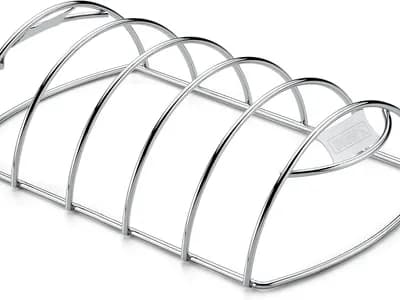
A whole rack of spare ribs rarely lies flat on the grate of a large kamado, about 46 cm across. Cut it in two, roll it or stand it up in a rib rack: its spec sheet says up to five racks, but on a 46 cm kamado three or four fit depending on their size, and a small kamado may lack height under the dome.
Preparing the rack: membrane, salt and binder
The membrane is the silvery skin on the bone side. If you leave it on, neither smoke nor rub gets through it and it cooks up leathery. Lift a corner with the tip of a knife, grip it with kitchen paper and pull diagonally.
Salt or rub goes on in advance. Iowa State Extension notes that many recipes season at least four hours ahead; one of Kamado Joe's recipes is happy with half an hour. The night before, covered in the fridge, also works. More rub does not give more flavour, it gives more salt, and there is no sourced dose in grams per kilo: start light.
A binder is optional. A very thin layer of mustard only helps the rub stick and you cannot taste it at the end. A little oil does the same.
There is no need to bring it to room temperature: half an hour out of the fridge while you light the fire is enough, and USDA FSIS advises against going beyond two hours.
Setting up the kamado for five or six hours
Ribs always go indirect: over a direct fire they char before they soften, as the guide to direct and indirect cooking explains. On a Big Green Egg Large, the convEGGtor or a 44.5 cm cordierite deflector does the job; on a Kamado Joe Classic, the half-moons. Leave an air gap between deflector and grate and, in that gap, two drip trays with a little water in the bottom or on spacers, as their spec sheet advises: sitting dry on hot ceramic, the fat smokes sooner and turns bitter.
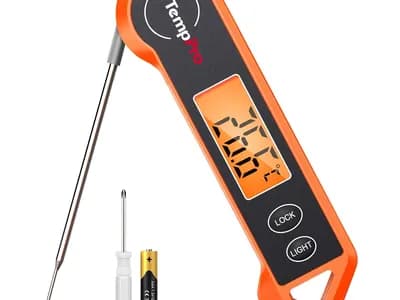
The target is 110-120 °C in the chamber, measured with a probe at grate level. The dome thermometer reads the air above and, with the deflector in, can differ from the grate by 10-25 °C, according to the guide to thermometers and probes. Clip an ambient probe to the grate, close to the rack without touching it. A ThermoPro TP25 with four probes leaves one for the chamber and others for one or two racks.
The charcoal goes in with the Minion method: a basket full of unlit charcoal and a handful of glowing coals on one side. That load is more than enough for ribs.
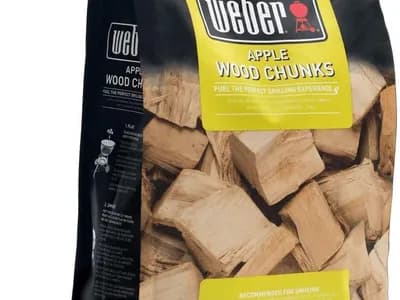
The wood, following the guide to smoking woods, is two or three chunks, about 100-150 grams, buried at different depths. For pork, apple chunks, cherry and olive all work; with hickory, use a single chunk. Put the meat on when the thick white smoke from lighting turns almost clear, ten to twenty minutes later.
After that, open the lid as little as possible and always with burping: lift it about five centimetres, wait about five seconds and then open fully.
Wrapping: butcher paper, foil or nothing
Wrapping speeds up the cook, because it cuts the evaporation that cools the surface, and it softens the meat, because the rack cooks in its own steam. Raichlen sums it up: wrapping in foil is boiling them in their own juices. That gives you the tenderness, and also a soft bark and a slightly washed-out flavour.
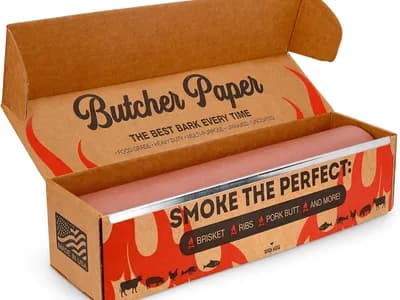
- Foil: airtight. It is the fastest and most tender route, and the one that punishes the bark most. Use a double sheet, because the bones puncture a single one. - Butcher paper: lets some of the steam through. Kamado Joe explains it in its beef rib recipe: foil is not permeable and partly steams the bark. A 45.7 cm-wide roll of butcher paper wraps a rack with room to spare. - Nothing: more bark and more bite, in exchange for more time and some risk of drying out a lean white pork rack.
In a kamado, wrapping matters less than in a smoker. The sealed chamber holds in plenty of moisture, the bark takes longer to form and wrapping early leaves it soft. The sensible move is to halve the wrapped phase or switch to paper. That is a deduction from the data cited here, not a measurement of our own.
The liquid is a small splash: in our St. Louis recipe, 100 ml of apple juice and 50 g of butter for two racks. Jeff Phillips, who publishes the 2-2-1 on a Big Green Egg, prefers to add nothing.
The moment is set by the bark: set, mahogany in colour and not sticking to your finger. In one recipe Kamado Joe gives a reference of at least 74 °C (165 °F) internal. Ribs also hit the stall, but because they are thin it lasts much less than on a brisket or a pulled pork. Wrapping to get through it is the Texas crutch.
When they are done: the bend test, a toothpick and temperature between the bones
With ribs, a probe pushed in tells you little: the meat is thin and the tip easily touches bone. The three tests Raichlen describes work better.
- Bend test: lift the rack with tongs from the middle. If it bows easily and the surface cracks, it is done. Our recipe makes this concrete: it bends about 30° without breaking; if it snaps, it has gone too far. - Toothpick: it slides in between two bones with only slight resistance. - Bone showing: the meat pulls back and leaves the ends of the bones exposed.
Temperature confirms. Our table gives 90-93 °C internal; Raichlen puts the finish between 195 and 205 °F (90-96 °C) and Kamado Joe at about 200 °F (93 °C). Measure it with an instant-read thermometer such as the ThermoPro TP19H, between two bones and without resting the tip on the bone, which throws the reading off.
Why is 63 °C not enough? USDA FSIS sets 145 °F (62.8 °C) with a three-minute rest for whole cuts of pork. From there ribs are safe but, as Iowa State Extension points out, still tough. Tenderness arrives when the collagen between the bones turns to gelatine, at about 88-93 °C internal.
Glazing, resting and carving
The sauce goes on in the last 15-30 minutes. It contains sugar, and sugar burns and turns bitter if it spends hours in the heat.
The direct sear is optional. In our St. Louis recipe the deflector comes out, the temperature goes up to 260 °C and the ribs get 60-90 seconds a side. That means moving hot ceramic: proper gloves and somewhere ready for the deflector, on stone or metal and away from your feet. And burp before opening: after hours with the vents almost closed, the chamber builds up unburnt gases and the sudden rush of air ignites them at once; that is the flashback.
Resting is short: 10 minutes in our recipe, about 20 wrapped in Kamado Joe's baby back recipe. Longer only cools them.
To carve, put the rack bone side up: that way you can see where each bone runs. Cut between the bones with a long knife, in a single stroke. If they fall apart as you cut, they went too long in the wrapped phase. Leftovers go in the fridge within two hours, or one if it is above 32 °C (90 °F): that is the USDA FSIS rule.
Times by cut, servings and what went wrong
The table sums up method, temperature and approximate time by cut. For servings, 1 kg of ribs on the bone feeds about two people; the full calculation is in the last FAQ.
- Dry: the chamber was hotter than you thought, or a lean rack spent the whole time unwrapped. Measure at the grate and try paper. - Tough: they need more time. Carry on until they pass the bend test and the toothpick. - Falling apart: too long wrapped or too much liquid. Raichlen suggests shortening the wrapped phase by 30 to 60 minutes. - Soft bark: foil or wrapping too early. Open the paper for the last 10-15 minutes. - Bitter: almost always dirty smoke, from putting the meat on in white smoke, too much wood or throttled vents. The guide to bitter smoke and creosote explains it. If the bitterness is only in the glaze, it was burnt sauce.
The 3-2-1 is a good starting point and a bad dogma. In a kamado, the ceramic already does part of the foil's job, so it makes sense to start with less wrapping: 2-1-1 for a rack of baby backs, 3-1-1 or paper for spare ribs and a short wrap or none for ibérico. Then adjust by half an hour at a time. And if you do not have a cooker yet, the guide to the best kamado for smoking covers which suits six-hour cooks.
What does not change is the finish: done when they bend and crack, at about 90-93 °C between the bones. The clock tells you when to light the fire; the meat decides when you eat.
Gear featured in this guide

Recipes to get started
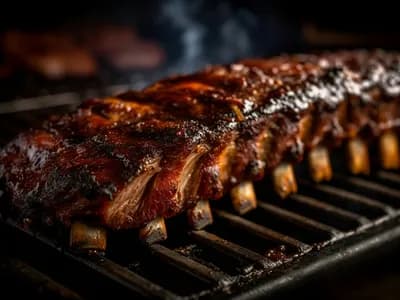
St. Louis-style ribs on the kamado
St. Louis-cut ribs (no rib tips), cooked reverse-sear: four hours at 130°C with light smoke, then a final blast of direct heat to caramelise the glaze.
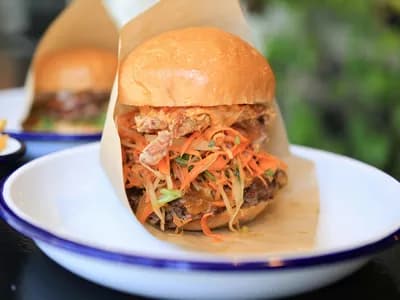
Carolina-style smoked pulled pork
Eight hours of patience, a five-and-a-half-kilo pork shoulder and North-Carolina vinegar — this is what a kamado does better than any other fire.
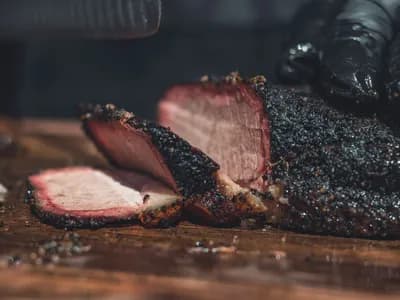
Low-and-slow smoked brisket
The kamado acid test. Ten hours at 110°C, a deep bark, a pink smoke ring and a texture that gives way under the weight of a fork.
GO DEEPER
Continue with these
- Related guide
Kamado cooking temperatures and times: a cheat-sheet by cut
The four heat zones, the technique-to-temperature table and the cut-to-internal-temp-to-time cheat-sheet. Why the probe beats the clock, every time.
- Related guide
Meat cuts for the kamado: what to ask for at a Spanish butcher
From brisket to pork butt: what each cut is called at the Spanish counter, what weight and what fat to ask for, and which method it needs afterwards on the kamado.
- Related guide
Minion Method and Snake Method: 12 Hours of Kamado Fire
How to build the charcoal bed to hold 110-120 °C for 8-14 hours without refueling or lifting the lid. The mother technique of low & slow, step by step.
- Related guide
Smoking woods for a kamado: which wood for which food
Olive, holm oak, apple or hickory: which aroma each cut asks for, how many chunks go into a sealed ceramic, when to add them and why soaking the wood does not help.
- Recipe to practice
St. Louis-style ribs on the kamado
St. Louis-cut ribs (no rib tips), cooked reverse-sear: four hours at 130°C with light smoke, then a final blast of direct heat to caramelise the glaze.
- Recipe to practice
Carolina-style smoked pulled pork
Eight hours of patience, a five-and-a-half-kilo pork shoulder and North-Carolina vinegar — this is what a kamado does better than any other fire.
- Recipe to practice
Low-and-slow smoked brisket
The kamado acid test. Ten hours at 110°C, a deep bark, a pink smoke ring and a texture that gives way under the weight of a fork.
- Editorial comparison
big green egg large vs kamado joe classic iii
The classic kamado matchup: the Big Green Egg Large, the indestructible pioneer with the widest accessory network, again
- Glossary term
Heat deflector
Ceramic plate placed between the coals and the grate to turn direct fire into indirect cooking.
- Glossary term
ConvEGGtor
Big Green Egg's current name for its ceramic heat deflector; successor to the plate setter, turning the EGG into a convection oven.
- Glossary term
Direct cooking
Cooking without a deflector, with food directly exposed to coal radiation at high temperature.
Frequently asked questions
What is the 3-2-1 method for ribs?
It is a timetable in three phases at 110-120 °C: three hours of smoke with the rack bare, two wrapped in foil or paper with a splash of liquid and a final one unwrapped, with sauce. It adds up to about six hours and is designed for spare ribs or St. Louis. It gives very tender ribs at the cost of a softer bark. In a kamado it pays to shorten the wrapped phase.
3-2-1 or 2-2-1 for baby back (loin) ribs?
2-2-1, or even 2-1-1. A rack of baby backs is shorter, thinner and leaner than spare ribs, and the full 3-2-1 usually leaves it too soft. The 2-2-1 adds up to about five hours at 110-120 °C and is the pattern in our temperature table, with 90-93 °C internal. In a kamado, which holds in more moisture, the 2-1-1 usually gives a better bark.
What temperature do you smoke pork ribs at?
Between 110 and 120 °C in the chamber, measured at grate level and not in the dome. That is the equivalent of the 225-250 °F in American recipes. Inside, they are tender at about 90-93 °C between the bones. They are safe long before that: USDA FSIS sets 145 °F (62.8 °C) with a three-minute rest for whole cuts of pork, but at that temperature ribs are still tough.
How long do ribs take in a kamado?
At 110-120 °C, a rack of baby backs takes about 4-5 hours, spare ribs about 5-6 and a St. Louis about 4.5-5.5. Wrapping shortens the time; not wrapping lengthens it. The manufacturers' recipes run hotter: Kamado Joe does a baby back in about two hours at 149 °C (300 °F). The time is for planning; take them off when they bow and crack as you lift them with tongs, a toothpick slides between two bones with little resistance and the temperature between the bones reads 90-93 °C.
Foil or butcher paper for wrapping ribs?
Foil is airtight: it cooks the meat in its steam, is the fastest and most tender route and softens the bark the most. Untreated butcher paper lets some of the steam escape, keeps the bark better and takes a little longer. In a kamado, which already holds in plenty of moisture, paper is the better starting point. With foil, use a double sheet: the bones puncture a single one.
How many people does 1 kg of ribs feed?
About two main-course servings. Our cuts guide works on 500-600 g of raw rack with bone per person: close to half the weight is bone and cartilage, and the meat loses 30-45% in cooking. As a rough guide, 1 kg leaves about 275-350 g of meat. A whole rack of baby backs feeds two; a 1.5-2 kg rack of spare ribs feeds three with sides, or two hungry people.