Recipe · Indirect · Advanced
Roscón de Reyes on the Kamado, Baked on a Stone: Fluffy, with Orange Blossom Water
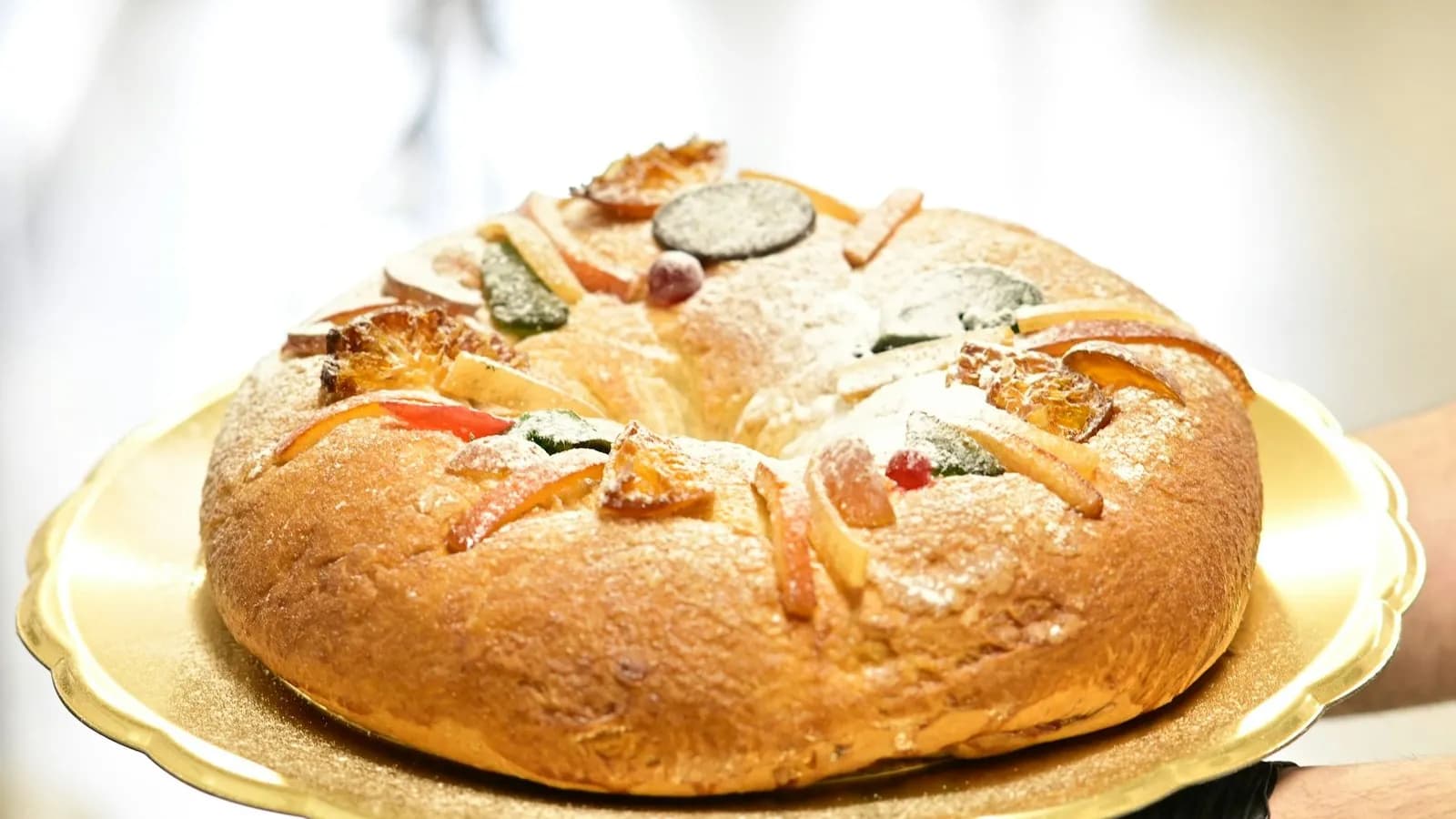
Two roscones of about 25 cm baked one after the other on a stone, with a deflector and the kamado held at 175 °C. Pre-ferment dough, a night in the fridge, orange blossom water, orange zest and cream only once cold.
Quick answer
Make a pre-ferment, then mix in egg, sugar, butter, orange blossom water and zest, and leave the dough overnight in the fridge. Shape two roscones of about 25 cm, prove for 2-3 hours and bake one at a time on a stone with a deflector at 175 °C for 18-22 minutes, to 88-90 °C in the centre. Cream only once cold.
- Prep
- 60 min
- Cook
- 55 min
- Servings
- 12 servings
- Temperature
- 175 °C
Ingredients
- strong bread flour (100 g for the pre-ferment and 400 g for the dough)500 g
- whole milk, lukewarm (60 ml for the pre-ferment and 80 ml for the dough)140 ml
- fresh baker's yeast (2 g for the pre-ferment and 13 g for the dough)15 g
- large eggs (2 for the dough and 1, beaten, for the glaze)3 ud
- caster sugar (100 g for the dough and 60 g moistened with 2 teaspoons of water for the topping)160 g
- unsalted butter, softened100 g
- orange blossom water (the baking kind)35 ml
- orange, zest only (and the zest of half a lemon, optional)1 ud
- fine salt5 g
- candied fruit in strips: orange, glacé cherry and citron or candied squash150 g
- flaked almonds50 g
- whipping cream (35% fat), very cold, with 30 g of icing sugar (optional, for the filling)400 ml
The gear for this recipe
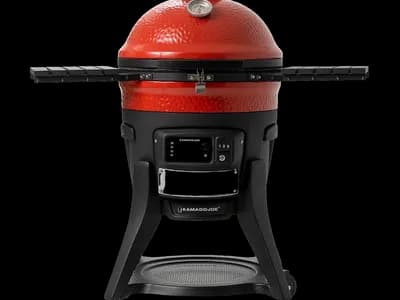
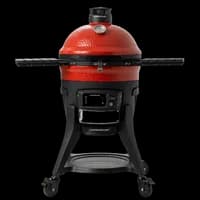 Kamado Joe Konnected JoeThis roscón calls for two bakes in a row at 175 °C with the lid opened between them, and never above 180 °C, because the dough contains sugar and the embers sit underneath. The Konnected Joe holds the setpoint with its fan, within the 107 to 371 °C range the brand states, so there is no need to reach down and adjust the bottom vent while the second roscón is being shaped or decorated. It comes with the two deflector half-moons and the two-level Divide & Conquer as standard: deflectors below, grate above and the 30 cm stone resting on it with air in between. Its grate is the 46 cm of the Classic format, with plenty of room around the stone. The trade-off is that it needs a power socket nearby.
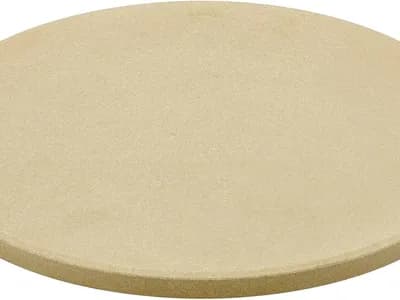
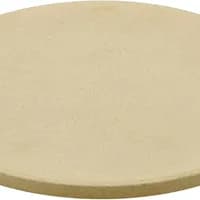 Rösle VARIO 25424: 30 cm cordierite pizza stoneThe base of a roscón cooks by contact, and in a kamado that contact has to be with something that spreads the heat rather than passing on the heat of the embers. The Rösle VARIO is cordierite, round, 30 cm across, 1.5 cm thick and 2.1 kg according to its listing: it stores heat during the preheat and gives it up evenly to the base over the 18-22 minutes. Its 30 cm sets the recipe. A whole roscón made with 500 g of flour does not fit, so the dough is divided into two of about 25 cm, which leave a couple of centimetres free on each side. On the 46 cm grate of the Konnected Joe it sits whole and centred.
 HOT! Kitchenware multilayer birch pizza peel, 29 × 41.5 cmA proved roscón is a soft, airy dough decorated with fruit and sugar: carried by hand, it distorts and loses half its volume. The HOT! Kitchenware birch peel is 29 cm wide, just enough to get under the baking paper with a roscón of about 25 cm and slide it onto the stone in one move. Afterwards it is used to lift it out golden and move it to the rack. Its listing gives a limit of 230 °C, above the 175 °C of this recipe, but the peel goes in, loads and comes out: it is never left resting on the stone or inside the kamado.
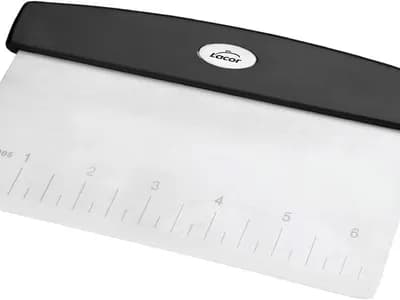
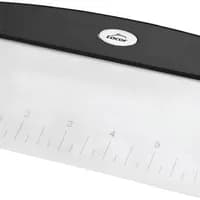 Lacor 67029: stainless steel bench scraper with a handleA dough with 100 g of butter, egg and sugar sticks to the worktop, to your fingers and to everything it touches, and every extra handful of flour used to tame it leaves it drier. The Lacor 67029 scraper does that job without adding flour: it lifts the cold dough off the bowl and the worktop, cuts it into two equal pieces in one go and picks them up to be rolled into balls. The scale marked on its edge lets you check that each ring measures about 22 cm before proving, and the rubber handle gives grip with buttery hands. It is a worktop tool: the rubber handle never goes near the hot stone or grate.
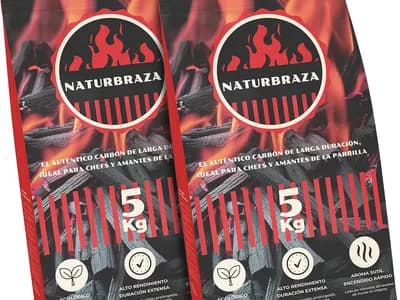
 NaturBraza marabu charcoal, pack of two 5 kg bags (10 kg)Between preheating the stone and the two bakes, the kamado spends close to two hours at 175 °C with the lid opened several times, and refuelling with the stone and deflectors in place is not an option. NaturBraza marabú charcoal comes from a very dense wood: it burns slowly with a short flame, and the listing promises little ash, though it publishes no figure or lump size. With the firebox filled to the brim there are embers to spare for the whole session. A clean fire with no white smoke is what a sweet bake needs when it should not taste smoky. Sift the dust from the bottom of the bag before loading.
Method
- 01
Pre-ferment (day 1)
Dissolve 2 g of fresh yeast in 60 ml of lukewarm milk, add 100 g of strong bread flour and mix to a soft ball. Cover it and leave at room temperature, about 22-24 °C, for 1 to 2 hours, until it doubles in volume and looks full of bubbles when torn open. This is what starts the fermentation: do not skip it, however short of time you are.
- 02
Knead and add the butter
In a large bowl combine the torn-up pre-ferment, 400 g of flour, 80 ml of milk, 13 g of yeast, 2 eggs, 100 g of sugar, the orange blossom water, the zest and the salt. Knead for 8-10 minutes until it pulls away from the bowl. Add the butter in pieces, one at a time, and keep going for another 8-10 minutes until it passes the windowpane test. The dough should not go above 26 °C.
- 03
Cold prove
Shape it into a ball, put it in a lightly greased bowl and cover with cling film. Leave it for 1 hour at room temperature so it starts to grow, then put it in the fridge for 12 to 16 hours. The next day it will be firmer, a little under double in size, and smell of orange blossom and ferment. That cold is what lets you shape such a rich dough without it sticking.
- 04
Divide and shape (day 2)
Tip the cold dough onto a barely floured worktop, weigh it and cut it with the Lacor scraper into two equal pieces of about 500 g. Roll each into a ball, rest them covered for 15 minutes, then open a hole in the centre with your fingers. Stretch each ring on its own 27 cm square of baking paper to about 22 cm outside diameter, which you can check with the scale along the scraper's edge: the final prove will take it to about 25 cm.
- 05
Final prove and lighting
Cover the roscones and prove at 24-26 °C for 2 to 3 hours, until they have almost doubled. With an hour to go, fill the Konnected Joe firebox with NaturBraza marabú charcoal and light it with its built-in electric igniter, which works with the dome closed and the vents open according to the maker. Set the two half-moons on the lower level of the Divide & Conquer, the grate above, and the Rösle stone on top of it. Set the target to 175 °C and let the stone sit for at least 30 minutes at a steady temperature.
- 06
Decorate
When they are about 30 minutes short of almost doubling, put the second roscón, covered, in the fridge: that way it is ready just as the first comes out. Brush the first with the beaten egg, without letting it drip onto the paper. Spread the candied fruit strips along the ring, put the flaked almonds in the gaps and finish with little mounds of the moistened sugar, which bakes like sweet sand instead of melting. The second is decorated the same way, but later, once it comes out of the fridge.
- 07
Bake the first roscón
Open the lid in two stages (burping): raise it about 5 cm, wait about 5 seconds, then open it fully, wearing gloves and keeping your face turned away. Slide the roscón on its paper from the HOT! Kitchenware peel onto the stone and close up. Bake for 18-22 minutes at 175 °C. If one side browns faster at the 12-minute mark, open again in two stages and turn it half a turn by pulling the paper with tongs or the peel. It is done when deep golden and at 88-90 °C in the centre.
- 08
Second roscón and cooling
Take the first one out with the peel and move it to a rack. While the kamado comes back to 175 °C, take the second out of the fridge and decorate it. Load it only once the chamber is steady again, opening in two stages, and bake it the same way: 18-22 minutes and 88-90 °C inside. Leave both to cool on a rack until they feel completely cold to the touch, inside as well. A warm roscón melts the cream and turns dense when cut.
- 09
Fill and serve
If you want it with cream, whip the 400 ml of very cold cream with the icing sugar in a chilled bowl until it holds firm peaks. Cut each roscón in half horizontally with a serrated knife, fill and put the top back. Into the fridge as soon as it is assembled, and out of it for 2 hours at most. If you hide a broad bean or a figurine in it, say so at the table and remove them from the portions for small children.
About this recipe
The roscón de Reyes (Spain's ring-shaped Three Kings cake, eaten on 6 January) is often bought ready-made, because it takes two days and a dough that does not forgive haste. The kamado suits it better than you might think: with the deflector in and the ceramic steady at 175 °C, the chamber behaves like a bread oven with ember heat from below. This version takes no shortcuts. It has a pre-ferment, a night in the fridge, orange blossom water, orange zest, candied fruit, flaked almonds and moistened sugar on top. The cream, if you want it, goes in at the end and cold.
Two 25 cm roscones, not one big one
500 g of flour makes one big bakery-style roscón, and that will not fit on a 30 cm stone. The Rösle VARIO cordierite stone is exactly that size, so the dough is divided into two pieces of about 500 g which, after proving, come to around 25 cm across and leave a couple of centimetres free on each side. The HOT! Kitchenware birch peel is 29 cm wide: it carries each roscón on its own sheet of baking paper without distorting it. They bake one after the other, and while the first is in, the second waits in the fridge so it does not overprove. Dividing sticky dough and lifting it off the worktop is a job for a scraper, not for hands: the Lacor 67029 scraper cuts in one go and has a scale along its edge to check the ring's diameter.
Pre-ferment, cold and orange blossom: where the flavour comes from
A roscón made in one go tastes of sugar and yeast. The pre-ferment, a small dough of flour, milk and a pinch of yeast that works for a couple of hours beforehand, kick-starts fermentation and gives a more open crumb and a deeper aroma. The night in the fridge does the rest: the dough ferments slowly, the butter firms up and the next day it shapes without sticking. Without that cold, a dough with this much sugar and fat is almost impossible to handle.
The perfume is what sets a roscón apart from a sweet bun: orange blossom water and orange zest, only the orange part of the peel, because the white is bitter. It is not the same as the brioche burger bun, even though they belong to the same family of enriched doughs: there the aim is a neutral bun for the meat, here a scented, sweet festive piece. If you like baking in ceramic, the coca de llanda (a Valencian tray-baked sponge) uses the same indirect oven at 180 °C.
The heat comes from below: deflector and a 180 °C ceiling
In a kamado the embers sit under the dough, and a dough with this much sugar scorches on the base far sooner than in a home oven. That is why the deflector always goes in, the stone sits on the grate with air between the two, and the chamber never goes above 180 °C. The Konnected Joe fits its two half-moons on the lower level of the Divide & Conquer system, and its fan holds the setpoint you give it, within the 107 to 371 °C range Kamado Joe states, without you having to reach down to the bottom vent between one roscón and the next. The guide to direct and indirect cooking explains it in depth, and the one on temperature control covers how to steady the chamber. The stone-over-deflector set-up is the same as in the guide to pizza on a kamado, at less than half the temperature. A firebox full of NaturBraza marabú charcoal, made from a very dense wood that burns slowly, carries through the preheat and both bakes without a refill. The clock is a guide, but the thermometer decides: 88-90 °C internal temperature in the centre of the loaf.
In 30 seconds
A 1-2 hour pre-ferment, an enriched dough with orange blossom water and orange, and a night in the fridge. Two roscones of about 25 cm, a final prove of 2-3 hours, topped with candied fruit, almonds and moistened sugar. Kamado with deflector and stone at 175 °C, one at a time, 18-22 minutes to 88-90 °C inside. Cream only once the roscón is cold, then back in the fridge. Broad bean and figurine: warn the table if there are children.
Editor's tips
- Take the temperature of the dough once kneading finishes: if it goes above 26 °C, the butter melts, the dough turns greasy and the crumb ends up heavy. Ten or fifteen minutes in the fridge before you carry on kneading fixes it.
- The moistened sugar is made with 60 g of sugar and two teaspoons of water, stirred until it looks like wet sand. Do not swap it for icing sugar: icing sugar dissolves into the egg and disappears in the oven.
- If the surface browns quickly before the 15-minute mark, cover it with a loose sheet of aluminium foil, not pressed down. Foil does not fix the base: if it scorches underneath, check that the chamber has not gone above 180 °C and that the deflector is in.
- Unfilled and well wrapped in cling film, the roscón stays tender the next day and freezes well. Fill it with cream on the day it will be eaten, never before freezing.
Gear for this recipe
As an Amazon Associate, mikamado.es earns from qualifying purchases. At no extra cost to you.
Kamado Joe Konnected Joe
This roscón calls for two bakes in a row at 175 °C with the lid opened between them, and never above 180 °C, because the dough contains sugar and the embers sit underneath. The Konnected Joe holds the setpoint with its fan, within the 107 to 371 °C range the brand states, so there is no need to reach down and adjust the bottom vent while the second roscón is being shaped or decorated. It comes with the two deflector half-moons and the two-level Divide & Conquer as standard: deflectors below, grate above and the 30 cm stone resting on it with air in between. Its grate is the 46 cm of the Classic format, with plenty of room around the stone. The trade-off is that it needs a power socket nearby.
€3,140
Rösle VARIO 25424: 30 cm cordierite pizza stone
The base of a roscón cooks by contact, and in a kamado that contact has to be with something that spreads the heat rather than passing on the heat of the embers. The Rösle VARIO is cordierite, round, 30 cm across, 1.5 cm thick and 2.1 kg according to its listing: it stores heat during the preheat and gives it up evenly to the base over the 18-22 minutes. Its 30 cm sets the recipe. A whole roscón made with 500 g of flour does not fit, so the dough is divided into two of about 25 cm, which leave a couple of centimetres free on each side. On the 46 cm grate of the Konnected Joe it sits whole and centred.
€19

HOT! Kitchenware multilayer birch pizza peel, 29 × 41.5 cm
A proved roscón is a soft, airy dough decorated with fruit and sugar: carried by hand, it distorts and loses half its volume. The HOT! Kitchenware birch peel is 29 cm wide, just enough to get under the baking paper with a roscón of about 25 cm and slide it onto the stone in one move. Afterwards it is used to lift it out golden and move it to the rack. Its listing gives a limit of 230 °C, above the 175 °C of this recipe, but the peel goes in, loads and comes out: it is never left resting on the stone or inside the kamado.
€19
Lacor 67029: stainless steel bench scraper with a handle
A dough with 100 g of butter, egg and sugar sticks to the worktop, to your fingers and to everything it touches, and every extra handful of flour used to tame it leaves it drier. The Lacor 67029 scraper does that job without adding flour: it lifts the cold dough off the bowl and the worktop, cuts it into two equal pieces in one go and picks them up to be rolled into balls. The scale marked on its edge lets you check that each ring measures about 22 cm before proving, and the rubber handle gives grip with buttery hands. It is a worktop tool: the rubber handle never goes near the hot stone or grate.
€10
NaturBraza marabu charcoal, pack of two 5 kg bags (10 kg)
Between preheating the stone and the two bakes, the kamado spends close to two hours at 175 °C with the lid opened several times, and refuelling with the stone and deflectors in place is not an option. NaturBraza marabú charcoal comes from a very dense wood: it burns slowly with a short flame, and the listing promises little ash, though it publishes no figure or lump size. With the firebox filled to the brim there are embers to spare for the whole session. A clean fire with no white smoke is what a sweet bake needs when it should not taste smoky. Sift the dust from the bottom of the bag before loading.
€47
FAQ
What temperature and how long do you bake a roscón de Reyes?
Between 170 and 180 °C; this recipe uses 175 °C with a deflector and a stone in the kamado. A roscón of about 25 cm takes 18-22 minutes. The reliable sign is not the clock but the internal temperature: 88-90 °C in the centre of the dough and a deep golden colour outside. On a kamado, with this dough's 20% sugar to flour and the embers underneath, going above 180 °C browns the base before the crumb sets.
How do you fill a roscón with cream without it collapsing?
With the roscón completely cold and the cream very cold. Whip cream of 35% fat with a little icing sugar in a chilled bowl until it holds firm peaks, cut the roscón horizontally with a serrated knife and fill just before serving. Then straight into the fridge: a cake with cream should not spend more than 2 hours at room temperature.
Where do you hide the broad bean and the figurine in a roscón?
The most practical way is to push them in after baking, through a small cut in the base: that way a plastic figurine does not warp in the heat. They are small, hard pieces with a real choking risk, especially for small children and older people. Warn the table that the roscón contains them, cut small portions and, if small children are eating, remove them before serving or leave them out.
Can you make roscón dough the day before?
Yes, and it is the recommended way. The pre-ferment dough is kneaded on day 1, proves for an hour at room temperature and then spends 12-16 hours in the fridge. On day 2 it is shaped cold, proves for 2-3 hours and is baked. The cold builds more aroma and, above all, firms up the butter, which is what lets you form the ring without the dough sticking to everything.
Why does roscón de Reyes turn out dry or hard?
Almost always for one of three reasons. A short final prove leaves the crumb tight: the dough should almost double, and coming out of the fridge it takes 2-3 hours. A long bake dries it out: take it out at 88-90 °C inside. And adding flour so it does not stick toughens it: work the dough cold and with a scraper instead of flouring heavily.
More kamado recipes

Brioche Burger Buns on the Kamado
Brioche burger buns baked on the kamado: a soft, buttery crumb, an egg-glazed shine and a scatter of sesame. The perfect cushion for your next homemade smash burger.

Valencian coca de recapte on the kamado, escalivada and sardine
A thin oil-dough savoury coca topped with red-pepper and aubergine escalivada and salted sardine strips. Indirect at 250°C on stone, crisp base. No cheese, the Levante way. Serves 6.
Olive Oil Ciabatta on the Kamado
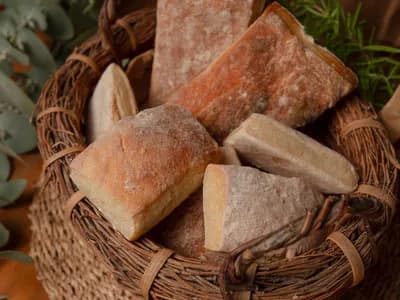
A very wet poolish dough with a wild, open crumb and a thin, crackly crust. Baked on a cordierite stone with a burst of steam, this ciabatta comes out of the kamado like it left a hearth oven.
KEEP READING
Go deeper on this dish
- Recommended kamado
Kamado Joe Konnected Joe
This roscón calls for two bakes in a row at 175 °C with the lid opened between them, and never above 180 °C, because the dough contains sugar and the embers sit underneath. The Konnected Joe holds the setpoint with its fan, within the 107 to 371 °C range the brand states, so there is no need to reach down and adjust the bottom vent while the second roscón is being shaped or decorated. It comes with the two deflector half-moons and the two-level Divide & Conquer as standard: deflectors below, grate above and the 30 cm stone resting on it with air in between. Its grate is the 46 cm of the Classic format, with plenty of room around the stone. The trade-off is that it needs a power socket nearby.
- Editorial guide
How to light a kamado: the step-by-step method
No petrol, no weird tablets and no 45-minute waits. The cone method, airflow control and the mistakes that prevent 80% of the frustration.
- Glossary term
Heat deflector
Ceramic plate placed between the coals and the grate to turn direct fire into indirect cooking.
- Related comparison
kamado joe classic iii vs kamado joe konnected joe
Same Kamado Joe, two opposite philosophies. The Classic III is the classic kamado you light by hand and watch with your…