Analysis by Valery Grin · · updated September 12, 2026
Lacor 67029: stainless steel bench scraper with a handle
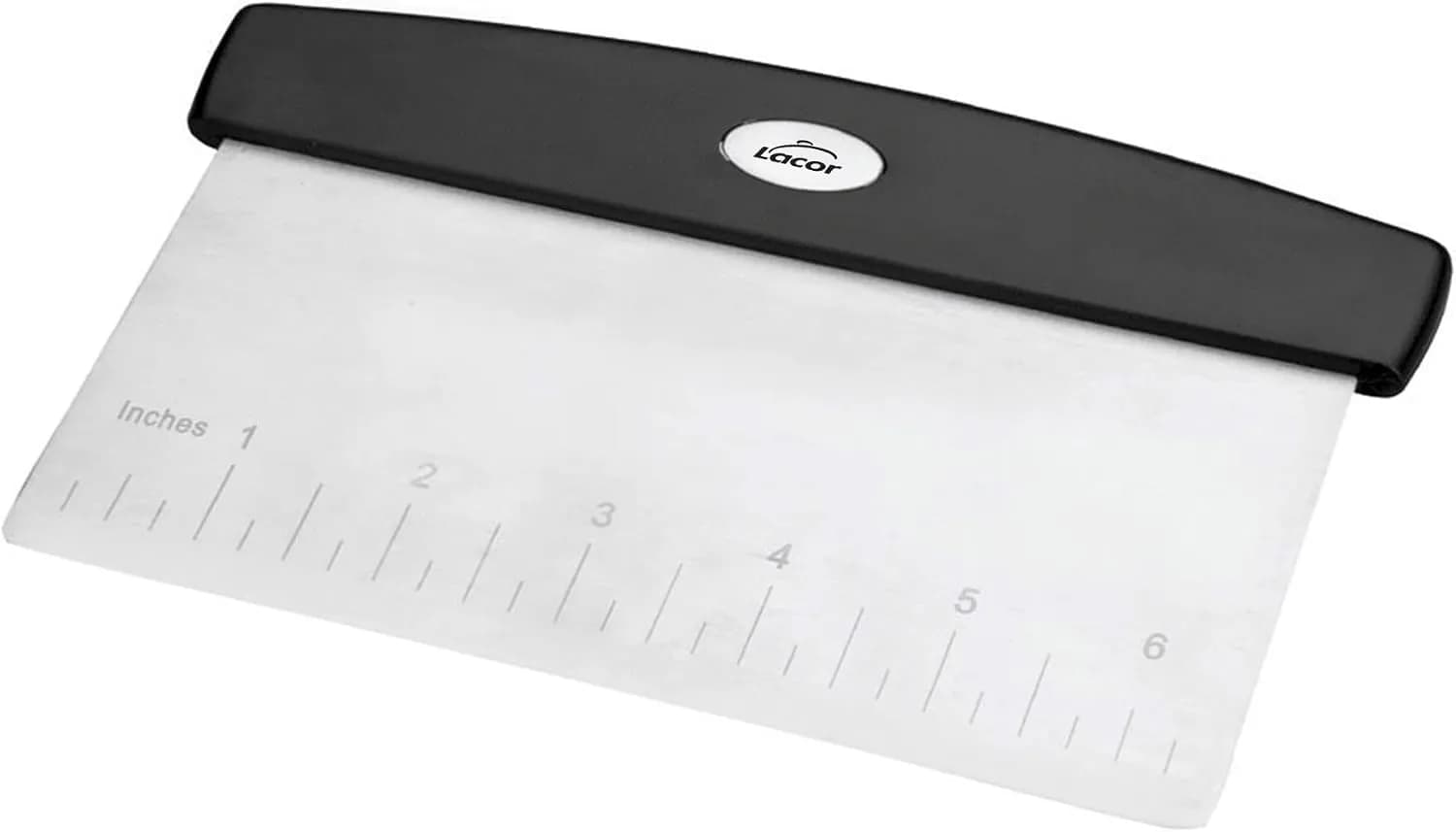
A stainless blade with a printed scale and a non-slip rubber handle, for high-hydration doughs
From€10
Price verified on Amazon on September 12, 2026 · may change
As an Amazon Associate, mikamado.es earns from qualifying purchases. At no extra cost to you.
- Weight
- 0.212 kg
- Material
- Stainless steel blade with a bevelled edge and a rubber handle
Quick answer
Yes for bread, no for the grill. This is the classic bench scraper: a stainless blade around 11 cm with a bevelled edge, a printed scale, a non-slip rubber handle, dishwasher safe, two-year warranty. On an 80 % hydration dough it is what lets you divide and fold without gluing yourself to everything. The handle is rubber: never take it near a hot grate.
Stainless steel, bevelled edge, a measuring scale along the blade and a rubber handle. This is what makes an 80 % dough manageable: divide, fold, lift it off the bench and get it to the peel intact.
The 67029 is Lacor's rectangular bench scraper, and its listing says exactly what you want to read: a stainless steel blade with a bevelled edge, an ergonomic non-slip rubber handle, a measuring scale printed along the edge, 212 g, dishwasher safe, a two-year warranty and Spain as the stated country of origin.
In a kamado kitchen this is not a pastry gadget, it is the tool that makes possible the kind of bread that comes out of hot ceramic properly. [Pan de cristal](/recetas/pan-de-cristal-kamado) runs at 82 % hydration and [ciabatta](/recetas/chapata-aceite-oliva-kamado) at 80 %: doughs that are not kneaded but folded, and that, once tipped onto a semolina-dusted bench, cannot be handled without degassing them. There the scraper does three jobs in a row. It divides the slab into two or three strips with one decisive cut, no sawing. It lifts each strip without stretching it, to get it onto the peel. And afterwards it clears the bench of semolina and stuck dough, which is the job it is named for.
The detail that matters is the handle. Most cheap scrapers are a single folded sheet with no grip of their own: with wet hands — and at 80 % hydration you work with wet hands, not extra flour — that sheet slips and you end up pushing with your fingertips. A rubber grip stops that, and the manufacturer's own listing leans on the ergonomic handle as the product's argument. The scale along the edge is the other useful touch: it divides dough into equal pieces without reaching for the scales, welcome when you are cutting sticky dough against the clock.
And now the warning nobody prints, because it belongs to kamados rather than to bakeries: this is not a grill scraper. The handle is rubber and the blade is thin; against a grate or a cordierite stone at 250 °C the handle deforms and the blade strips away the carbon layer that protects the iron. There is a right tool for the grate — a [grill brush](/accesorios/char-broil-360-cool-clean-brush) — and a stone cleans itself if you let it burn off. It is worth saying, because that is the commonest way to ruin a scraper that otherwise lasts for years. The [maintenance guide](/guias/mantenimiento-limpieza-kamado) sets out that division of labour.
One honest note on the listing: the measurements do not agree with each other. The bullets say 16.5 × 11 cm, the brand block describes a 16.7 × 7.4 cm scraper inside an 18.3 × 10.8 × 1 cm item, and Amazon's technical field gives an 11 cm blade length. What can be said safely is that this is a domestic bench scraper with roughly 11 cm of working edge, comfortable for dividing and portioning, not the 15 cm bakery blade professionals use. For one loaf, two ciabattas or a tray of brioche buns it is plenty; for twenty pieces in a row it is not.
A final buying note: there is a second ASIN on Amazon carrying the same Lacor 67029 reference. It is the same product, so if the page you land on differs in photos or presentation, simply check that the reference matches before paying.
The right bench scraper for high-hydration dough: stainless, rubber handle, printed scale. Only two gripes, both from the listing: the measurements disagree and there is a twin ASIN.
Editorial rating from spec sheet, measurements and kamado fit · not a hands-on test
Pros
- Stainless blade with a bevelled edge: it divides sticky dough in one clean cut and clears the bench without scratching it
- Non-slip rubber handle: at 80 % hydration, with wet hands, that is what keeps it from skating
- A measuring scale along the edge for equal portions without reaching for the scales
- Dishwasher safe, with a two-year warranty stated on the listing
- Sold singly by a Spanish catering brand, in a category full of generic two- and four-packs
Cons
- The listing gives three different blade sizes (16.5 × 11, 16.7 × 7.4 and 18.3 × 10.8 cm): this is a domestic scraper of about 11 cm, not the 15 cm bakery blade
- The handle is rubber, so it is no use scraping a hot grate or stone — and that is exactly how most people ruin one
- It is rigid: for scraping dough out of a curved bowl, a flexible plastic scraper still does it better
- A second Amazon ASIN carries the same 67029 reference: if the page you open differs in photos, check the reference before paying
Who it's for
For anyone baking high-hydration bread in a kamado — cristal, ciabatta, focaccia — still wrestling the dough across the worktop by hand.
Not for
Do not look to it as a grill scraper or an ember spatula: the handle is rubber. And if you scrape out curved bowls, a flexible plastic scraper does that job better.
Specifications
- Weight
- 0.212 kg
- Material
- Stainless steel blade with a bevelled edge and a rubber handle
As an Amazon Associate, mikamado.es earns from qualifying purchases. At no extra cost to you.
Goes well with

FAQ
Can I use it to scrape the grate or the pizza stone?
No, and it is worth being clear about that from day one. The handle is rubber and deforms in the residual heat of a grate that has just gone out, and the thin blade drags off the carbon layer that protects cast iron. A cordierite stone, besides, is not scraped at all: it cleans itself if you let the kamado climb until the fat burns off, and the stains left behind are cosmetic. For the grate, a grill brush; for the scraper, the bench.
Metal or plastic scraper for pan de cristal?
Both, and each does one thing. The metal one cuts: it divides the slab into rectangles with one crisp stroke, lifts pieces off the bench and clears semolina and dried dough. The flexible plastic one scoops: it follows the curve of the bowl and gets all the dough out instead of leaving half behind. If you are only going to own one and you bake at 80 % hydration, make it the metal one, because a clean cut that does not degas the dough is the step that decides the crumb.
How do I handle 80 % dough without wrecking it?
Plenty of semolina on the bench and decisive movements. Tip the slab out without touching the middle, dust the top, and cut straight down by setting the edge and pushing — never sawing, since every stroke back and forth drives the gas out. To move a strip, slide the blade underneath and lift with the scraper acting as a spatula rather than pulling with your fingers. And work with the blade wet or lightly oiled, like your hands, as the ciabatta recipe recommends: dough releases better from damp metal than from floured metal.
Is it dishwasher safe?
Yes, the listing says so and stainless steel has no issue with it. Even so, in day-to-day baking the quick route is hot water and a cloth the moment you finish, before dough dries into the joint between blade and handle, which is where it lodges. If it does go in the machine, take it out before the drying cycle or at least wipe it down: rubber holds droplets and the drawer ends up damp.
Can I cut pizza with it?
You can, but it is not what it is for. A straight scraper crushes a pizza fresh out of the kamado: it pushes the cheese sideways and wrecks the cornicione before it cuts. That is what a wheel cutter is for, and better still a rocker blade, which cuts by rocking pressure and leaves the toppings where they were. On pizza night the scraper has a different job: clearing flour and semolina off the bench where you opened the dough balls.
YOU MIGHT ALSO LIKE