Recipe · Direct · Easy
Kamado-Roasted Potatoes with Cured Pork Fat and Dill
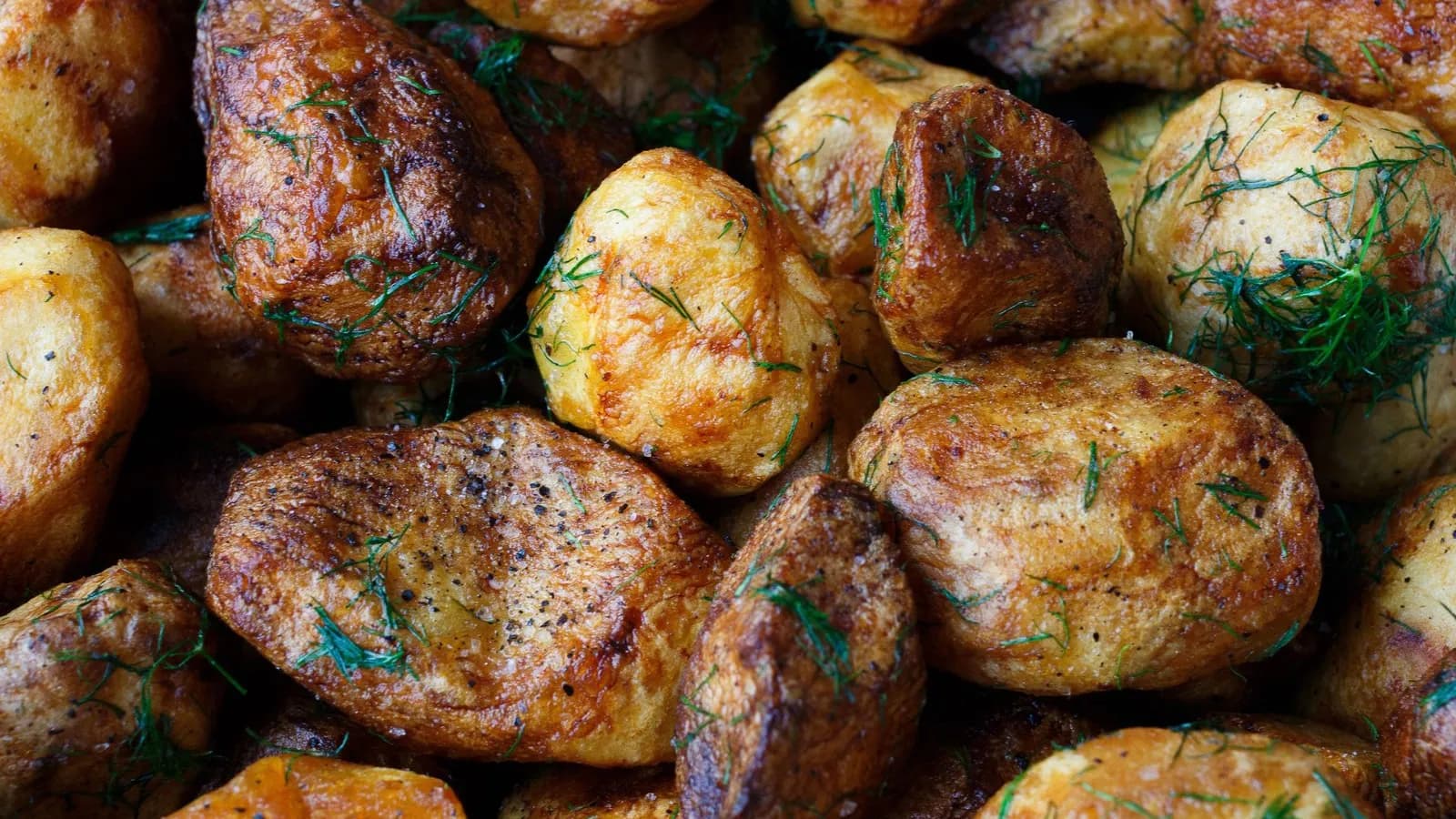
This dacha side dish moves to the kamado: accordion-cut potatoes with slices of cured Iberian tocino, 40-50 minutes in a parcel at 200 °C, a final crisping over direct heat, then dill, garlic and butter.
Quick answer
Cut medium potatoes into an accordion, tuck slices of cured tocino (pork back fat) and garlic between the cuts and wrap in baking parchment and foil. Roast on the kamado grate at 200 °C, direct, for 40-50 minutes, until a knife goes in without resistance. Unwrap, crisp 10-15 minutes on the grate, finish with butter, dill and garlic.
- Prep
- 20 min
- Cook
- 60 min
- Servings
- 4 servings
- Temperature
- 200 °C
Ingredients
- medium baking potatoes, long-shaped, 200-250 g each4 ud
- cured Iberian tocino (pork back fat) in thin slices, or cured papada (pork jowl fat), in place of salo120 g
- garlic cloves (2 sliced for inside, 2 grated for the finish)4 ud
- fresh dill, chopped20 g
- butter40 g
- extra virgin olive oil2 cda
- flaky sea salt, to serve1 cdta
- freshly ground black pepper1 pizca
- young spring onion, in thin rings1 ud
- soured cream (smetana, сметана), to serve150 g
The gear for this recipe
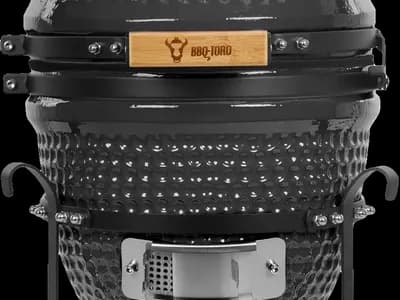
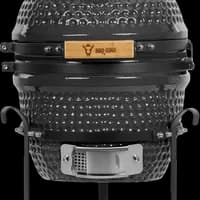 BBQ-Toro Haiiro 32 cmA side dish for four does not call for a big kamado. The **BBQ-Toro Haiiro 32** is a 32 cm ceramic mini kamado in which four parcels of medium potato fit with air around them, six at most if they are small. The ceramic holds the recipe's 200 °C with the lid closed, and the dome thermometer it comes with is enough to watch the hour of roasting. It has a lid thermometer and bamboo handles, which makes it easier to take out the parcels and move the potatoes to the grate to crisp. For a main course and a side dish at the same time it falls short: it is designed for one or two diners.
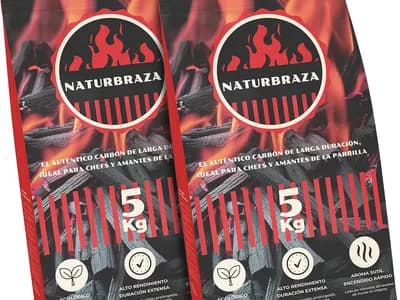
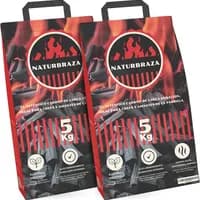 NaturBraza marabu charcoal, pack of two 5 kg bags (10 kg)The recipe asks for a good hour of steady direct fire at 200 °C and a final push to 210-220 °C to crisp. **NaturBraza marabú charcoal** comes in two 5 kg bags and, according to the product page, is marabú wood only, with no additives. Marabú is a very dense wood: its charcoal burns slowly, with a short flame, and leaves little ash, which matters in the small firebox of a mini kamado because ash soon blocks the air inlet. Because ash blocks the air inlet, rake it out before lighting and leave the dust at the bottom of the bag out of the firebox.
 Weber Precision Tongs 46 cm (6760)Here the tongs move foil parcels full of steam and hot fat, and then accordion potatoes that break if squeezed. The **Weber Precision tongs** measure 46 cm, so your hand stays well away from the coals when placing and turning parcels over direct heat. The fine serrated edge grips the fold of the foil without tearing it and lifts the potato by its base without splitting the slices, and the angled handle does not slip on tocino fat. They are solid stainless steel and dishwasher safe, which is welcome after a recipe that sheds this much fat.
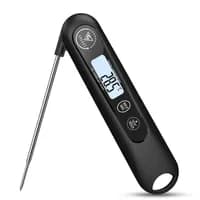 DOQAUS instant-read thermometer, folding probe, 3-second readIn this recipe the knife gives the doneness, and the instant-read thermometer serves to confirm the centre of the thickest potato without leaving the parcel open longer than necessary. The **DOQAUS** is for confirming the centre of the thickest potato, going in vertically down to the base. As a technique reference, a roast potato is done at around 95-99 °C. The magnetic back will not stick to ceramic: hang it from the hook.
Method
- 01
Light the kamado
Fill the firebox of the BBQ-Toro Haiiro 32 to the brim with NaturBraza marabú charcoal and light it with two or three vegetable-wax firelighters in the centre, no liquids. Leave the lid open for about 10 minutes, until there are live coals, and set the grate in with no deflector. Close up with the bottom vent open two fingers' width and the top vent half open until the dome thermometer settles at about 200 °C: allow 25-30 minutes.
- 02
Cut the accordion
Wash and dry the potatoes, unpeeled. Rest each one between two chopsticks or two wooden spoons, which act as a stop, and cut slices 3-4 mm thick without cutting all the way through: a base of 1 cm is left to hold the potato together. If it rocks, trim a thin slice off the base so it sits flat. Work a tablespoon of olive oil in between the slices.
- 03
Fill
Cut the slices of cured Iberian tocino into pieces the width of the potato and push one into every second slit, without forcing: the accordion opens by itself in the heat. In the free slits, spread the two sliced garlic cloves. Add no salt, as the cured tocino already supplies it. Finish with freshly ground black pepper on top and the other tablespoon of oil.
- 04
Wrap
Cut four sheets of baking parchment and four of foil, about 30 cm each. Set each potato on the parchment, which is the only thing that touches the tocino, then wrap it in foil, closing the top with a double fold and leaving some air inside. The parchment keeps the salty fat off the hot metal; the foil holds in the steam that cooks the inside.
- 05
Roast in the parcel
Open the dome with a burp: lift the lid about 5 cm, wait about 5 seconds and open it fully, wearing gloves. Place the four parcels on the grate with the Weber Precision tongs, fold facing up, and close. After 20-25 minutes, burp the lid again and rotate each parcel 180° on the grate without turning it over, fold always facing up, to spread the heat from the coals. In all, 40-50 minutes at 200 °C with the lid closed.
- 06
Check for doneness
Open the dome with a burp (about 5 cm, about 5 seconds, then fully, wearing gloves) and open one parcel with your face turned away, because the steam burns. Pierce the potato at its thickest part with a thin knife: it must go in without resistance down to the base. To confirm the centre, the DOQAUS thermometer reads in about 3 seconds; as a technique reference, a roast potato is done at around 95-99 °C. If it is short, close the parcel and give it 10 more minutes.
- 07
Crisp over direct heat
Remove the foil and parchment with the tongs and put the potatoes on the grate, slices facing up. Leave the vents as they were, as the open lid has already livened the coals, and close it for 10-15 minutes, until the edges are golden and the tocino is crisp. If it is still at 200 °C after 5 minutes, open the bottom vent one finger to climb to 210-220 °C. If the fat sparks a flare-up, close the lid fully; never leave it ajar, and burp it before opening again.
- 08
Finish and serve
While they crisp, melt the butter indoors with the two grated garlic cloves and stir in half the dill. Burp the dome open and move the potatoes to a platter with the tongs, spoon the butter over the slices and add the flaky salt, the rest of the dill and the spring onion. Serve with the soured cream alongside and eat them within the next two hours.
About this recipe
Kartoshka s salom (картошка с салом) is the dacha side dish: potatoes roasted in the embers at the end of an afternoon, with slices of salo melting over them and a handful of dill. This version moves it to the kamado without changing the idea. The potatoes are cut into an accordion, filled with cured Iberian tocino (pork back fat) and garlic, wrapped in parcels and set on the grate at 200 °C for 40 to 50 minutes. At the end they are unwrapped and moved to the grate over direct heat so the edges crisp, then finished with dill, garlic and butter. It is easy, fits in a mini kamado and goes with a codillo (pork knuckle), a cochinillo (roast suckling pig) or the pork neck shashlik.
Accordion, parcel and fire, in that order
The accordion cut is what separates this recipe from an ordinary potato baked in foil. Slices of 3-4 mm joined at the base multiply the surface: heat enters through every slit, the tocino melts inside and its fat runs down towards the centre of the potato instead of being lost on the grate. The closed parcel does the first half of the work, because the potato's own steam cooks the inside without the skin scorching against the hot grate. The fire does the second half: with no wrapping, the slices fan apart, the edges brown and the tocino that peeks out turns crisp. Keep the parcel closed to the end and you get a boiled potato, soft and pale; skip the parcel from the start and the skin burns before the centre is done.
Salo, tocino or papada
Salo (сало) from Ukraine and Russia is pork back fat cured in salt, often with garlic, eaten in very thin slices. It is not pancetta: it has almost no streak of meat, which is why it melts and flavours the dish without drying out. In Spain the closest equivalents are cured Iberian tocino sliced thinly or cured papada (pork jowl fat); both release just enough fat and stand up to an hour of roasting. Pancetta will do, but its lean strip dries out inside the cuts. There are two warnings. The first is salt: cured tocino is already salted, so the potato gets no salt inside, only flakes at the table. The second is the material: the German Federal Institute for Risk Assessment (BfR) advises against wrapping salty food in aluminium, because salt helps the metal migrate into the food. That is why the parcel has baking parchment inside and foil only outside.
A 32 cm kamado is enough
A side dish does not need a big cooker. In the 32 cm of a mini kamado such as the BBQ-Toro Haiiro 32, four parcels of medium potato fit with air around them, six at most if the potatoes are small. In a 46 cm one, Large or Classic size, the grate area is roughly double, and so is the number of parcels. The fire is direct with no deflector, the firebox filled with a dense charcoal such as NaturBraza marabú, which burns slowly and leaves little ash; the guide to which charcoal to use in a kamado explains why hardwood lump leads the field. To settle at 200 °C, the vent settings in the guide to how to light a kamado work: bottom vent open two fingers' width and the top vent half open.
Two things are not negotiable. The first: the potatoes are not buried here. That is the ember method of the chestnuts and sweet potato, with spent embers and ash; a foil parcel sitting for hours over live coals with the kamado wide open only burns the base. The second: when opening a hot dome, burp it (lift the lid about 5 cm, wait about 5 seconds and open fully, with gloves and your face turned away), and if the fat from the tocino sparks a flare-up, close the lid fully, never leave it ajar. The guide to kamado temperature problems covers it.
In 30 seconds
Medium potatoes cut into an accordion with slices of cured Iberian tocino and garlic, wrapped in baking parchment and foil, 40-50 minutes on the kamado grate at 200 °C, direct. Unwrap, crisp 10-15 minutes on the grate and finish with butter, dill and garlic. Done when a knife goes in without resistance, around 95-99 °C in the centre.
Editor's tips
- With small new potatoes the accordion is not worth it: halve them, put a slice of tocino between the two halves, close them in the parcel and start checking for doneness at 30 minutes.
- If any are left over, take off the foil before storing them and get them into the fridge within two hours. A roast potato left wrapped in foil at room temperature is the classic botulism case.
- The fat left in the bottom of the parcel carries all the flavour of the tocino and the garlic: pour it over the potatoes at the table instead of throwing it out with the paper.
- In a 46 cm kamado the grate has roughly double the area of a 32 cm one: double the quantities and leave a couple of centimetres between parcels so the heat can circulate.
Gear for this recipe
As an Amazon Associate, mikamado.es earns from qualifying purchases. At no extra cost to you.
BBQ-Toro Haiiro 32 cm
A side dish for four does not call for a big kamado. The **BBQ-Toro Haiiro 32** is a 32 cm ceramic mini kamado in which four parcels of medium potato fit with air around them, six at most if they are small. The ceramic holds the recipe's 200 °C with the lid closed, and the dome thermometer it comes with is enough to watch the hour of roasting. It has a lid thermometer and bamboo handles, which makes it easier to take out the parcels and move the potatoes to the grate to crisp. For a main course and a side dish at the same time it falls short: it is designed for one or two diners.
€145
NaturBraza marabu charcoal, pack of two 5 kg bags (10 kg)
The recipe asks for a good hour of steady direct fire at 200 °C and a final push to 210-220 °C to crisp. **NaturBraza marabú charcoal** comes in two 5 kg bags and, according to the product page, is marabú wood only, with no additives. Marabú is a very dense wood: its charcoal burns slowly, with a short flame, and leaves little ash, which matters in the small firebox of a mini kamado because ash soon blocks the air inlet. Because ash blocks the air inlet, rake it out before lighting and leave the dust at the bottom of the bag out of the firebox.
€47
Weber Precision Tongs 46 cm (6760)
Here the tongs move foil parcels full of steam and hot fat, and then accordion potatoes that break if squeezed. The **Weber Precision tongs** measure 46 cm, so your hand stays well away from the coals when placing and turning parcels over direct heat. The fine serrated edge grips the fold of the foil without tearing it and lifts the potato by its base without splitting the slices, and the angled handle does not slip on tocino fat. They are solid stainless steel and dishwasher safe, which is welcome after a recipe that sheds this much fat.
€33
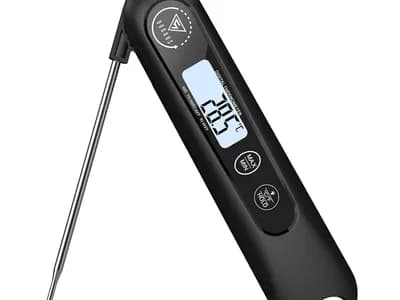
DOQAUS instant-read thermometer, folding probe, 3-second read
In this recipe the knife gives the doneness, and the instant-read thermometer serves to confirm the centre of the thickest potato without leaving the parcel open longer than necessary. The **DOQAUS** is for confirming the centre of the thickest potato, going in vertically down to the base. As a technique reference, a roast potato is done at around 95-99 °C. The magnetic back will not stick to ceramic: hang it from the hook.
€8
FAQ
How long do potatoes in foil take over charcoal?
It depends on size and cut. A medium potato of 200-250 g cut into an accordion needs 40-50 minutes wrapped on the kamado grate at 200 °C, then another 10-15 minutes unwrapped to crisp. Whole and uncut it takes longer, because the heat has to cross all the flesh. The clock is a guide, but the knife decides: it must go in without resistance down to the base.
What is salo and what replaces it in Spain?
Salo (сало) is pork back fat cured in salt, sometimes with garlic or pepper, very common in Ukraine and Russia. It is eaten raw in thin slices or melted over potatoes. In Spain the closest is cured Iberian tocino or cured papada (jowl fat), which have little meat and plenty of fat. Pancetta works, though its lean part dries out inside the cuts of the potato.
How is this different from potatoes cooked al caliu or in the embers?
Cooked al caliu, or in the embers, potatoes are buried in hot ash and dying coals, with no parcel and no grate, as in the recipe for chestnuts and sweet potato in the embers. Here they go in parcels on the grate, with the kamado steady at 200 °C and the lid closed, and are finished unwrapped over the grate. The accordion cut and the tocino only work with this method.
Is it dangerous to leave roast potatoes wrapped in foil?
Yes, if they sit for hours at room temperature. Foil seals the potato from the air, and spores of Clostridium botulinum, which survive roasting, can germinate and produce toxin. The British Columbia Centre for Disease Control (BCCDC) advises eating them within 2 hours, keeping them at 60 °C or above, or refrigerating them within 2 hours. Always remove the foil before putting them in the fridge.
Do the potatoes need boiling before going over the coals?
No. The accordion cut lets heat in through every slit and the closed parcel holds the potato's own steam, so the inside cooks on the grate without a pot. Parboiling shortens the time, but the slices break when cut and the potato absorbs water that later stops the edges from crisping. Better raw and well dried.
More kamado recipes

Whole roasted cauliflower on the kamado with saffron aioli
A whole cauliflower roasted indirect at 180°C: steam first to tame the core, then a deep sear and a spiced glaze. Golden outside, tender inside, with saffron aioli. Serves 4.
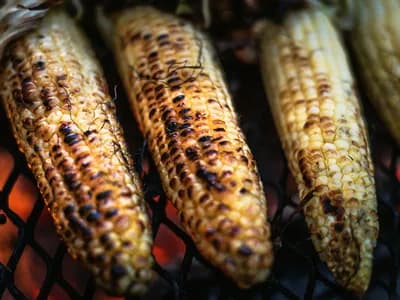
Grilled Corn Mexican Elote Style on the Kamado
Cobs charred over direct fire, slathered with lime mayo, cotija cheese, chili and cilantro. Got leftovers? Strip the kernels and turn them into cups of esquites.
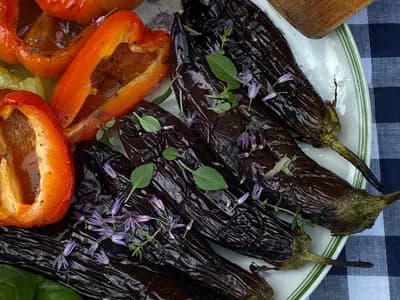
Kamado escalivada with smoked peppers and aubergine
Red pepper, aubergine and onion roasted whole over live coals until the skin chars black, then peeled and dressed with nothing but extra-virgin olive oil and flaky salt.
KEEP READING
Go deeper on this dish
- Recommended kamado
BBQ-Toro Haiiro 32 cm
A side dish for four does not call for a big kamado. The BBQ-Toro Haiiro 32 is a 32 cm ceramic mini kamado in which four parcels of medium potato fit with air around them, six at most if they are small. The ceramic holds the recipe's 200 °C with the lid closed, and the dome thermometer it comes with is enough to watch the hour of roasting. It has a lid thermometer and bamboo handles, which makes it easier to take out the parcels and move the potatoes to the grate to crisp. For a main course and a side dish at the same time it falls short: it is designed for one or two diners.
- Editorial guide
How to light a kamado: the step-by-step method
No petrol, no weird tablets and no 45-minute waits. The cone method, airflow control and the mistakes that prevent 80% of the frustration.
- Glossary term
Heat deflector
Ceramic plate placed between the coals and the grate to turn direct fire into indirect cooking.
- Related comparison
big green egg large vs kamado joe classic iii
The classic kamado matchup: the Big Green Egg Large, the indestructible pioneer with the widest accessory network, agai…