Recipe · Direct · Medium
Chicken tabaka on the kamado: poussin pressed in cast iron, crisp skin
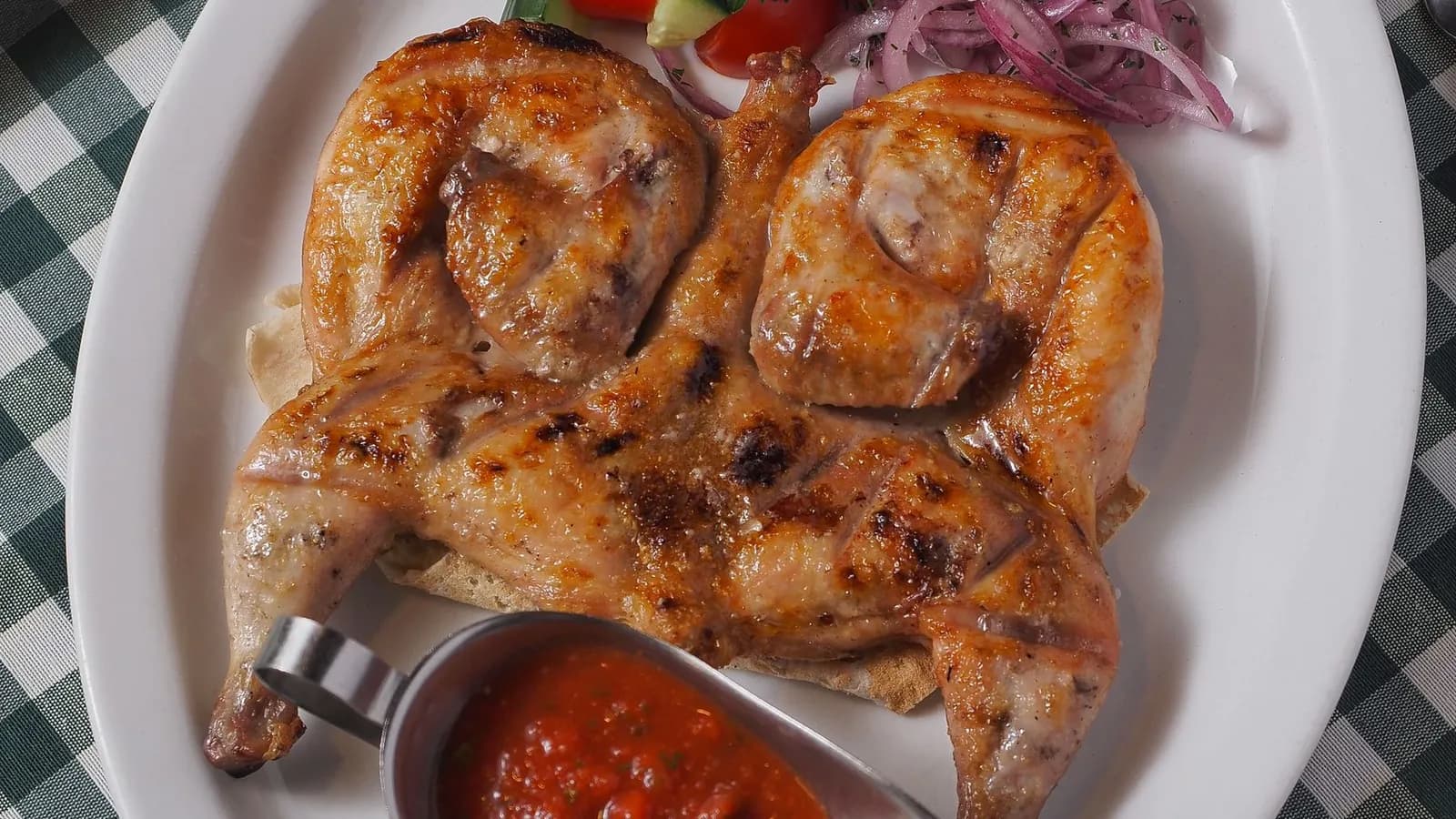
The Georgian poussin that is split down the breast and pressed under a second cast-iron pan, as I cook it on my Big Green Egg Large: direct fire, the whole skin against the metal and garlic with adjika to finish.
Quick answer
Split a poussin of about 500 g down the breast, flatten and salt it. Settle the kamado for direct cooking at 220-230 °C with a 35 cm cast-iron pan inside. Lay the bird skin down, set a hot 26 cm cast-iron pan on top as a weight and close the lid for 12-14 minutes. Turn, 8-10 minutes more, until 74 °C in the breast. Garlic in the fat, adjika alongside.
- Prep
- 25 min
- Cook
- 50 min
- Servings
- 2 servings
- Temperature
- 220 °C
Ingredients
- poussins of about 500 g each2 ud
- coarse salt (12 g for the birds, the rest for the adjika)15 g
- freshly ground black pepper1 cdta
- sunflower or mild olive oil3 cda
- butter30 g
- garlic cloves (4 for the sauce, 2 for the adjika)6 ud
- large red pepper, for the quick adjika1 ud
- fresh red chillies, deseeded2 ud
- ground coriander seed1 cdta
- white wine vinegar1 cda
- fresh coriander, chopped, to serve1 puñado
- flatbreads (shoti or lavash), to serve2 ud

Method
- 01
Split and flatten the poussin
Pat the poussin dry with kitchen paper and set it on the board breast up. Cut along the breastbone with a sturdy knife, open the bird out like a book and press down with your palm until the ribs crack and it lies flat. Tuck the wing tips back behind the shoulders. Salt both sides with 6 g per bird, add the pepper and leave it uncovered in the fridge for 30-60 minutes: the salt dries the skin, and dry skin is the skin that crisps.
- 02
Quick adjika
While the poussin takes the salt, put the chopped red pepper, the two deseeded chillies, two garlic cloves, the ground coriander, half a teaspoon of salt and the vinegar in the blender. Blitz to a coarse paste, not a smooth purée, and taste: it should have heat without burying the pepper. If you would rather use a jar, choose a red adjika without tomato and skip this step. Keep it in a covered bowl until serving.
- 03
Light the Egg for direct cooking
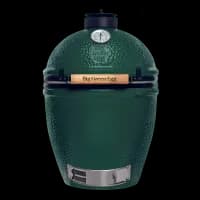
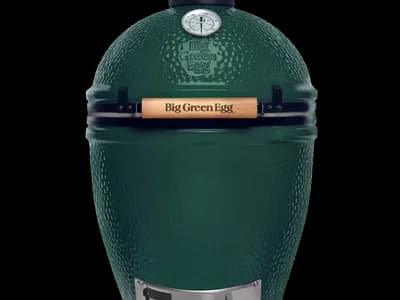
On my Big Green Egg Large I fill the firebox to half height with lump charcoal, light it with one firelighter in the centre and leave the dome open for ten minutes; a dense charcoal such as Jealous Devil's white quebracho is the kind that lasts both batches without a top-up. No deflector: this is a direct cook. I close it with the bottom vent open two fingers' width and the top vent half open, and wait for the dome thermometer to settle between 220 and 230 °C with the smoke running clean. That usually takes about 20 minutes from closing.
- 04
Preheat both pans
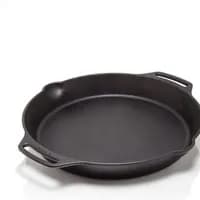
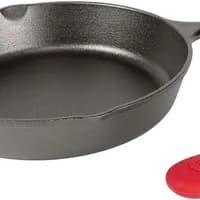
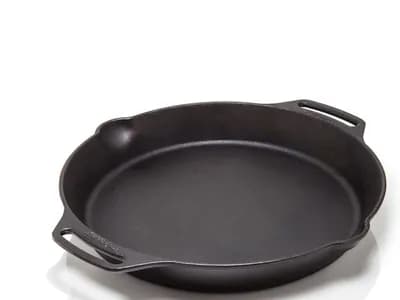
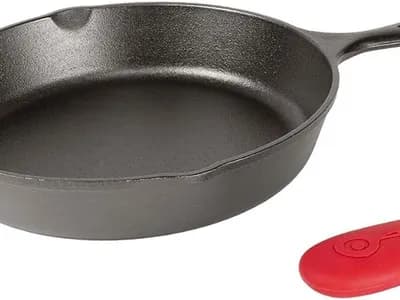
Set the Petromax FP35 on the grate, centred, and inside it the 26 cm Lodge, with its long handle resting over one of the FP35's loop handles and pointing towards you: it stands above the rim, and it is what you will grab with the glove to lift it out. Close the lid and give them ten minutes: iron takes time to load up with heat, and that stored heat is what will brown the skin without the pan cooling when the bird lands. When a drop of water dances and vanishes instantly on the FP35, it is ready. Lift the Lodge out with a thick glove and rest it on a surface that can take the heat.
- 05
Seat the bird and set the weight
Brush the oil onto the skin side of the poussin rather than pouring it into the pan: on iron that already makes water dance, a pool of oil smokes and can catch over the coals. Lay the bird skin down, fully opened out, pushing the thighs down against the base of the pan. Set the hot Lodge on top, its base resting on the bird, and close the kamado lid completely. Not cracked, not ajar. Leave it 12-14 minutes without opening: the iron does the work on its own and the fat the skin releases gathers in the free ring of the pan.
- 06
Burp and turn
Before opening, burp the lid: lift it 5 cm, count three seconds and open fully. With a glove, take the Lodge off and set it aside, its job is done. Turn the poussin with tongs: the skin should be a deep golden brown and lift cleanly off the iron; if it resists, give it two more minutes. Close the lid again and leave it 8-10 minutes skin up, now without the weight, so the bone side finishes.
- 07
Check for 74 °C in the breast
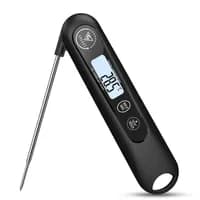
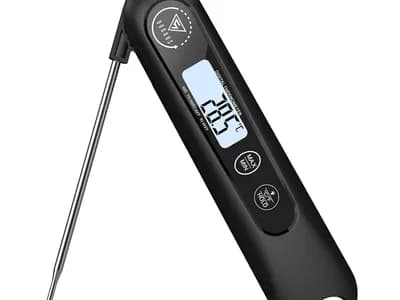
Burp again and measure with the DOQAUS instant thermometer: probe in from the side into the thickest part of the breast, without touching bone. You want 74 °C there, and the thigh above 80 °C. If the breast is two or three degrees short, close up and give it three more minutes; if the thigh is lagging, rotate the bird so the legs sit over the hottest part of the pan. Move the poussin to a warmed platter.
- 08
Garlic in the fat and the second batch
Spoon the fat left in the FP35 into a small saucepan away from the kamado, without scraping the pan. In the saucepan, on the hob, melt the butter with the four finely chopped garlic cloves for 30 seconds and add three tablespoons of hot water: it comes together as a cloudy garlic sauce that goes over the poussin. The FP35 stays inside and hot: brush the second poussin with the rest of the oil, return the Lodge to the pan, close the lid for the five minutes the first bird rests, and repeat from step five.
- 09
Rest and serve
Give each bird five minutes before cutting it into four, down the breastbone and between breast and leg. The first waits uncovered, skin up, on a warmed platter: under foil the steam softens the skin you have just earned. The flatbreads are toasted at the end, in the emptied FP35 with the last of the fat, a minute a side with the lid open, while the second poussin rests. Spoon the garlic sauce over each bird, put the adjika alongside, not on top, and finish with fresh coriander. Eat with your hands, crisp skin up.
About this recipe
Chicken tabaka, or tsyplionok tabaka (цыплёнок табака), is the poussin that in Georgia is split down the breast, flattened under a weight in a cast-iron pan and fried in its own fat until the whole skin turns into a single crisp sheet. The name comes not from tobacco but from tapa (ტაფა), Georgian for "pan": it is cooked in a heavy cast-iron pan with a lid that acts as the weight. On my Big Green Egg Large I cook it over direct fire, with one cast-iron pan acting as the hotplate and another as the weight. It is not the [spatchcock whole chicken](/recetas/pollo-entero-espatchcock-kamado): that is a 1.5 kg bird roasted indirect over a deflector; this is a poussin of about 500 g cooked in a pan, with the kamado as a lidded charcoal stove.
Why cast iron and not the grate
On a grate, a bird's skin browns where it touches the bars and stays soft between them. In a cast-iron pan the skin touches metal across its whole surface, and iron, which is slow to heat, is just as slow to cool: when the cold poussin goes in, the pan does not collapse in temperature the way thin sheet metal would. That is the principle behind the [guide to cast iron and Dutch ovens in the kamado](/guias/hierro-fundido-y-dutch-oven-en-kamado): the iron works as a heat store between the coals and the food. The Petromax FP35 measures 35 cm across the top and has two short handles rather than a long one, which is why it sits on the Large's 46 cm grate and the lid closes without touching it.
The weight is the other half of the technique. A split poussin is not flat: without pressure, only its highest points touch the iron. A second pan on top, preheated, flattens the bird, forces every bit of skin onto the metal and cooks it from above. The 26 cm Lodge fits inside the FP35 leaving a free ring where the fat collects; a square 28 cm griddle plate would not fit, because its diagonal is over 39 cm. A flattened poussin takes up almost the whole pan: one bird per batch, because two 35 cm pans will not fit on the Large's 46 cm grate, and the first waits uncovered on a warmed platter.
Direct, lid closed and burping before you open
There is no deflector here: the pan sits on the grate and the coals hit it from below, as the [guide to direct and indirect cooking](/guias/coccion-directa-vs-indirecta-kamado-deflector) sums up. The charcoal matters because iron needs a bed that does not fade halfway through the cook: Jealous Devil's white quebracho is a very dense wood, and a dense bed of coals lasts longer and recovers as soon as you open the vent. I settle the Egg between 220 and 230 °C on the dome thermometer before the pan goes in, and the pan then preheats inside for another ten minutes.
The poussin gives off fat, and some of it spits out of the pan and lands on the coals. With the lid closed the flare-up finds no oxygen beyond what comes through the vents and dies on its own. What you never do in a kamado is crack the lid open to check on the flame: air rushes in through the gap and the fire comes out at your face. The lid is either closed or open. And opening it with hot fat inside calls for burping: lift 5 cm, count three seconds and only then open fully, as the [guide to kamado temperature and problems](/guias/kamado-temperatura-problemas-soluciones) explains.
Garlic, adjika and 74 °C in the breast
Doneness is the same as for any chicken: 74 °C in the thickest part of the breast, with no exceptions because the bird is small. A 500 g poussin gets there in around 20-24 minutes, but that is a reference, not a clock: the reading comes from an instant thermometer such as the folding DOQAUS, with the probe going into the breast from the side without touching bone. The thigh will be above 80 °C, which is where it is at its best. The moment the bird comes out, the fat from the pan goes into a small saucepan with the chopped garlic, the butter and a splash of hot water: thirty seconds on the heat and you have the garlic sauce that is poured over the chicken in Georgia. Adjika is the paste of red pepper, chilli and coriander served alongside. Here it is a quick blender version, and a jar does the job just as well: every household has its own.
In 30 seconds
A poussin of about 500 g split down the breast and salted, skin down in a 35 cm cast-iron pan preheated in the kamado over direct fire at 220-230 °C, with a hot 26 cm pan on top as a weight. 12-14 minutes with the lid closed, burp, turn, 8-10 minutes more until 74 °C in the breast. Garlic in the fat, adjika alongside, one bird per pan.
Editor's tips
- The weight has to fit inside the pan, not rest on the rim: the body of the 26 cm Lodge fits in the 35 cm FP35 with room to spare and its handle stands above the rim; a square 28 cm griddle plate has a 39.6 cm diagonal and would sit on the handles without touching the bird. If you have no second pan, a small cast-iron pot or a brick wrapped in foil does the same job.
- A flattened poussin covers almost the whole base of the 35 cm pan. Do not force two birds into one: they overlap, the skin that is not touching iron stays soft and the weight flattens neither. One per batch: two 35 cm pans will not fit on the Large's 46 cm grate, and the first waits uncovered on a warmed platter.
- Skin crisps when it is dry. After salting, leave the poussin uncovered in the fridge and pat it dry again with kitchen paper before it touches the oil: damp skin steams against the iron instead of frying.
- The fat in the pan is not for throwing away. It carries the garlic, and a spoonful over flatbread toasted on the coals is worth the whole batch on its own.
Gear for this recipe
As an Amazon Associate, mikamado.es earns from qualifying purchases. At no extra cost to you.

FAQ
What is chicken tabaka and why is it called that?
It is a Georgian poussin split down the breast, pressed under a weight and fried in a cast-iron pan until all the skin is crisp. In Russian it is known as tsyplionok tabaka (цыплёнок табака) and in Georgian as tsitsila tabaka. The name comes not from tobacco but from tapa (ტაფა), Georgian for "pan": it is traditionally cooked in a heavy cast-iron pan with a lid that acts as the weight. It is served with garlic sauce and adjika.
Can I make chicken tabaka with a whole 1.5 kg chicken?
Not with this technique. A bird that size will not fit flattened in a 35 cm pan, and it carries so much meat that the skin burns against the iron before the breast reaches 74 °C. Tabaka works because the poussin is small and thin: it cooks in around 20-24 minutes, all over direct fire. For a large chicken, the spatchcock recipe cooked indirect over a deflector is the one to follow.
What internal temperature is the poussin done at?
74 °C in the thickest part of the breast, measured with an instant thermometer going in from the side without touching bone. The bird being small does not change the figure. The thigh, with more collagen, is better above 80 °C, and in a flattened poussin it usually gets there before the breast because it sits closer to the iron. If the breast is lagging, three more minutes with the lid closed.
Why direct and with the lid closed, if the fat flares up?
Because the pan needs coals underneath to hold frying temperature, and a deflector would leave it lukewarm. Fat that spits onto the coals can indeed catch, and that is exactly why the lid stays fully closed: with no oxygen beyond what the vents let in, the flare-up dies on its own. Cracking the lid open is the dangerous move, because the gap feeds the fire outwards. When you open, always burp: 5 cm, three seconds, then fully.
What can I use as a weight if I do not have a second cast-iron pan?
Anything heavy that can take the heat and fits inside the pan without resting on the rim: a small cast-iron pot, a clean brick wrapped in foil or a pot of hot water standing on a plate. What does not work is a griddle plate or lid wider than the pan, because it sits on the handles and never touches the bird. If the weight is iron it should go on hot, so it does not steal heat from the skin.
More kamado recipes
Crispy chicken wings on the kamado with honey and Pimentón de la Vera (crackling skin, no frying)
Glass-crisp skin without a fryer: dry brine with baking soda, indirect at 200°C with apple smoke and a final sear. Honey and Pimentón de la Vera glaze. Serves 4.
Whole spatchcock chicken on the kamado, even crispy skin
A 1.6 kg chicken butterflied flat, roasted at 180°C indirect over a deflector. Golden crackling skin end to end, juicy meat, ready in an hour: the Sunday roast I actually cook on my Torrevieja terrace.
Chicken Gyros on the Rotisserie in a Kamado
A block of chicken thighs marinated in yoghurt, lemon and oregano, turning on the kamado's rotisserie at 180 °C: shave thin slices as the outer face browns, send the block back to the fire, repeat.
KEEP READING
Go deeper on this dish
- Recommended kamado
Big Green Egg Large
The classic kamado that defined the category
- Editorial guide
How to light a kamado: the step-by-step method
No petrol, no weird tablets and no 45-minute waits. The cone method, airflow control and the mistakes that prevent 80% of the frustration.
- Glossary term
Heat deflector
Ceramic plate placed between the coals and the grate to turn direct fire into indirect cooking.
- Related comparison
big green egg large vs kamado joe classic iii
The classic kamado matchup: the Big Green Egg Large, the indestructible pioneer with the widest accessory network, agai…