Analysis by Valery Grin · · updated September 12, 2026
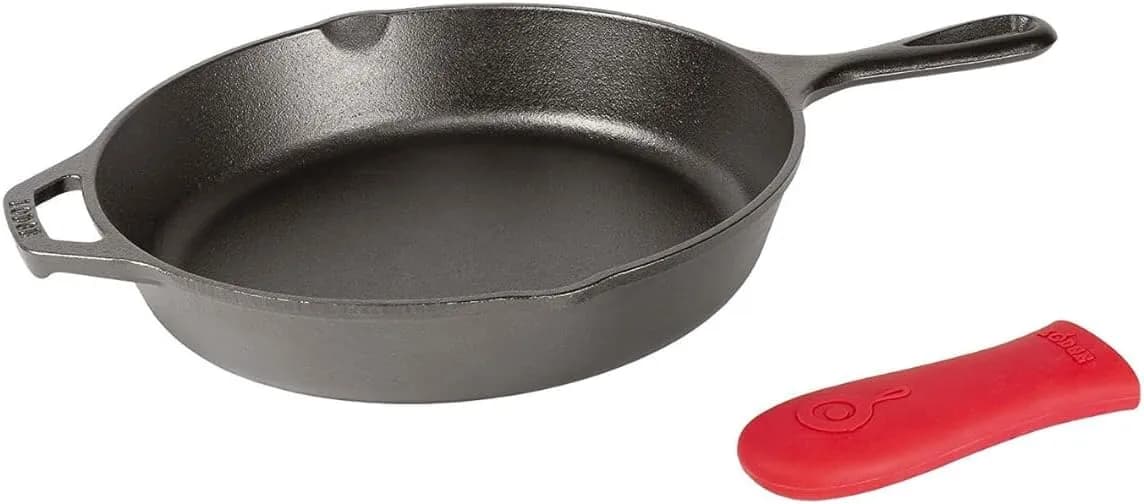
Lodge L8SK3: pre-seasoned cast iron skillet, 26 cm
Solid 10.25" iron that takes a kamado's direct heat at 270 °C and comes to the table with the cheese still in it
From€49
Price verified on Amazon on September 12, 2026 · may change
As an Amazon Associate, mikamado.es earns from qualifying purchases. At no extra cost to you.
- Diameter
- 26 cm
- Weight
- 2.43 kg
- Material
- Solid pre-seasoned cast iron, no enamel and no non-stick (removable silicone handle sleeve included)
Quick answer
Yes, if you cook on ceramic. Solid 26 cm iron takes a kamado's direct heat at 270 °C without warping, holds enough heat to sear the base of a provoleta, and doubles as the tin for a brownie at 175 °C indirect. It ships with a silicone handle sleeve you must always remove: over coals it melts.
A 26.04 cm pre-seasoned cast iron skillet, no enamel and no non-stick. It is the right stand-in for the Argentinian provoletera, which Amazon.es does not sell. The silicone handle sleeve comes off before the coals.
Amazon.es does not sell provoleteras. Type the word into the search box and you get aluminium trays, thin steel dishes and the odd two-handled gadget that would not last half an hour over charcoal: the Argentinian utensil, as such, does not exist in the Spanish catalogue. The sensible answer is a cast iron skillet of 24 to 26 cm, and this Lodge L8SK3 measures 10.25 inches, that is 26.04 cm, the exact top of that range. For [provoleta on the kamado](/recetas/provolone-a-la-brasa-kamado) that means a 10-12 cm wheel of provolone sits with room to spare, and the walls — around 5 cm tall — hold the melted cheese instead of letting it run onto the coals.
What makes it right for ceramic is, above all, what it lacks. No enamel, which is the first thing to chip when a dome climbs from 120 to 280 °C in ten minutes, and no non-stick, which degrades long before it gets there. It is solid cast iron with a factory cure of polymerised oil, and that is the one domestic cooking surface you can leave sitting on live coals without a second thought. The handle is cast into the same piece — not bolted on, which is where cheap pans work loose — and there is an assist handle opposite, so you grip it with two gloves and lift it out of the kamado without balancing it one-handed.
Thermal mass is the other half of the argument. Its 2.43 kg of iron are slow to heat and far slower to cool, which is exactly what you need when 400 g of cold cheese lands on a surface that cannot afford to drop in temperature: the base seals instantly and builds the crust that holds the whole wheel together when you serve it. The same inertia works [direct](/glosario#direct-cooking) at 250-270 °C with [Padrón peppers](/recetas/pimientos-padron-brasa-kamado), and it works [indirect](/glosario#indirect-cooking) behind a deflector between 175 and 190 °C, where the pan stops being a pan and becomes a tin: [smoked brownie](/recetas/brownie-ahumado-sarten-hierro-kamado), [cherry clafoutis](/recetas/clafoutis-cerezas-sarten-hierro-kamado), [nachos](/recetas/nachos-ahumados-kamado) or [stuffed portobellos](/recetas/portobello-relleno-ajillo-kamado). In all of them the iron keeps cooking for fifteen minutes after it leaves the kamado, so pull it a shade earlier than instinct tells you.
Two warnings the Amazon listing does not put this plainly. First: the set includes a red silicone handle sleeve, designed for a domestic hob and rated to around 260 °C. Over direct heat in a kamado it melts, so it comes off every time before the pan goes near the fire, and goes back on, at most, to carry the pan to the table. Second: the factory seasoning is a base, not a non-stick coating. There are Spanish reviews complaining that everything sticks, and it is almost always that — a new pan nobody finished seasoning. Before the first cook, wipe on the thinnest possible film of high-smoke-point oil, set it upside down at 220 °C indirect for an hour and let it cool inside; two or three rounds and the problem is gone. The full routine is in [the cast iron and dutch oven guide](/guias/hierro-fundido-y-dutch-oven-en-kamado).
It is bought through Amazon Global Store, imported from the United States: the listing itself warns that imported items may differ from local products and that the manufacturer's European warranty does not apply, and the total includes import charges. With bare iron that matters little — there is no electronics to fail and no spare part to order — but it is worth knowing before you pay. And if you cook on the coast, dry it over the fire after washing and give it a film of oil: salt air rusts bare iron considerably faster than inland air does, as [the salt and coastal climate guide](/guias/proteger-kamado-salitre-humedad-clima-costero) explains.
The right stand-in for a provoletera Spain's catalogue does not sell, and the tin for half the kamado's baking besides. Pull the silicone sleeve off and season it before the first cook.
Editorial rating from spec sheet, measurements and kamado fit · not a hands-on test
Pros
- 26.04 cm across: the right size for a 10-12 cm wheel of provolone, with roughly 5 cm walls that hold the melted cheese in
- Solid cast iron, no enamel and no non-stick: it takes a kamado's 270 °C direct heat with nothing to chip or degrade
- 2.43 kg of thermal mass that sear the cheese on contact instead of dropping in temperature when the food goes in
- Handle cast into the body plus an assist handle opposite: lifted out of the kamado with two gloves, no wobbling
- Doubles as a tin at 175-190 °C indirect for brownie, clafoutis, nachos or portobellos, and goes from coals to table
Cons
- The red silicone sleeve in the set cannot go into the kamado: it is rated to around 260 °C and melts over coals, so you must remember to pull it off every time
- The factory seasoning is a base, not a non-stick coating; there are Spanish reviews complaining everything sticks until you season it two or three times
- It arrives via Amazon Global Store from the United States: no European manufacturer's warranty, import charges in the price, and a notice that imported items may differ from local ones
- Amazon does not list the diameter in centimetres: the 26.04 cm comes from the L8SK3's 10.25 inches, not from the listing's specification table
- 2.43 kg on a short handle: it needs a thick glove or tongs, and lifting it full out of the kamado one-handed is not an option
Who it's for
For anyone cooking provoleta, skillet puddings or direct-heat starters who wants one piece of bare iron that goes in and out of the kamado without fearing 270 °C.
Not for
Not for anyone who wants to take it out of the box and cook: the factory seasoning is a base and needs two or three rounds before it behaves. Nor for anyone after non-stick or dishwasher-safe.
Specifications
- Diameter
- 26 cm
- Weight
- 2.43 kg
- Material
- Solid pre-seasoned cast iron, no enamel and no non-stick (removable silicone handle sleeve included)
As an Amazon Associate, mikamado.es earns from qualifying purchases. At no extra cost to you.
Goes well with
FAQ
Can I put it straight on the kamado's coals?
Yes, that is what it is built for. Bare cast iron has nothing to chip or degrade, so it takes direct heat with no deflector: provoleta is cooked at 230 °C and Padrón peppers at 250-270 °C. Two conditions: take the silicone sleeve off first, because it melts, and never quench it under cold water when it comes out — thermal shock is the one thing that can crack a casting.
Is this the same as a proper provoletera?
Not exactly, and that is worth saying. An Argentinian provoletera is a low-rimmed iron disc with a long handle, made for one job. This skillet has taller walls — around 5 cm — and a short handle, so you handle it with a glove or tongs. In exchange it does the same job (holding the cheese and searing its base) and also works as a frying pan, a baking tin and a serving dish. There are simply no provoleteras on Amazon.es: searching for one returns nothing real.
Everything sticks — is mine faulty?
Almost certainly not. The factory seasoning is a starter layer, not a finished non-stick surface, and it is the most repeated complaint in this pan's Spanish reviews. Season it before the first cook: the thinnest possible film of high-smoke-point oil inside and out, excess wiped back with paper until it looks dry, then an hour upside down in the kamado at 220 °C indirect behind a deflector. Let it cool inside and repeat two or three times. From then on every fatty cook improves it.
Will it fit any kamado?
It depends on the size. At 26 cm plus the handle, on an 18-inch kamado (Kamado Joe Classic, Big Green Egg Large, Monolith Classic) it sits with room around it and still leaves free grate. On a Joe Jr, a MiniMax or a Monolith Icon it fits, but it takes up practically the whole grate: nothing else goes on beside it and you are tight for room getting it in and out with gloves. Worth bearing in mind if your ceramic is one of the small ones.
How do I clean and store it in a coastal home?
While it is still hot, with water and a brush or a stainless mesh; a little mild soap now and then will not ruin the seasoning — leaving it to soak will. What matters is what comes next: dry it over the fire until there is not a trace of moisture left, then wipe on the thinnest film of oil before it goes away. On the coast that is not fussiness: salt air rusts bare iron far faster, and a pan put away damp on the porch will show rust within a week.
YOU MIGHT ALSO LIKE