GUÍA DE COMPRA
Supermarket kamados from Lidl, Aldi, Carrefour, Leroy Merlin, Create and Cecotec: are they worth it?
What Spanish retailers actually sell, what you get for under 500 euros and when it pays to step up to an entry-level brand.
Quick answer
A supermarket kamado is worth it for learning and cooking for two to four people. Lidl's, with a grate of about 26.5 cm, appears in seasonal campaigns and sells out fast; Leroy Merlin, Create and Cecotec keep permanent models. All cut corners on ceramic, gasket and hardware, so expect to replace the gasket early.
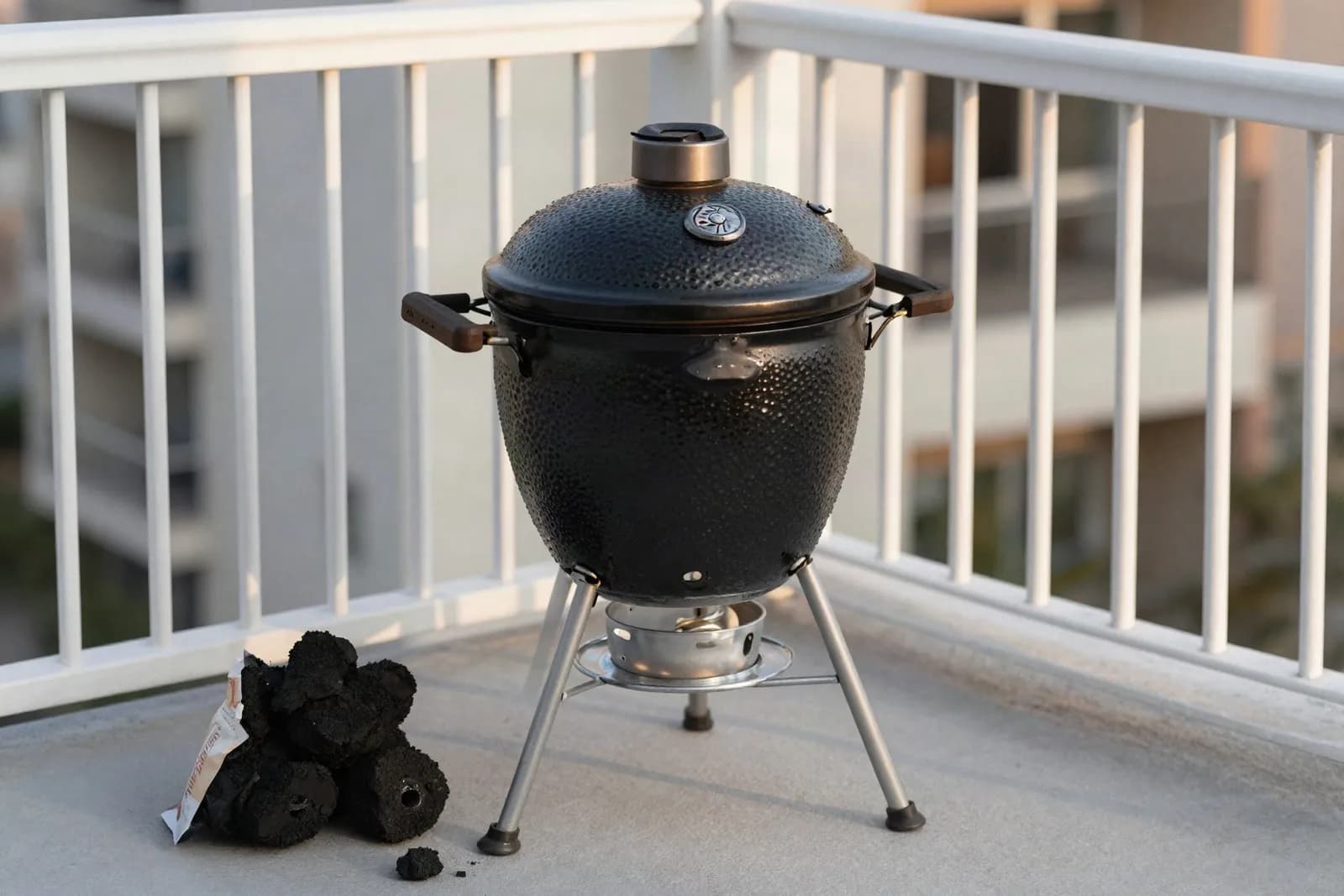
A supermarket kamado is worth it if you cook for two to four people, use it often without twelve-hour sessions and accept that you will replace the gasket and watch the glaze sooner than on a branded kamado. To learn the technique on a small budget, yes; as a grill for life, rarely. The catch is that the offer changes every season: the Lidl kamado appears and sells out within days, Aldi has no current listing in Spain, and what you see at Carrefour or Makro is usually a third-party marketplace. We checked every retailer's product pages in September 2026, and here is what they sell, how big their grates are and where they cut corners. Our judgement comes from six years of kamado cooking in Torrevieja, with a Big Green Egg Large as our benchmark, and we are never paid for reviews.
| Retailer | Model | Grate | Material | Guide price | Our take |
|---|---|---|---|---|---|
| Lidl | Grillmeister Barbacoa de cerámica | 26.5 cm | Glazed ceramic, felt gasket | Around €100-110 (seasonal) | Good starter for two |
| Leroy Merlin | Naterial Drago; Kamado Mediana | 46 cm; 37 cm | Ceramic, steel cart | €500-700 | Check a brand with spares first |
| Carrefour | vidaXL and Create (marketplace) | 26.5-33 cm | Ceramic | Depends on seller | Third-party seller warranty |
| Makro | H.Koenig YOKO18 (marketplace) | 39 cm | Ceramic, about 72 kg | Depends on seller | Family size; check the seller |
| El Corte Inglés | Weber Summit Kamado E6; Broil King KEG | 61 cm (Weber) | Double-walled steel | High end | Not a budget kamado |
| Create | BBQ Kamado 13, 16 and 21" | 26.5 / 34.5 / 46 cm | Ceramic, 3-year warranty | Around €250 (13" and 16") | The 16" is the best balanced |
| Cecotec | DragonFire 3200 to 6600 | 32 to 66 cm | Ceramic, cast-iron stand | From about €160 (3200) | The 3200 is the Lidl model's direct rival |
What you get for under 500 euros (and what you don't)
A cheap kamado is not a fake kamado. The shape, the working principle and the two air vents are the same as on a Big Green Egg: a ceramic pot that stores heat and an adjustable draught that sets the temperature. What changes is everything the photo doesn't show. The ceramic is usually thinner and fired with less control, so it holds a little less heat and is more sensitive to sudden temperature changes; none of the product pages we reviewed states the wall thickness, which tells you something. The gasket is almost always basic felt, like the one on the Lidl kamado according to its listing, and it is the first part to burn. The firebox, when there is one, is thin ceramic or just a cast-iron charcoal grate at the bottom. The hinge and metal band are painted steel rather than stainless, and the dome thermometer is only a rough guide. In return you get the essentials: a seal good enough to smoke at 110 °C, the ability to climb to 300 °C for searing, and exactly the same learning curve as on an expensive model. What you don't get is headroom: few official spare parts, fewer compatible accessories and warranties that cover manufacturing defects, not the normal wear of the gasket or hardware.
Lidl and Aldi: which models, when they appear and what we think
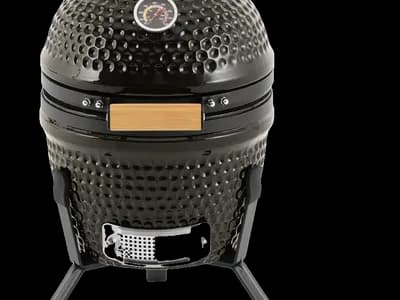
The Lidl kamado is the Grillmeister "Barbacoa de cerámica", a small egg with a stainless-steel grate of about 26.5 cm, a cast-iron charcoal grate, a felt gasket, a spring-assisted lid and a dome thermometer. According to Lidl's product page it weighs around 23 kg and works between roughly 50 and 450 °C. It is sold mainly through the online shop and in the spring and summer barbecue campaigns; at the end of September 2026 it was listed as sold out, and in recent years its price has moved between just under 100 euros on offer and around 110. In practice it is a 13-inch kamado: enough for two people, a small chicken or one thick steak. Our reading is that, as a gateway to the technique, it is honest, and nothing else in ceramic comes close for that money. But its grate won't take a normal-sized pizza or a lamb shoulder, and the felt gasket will last one season if you use it seriously. The warranty isn't mentioned on the listing, although the legal guarantee in Spain for a new product is three years. As for Aldi, in other countries it sells seasonal ceramic kamados with a cart and side shelves, but we found no current listing at Aldi Spain; if you spot one in the leaflet, compare the grate size and weight with the figures in this guide before you buy.
Leroy Merlin, Carrefour, Makro, Bauhaus and El Corte Inglés
The Leroy Merlin kamado is not one model but a catalogue. Its own brand, Naterial, offers the Drago, a 46 cm ceramic kamado on a cart with shelves, a double grate and a wok, which according to Leroy Merlin's listing is designed for six to ten people and costs around 700 euros. Alongside it the chain sells generic models such as the "Barbacoa Kamado - Mediana", with a 37 cm grate and 71 kg, close to 500 euros, and Create and H.Koenig appear in its marketplace. It is the only retailer on this list where you can see a kamado in a physical store before buying. Carrefour has no kamado of its own: on its website you will find third-party sellers, mostly vidaXL with grates between 26.5 and 33 cm, plus the Create. Makro works the same way through its marketplace: H.Koenig YOKO (the YOKO18 has a 39 cm grate and weighs about 72 kg, according to the manufacturer's listing), Grill Guru and Tarrington House. At Bauhaus we found no current listing for a ceramic kamado. And El Corte Inglés plays in a different league: what it sells under the kamado name is the Weber Summit Kamado E6 and the Broil King KEG, both double-walled steel and priced at the high end. A warning for every marketplace: the warranty, delivery of a 70 kg product and returns are handled by the seller, not the retailer.
Create and Cecotec: the kamados sold online
Create and Cecotec are two small-appliance brands well known in Spain that have entered the kamado market with aggressive prices and online sales, Amazon included. The Create kamado (BBQ Kamado) comes in three sizes: 13 inches (26.5 cm grate, 21 kg), 16 inches (34.5 cm, 30 kg) and 21 inches (46 cm, 86 kg), with a three-year warranty according to Create's listing; the two smaller ones have been on offer at around 250 euros. The 16-inch is the most interesting of the group: 34.5 cm lets you cook for four and fit a medium pizza. The Cecotec kamado is the DragonFire family: 3200 (32 cm), 4600 (46 cm), 6000 (60 cm) and 6600 (66 cm). According to its official shop, the 3200 costs around 160 euros and the 4600 sits between 600 and 700; all have a cast-iron stand, a thermometer and a three-year warranty. The listing boasts "resistance up to 1000 °C", a marketing figure that tells you nothing useful: no home kamado cooks at that temperature, and what matters is how the ceramic withstands hundreds of heating cycles. Who are they for? The 16-inch Create or the DragonFire 3200 suit anyone who wants a step up from the Lidl model without going over 300 euros. The larger sizes of both brands already compete on price with branded ceramics that come with spare parts, and there we would look at the entry-level range first.
The five things that fail first on a cheap kamado
After six years with kamados and hundreds of community threads read, the wear pattern of budget models is very predictable. First, the gasket: the felt chars after a few pizza or searing sessions, leaks air and stops you bringing the temperature down. Replace it with a fibreglass one following our gasket replacement guide. Second, the outer glaze: fine surface cracks appear that are cosmetic at first, but if water gets in and freezes, or salt builds up, they spread. Third, the hinge and metal band: they loosen under the weight of the lid and knock the seal off centre; check the bolts every month and grease the spring. Fourth, the dome thermometer: it is often off by several tens of degrees, so test it in boiling water and cook with a digital probe. Fifth, the base and cart: painted steel that rusts, small wheels and legs that suffer under 70 kg. On the coast all of this speeds up; in Torrevieja we see it every summer. A breathable cover, emptying damp ash and following our guide to salt air and humidity extend the life of any kamado, and even more so a cheap one.
An honest comparison with branded entry-level kamados
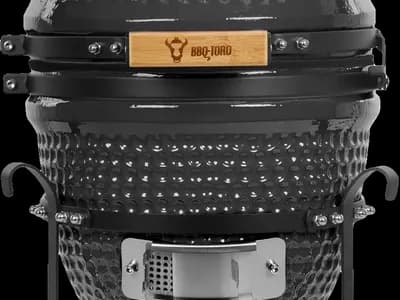
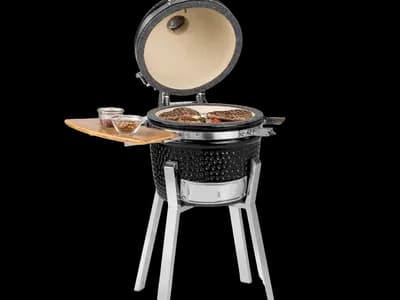
Between the supermarket kamado and a Kamado Joe or Big Green Egg there is a middle step worth looking at before you decide. The 40 cm Kamado Bono Minimo and the 51 cm Kamado Bono Media are ceramics with spare parts and an active community behind them. The Char-Griller Akorn and its little brother, the Akorn Jr., are double-walled insulated steel: much lighter, they don't break if knocked and heat up quickly, at the cost of holding heat less well and rusting if neglected. In compact ceramic you have the BBQ-Toro Haiiro, the Klarstein Princesize Pro and the Landmann Kamado Mini, which go head to head with the Lidl model. When is the step up worth it? If you will cook for more than four people, if you want to make pizza often or run long smokes, and if you value being able to order a gasket, firebox or hinge in three years' time. Paying a little more for a brand with spare parts usually works out cheaper than buying two kamados. If your spending ceiling is clear, see our pick of the best value kamado, our kamados under 1,000 euros, or compare specs side by side in the comparison tool.
Who it suits and who it doesn't
A supermarket kamado suits three profiles. The curious cook who wants to try ceramic cooking without risking much money and learn to manage the draught before investing seriously. The couple with a small terrace who cook for two, grill skewers, a sea bream or a small chicken, and don't need more than 30 cm of grate. And anyone looking for a second kamado for the beach flat or the village house, knowing it will wear out sooner. It does not suit the family of six who want to cook ribs and vegetables at the same time, anyone dreaming of 400 °C pizzas every Friday, or someone living on the seafront with nowhere to keep it under cover. Nor anyone who expects it to last twenty years without maintenance. If you are unsure about size, the general rule is 33 cm for two to four diners and 46 cm for four to eight. Our calculator weighs people, use and budget and tells you whether an entry model is enough or whether it pays to save for a few more months. And if you are still not sure a kamado is for you, first read whether a kamado is worth buying and, once you have decided, our first kamado guide.
Getting started right: first fire, curing and charcoal
A cheap kamado is less forgiving of first-day mistakes, so take your time breaking it in. Before lighting, check that the lid closes centred, tighten the metal band and make sure the gasket has no folds. The first fire should be a cure: little charcoal, vents almost closed and two or three hours between 120 and 180 °C, so the ceramic and the gasket adhesive settle without thermal shock. Repeat the next day climbing to around 250 °C, and only then try searing. Never go from cold to 350 °C in ten minutes, especially with the lid open in the wind: it is the quickest way to crack a thin firebox. Use lump charcoal, never briquettes with additives or lighter fluid, because porous ceramic absorbs odours; our guide to which charcoal to use in a kamado helps you choose, and how to light a kamado explains the method with natural firelighters or a chimney starter. Buy a digital probe too and, if the model has no deflector, a stone or ceramic plate to act as a barrier for indirect cooking. With those two accessories, a Lidl or Leroy Merlin kamado already cooks very well.
Supermarket and big-box kamados exist, they work and they teach you the technique for a fraction of the price of a brand. Lidl's is a small seasonal egg; Leroy Merlin has the widest range in physical stores; Carrefour and Makro sell through third parties; Create and Cecotec are the most complete online options, with a three-year warranty. They all cut the same corners: thinner ceramic, a felt gasket, painted hardware and an approximate thermometer. If you cook for two and accept the upkeep, buy one without hesitation. If you are thinking of a family, weekly pizza or many years of use, stepping up to an entry-level range with spare parts will work out cheaper in the long run.
Gear featured in this guide
GO DEEPER
Continue with these
- Related guide
Kamado barbecue: what it is, how it works and which one to buy in Spain (2026)
The kamado barbecue, plainly: how the ceramic works, which types and sizes exist, what it really costs and which models deserve your money in Spain this year.
- Related guide
Your first kamado: the complete pre-purchase guide
Size, materials, brand and budget. Everything you have to decide before clicking Buy, told by someone who has made enough mistakes.
- Related guide
What charcoal to use in a kamado (and which to avoid)
Quebracho or holm-oak lump wins; supermarket briquettes and chemical lighter fluid stay out. Here is what to load and why.
- Related guide
Replacing a kamado gasket: when it is due and how to fit it
The banknote test, which fibre to choose, how to strip the old adhesive and the cure that stops a new gasket peeling off on the first hot fire.
- Editorial comparison
kamado joe joe jr vs klarstein princesize pro
The first-kamado-for-the-terrace dilemma: €549 for a Joe Jr that's a real Kamado Joe, or €449 for a Klarstein Princesize
- Glossary term
Heat deflector
Ceramic plate placed between the coals and the grate to turn direct fire into indirect cooking.
- Glossary term
Firebox
Lower ceramic part inside the kamado that holds the charcoal and contains combustion.
- Glossary term
Gasket
Fibre band that seals the join between the ceramic base and lid, ensuring the kamado is airtight.
Frequently asked questions
Is the Lidl kamado worth it?
Yes, if you see it as a kamado for two people and for learning. Its roughly 26.5 cm grate, felt gasket and lid thermometer limit what you can do, but at its price there is no comparable ceramic. Don't buy it if you cook for four or more, or if you want to make pizza often.
How long does a cheap kamado last?
Looked after, the ceramic lasts for years; what gives out first is the felt gasket, which usually needs replacing in the first or second season of frequent use, and the painted hardware, which rusts in damp or coastal areas. Keeping it dry, covered and free of damp ash is what extends its life most.
Can you make pizza in a supermarket kamado?
Yes, within limits. A 26 to 32 cm model only fits a small pizza, you need a deflector and a stone, and the felt gasket suffers above 300 °C. From around 35 cm, like the 16-inch Create, it becomes reasonable. You will find the method in our kamado pizza guide.
Steel kamado or cheap ceramic?
Double-walled steel, like the Char-Griller Akorn, weighs less, won't break if knocked and heats up quickly, but holds heat less well and rusts if neglected. Cheap ceramic holds heat better on long smokes, though it is heavy and fragile. If you will move it often, go for steel; if you prioritise long, stable cooks, ceramic.
What accessories does a Lidl or Leroy Merlin kamado need?
Three, in this order: a digital probe, because the lid thermometer is only approximate; a deflector or stone for indirect cooking, if one isn't included; and a spare fibreglass gasket. After that, a breathable cover and long tongs. You will find more ideas in essential kamado accessories.
When do kamados appear at Lidl and Aldi?
Lidl launches its kamado in the spring and summer barbecue campaigns, mainly in its online shop, and it tends to sell out within days; out of season it shows as sold out. We found no current kamado listing at Aldi Spain. The practical approach is to watch the leaflets from March and decide on the size before it comes out.