Recipe · Direct · Easy
Grilled Navarre-Style Trout on the Kamado, Stuffed with Ham
Classic trucha a la navarra is fried. This version goes over direct fire at 250 °C: toasted, crisp skin, serrano ham inside and 10-12 minutes on the grate. It fits a Tuesday-night dinner.
Quick answer
Stuff each portion trout (300-350 g) with two slices of serrano ham, dry and oil the skin and grill it direct on the kamado at 250 °C over a very hot grate: 5-6 minutes untouched, turn with a fish spatula, then 4-5 minutes more, to 60 °C by the bone. Serve with garlic, parsley and lemon.
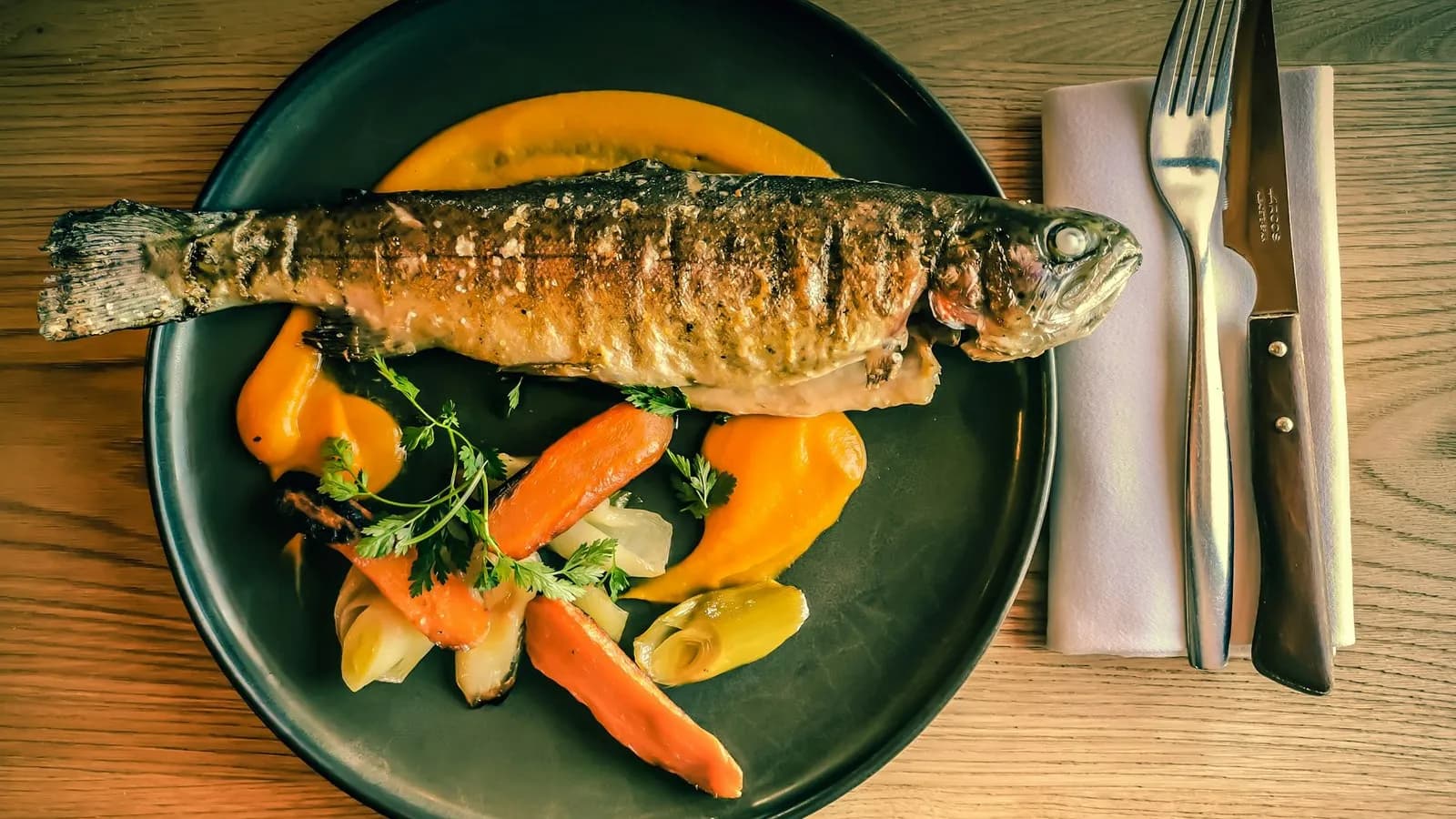
One big step at a time, screen kept on and built-in timers.
- Prep
- 20 min
- Cook
- 15 min
- Servings
- 3 servings
- Temperature
- 250 °C
What time do you want to eat?
Pick a time and we'll tell you when to start.
12:55
Start the prep
13:15
Light the kamado
13:35
Onto the kamado
14:00
Serve
Estimate: it includes lighting and settling the kamado plus a margin for large cuts. If the recipe asks you to marinate or salt ahead, add that time.
Fire setupDirect heat
- Dome
- 250 °C
- Deflector
- No
- Grate
- Standard height
- Fuel
- Quebracho charcoal, full firebox
Temperature curve
0:43 h from lighting
Kamado domeInside the meat (probe)
| # | From | Phase | Dome | Internal |
|---|---|---|---|---|
| 1 | 0:00 | Light the charcoalDirect, no deflector, dome at 250 °C | 20 → 250 °C | no probe |
| 2 | 0:20 | StabiliseAt 250 °C, 10 more minutes to heat the grate | 250 °C | no probe |
| 3 | 0:30 | Put the food inBurp the dome, brushed grate, trout at an angle to the bars | 250 → 215 °C | 6 °C |
| 4 | 0:31 | Cook5-6 min untouched, until the skin releases | 215 → 250 °C | 6 → 35 °C |
| 5 | 0:37 | CookTurn from the back; pull at 60 °C by the spine | 240 → 250 °C | 35 → 60 °C |
| 6 | 0:42 | SearReserved ham, 20-30 s a side, until it curls | 250 °C | no probe |
| 7 | 0:43 | Serve | off | no probe |
0:00 is the moment you light the charcoal. Internal temperatures are the ones the recipe gives; without a probe, go by the times. Turn these times into clock times with the planner
For this recipe
Ingredients
- portion-sized rainbow trout (300-350 g each), cleaned, whole, head and bone in3
- serrano ham (jamón serrano) in thin slices (9 slices: 6 for stuffing and 3 for crisping)135 g
- extra virgin olive oil for the skin30 ml
- extra virgin olive oil for the dressing60 ml
- garlic cloves, very finely chopped2
- fresh parsley, chopped15 g
- lemons (one for the dressing and one cut into wedges to serve)2
- fine salt (go easy: the ham is already salty)1 tsp
- freshly ground black pepper1 pinch
Another cut
Got a different cut? Here is how the recipe changes
For 3 people the recipe uses 1.2 kg (3 pieces) of portion-size whole fish: indirect at 200 °C, 20 min plus 5 min rest. If the shop had something else:
- Fire
- Indirect · 200 °C
- Time
- 40 min
- Rest
- 10 min
Light 25 min earlier
Same recipe, one big fish. Indirect at 200 °C and pull at 58-60 °C in the centre, next to the bone. Use a large sea bass or bream and serve it on the platter.
- Salmon (fillet)Buy 700 g
- Fire
- Indirect · 190 °C
- Time
- 25 min
- Rest
- 3 min
Same lighting time
Boneless, different doneness. Indirect at 190 °C, fillet skin side down, pull at 50-57 °C in the centre, just opaque. It rises 3-6 °C while resting.
- SardinesBuy 960 g (16 pieces)
- Fire
- Direct · 250 °C
- Time
- 8 min
- Rest
- no rest
Light 25 min later
Different fire: direct at 250 °C. Whole sardines on the grate, no probe: they are done when the white flesh lifts off the backbone. You get a beach-style skewer.
Times are a guide, based on the How much to buy figures; follow the recipe first. Full fire plan for 3 people: Large whole fish (sea bass or sea bream, 1-1.5 kg), Salmon (fillet), Sardines.
Allergens
- Fish
Based on the recipe's ingredients. Always check the label of every product you buy.
The gear for this recipe
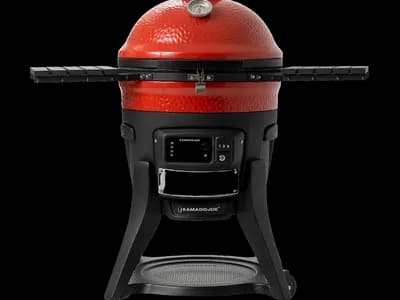
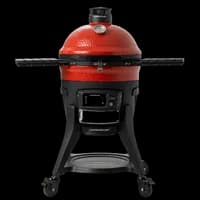 Kamado Joe Konnected JoeA portion trout cooked direct calls for a big, hot grate, not a fan. The 46 cm Konnected Joe has room for three trout of 31-32 cm without them touching, and its ceramic, soaked with heat, helps the chamber recover as soon as you close the lid after turning them. Its automatic igniter can light the charcoal and save you the firelighter, but the fan is not needed for twelve minutes on the grate: you cook in what the maker calls Classic Cook Mode, with the top and bottom vents, just as on any kamado of that size. In other words, this recipe does not need its electronics; it makes use of the ceramic and the diameter.
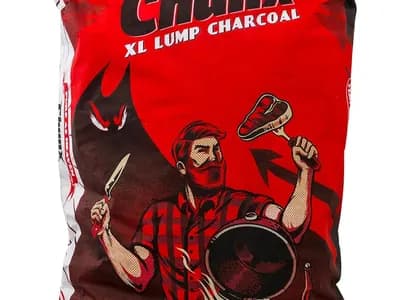
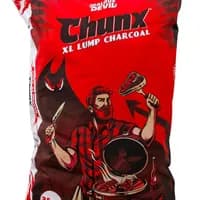 Jealous Devil 100% White Quebracho lump charcoal 15.8 kgTo hold 250 °C with the vents part open, air has to pass between the embers without ash blocking the intake. Jealous Devil is Paraguayan white quebracho lump in big pieces, and the maker describes it as very low in ash and very mild in flavour, suited to fish as well. It is not an odourless fuel: it leaves a discreet toasty background that, over twelve minutes on the grill, accompanies the ham without covering it, as the guide to woods for smoking in a kamado explains. With the firebox full, whatever does not burn in these twelve minutes goes out when you close the vents and is saved for the next cook. The biggest pieces are best broken up so the bed under the grate is even.
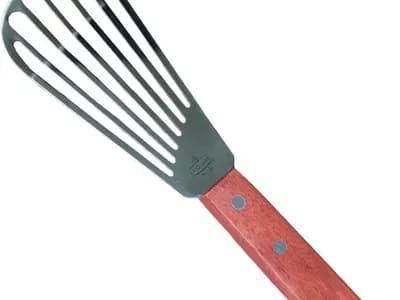
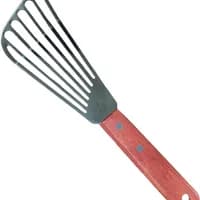 La Cuisine Spatola a fessura: slotted stainless fish slice, 28 cmThe turn is the moment a whole trout breaks or stays stuck. The slotted fish spatula from La Cuisine has a thin, bevelled 16 cm blade that slides under toasted skin without tearing it and supports the middle of the back of a portion trout; with your other hand steadying it from above, the fish turns in one piece and the ham stays in the belly. The slots let oil drain away rather than dragging it across the skin. It measures 28 cm overall, so it is short for working over live embers at 250 °C: always use it with a glove and with your hand above the fish, not over the charcoal.
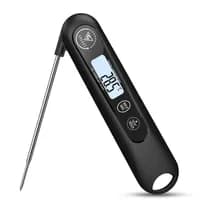 DOQAUS instant-read thermometer, folding probe, 3-second readBetween 55 and 60 °C trout is juicy; a few degrees more and it dries out, because it is a thin fish with little margin. An instant thermometer such as the DOQAUS settles the question at the back, next to the bone, without having to open the trout. Here it comes off at 60 °C, the top of the range: next to the bone and with the ham inside, that is the last part to cook. If it is river (wild) trout, hold it a minute longer at 60 °C, the AESAN (Spanish food safety agency) reference against anisakis.
Method
- 01
Light for direct cooking
Fill the firebox with Jealous Devil charcoal. With a firelighter, light one spot, leave the lid open until you see live embers and close it with the vents open. On the Konnected Joe you can use its automatic igniter, which works with the dome closed and the vents open, according to the maker. With no deflector and the grate in its normal position, when the dome thermometer reads 250 °C adjust the vents to hold it and let the grate heat for at least 10 minutes more.
- 02
Dry and season
While the kamado climbs, dry the trout with kitchen paper outside and inside the belly: damp skin is the skin that sticks. Season the cavity with a pinch of salt and pepper, and go light on the salt because the ham already brings plenty. Do not slash the skin: on a 300-350 g trout the heat reaches the centre without cuts, and cuts are where the skin tears when you turn it.
- 03
Stuff with ham
Fold two slices of serrano ham lengthways and tuck them into the belly of each trout, well inside, so none pokes out over the edge: ham left outside burns over the embers. Close the belly by pressing with your hand. If it gapes too much, pin it with a wooden cocktail stick soaked for 10 minutes in water. Keep the three remaining slices for the end.
- 04
Make the dressing
Before the trout goes into the kamado, get the dressing ready, because everything moves fast afterwards. In a bowl, mix the very finely chopped garlic, the parsley, the zest and juice of one lemon, the 60 ml of oil and a pinch of salt. Cut the other lemon into wedges. Have the thermometer, the spatula, the gloves and a warm serving dish within reach.
- 05
Onto the grate
Open the kamado with burping: lift the lid about 5 cm, wait about 5 seconds and then open it fully, wearing gloves and keeping your face turned away. Brush the grate. Brush the trout skin with the 30 ml of oil, salt it on the outside and lay the fish diagonally across the bars, apart from each other. On a 46 cm grate three fit comfortably. Close the lid.
- 06
First side, untouched
Leave the trout for 5-6 minutes with the lid closed and the vents as they were, at 250 °C. Do not move it or lift it to look. After that time, open with burping and slide the spatula under the skin along the back. If it comes away clean, it is ready to turn; if it resists, close the lid and give it another minute: toasted skin lets go by itself.
- 07
Turn and probe
Wearing a glove, slide the La Cuisine spatula in along the back, not the belly, so the filling stays put, and turn the trout while steadying it from above with the other hand. Close the lid and count 4-5 minutes. Open with burping and push the DOQAUS into the thickest part of the back, next to the bone, without touching the bone or the ham. Take it off at 60 °C.
- 08
Crisp ham and serve
With the trout already on the dish, lay the three reserved slices of ham on the hot grate for 20-30 seconds each side, until they are no longer soft and start to curl. After a minute's cooling they turn crisp. Remove the cocktail sticks, spoon the garlic, parsley and lemon dressing over each trout, top with a crisped slice and serve with the lemon wedges.
About this recipe
Trucha a la navarra (Navarre-style trout) is a classic of river cooking: a portion-sized trout opened along the belly, jamón serrano (Spanish dry-cured ham) tucked inside, then flour and a pan of generous oil. This recipe is not that one, and it is worth saying so from the start. Here the trout goes over the kamado's direct fire, with no flour and no frying, and what was a golden coating in the pan becomes toasted skin. The filling stays where it was. It is the first river fish in this collection and it is done in 10-12 minutes on the grate.
A grilled version, not the fried recipe
In the pan, the flour protects the flesh. Over embers the skin does it: trout skin is thin, with a layer of fat underneath, and at 250 °C in direct cooking that fat melts, the skin dries and browns through the Maillard reaction. The ham brings the salt and the cured note, and its fat melts towards the loin as the fish cooks. You lose the coating and gain charcoal smoke with far less oil. The trout you find at the fishmonger all year round is farmed rainbow trout, the third-ranked species in Spanish aquaculture, cheap and very regular in portion size. If you have already made the butterflied dorada (dorada a la espalda) or the sardines al espeto (skewered over embers), the support changes here: the trout goes on whole and closed, straight onto the bars, with no plancha (griddle plate) or basket.
Direct fire, a full firebox and vents in hand
This is a direct cook: no deflector, the grate in its usual place and the embers underneath. Fill the firebox even though you will only cook for twelve minutes, as the charcoal guide for kamados explains: the vents set the temperature, not the quantity, and whatever does not burn is there for next time. A white quebracho lump such as Jealous Devil comes in big pieces that let air through with the vents part open and, according to the maker, leaves very little ash. On the 46 cm Konnected Joe, the automatic igniter can light the charcoal if you want to use it, but the fan controller has no part to play in a cook this short: you work in manual mode, with the vents, as on any kamado. Those 46 cm hold three portion trout comfortably.
Keeping the skin from sticking, and 60 °C by the bone
The classic failure with whole fish over direct heat is leaving half the skin on the bars. Three things prevent it. A very hot, clean grate: give it at least 10 minutes at 250 °C with the lid closed and brush it just before the fish goes on. Skin dried with kitchen paper inside and out, and oiled at the last moment. And patience: the trout is not touched until it releases by itself. To turn it, a thin fish spatula such as the slotted La Cuisine slides under the skin without tearing it, and its 16 cm blade supports the middle of the back while your other hand steadies the fish from above. It is short for working over live embers, so wear a glove.
The clock gives a rough guide and the thermometer decides. Trout is juicy between 55 and 60 °C at the thickest part of the back; here it comes off at 60 °C, the top of that range: next to the bone and with the ham inside, that is the last part to cook. If it is river (wild) trout, hold it a minute longer at 60 °C, the AESAN (Spanish food safety agency) reference against anisakis. An instant thermometer such as the DOQAUS, which reads in 3 seconds according to its data sheet, keeps the lid open only as long as needed. And with the kamado at 250 °C and the vents part open, every opening is done with burping: lift the lid about 5 cm, wait about 5 seconds and then open it fully, wearing gloves and keeping your face turned away.
In 30 seconds
Portion rainbow trout (300-350 g) stuffed with two slices of serrano ham, skin dry and oiled, kamado direct at 250 °C with a hot grate, 5-6 minutes untouched, turn with a fish spatula and 4-5 minutes more, to 60 °C by the bone. Burp the lid every time you open it. Garlic, parsley and lemon to serve. This is a grilled version: the classic is fried.
Will it fit your kamado?
Small
33-40 cm · Joe Jr, MiniMax
Tight
Probably two trout per batch, or three tightly on the diagonal.
Medium
46-51 cm · Classic, Large
Fits
On a 46 cm grate the three trout fit with room to spare.
Large
56-61 cm · Big Joe, XL
Fits
Plenty of room; probably five or six trout at once.
What to serve with it
Sides
- Grilled Padrón peppers
- Lettuce, tomato and onion salad
- Wine
- Navarra rosé or a Navarra Chardonnay
- Beer
- Pilsner or pale lager
- Alcohol-free
- Sparkling water with lemon and parsley
Leftovers and storage
- In the fridge
- Boned, airtight, within 2 hours; 1-2 days in the fridge.
- Freezing
- Doesn't freeze well: grilled trout dries out and the ham loses its crunch.
- Reheating
- Best cold; otherwise in a covered pan over low heat with a little oil, until 74 °C at the centre.
- Using them up
- Flaked with the ham into scrambled eggs or a potato salad.
Cool and refrigerate within 2 hours. When in doubt, throw it out.
Leftover embers
You still have embers: what to do with the leftover heat
For 15 min at 250 °C in a classic kamado you load about 800 g of charcoal and burn 600 g: when you serve, about 250 g of live embers remain. Before you shut the vents, that is still enough for:
Without touching the vents
250 °Cgrilled vegetables
25 minof embers
- Charred Wild Green Asparagus on the Kamado8 min · 240 °C
- Rum-glazed grilled pineapple on the kamado14 min · 220 °C
- Grilled provolone on the kamado with tomato, oregano and olive oil, in a cast-iron skillet12 min · 230 °C
No recipe needed
- Strips of courgette and aubergine, char-marked (5 min)
- Pita or naan from shop dough, on the grate (3 min each)
- Halved tomatoes, cut side down, for a sauce (10 min)
Closing the vents halfway and waiting for it to drop
140-200 °Cdessert while you eat
35 minof embers
- Smoked Loaded Nachos on the Kamado12 min · 185 °C
- Brioche Burger Buns on the Kamado18 min · 190 °C
- Garlic-stuffed portobello mushrooms grilled in the kamado22 min · 190 °C
No recipe needed
- Yesterday's bread with oil and garlic, on the grate (10 min)
- Corn cobs in their husks (30 min)
Before opening the lid, crack it open for a few seconds first; if you raise the heat, stir the ash so the coals can breathe. And if you are not going to use them: once the food is out, close the bottom and top vents. The charcoal that does not burn (about 250 g) can be used next time. Different size of kamado? Work out your load for 1 h of fire, lighting included.
Editor's tips
- Oil the skin of the fish, not the grate: oil falling on bars at 250 °C smokes, burns and can flare, whereas the oil on the skin helps it brown and release.
- If dripping oil raises flames, close the lid: with the dome shut, air only comes in through the vents and the flames die down; if they persist, close the bottom vent a little and open again with burping. Do not cook with the lid half open to watch them: that feeds the fire and exposes you to a flare-up when you open it.
- Filleted trout is not suited to this technique: with no bone and the flesh exposed, it breaks apart on the bars. If that is what you have, grill it skin side down on a plancha, as with the butterflied dorada.
- For more than three diners, cook two batches instead of squeezing four trout onto a 46 cm grate. If they touch, they steam at the sides and the skin there does not toast.
Gear for this recipe
As an Amazon Associate, mikamado.es earns from qualifying purchases. At no extra cost to you.
Kamado Joe Konnected Joe
A portion trout cooked direct calls for a big, hot grate, not a fan. The 46 cm Konnected Joe has room for three trout of 31-32 cm without them touching, and its ceramic, soaked with heat, helps the chamber recover as soon as you close the lid after turning them. Its automatic igniter can light the charcoal and save you the firelighter, but the fan is not needed for twelve minutes on the grate: you cook in what the maker calls Classic Cook Mode, with the top and bottom vents, just as on any kamado of that size. In other words, this recipe does not need its electronics; it makes use of the ceramic and the diameter.
€3,140
Jealous Devil 100% White Quebracho lump charcoal 15.8 kg
To hold 250 °C with the vents part open, air has to pass between the embers without ash blocking the intake. Jealous Devil is Paraguayan white quebracho lump in big pieces, and the maker describes it as very low in ash and very mild in flavour, suited to fish as well. It is not an odourless fuel: it leaves a discreet toasty background that, over twelve minutes on the grill, accompanies the ham without covering it, as the guide to woods for smoking in a kamado explains. With the firebox full, whatever does not burn in these twelve minutes goes out when you close the vents and is saved for the next cook. The biggest pieces are best broken up so the bed under the grate is even.
€207
La Cuisine Spatola a fessura: slotted stainless fish slice, 28 cm
The turn is the moment a whole trout breaks or stays stuck. The slotted fish spatula from La Cuisine has a thin, bevelled 16 cm blade that slides under toasted skin without tearing it and supports the middle of the back of a portion trout; with your other hand steadying it from above, the fish turns in one piece and the ham stays in the belly. The slots let oil drain away rather than dragging it across the skin. It measures 28 cm overall, so it is short for working over live embers at 250 °C: always use it with a glove and with your hand above the fish, not over the charcoal.
€10
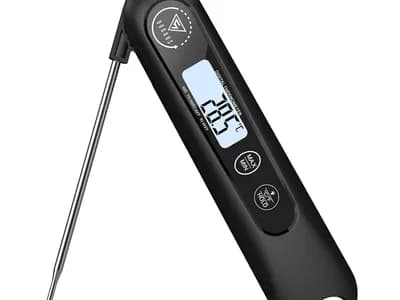
DOQAUS instant-read thermometer, folding probe, 3-second read
Between 55 and 60 °C trout is juicy; a few degrees more and it dries out, because it is a thin fish with little margin. An instant thermometer such as the DOQAUS settles the question at the back, next to the bone, without having to open the trout. Here it comes off at 60 °C, the top of the range: next to the bone and with the ham inside, that is the last part to cook. If it is river (wild) trout, hold it a minute longer at 60 °C, the AESAN (Spanish food safety agency) reference against anisakis.
€6
Have you made it?
Tell us how it turned out on your kamado. We review every rating before publishing it.
No published ratings yet. Be the first!
FAQ
How long does trout take on the barbecue?
A portion trout of 300-350 g, cooked direct in the kamado at 250 °C, needs 5-6 minutes on the first side and 4-5 on the second, around 10-12 minutes in total. That timing is a guide, but the thermometer decides: trout is juicy at 55-60 °C at the thickest part of the back, next to the bone, and here it comes off at 60 °C, the top of the range: next to the bone and with the ham inside, that is the last part to cook. If it is river (wild) trout, hold it a minute longer at 60 °C, the AESAN (Spanish food safety agency) reference against anisakis. A bigger trout needs more minutes and the same final reading.
How do you stop trout sticking to the grill?
A very hot, clean grate, dry and oiled skin, and no touching the fish. Let the grate sit for at least 10 minutes at 250 °C with the lid closed and brush it just before cooking. Dry the trout with kitchen paper, oil the skin at the last moment and do not move it for the first 5-6 minutes. Once the skin is toasted it releases by itself; if it resists when the spatula goes in, it needs another minute.
Is trucha a la navarra fried or grilled?
The traditional recipe is fried: the trout is stuffed with serrano ham, dredged in flour and fried in generous oil, sometimes with the ham slices fried too. This recipe is a grilled version with the same filling, without flour and without frying: the crisp skin comes from the kamado's direct heat and not from a coating. It uses less oil and adds the flavour of charcoal.
Which ham works best in trucha a la navarra?
Serrano ham in thin, medium-cured slices: it melts in the heat without turning hard. Two slices per trout are enough, and since the ham already brings the salt, season the cavity very lightly. Acorn-fed ibérico also works, but its fine fat is lost over 250 °C of direct embers; serrano is the better fit here.
Can you grill trout in aluminium foil?
You can, but it is a different dish. Wrapped in aluminium foil, the trout steams in its own juices: it stays tender and does not stick, although the skin comes out soft and without the toasting of the embers. This recipe goes without foil precisely to get crisp skin. If you do wrap it, the doneness check is the same, with the thermometer at 60 °C next to the bone.
Can I make this recipe with a different cut instead of portion-size whole fish?
A large whole fish keeps the indirect 200 °C roast and the doneness check by the bone; salmon is also indirect but comes off earlier. Sardines switch to direct heat and become a skewer. In every case the probe or the bone decides, not the clock.
What do I do with the embers left after making Grilled Navarre-Style Trout on the Kamado, Stuffed with Ham?
After 15 min at 250 °C in a classic kamado about 250 g of live embers remain: 25 min more at 250 °C without touching the vents or 35 min at 140-200 °C closing the vents. If you are not going to use them, close both vents and keep the charcoal for next time.
More kamado recipes
KEEP READING
Go deeper on this dish
- Recommended kamado
Kamado Joe Konnected Joe
A portion trout cooked direct calls for a big, hot grate, not a fan. The 46 cm Konnected Joe has room for three trout of 31-32 cm without them touching, and its ceramic, soaked with heat, helps the chamber recover as soon as you close the lid after turning them. Its automatic igniter can light the charcoal and save you the firelighter, but the fan is not needed for twelve minutes on the grate: you cook in what the maker calls Classic Cook Mode, with the top and bottom vents, just as on any kamado of that size. In other words, this recipe does not need its electronics; it makes use of the ceramic and the diameter.
- Editorial guide
How to light a kamado: the step-by-step method
No petrol, no weird tablets and no 45-minute waits. The cone method, airflow control and the mistakes that prevent 80% of the frustration.
- Glossary term
Heat deflector
Ceramic plate placed between the coals and the grate to turn direct fire into indirect cooking.
- Related comparison
kamado joe classic iii vs kamado joe konnected joe
Same Kamado Joe, two opposite philosophies. The Classic III is the classic kamado you light by hand and watch with your…