Recipe · Indirect · Advanced
Beef Wellington on the Kamado, Baked on Steel: Golden Pastry, Rosy Centre
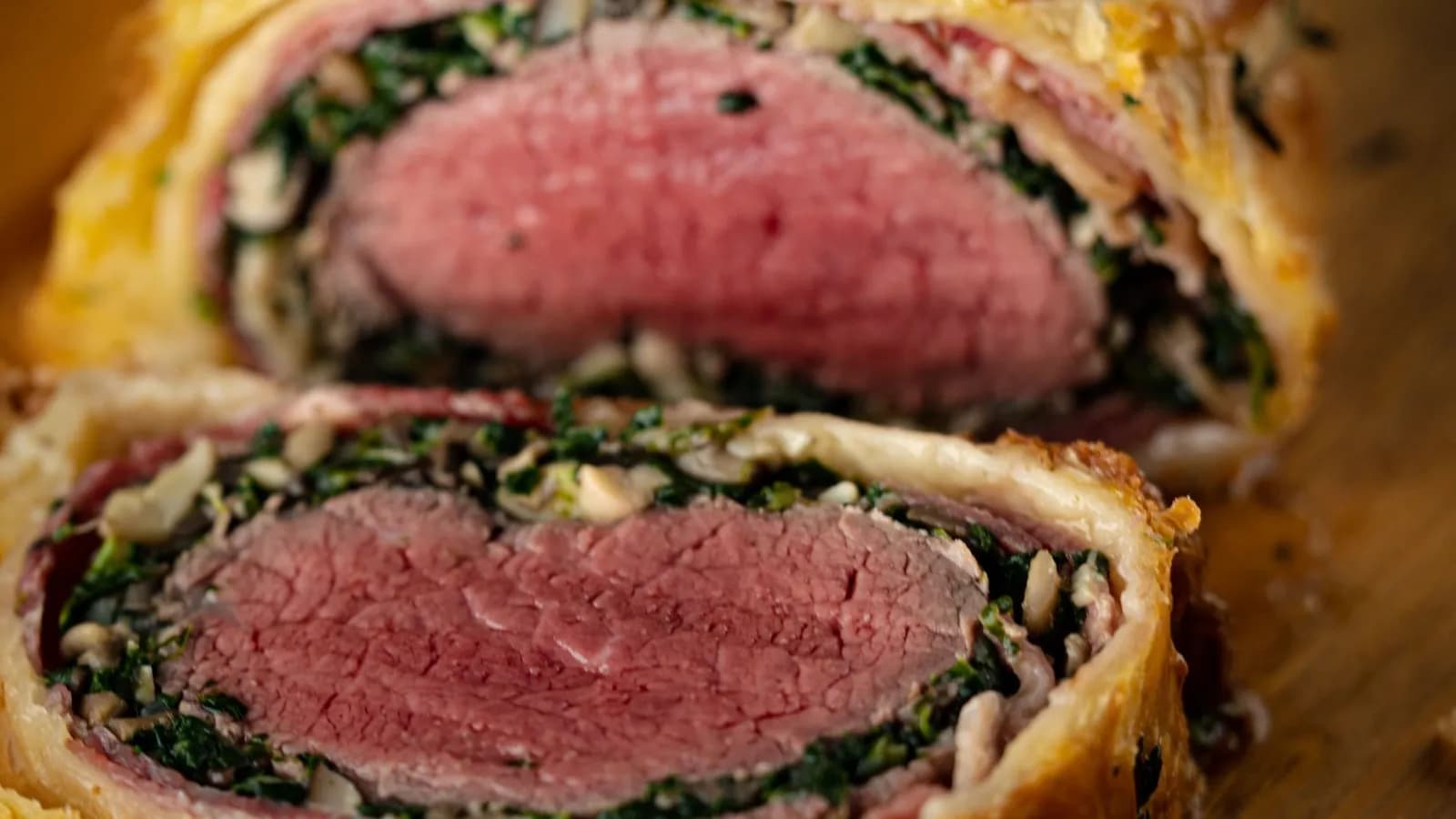
The New Year's Eve roast, cooked in a kamado: beef fillet seared over the coals, wrapped in duxelles, ham and all-butter puff pastry, then baked at 200-210 °C on a steel that browns the base.
Quick answer
Sear the beef fillet over direct heat, brush it with mustard and wrap it cold in dry duxelles, ham and all-butter puff pastry. Bake at 200-210 °C with the deflector and a preheated steel underneath, probe in the centre: pull at 50-52 °C and a 10-15 minute rest takes it to 52-57 °C.
- Prep
- 120 min
- Cook
- 55 min
- Servings
- 6 servings
- Temperature
- 205 °C
Ingredients
- beef fillet (solomillo de vacuno), centre cut (the heart), trimmed of silverskin, of even thickness1.1 kg
- button mushrooms or cultivated oyster mushrooms, for the duxelles600 g
- shallots, very finely chopped2 ud
- garlic cloves, chopped2 ud
- sprigs of fresh thyme, leaves only4 ud
- thin slices of serrano ham (jamón serrano)8 ud
- all-butter puff pastry, chilled (2 sheets)500 g
- Dijon mustard2 cda
- egg yolks, beaten with 1 tablespoon of milk, for brushing2 ud
- butter for the duxelles30 g
- extra virgin olive oil for searing2 cda
- flaky sea salt and freshly ground black pepper, to taste1 cdta
The gear for this recipe
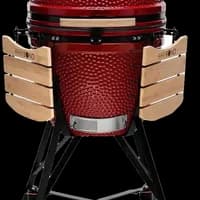 Kamado Bono Grande XXL 59 cmA 1.1 kg Wellington on a rectangular steel needs room, and here size is a matter of geometry. The Kamado Bono Grande XXL is sold as a 59 cm model, which is the body; distributor listings give around 49-50 cm of usable grate, and there the 35.6 × 30.5 cm steel, with its diagonal of about 46.9 cm, sits flat with air around it. It comes with the ceramic deflector that turns the kamado into an oven at 200-210 °C, so the direct sear and the indirect bake come from the same appliance without buying anything else. Its ceramic mass is slow to come down after the sear, which is why the vents are closed early, while the meat is being assembled.
 Chef Pomodoro CP-SBP: 35.6 × 30.5 cm steel pizza plateThe classic Wellington failure is a pale, damp base, and the Chef Pomodoro steel is in this recipe to prevent it. It is 6.35 mm of steel which, preheated for at least 30 minutes on the deflector, stores heat and passes it by contact to the pastry as soon as the piece is set down. The deflector stops the coals scorching the base, and the steel makes it brown. It measures 35.6 × 30.5 cm, plenty for a cylinder of fillet, but its diagonal of about 46.9 cm calls for a 49-50 cm grate like that of the Bono Grande XXL; on a 46 cm one it will not lie flat. The manufacturer states it is rated to 300 °C, above the 210 °C of the bake.
 MEATER+ wireless WiFi thermometerWith the pastry sealed you cannot look at the centre, and the difference between 52 and 60 °C is the difference between rosy and grey. The MEATER+ is wireless and has a single probe, with no cable to run across the lid seal: it goes in horizontally from one end, following the axis through the centre of the meat, past the safety notch, with the ambient end outside the meat and the pastry. Its datasheet gives 100 °C maximum internal and 275 °C ambient, so it works comfortably at 200-210 °C but stays out during the 260-280 °C sear. It alerts you on your phone at 50-52 °C and keeps reading through the rest up to 52-57 °C.
 Miyabi 5000FCD – 24 cm Japanese Sujihiki (Slicing Knife)Carving a Wellington is the last place it can be ruined: a short or serrated knife crushes the pastry, lifts the duxelles away and drags the ham. The Miyabi 5000FCD sujihiki is a 24 cm slicing knife with an FC61 steel core of about 61 HRC according to the manufacturer, and that length lets it cut through a 2-3 cm slice in a single stroke from heel to tip, with no back and forth. The narrow blade drags less surface and leaves a clean cut with the layers visible. It needs hand washing and immediate drying, like any Japanese steel of that hardness, and a wooden board, not a glass one.
 NaturBraza marabu charcoal, pack of two 5 kg bags (10 kg)This recipe asks two things of the charcoal in sequence: a sear at 260-280 °C and then, with no refuelling, more than an hour and a half of embers covering the drop to 200-210 °C while the meat is assembled and the 35-45 minutes of baking. The NaturBraza marabú charcoal comes in two 5 kg bags and its listing declares marabú wood only, with no additives; the listing promises little ash, but it publishes neither the grade nor a figure. What can be reasoned is the wood: marabú is very dense, so a full firebox gives plenty of ember mass for both phases. Fill the firebox to the rim of the ring with marabú charcoal: whatever is left over gets reused next time, and a thin bed of embers will not carry the bake.
Method
- 01
Make the duxelles
Chop the 600 g of mushrooms very finely, by hand or with short pulses of a food processor, stopping short of a purée. Melt the butter in a wide pan over high heat, add the shallot, garlic and thyme, then the mushrooms with a pinch of salt. Cook for 15-20 minutes, stirring, until there is no water left and the paste pulls away from the base of the pan. Spread it on a tray and chill it completely in the fridge.
- 02
Light and sear
Fill the firebox to the rim of the ring with marabú charcoal, light it and open both vents until it reaches 260-280 °C, without the deflector. Tie the fillet every 3 cm so it stays cylindrical, salt it and rub it with oil. Burp the lid when opening, then sear for 90 seconds per side, about 6-8 minutes in total, until browned all over. No probe in at this stage: that temperature is beyond its limit.
- 03
Set up for baking
As soon as the fillet comes off, wearing gloves (and burping the lid if you have closed it), fit the Bono's ceramic deflector, the grate and, on top, the Chef Pomodoro steel. Close the bottom vent to a couple of fingers' width and the top one almost completely now: ceramic takes time to come down to 200-210 °C at grate level, and the meat cools meanwhile. That gives the steel over 30 minutes to heat; if the temperature overshoots, close a little more and wait.
- 04
Mustard and chill
Move the fillet to a rack, remove the strings once you can touch it, and brush it all over with the Dijon mustard while it is still warm, so it sticks. Leave it for 10 minutes at room temperature, then 20-30 minutes in the fridge, uncovered. The meat must feel cold to the touch before assembly, or the heat will soften the butter in the pastry.
- 05
Assemble ham and duxelles
Lay out two sheets of cling film and arrange the 8 slices of ham on top, overlapping, to form a rectangle slightly longer than the fillet. Spread the cold duxelles in a thin, even layer of about 5 mm. Place the fillet at the edge and roll it up in the film, pulling tight to form a firm cylinder. Twist the ends and keep it in the fridge for 20 minutes.
- 06
Seal in the pastry
Join the two sheets of puff pastry with a 2 cm overlap and press the seam. Remove the film from the cylinder, set it on the pastry and wrap it, seam underneath and the ends folded like a parcel. Trim the excess, brush the whole surface with yolk and score a light crosshatch with the back of a knife. Chill for 15-20 minutes, until the pastry is firm.
- 07
Bake with the probe
On the worktop, push the MEATER+ probe in horizontally from one end, following the axis, past the notch and with the ambient end outside the pastry. Brush with yolk again. After so long with the vents almost closed, burp the kamado: lift the lid about 5 cm, wait about 5 seconds and open it fully, with gloves on. Move the Wellington on its paper onto the steel, close the lid and bake at 200-210 °C, roughly 35-45 minutes, until the centre reads 50-52 °C.
- 08
Rest
Burp the lid before opening it fully and lift the Wellington out with a peel or a wide tray, without bending it. Leave it on a board for 10-15 minutes, uncovered, with the probe still in: the stored heat keeps raising the centre to 52-57 °C, and the juices settle instead of soaking the pastry when you cut. Covering it with foil would soften the pastry.
- 09
Carve and serve
Remove the probe and cut 2-3 cm slices with a long, thin knife, in a single stroke from heel to tip and without sawing, so the pastry is not crushed or separated from the meat. Wipe the blade between cuts. Serve straight away, cut side up, so the rosy centre, the ham and the duxelles show.
About this recipe
Beef Wellington (solomillo Wellington) is a New Year's Eve (Nochevieja) classic in Spain, and it is also one of the hot dishes of the Russian New Year table, where it is known as výrezka vellington (вырезка веллингтон). It is the centre cut of the beef fillet (solomillo de vacuno), seared, coated in a dry mushroom paste, wrapped in ham and sealed in all-butter puff pastry. It nearly always fails in the same place: golden on top, pale and damp underneath. The kamado tackles exactly that problem, because with the deflector and a preheated steel the heat reaches the pastry from below, from the sides and from the dome at once.
Three layers against a raw base
Moisture is the enemy, and every layer of the assembly is there to hold it back. The duxelles (finely chopped mushrooms cooked down to a paste) is cooked until the mushroom stops releasing water and the paste pulls away from the pan: if it stays juicy, that steam ends up in the pastry. Thin slices of serrano ham (jamón serrano, Spanish dry-cured ham) act as a barrier between the duxelles and the puff pastry, and the Dijon mustard brushed over the freshly seared meat glues the whole thing together. Everything is assembled cold and goes back in the fridge twice: the butter in the pastry has to go into the heat still cold and firm, so that steam lifts the layers apart instead of the butter melting early and soaking the dough.
Sear hard, bake with deflector and steel
The kamado works in two stages. First, direct cooking at 260-280 °C to brown the fillet on all sides in 6-8 minutes, with the Maillard reaction doing its job. Then, while the meat cools and gets assembled, the ceramic deflector that comes with the Kamado Bono Grande XXL goes in and, on the grate, the 6.35 mm steel Chef Pomodoro. The vents are closed to bring the temperature down to 200-210 °C at grate level; coming down is slower than going up, so it pays to close them early. The steel stores heat and passes it by contact to the base of the Wellington. It measures 35.6 × 30.5 cm and its diagonal is around 46.9 cm: it sits flat on the roughly 49-50 cm grate of the Bono Grande XXL, not on a 46 cm one.
The fuel has to survive the searing, the drop in temperature while the meat is assembled and 35-45 minutes of baking, without a top-up. NaturBraza marabú charcoal (marabú wood only according to its listing, a dense hardwood) performs well with a full firebox. Every time you open the lid while the fire is lively, burp it: lift it about 5 cm, wait about 5 seconds, then open it fully. The guide to direct and indirect cooking explains both modes; the tomahawk reverse sear runs the opposite route, indirect first and seared at the end.
The probe decides, not the clock
With the pastry sealed there is no way to see the centre, so doneness is decided by probe. The MEATER+ is wireless and has a single probe: it goes in horizontally from one end, following the axis through the centre of the meat, past its safety notch, with the rear end, the one that reads ambient temperature, outside the meat and the pastry. Its datasheet gives a 275 °C ambient maximum, plenty of headroom for baking at 210 °C and none for the searing, which is why it goes in afterwards. Take the Wellington out at 50-52 °C; over 10-15 minutes of rest it rises to 52-57 °C, the rosy medium-rare of beef. The guide to probes and thermometers details the placement. For carving, a long, thin knife such as the Miyabi 5000FCD sujihiki (a Japanese slicing knife) cuts through pastry and meat in a single stroke without crushing the layers.
In 30 seconds
1.1 kg beef fillet seared direct at 260-280 °C, then mustard, dry duxelles, ham and all-butter puff pastry, all assembled cold. Kamado at 200-210 °C with the deflector and a preheated steel underneath, probe in the centre: out at 50-52 °C and a 10-15 minute rest up to 52-57 °C. Slices of 2-3 cm with a long knife.
Editor's tips
- Ask for the centre cut of the fillet, the heart, and not the tail: a cylinder of even thickness cooks evenly, whereas the thin tip would overcook long before the centre reached the right point. The tail is good for a stir-fry or a tartare.
- Test the duxelles with a spoon: if the line you draw across the base of the pan closes up with liquid, it needs another 5 minutes on the heat. This detail does most to decide whether the base comes out raw.
- Read the pastry label: if butter is the only fat, it tastes of butter and melts better in the mouth; vegetable-fat versions rise as well or better and work fine, but the flavour is different.
- Every time you open the lid while the fire is lively, especially after the sear, burp it with gloves on and your face turned away; the guide to temperature problems explains why the flare-up forms.
Gear for this recipe
As an Amazon Associate, mikamado.es earns from qualifying purchases. At no extra cost to you.
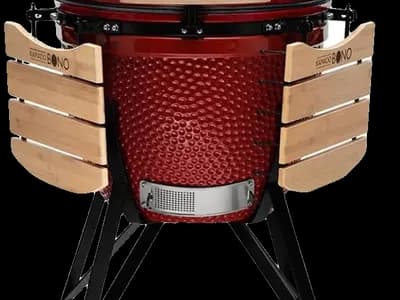
Kamado Bono Grande XXL 59 cm
A 1.1 kg Wellington on a rectangular steel needs room, and here size is a matter of geometry. The Kamado Bono Grande XXL is sold as a 59 cm model, which is the body; distributor listings give around 49-50 cm of usable grate, and there the 35.6 × 30.5 cm steel, with its diagonal of about 46.9 cm, sits flat with air around it. It comes with the ceramic deflector that turns the kamado into an oven at 200-210 °C, so the direct sear and the indirect bake come from the same appliance without buying anything else. Its ceramic mass is slow to come down after the sear, which is why the vents are closed early, while the meat is being assembled.
€1,084

Chef Pomodoro CP-SBP: 35.6 × 30.5 cm steel pizza plate
The classic Wellington failure is a pale, damp base, and the Chef Pomodoro steel is in this recipe to prevent it. It is 6.35 mm of steel which, preheated for at least 30 minutes on the deflector, stores heat and passes it by contact to the pastry as soon as the piece is set down. The deflector stops the coals scorching the base, and the steel makes it brown. It measures 35.6 × 30.5 cm, plenty for a cylinder of fillet, but its diagonal of about 46.9 cm calls for a 49-50 cm grate like that of the Bono Grande XXL; on a 46 cm one it will not lie flat. The manufacturer states it is rated to 300 °C, above the 210 °C of the bake.
€50
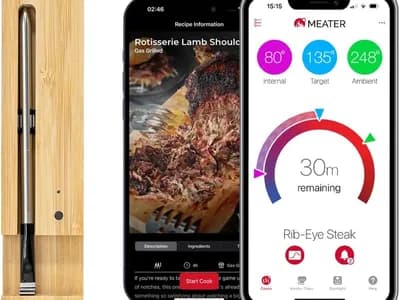
MEATER+ wireless WiFi thermometer
With the pastry sealed you cannot look at the centre, and the difference between 52 and 60 °C is the difference between rosy and grey. The MEATER+ is wireless and has a single probe, with no cable to run across the lid seal: it goes in horizontally from one end, following the axis through the centre of the meat, past the safety notch, with the ambient end outside the meat and the pastry. Its datasheet gives 100 °C maximum internal and 275 °C ambient, so it works comfortably at 200-210 °C but stays out during the 260-280 °C sear. It alerts you on your phone at 50-52 °C and keeps reading through the rest up to 52-57 °C.
€99
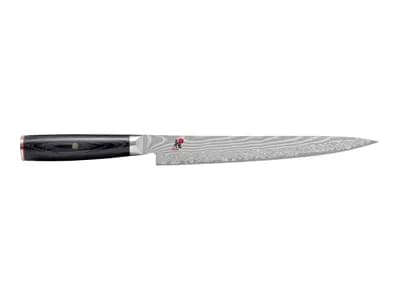
Miyabi 5000FCD – 24 cm Japanese Sujihiki (Slicing Knife)
Carving a Wellington is the last place it can be ruined: a short or serrated knife crushes the pastry, lifts the duxelles away and drags the ham. The Miyabi 5000FCD sujihiki is a 24 cm slicing knife with an FC61 steel core of about 61 HRC according to the manufacturer, and that length lets it cut through a 2-3 cm slice in a single stroke from heel to tip, with no back and forth. The narrow blade drags less surface and leaves a clean cut with the layers visible. It needs hand washing and immediate drying, like any Japanese steel of that hardness, and a wooden board, not a glass one.
€210
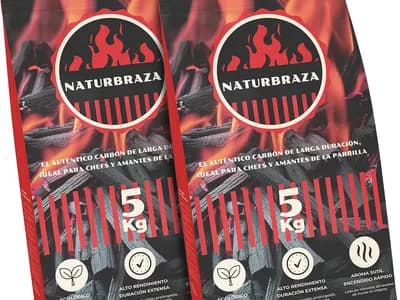
NaturBraza marabu charcoal, pack of two 5 kg bags (10 kg)
This recipe asks two things of the charcoal in sequence: a sear at 260-280 °C and then, with no refuelling, more than an hour and a half of embers covering the drop to 200-210 °C while the meat is assembled and the 35-45 minutes of baking. The NaturBraza marabú charcoal comes in two 5 kg bags and its listing declares marabú wood only, with no additives; the listing promises little ash, but it publishes neither the grade nor a figure. What can be reasoned is the wood: marabú is very dense, so a full firebox gives plenty of ember mass for both phases. Fill the firebox to the rim of the ring with marabú charcoal: whatever is left over gets reused next time, and a thin bed of embers will not carry the bake.
€47
FAQ
What internal temperature should beef Wellington come out at?
Take it out of the kamado when the probe reads 50-52 °C in the centre of the meat. During the 10-15 minutes of rest the stored heat keeps rising and finishes at 52-57 °C, the rosy medium-rare of beef. If you wait for 55 °C, resting can take it to 57-60 °C, past pink. The USDA sets 63 °C with a 3 minute rest for whole cuts of beef; anyone following that guideline will get a much less pink centre.
How do you stop the base of a Wellington being raw?
With three things. A duxelles cooked until it releases no liquid, ham as a barrier between mushroom and pastry, and cold assembly so that the butter in the puff pastry goes into the heat still cold and firm. In the kamado there is also the preheated steel underneath, which passes heat by contact to the base while the deflector stops the coals scorching it. Baking on the grate alone leaves the base paler.
Can you make a pork Wellington?
Yes, with the same assembly, but pork fillet is slimmer, around 4-5 cm, and the centre reaches temperature before the pastry browns: sear it briefly and chill it well before wrapping. With a lean, good-quality Iberian pork fillet you can choose to have it finish at 63-65 °C after resting (take it out 2-3 °C earlier), juicy and pink; with ordinary white pork, have it finish at 71-75 °C. It is a different dish from the glazed Iberian pork fillet with Pedro Ximénez, which is cooked direct on the grill, with no pastry.
Can you prepare beef Wellington the day before?
Yes, up to the cylinder of ham and duxelles. Sear the meat, brush it with mustard, roll it with the ham and duxelles in cling film and keep it in the fridge overnight. On the day, all that is left is to wrap it in pastry, chill for 15-20 minutes and bake. It is best not to leave the pastry assembled for many hours: it absorbs moisture from the duxelles and the base loses firmness.
Does a pizza steel fit in a 46 cm kamado?
A rectangular steel of 35.6 × 30.5 cm has a diagonal of about 46.9 cm, so it does not sit flat on a 46 cm grate such as that of a Large or a Classic. It fits kamados with a 49-50 cm grate, like the Bono Grande XXL. In a 46 cm one, use a round stone or plate that fits the grate and leave an air gap around it so the heat can circulate.
More kamado recipes
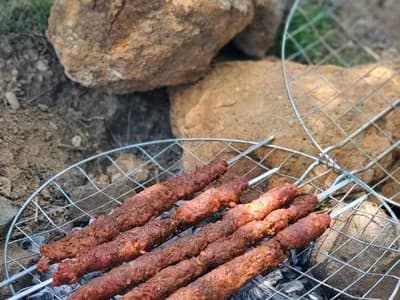
Lamb Lyulya Kebab on the Kamado
The question is never how to season it, but why it falls off the skewer. The answer is fat, a hand-chopped grain and real kneading: juicy lamb that holds together over direct fire.
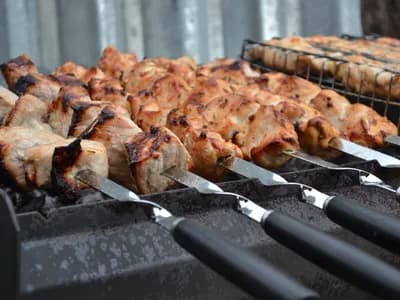
Pork Neck Shashlik on the Kamado, Onion Marinade
The skewer of the Russian-speaking world, cooked as I make it on my Big Green Egg Large: pork neck in 3 cm cubes, a grated onion marinade with not a drop of vinegar, and twenty minutes of steady direct fire.
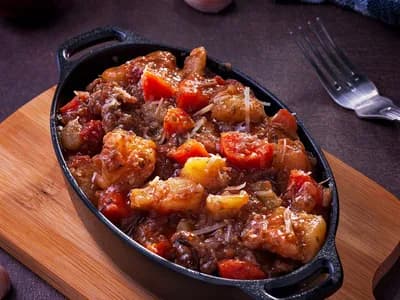
Beef Cheeks in Red Wine, Braised in a Dutch Oven on the Kamado
Three hours of red wine, cast iron and a thread of olive-wood smoke your kitchen oven simply cannot make. The braise that justifies lighting the kamado in midwinter.
KEEP READING
Go deeper on this dish
- Recommended kamado
Kamado Bono Grande XXL 59 cm
A 1.1 kg Wellington on a rectangular steel needs room, and here size is a matter of geometry. The Kamado Bono Grande XXL is sold as a 59 cm model, which is the body; distributor listings give around 49-50 cm of usable grate, and there the 35.6 × 30.5 cm steel, with its diagonal of about 46.9 cm, sits flat with air around it. It comes with the ceramic deflector that turns the kamado into an oven at 200-210 °C, so the direct sear and the indirect bake come from the same appliance without buying anything else. Its ceramic mass is slow to come down after the sear, which is why the vents are closed early, while the meat is being assembled.
- Editorial guide
How to light a kamado: the step-by-step method
No petrol, no weird tablets and no 45-minute waits. The cone method, airflow control and the mistakes that prevent 80% of the frustration.
- Glossary term
Heat deflector
Ceramic plate placed between the coals and the grate to turn direct fire into indirect cooking.
- Related comparison
big green egg large vs kamado joe classic iii
The classic kamado matchup: the Big Green Egg Large, the indestructible pioneer with the widest accessory network, agai…