Recipe · Reverse-sear · Advanced
Reverse-sear tomahawk on the kamado
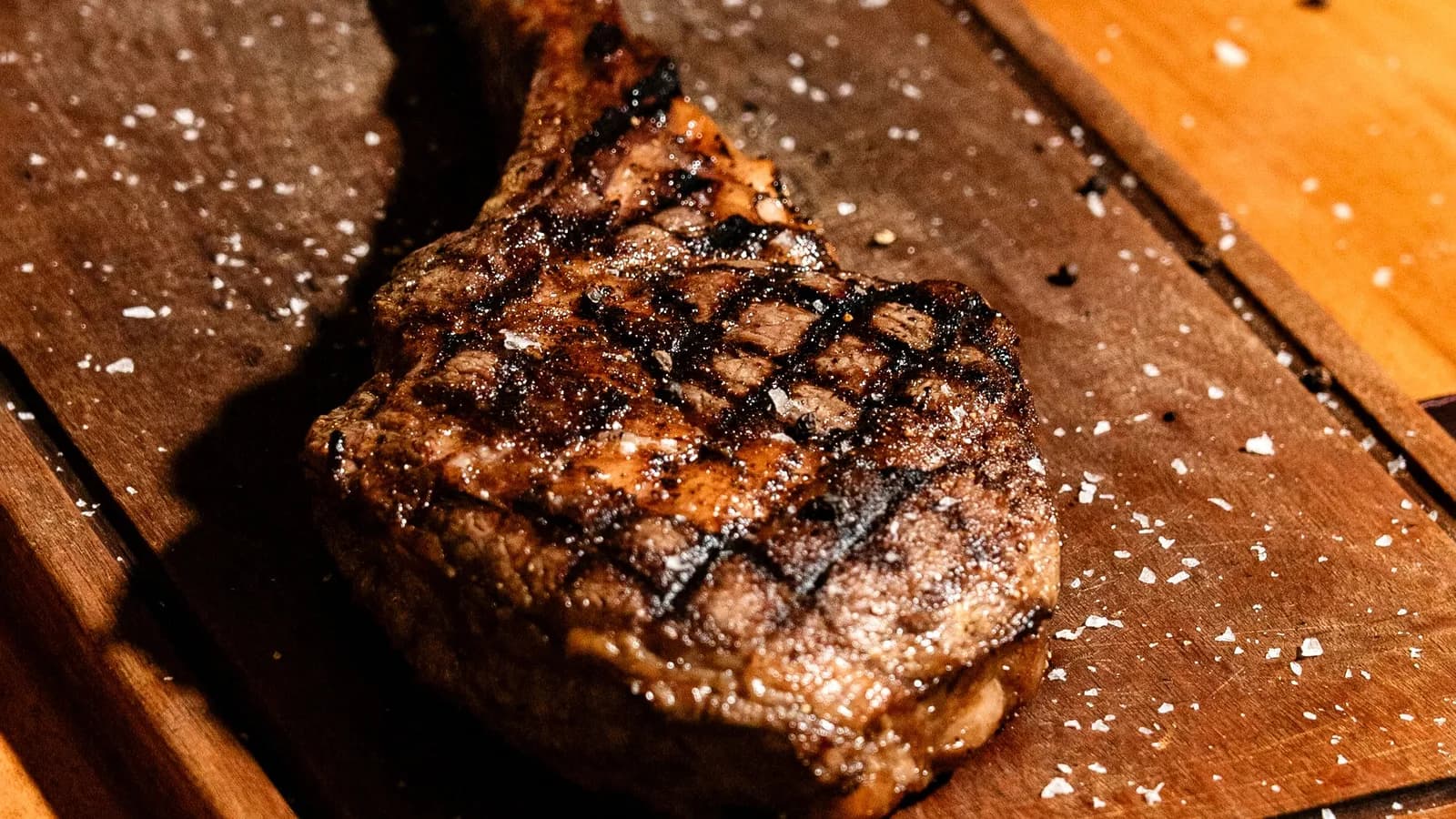
A 1.4 kg tomahawk, probe in the centre, ceramic at 110°C and a 90-second final sear. The Sunday centrepiece for when you want to impress without gambling on doneness.
Quick answer
Tomahawk on the kamado is done reverse-sear: ceramic at 110 °C indirect with a deflector until the probe reads 50 °C (50-60 minutes), a 10-minute rest, then a direct sear of 90 seconds per side at 350 °C. It finishes around 57-58 °C, a perfect medium-rare, edge to edge, with a real Maillard crust.
One big step at a time, screen kept on and built-in timers.
- Prep
- 90 min
- Cook
- 75 min
- Servings
- 4 servings
- Temperature
- 110 °C
What time do you want to eat?
Pick a time and we'll tell you when to start.
10:35
Start the prep
12:05
Light the kamado
12:35
Onto the kamado
14:00
Serve
Estimate: it includes lighting and settling the kamado plus a margin for large cuts. If the recipe asks you to marinate or salt ahead, add that time.
Fire setupIndirect, then direct
- Dome
- 110 °C
- Deflector
- Yes
- Grate
- Standard height
- Fuel
- Charcoal, a single lit zone (Minion method)
- Setup
- Deflector; optional GrillGrate or cast-iron plate for searing
Temperature curve
1:50 h from lighting
Kamado domeInside the meat (probe)
| # | From | Phase | Dome | Internal |
|---|---|---|---|---|
| 1 | 0:00 | Light the charcoalOne lit zone and deflector, 10 min steady | 20 → 110 °C | no probe |
| 2 | 0:30 | CookProbe at the centre, away from the bone, to 50 °C | 110 °C | 18 → 50 °C |
| 3 | 1:22 | Take out10 min partial rest while the kamado heats | 110 → 95 °C | 50 → 51 °C |
| 4 | 1:32 | Raise the heatDeflector out, top vent wide open, over 350 °C | 95 → 350 °C | 51 °C |
| 5 | 1:41 | Sear90 s per side and 30 s on the edge | 350 → 330 °C | 51 → 54 °C |
| 6 | 1:45 | RestGarlic and rosemary on top, Maldon salt when slicing | 330 → 300 °C | 54 → 56 °C |
| 7 | 1:50 | Serve | off | no probe |
0:00 is the moment you light the charcoal. Internal temperatures are the ones the recipe gives; without a probe, go by the times. Turn these times into clock times with the planner
For this recipe
Ingredients
- premium tomahawk steak, 1.2-1.5 kg (rubia gallega or similar)1
- kosher coarse salt (not fine)2 tbsp
- freshly ground black pepper1 tsp
- extra-virgin olive oil (to brush before searing)1 tbsp
- crushed garlic cloves (optional, to rub after searing)2 cloves
- fresh rosemary1 sprig
- flaky sea salt, Maldon-style (to finish)1 pinch
Another cut
Got a different cut? Here is how the recipe changes
For 4 people the recipe uses 1.5 kg of bone-in ribeye: reverse sear at 160 °C, 1 h plus 10 min rest. If the shop had something else:
- Picanha (rump cap)Buy 1.25 kg
- Fire
- Reverse sear · 160 °C
- Time
- 40 min
- Rest
- 10 min
Light 20 min later
Same reverse sear, boneless. Dome at 160 °C fat side up, pull at 46-49 °C, sear the fat cap to 52 °C in the centre and slice against the grain.
- Beef tenderloinBuy 1 kg
- Fire
- Indirect · 190 °C
- Time
- 35 min
- Rest
- 10 min
Light 25 min later
No reverse sear: sear first. Tie it, mark it over direct heat, then move to indirect with the dome at 190 °C; pull at 52-54 °C in the centre, it rises while resting.
- Ibérico pork presaBuy 1.25 kg (in 2 pieces)
- Fire
- Reverse sear · 115 °C
- Time
- 53 min
- Rest
- 15 min
Same lighting time
A pork reverse sear, on a lower fire. Dome at 115 °C, pull at 55-58 °C, sear hard and let it climb to 63 °C while resting; it stays juicy and slightly pink.
Times are a guide, based on the How much to buy figures; follow the recipe first. Full fire plan for 4 people: Picanha (rump cap), Beef tenderloin, Ibérico pork presa.
Allergens
None of the 14 mandatory-declaration allergens in the ingredients.
Based on the recipe's ingredients. Always check the label of every product you buy.
The gear for this recipe
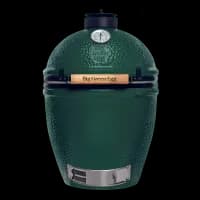 Big Green Egg LargeThe Large has thermal mass to spare to settle at 110 °C with the 1.4 kg tomahawk.
 Kamado Joe Big Block XL lump charcoal 9.1 kgQuality lump for the slow stage at 110 °C and then the sharp climb for the sear.
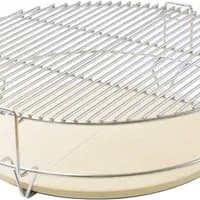 Onlyfire GCG-8552 Cooking System (2 grates + rack + 2 deflectors) for Large Kamado
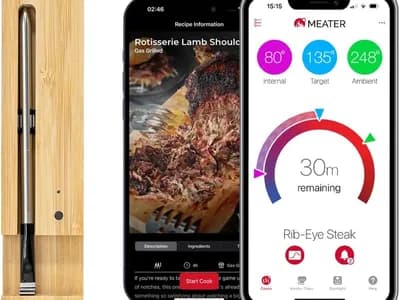
 MEATER+ wireless WiFi thermometerProbe in the centre of the tomahawk to nail 50 °C before cranking up the heat.
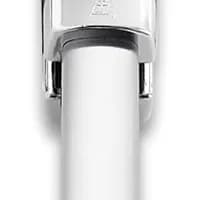 Weber Precision Tongs 46 cm (6760)
Method
- 01
Temper 1h
Take the tomahawk out of the fridge, pat it dry and leave it uncovered at room temperature for 1 hour. A cold steak takes far longer to come up to temp and the reverse-sear loses precision.
- 02
Dry-salt 30 min before
Season with coarse kosher salt on every face 30 minutes before loading the kamado. The salt dissolves, penetrates and reabsorbs — you season deep without drawing moisture. Add pepper only at the end, before the sear: pepper at low heat turns bitter.
- 03
Set deflector and stabilise 110°C
Light a single zone of charcoal (Minion method), set the deflector and stabilise the kamado at 110°C indirect. It takes 25-30 minutes. Do not load the steak until the chamber probe holds steady for 10 minutes.
- 04
Indirect phase with probe
Stick the Bluetooth probe into the geometric centre, away from the bone. Lay the tomahawk on the grate and close the lid. Cook until the probe reads 50°C internal — anywhere from 50 to 60 minutes depending on the steak and outside temperature. Do not lift the lid.
- 05
Pull and rest 10 min
Move the tomahawk to a board and let it rest, uncovered, for 10 minutes. This partial rest stabilises the juices before the sear and, more importantly, buys you time to ramp the ceramic without carry-over running away.
- 06
Ramp up to 350°C
Remove the deflector with gloves (heads up: it is heavy and very hot). Open the bottom damper 80% and the top vent fully. In 8-10 minutes the ceramic clears 350°C. If you own a GrillGrate or a cast-iron plate, this is the moment to drop it in for thermal mass.
- 07
Pepper and oil
Brush the steak with a very thin film of olive oil on both faces and pepper generously. The oil conducts heat in the first seconds and helps the pepper stick.
- 08
Direct sear, 90 seconds per face
Place the tomahawk over the direct zone. Time 90 seconds untouched, flip with tongs (never a fork) and another 90 seconds. Then stand the steak on edge over the fat strip for another 30 seconds. For diamond grill marks with a GrillGrate, rotate 45° at the 45-second point on each face.
- 09
Final 5 min rest and carve
Move the tomahawk to the board, rub the top with a crushed garlic clove and a rosemary sprig. Rest 5 minutes. Cut the meat off the bone with a boning knife and slice across the grain, finger-thick. Finish with Maldon flakes.
About this recipe
Reverse-sear is the honest method for cooking a 1.2-1.5 kg tomahawk without gambling: you bring the interior up slowly to 50°C probe with the ceramic at 110°C, pull the steak to rest, open the vents to 350°C and sear 90 seconds a side. The result is edge-to-edge even, with real Maillard crust and none of the grey band you get with a classic "hot pan first" approach.
Why reverse-sear beats the classic method
The classic method sears first over fierce heat and finishes in the oven; that forces a temperature gradient from crust to centre and leaves a grey, overcooked ring under the bark. Reverse-sear flips it: the steak tempers for 1 hour at room temperature, is dry-salted 30 minutes ahead (the salt dissolves and reabsorbs), goes into the kamado with the deflector at 110°C indirect and only hits the sear once a Bluetooth probe reads 50°C internal — roughly 50-60 minutes. Out it comes, rests 10 minutes, and meanwhile you crank the ceramic by opening the bottom damper and top vent.
The sear: 90 seconds, one face at a time
Once the kamado clears 350°C, the tomahawk goes back on: 90 seconds per face, no fidgeting, plus 30 seconds on the fat-cap edge. Final rest of 5 minutes on a wooden board, then slice thick (a finger wide) across the grain. Carry-over after the sear lifts the centre another 5-7°C — you finish around 57-58°C, which is a perfect medium-rare for a cut this marbled.
In 30 seconds
1.4 kg tomahawk tempered 1h. Dry-salt 30 min before. Deflector, 110°C indirect until 50°C internal probe (50-60 min). Pull, rest 10 min while the kamado climbs to 350°C with vents open. Sear direct 90 sec each face + 30 sec edges. Rest 5 min, slice thick across the grain. Four diners, Sunday glory.
Will it fit your kamado?
Small
33-40 cm · Joe Jr, MiniMax
Tight
Probably a tight fit: the long bone nears the wall; set it diagonally. One piece only.
Medium
46-51 cm · Classic, Large
Fits
One tomahawk fits comfortably; two would probably be tight.
Large
56-61 cm · Big Joe, XL
Fits
Probably two tomahawks fit; for just one, less charcoal is enough.
What to serve with it
- Wine
- Crianza red from Ribera del Duero or Rioja
- Beer
- Stout or amber ale with body and roasty notes
- Alcohol-free
- Red grape juice with soda and a sprig of rosemary
Leftovers and storage
- In the fridge
- Refrigerate airtight within 2 hours: 3-4 days, best kept whole rather than sliced.
- Freezing
- Vacuum-packed slices keep 2-3 months. Thaw in the fridge; never refreeze.
- Reheating
- Low oven, covered with a splash of stock, until piping hot in the centre (74 °C); or serve cold, thinly sliced.
- Using them up
- Thin-sliced steak sandwich with roasted peppers, or a warm salad with rocket and cheese shavings.
Cool and refrigerate within 2 hours. When in doubt, throw it out.
Leftover embers
You still have embers: what to do with the leftover heat
For 1 h 15 min at 110 °C in a classic kamado you load about 800 g of charcoal and burn 300 g: when you serve, about 520 g of live embers remain. Before you shut the vents, that is still enough for:
Without touching the vents
110 °Ca short smoke
3 h 40 minof embers
- Hot-Smoked Whole Mackerel on the Kamado45 min · 120 °C
No recipe needed
- Coarse salt on a tray, with a wood chunk: smoked salt for months (1-2 h)
- Almonds or walnuts on a rack (45 min)
- Whole heads of garlic, for spreading (1 h)
Opening the vents halfway
140-200 °Cdessert while you eat
1 h 40 minof embers
- Smoked Loaded Nachos on the Kamado12 min · 185 °C
- Brioche Burger Buns on the Kamado18 min · 190 °C
- Kamado-Roasted Potatoes with Cured Pork Fat and Dill1 h · 200 °C
No recipe needed
- Yesterday's bread with oil and garlic, on the grate (10 min)
- Corn cobs in their husks (30 min)
- Whole apples with a slit in the skin (45 min)
Before opening the lid, crack it open for a few seconds first; if you raise the heat, stir the ash so the coals can breathe. And if you are not going to use them: once the food is out, close the bottom and top vents. The charcoal that does not burn (about 520 g) can be used next time. Different size of kamado? Work out your load for 2 h of fire, lighting included.
No kamado?
How to make it without a kamado: oven, gas grill or pellets
Reverse sear has two phases: 110 °C to 50 °C internal, then a sear above 350 °C. The slow part works anywhere; the sear is the hard bit.
Home oven
- Temp.
- 110 °C conventional; sear in a cast-iron pan
- Time
- 50-70 min in the oven and about 5 min in the pan
- Put it on a rack over a tray so hot air reaches the underside too
- Sear in a smoking-hot cast-iron pan for 90 s a side; if the bone will not fit, lay it diagonally
- Extractor on full and a window open: searing indoors fills the kitchen with smoke
SmokeBarkJuicinessSpot-on doneness, a slightly thinner crust, no ember aroma
Gas grill
- Temp.
- 110-120 °C two-zone; sear with all burners on high (about 300 °C)
- Time
- 50-60 min indirect and 2 min a side to sear
- Slow phase over the unlit side with a single burner on low and the probe in
- When it comes off, light everything and wait 10-15 min lid down; stretch the rest to match
- A cast-iron plate on the grate stores heat and makes up for the missing 50 °C
- Sear 2 min a side instead of 90 s, since gas tops out around 300 °C, not 350 °C
SmokeBarkJuicinessVery close to the kamado; the crust takes a bit longer
Pellet grill or electric smoker
- Temp.
- 110 °C, then the grill flat out (260-290 °C) or a pan
- Time
- 50-70 min slow phase and 2-3 min a side to sear
- Oak pellets for the slow phase: more smoke than the kamado, which runs without wood chunks here
- The grill takes about 15 min to heat up: let the steak rest that long
- In an electric smoker, do the slow phase at 110 °C and sear in a cast-iron pan or on another grill
SmokeBarkJuicinessSmokier than the original; the sear is more timid
Temperatures and times are a guide; the original recipe is the kamado one. Tempted? which kamado to choose for what you cook
Editor's tips
- A Bluetooth probe is non-negotiable: the centre of a tomahawk is not where you think, and at 1.4 kg the gap between 50°C and 55°C internal changes the dish. Inkbird IBT-26S or Meater Plus, whatever you own.
- A GrillGrate gives you proper dark grill lines and spreads heat more evenly, but it is not essential. Without it, the kamado grate at 350°C still marks well — you just clean more drippings afterwards.
- During the indirect phase do NOT lift the lid, not even for a peek. Every opening drops the chamber from 110°C to 80°C and adds 10-15 minutes to the curve. The Bluetooth probe exists for exactly this reason.
- Sear sequentially, not simultaneously. One face → timer → flip → timer → edges. If you start fiddling with both faces at once you lose thermal contact and the crust comes out uneven.
- Cutting across the grain is the difference between a tender tomahawk and a chewy one. Look at the visible fibres before lifting the knife: the cut must be perpendicular to them. Finger-thick slices, no thinner, no thicker.
Gear for this recipe
As an Amazon Associate, mikamado.es earns from qualifying purchases. At no extra cost to you.
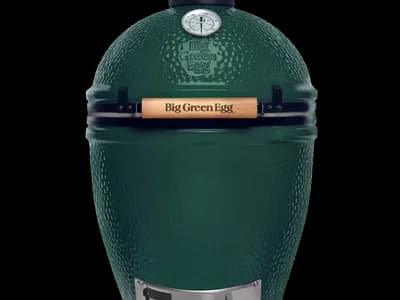
Big Green Egg Large
The Large has thermal mass to spare to settle at 110 °C with the 1.4 kg tomahawk.
€2,099
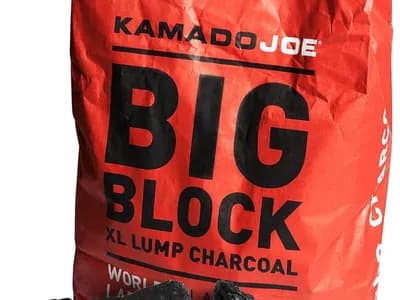
Kamado Joe Big Block XL lump charcoal 9.1 kg
Quality lump for the slow stage at 110 °C and then the sharp climb for the sear.
€67
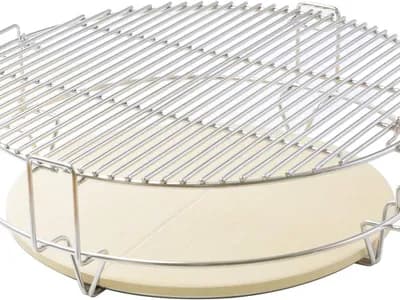
Onlyfire GCG-8552 Cooking System (2 grates + rack + 2 deflectors) for Large Kamado
€95
MEATER+ wireless WiFi thermometer
Probe in the centre of the tomahawk to nail 50 °C before cranking up the heat.
€99
Weber Precision Tongs 46 cm (6760)
€28
Have you made it?
Tell us how it turned out on your kamado. We review every rating before publishing it.
No published ratings yet. Be the first!
FAQ
What does reverse-sear actually offer over the classic sear-first method?
Reverse-sear takes the meat up to the target internal temperature at low indirect heat first, and only then hits it with a fierce sear. That gives you edge-to-edge even pink, with none of the grey overcooked band you get from the classic sear-first method. The Maillard crust also forms faster on a surface already dried by the indirect phase, so it comes out darker and crisper with less risk of overcooking.
Is a Bluetooth probe really mandatory?
For a steak this expensive and this thick, yes. The difference between pulling at 48°C, 50°C or 52°C internal is not cosmetic — it changes the final doneness. A Bluetooth probe (Inkbird IBT-26S, Meater Plus, ThermoPro) costs 40-80 € and lasts years. The analogue probes on a kamado are for chamber temperature, not the centre of the meat. If you only have an instant-read thermometer, check every 10 minutes from the 35-minute mark onward — it works, but precision drops.
Without a deflector, can you improvise the indirect phase?
You can, but you lose consistency. One option is to build the charcoal only on one side and place the tomahawk on the other — turning the kamado into a two-zone grill. Another is to slide a heavy aluminium tray with water between the coals and the grate. Neither matches a ceramic deflector for even radiant heat. If you cook reverse-sear regularly, the OEM deflector for your kamado brand is the most cost-effective accessory after the probe.
Does the tomahawk bone affect cooking time?
Yes, but less than folklore claims. Bone conducts heat more slowly than meat, so the zone immediately next to the bone runs 2-3°C cooler than the rest. That is why it is best to sink the probe into the geometric centre of the muscle, not next to the bone — probe close to the bone and you will pull late, with the rest overcooked. In total time, a bone-in steak adds about 5-8 minutes versus a boneless ribeye of the same thickness.
Thick or thin slices when serving?
Thick. A finger-thick slice (1.5-2 cm) holds internal temperature and keeps the juices in as you chew. Thin, carpaccio-style slices cool in seconds and look visually dry, on top of losing the contrast between Maillard crust and pink centre that defines a good reverse-sear. Serve on a warm platter, 2-3 slices per diner. Leftovers keep whole, wrapped in cling film, and are warmed at 70°C in the kamado the next day.
Can you reverse-sear a tomahawk without a kamado?
Yes: the 110 °C phase works the same in an oven, on gas or with pellets, and the challenge is the sear. A gas grill with a cast-iron plate gets very close; with an oven or pellets, sear in a very hot cast-iron pan.
Can I make this recipe with a different cut instead of bone-in ribeye?
Picanha keeps the reverse sear exactly as is, and Iberian pork presa does too with a cooler dome. Tenderloin moves to an indirect roast and is seared at the start. In all three the probe decides: pull a few degrees early, it rises while resting.
What do I do with the embers left after making Reverse-sear tomahawk on the kamado?
After 1 h 15 min at 110 °C in a classic kamado about 520 g of live embers remain: 3 h 40 min more at 110 °C without touching the vents or 1 h 40 min at 140-200 °C opening the vents. If you are not going to use them, close both vents and keep the charcoal for next time.
More kamado recipes
KEEP READING
Go deeper on this dish
- Recommended kamado
Big Green Egg Large
The Large has thermal mass to spare to settle at 110 °C with the 1.4 kg tomahawk.
- Editorial guide
How to light a kamado: the step-by-step method
No petrol, no weird tablets and no 45-minute waits. The cone method, airflow control and the mistakes that prevent 80% of the frustration.
- Glossary term
Heat deflector
Ceramic plate placed between the coals and the grate to turn direct fire into indirect cooking.
- Related comparison
big green egg large vs kamado joe classic iii
The classic kamado matchup: the Big Green Egg Large, the indestructible pioneer with the widest accessory network, agai…