Recipe · Indirect · Medium
Burnt Basque cheesecake on the kamado, creamy inside
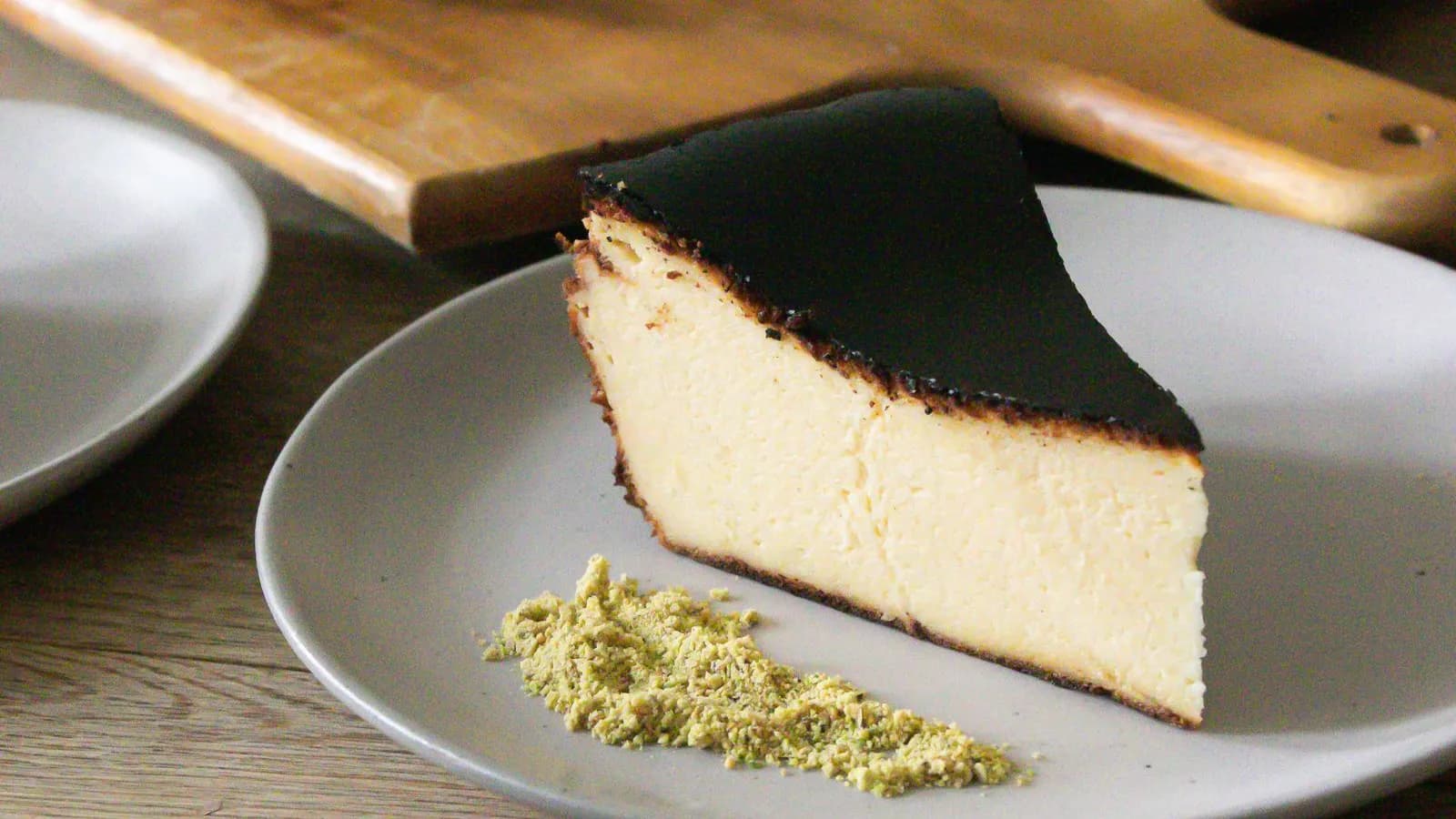
La Viña on the kamado: a near-burnt mahogany top and a wobbly, creamy centre. Indirect at 210°C, the Basque cheesecake that beats the home-oven version.
Quick answer
Basque burnt cheesecake on the kamado bakes at 210 °C indirect with a deflector, 45-55 minutes without lifting the lid, in a tall 23 cm tin lined with crumpled paper. It's ready when the surface is mahogany, almost burnt, and the centre wobbles like a flan. Let it cool for 1 hour and chill 3-4 hours before slicing: the centre sets as it cools.
One big step at a time, screen kept on and built-in timers.
- Prep
- 20 min
- Cook
- 50 min
- Servings
- 10 servings
- Temperature
- 210 °C
What time do you want to eat?
Pick a time and we'll tell you when to start.
12:10
Start the prep
12:30
Light the kamado
13:00
Onto the kamado
14:00
Serve
Estimate: it includes lighting and settling the kamado plus a margin for large cuts. If the recipe asks you to marinate or salt ahead, add that time.
Fire setupIndirect
- Dome
- 210 °C
- Deflector
- Yes
- Grate
- Standard height
- Setup
- Deflector (plate-setter); 23 cm springform pan
Temperature curve
1:35 h from lighting
Kamado dome
| # | From | Phase | Dome |
|---|---|---|---|
| 1 | 0:00 | Light the charcoalPlate-setter in; 20-25 min up to 210 °C | 20 → 210 °C |
| 2 | 0:25 | StabiliseDo not load the cake until 10 min dead steady at 210 °C | 210 °C |
| 3 | 0:35 | Put the food in23 cm tin with crumpled paper on the deflector | 210 → 185 °C |
| 4 | 0:37 | Bake45-55 min unopened; dark mahogany top, wobbly centre | 185 → 210 °C |
| 5 | 1:25 | RestCool in the tin; then an hour out and into the fridge | 210 → 150 °C |
| 6 | 1:35 | Serve | off |
0:00 is the moment you light the charcoal. Internal temperatures are the ones the recipe gives; without a probe, go by the times. Turn these times into clock times with the planner
For this recipe
Ingredients
- full-fat cream cheese (Philadelphia-style), at room temperature1 kg
- white sugar300 g
- large eggs, at room temperature5
- double cream (35% fat)400 ml
- plain flour (a veil, sifted)30 g
- orange (fine zest, no white pith)1
- orange-blossom honey (optional, to round out the bitterness)1 tbsp
- vanilla extract1 tsp
- fine salt (lifts the cheese and the caramel of the burn)1 pinch
Allergens
- Gluten
- Eggs
- Milk
Based on the recipe's ingredients. Always check the label of every product you buy.
The gear for this recipe
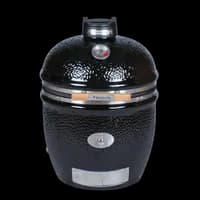 Monolith Classic Pro 2.0
 Kamado Joe Big Block XL lump charcoal 9.1 kgClean lump with no off-flavours to mask the cheese at 210 °C.
 Inkbird IBT-4XS Bluetooth thermometerKeep track of the steady 210 °C the creamy centre needs.
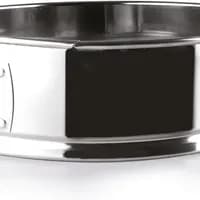 IBILI 650223 Stainless Steel Springform Cake Tin, 23 cm
Method
- 01
Bring everything to room temperature
An hour ahead, take the cream cheese, eggs and cream out of the fridge. This is the invisible step that decides the texture: cold cheese will not integrate and leaves lumps no amount of beating clears, and a lumpy batter bakes unevenly. The cheese should be soft and pliable, almost a paste, before you start beating.
- 02
Set the deflector and stabilise 210°C
Light the kamado, set the deflector (plate-setter) and stabilise the chamber at 210°C indirect. It takes 20-25 minutes. Do not load the cake until the thermometer holds at 210°C for 10 minutes: this cake lives on the initial heat burst, and an oven still climbing will not burn the top properly.
- 03
Line the tin with crumpled paper
Use a tall 23 cm springform tin. Crumple two large sheets of baking paper, dampen them slightly and squeeze so they mould, and line the base and sides letting them stand 5-6 cm above the rim. Those creases score the crust and cradle the cake as it rises and puffs in the oven.
- 04
Beat the cheese, sugar and eggs
Beat the cream cheese with the sugar and salt on medium until smooth and lump-free, 2-3 minutes. Add the eggs one at a time, fully integrating each before the next. Mix in the orange zest, honey and vanilla. Do not over-beat: aerating the batter traps bubbles that puff and crack the cake.
- 05
Add cream and flour
Pour in the cream in a stream, beating on low until combined. Sift the flour over the top and fold it in gently, just until it disappears: the flour is only a veil that stabilises the centre, it should not be noticeable. Pour the batter into the lined tin; it should be loose and glossy.
- 06
Bake 45-55 min without lifting the lid
Place the tin on the grate over the deflector and close the kamado. Bake 45-55 minutes at 210°C without lifting the lid. It is ready when the top is dark mahogany, almost burnt, and the centre wobbles like a barely-set flan when you shake the tin. It looks raw and that is exactly the point: the centre sets as it cools.
- 07
Cool, then chill before slicing
Pull the cake with gloves and let it cool in the tin at room temperature for 1 hour; it will sink a little and settle. Then refrigerate at least 3-4 hours, ideally overnight. Straight out it is too loose to slice and the flavour of the burn has not settled. Unmould using the paper itself and serve at a gentle room temperature.
About this recipe
A Basque burnt cheesecake on the kamado bakes hot and fast —210°C indirect with the deflector in— to get what defines it: a burnt, mahogany-coloured top and a centre that wobbles, almost liquid, as you pull it. This is not a set, firm American cheesecake; it is the opposite. The kamado, which holds that 210°C like a real wood-fired oven and throws an enveloping radiant heat, gives a deeper, more aromatic burn than any home oven, without overcooking the centre.
Why the centre has to stay liquid
The whole point of the Basque cake, the one La Viña invented in San Sebastián, is contrast: a burnt, bitter crust on top and an interior that is unset, creamy, almost custard-like. You get there by baking hot and short —not at 160°C for an hour like a classic cheesecake— so the heat caramelises and burns the surface before the centre has a chance to set. You pull it when the edges are firm but the middle still jiggles when you shake the tin: it looks raw and it isn't. As it cools it settles into a silky, spoonable texture. Wait for the centre to stop wobbling in the oven and you pull a plain cheesecake, not a Basque one.
Why the kamado burns better than a home oven
This cake was born for a wood-fired oven that throws heat from above and all around. The kamado replicates that better than an electric oven: with the deflector it holds a pinned 210°C without swinging every time the element fires, and the ceramic mass returns an enveloping radiant heat that browns the surface evenly and deeply, not just from an overhead grill. The result is that even, mahogany burn with toasted, almost bitter-caramel notes that a domestic oven struggles to land without scorching one side. The golden rule of all kamado baking still holds: stabilise first, do not lift the lid mid-bake.
A Mediterranean touch and the rest
Over the classic base —cream cheese, cream, eggs, sugar and a veil of flour— I give it a backbone of home with orange zest and a spoon of orange-blossom honey that round out the bitterness of the burn without masking it. The crumpled baking paper poking up above the tin is not for looks: the creases score the crust and cradle the cake as it rises. And the step most people skip: the rest. Let it come down to room temperature, then chill for a few hours in the fridge; straight out it is too loose to slice and the flavour has not settled. It is the dessert I bring out to close a meal on the terrace in Torrevieja with something that looks like patisserie and is made in one piece.
In 30 seconds
Deflector in, kamado a stable 210°C indirect oven. Tin lined with crumpled baking paper, sides high. Beat room-temperature cream cheese + sugar + eggs + cream + a veil of flour + orange zest and orange-blossom honey. Bake 45-55 min without lifting the lid until the top is mahogany and the centre wobbles (it looks raw, that's right). Cool, then chill a few hours in the fridge before slicing. Serves 10, creamy inside.
Will it fit your kamado?
Small
33-40 cm · Joe Jr, MiniMax
Fits
The 23 cm pan fits; make sure the paper doesn't touch the lid as the cake rises.
Medium
46-51 cm · Classic, Large
Fits
The 23 cm pan fits comfortably.
Large
56-61 cm · Big Joe, XL
Fits
Fits comfortably; probably two pans at once.
What to serve with it
Sides
- Fresh red berries
- Wine
- Pedro Ximénez from Montilla-Moriles or Moscatel de Valencia
- Beer
- Sweet stout or red berry beer
- Alcohol-free
- Black coffee or black tea with orange
Leftovers and storage
- In the fridge
- Once cool, covered and refrigerated within 2 hours in an airtight container: 2-3 days.
- Freezing
- Well-wrapped slices, 2-3 months; slightly less creamy. Thaw in the fridge; do not refreeze.
- Reheating
- Not reheated: take out of the fridge 30 minutes before serving so it turns creamy again.
- Using them up
- Crumbled into glasses with berries and crushed biscuits.
Cool and refrigerate within 2 hours. When in doubt, throw it out.
Leftover embers
You still have embers: what to do with the leftover heat
For 50 min at 210 °C in a classic kamado you load about 1 kg of charcoal and burn 800 g: when you serve, about 170 g of live embers remain. Before you shut the vents, that is still enough for:
Closing the vents halfway and waiting for it to drop
140-200 °Cdessert while you eat
20 minof embers
- Smoked Loaded Nachos on the Kamado12 min · 185 °C
- Kamado-roasted figs with goat cheese and honey7 min · 200 °C
No recipe needed
- Yesterday's bread with oil and garlic, on the grate (10 min)
Before opening the lid, crack it open for a few seconds first; if you raise the heat, stir the ash so the coals can breathe. And if you are not going to use them: once the food is out, close the bottom and top vents. The charcoal that does not burn (about 170 g) can be used next time. Different size of kamado? Work out your load for 1 h 30 min of fire, lighting included.
History of the dish
- Origin
- San Sebastián, Basque Country (Spain)
- Period
- Late 20th century (1988 or 1990, depending on the source)
- Where it is cooked today
- San Sebastián and, after its online fame, cafés and homes across the world
The "burnt" cheesecake is not a centuries-old recipe but a recent creation. It is credited to Santiago "Santi" Rivera, of the pintxo bar La Viña in the Old Town of San Sebastián, although sources differ on the date: 1988 or 1990. The bar had been opened in 1959 by his parents and his aunt and uncle, and at La Viña itself it is simply called "tarta de queso".
Its hallmark is high-temperature baking: the surface caramelises and toasts while the interior stays creamy. Rivera himself has played down the word "burnt", calling it marketing; outside Spain it has spread as "Basque cheesecake" or "Basque burnt cheesecake".
For years it was a local speciality. Worldwide fame came through the internet, social media and gastronomic tourism; by 2021 The Guardian considered it ubiquitous, helped in part by the recipe Nigella Lawson included in Cook, Eat, Repeat. Today it is imitated in cafés and kitchens around the world, yet those who want to try it where it began still go to La Viña.
Sources
- Basque cheesecake — Wikipedia (en.wikipedia.org)
- The Story Behind the Famed Basque Country Cheesecake (Nicole Konstantinakos, 2022) — America's Test Kitchen (americastestkitchen.com)
- How to make the perfect Basque cheesecake (Felicity Cloake, 2021) — The Guardian (theguardian.com)
- ¿Por qué la San Sebastián Cheesecake conquista el mundo? — Donostia San Sebastián Turismoa (sansebastianturismoa.eus)
No kamado?
How to make it without a kamado: oven, gas grill or pellets
Basque cheesecake is an oven recipe: 45-55 minutes at 210 °C until the top scorches. Without a kamado you lose nothing; gas or pellets burn the top less.
Home oven
- Temp.
- 210-220 °C conventional (200 °C fan)
- Time
- 45-55 min, same as on the kamado
- This is its home appliance: tin on the middle rack, top and bottom heat
- If the top is not mahogany at 45 min, give it 2-3 min under the broiler, watching
- Same doneness cue: the centre should wobble like a flan
SmokeBarkJuicinessAs good or better: it is an oven cake
Gas grill
- Temp.
- 210 °C indirect, two-zone setup
- Time
- 50-60 min; one-sided heat browns more slowly
- Tin on a tray or stone over the unlit side so the base does not burn
- Turn the tin 180° at 30 min; the burner side browns first
- A pit probe beside the tin; at 210 °C a 30-degree error changes everything
SmokeBarkJuicinessTurns out well, with a less burnt top
Pellet grill or electric smoker
- Temp.
- 210 °C on a pellet grill, 230 °C to finish
- Time
- 45-55 min, the last 10 at 230 °C
- Pellet grill only; at an electric smoker's 135 °C there is no burnt top
- Mild fruitwood pellets; heavy smoke clashes with the cheese and orange
- Go up to 230 °C for the last 10 min; pellet heat browns less
SmokeBarkJuicinessCreamy with a hint of smoke; the burn is shyer
Temperatures and times are a guide; the original recipe is the kamado one. Tempted? which kamado to choose for what you cook
Editor's tips
- An independent chamber probe (Inkbird) at grate height is more reliable than the dome gauge, which reads the air under the lid, not next to the tin. At 210°C, thirty degrees of drift is the difference between a mahogany burn and either a set centre or a pale top.
- The centre must wobble when you pull it, full stop. This is the mistake that ruins a Basque cake: you leave it until it sets for fear it is raw, and out comes a plain firm cheesecake. Pull it when the edges are firm and the middle jiggles; the custard sets itself as it chills.
- Smoke has no place here. The Basque cake is cheese, cream and the caramel of the burn: the kamado's clean charcoal already lends a subtle toasted backdrop. Do not add wood chunks; a cheese dessert with smoke tastes of forgotten barbecue, not complexity.
Gear for this recipe
As an Amazon Associate, mikamado.es earns from qualifying purchases. At no extra cost to you.

Monolith Classic Pro 2.0
€2,000
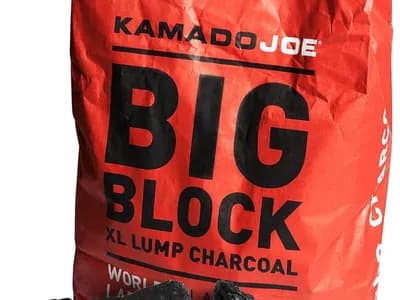
Kamado Joe Big Block XL lump charcoal 9.1 kg
Clean lump with no off-flavours to mask the cheese at 210 °C.
€67
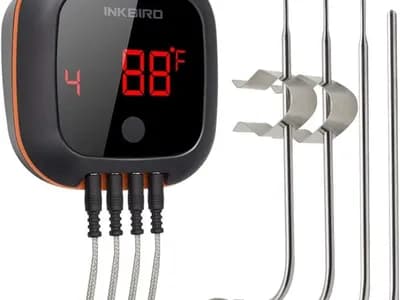
Inkbird IBT-4XS Bluetooth thermometer
Keep track of the steady 210 °C the creamy centre needs.
€72
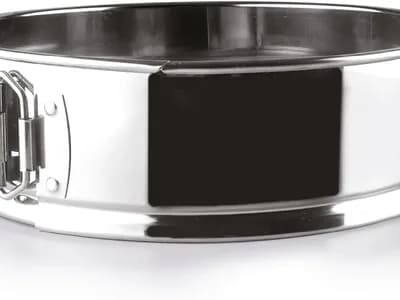
IBILI 650223 Stainless Steel Springform Cake Tin, 23 cm
€10
Have you made it?
Tell us how it turned out on your kamado. We review every rating before publishing it.
No published ratings yet. Be the first!
FAQ
Why does a Basque cheesecake have to stay liquid in the centre?
Because that contrast is the essence of the dessert: a burnt, bitter crust outside, a creamy, barely-set interior within. The Basque cake, born at the La Viña bar in San Sebastián, is baked hot and short precisely for this: the heat burns the surface before the centre can set. When you pull it, the centre wobbles and looks raw, but it isn't; as it chills in the fridge the egg and cream settle into a silky, custard-like texture. Bake it until the centre is firm and you have made a plain American cheesecake, not a Basque one. The wobble on pulling it is not a fault: it is the goal.
Which cream cheese should you use and at what temperature should it be to mix?
Use a full-fat cream cheese like Philadelphia, not light or low-fat: the fat is what gives the creaminess and the body that holds the cake. Avoid cheap, watery spreadable tubs; they weep whey and the cake turns watery. And the rule that causes the most failures: the cheese, eggs and cream must be at room temperature, out of the fridge an hour ahead. Cold cheese will not integrate and leaves lumps that more beating will not clear; a lumpy batter bakes unevenly and streaks. The cheese should be soft and pliable, almost a paste, before you start beating it with the sugar.
How do you get the characteristic burnt top without overdoing it?
The burn comes from high, enveloping heat, not from time. Stabilise the kamado at 210°C with the deflector already in and load the cake only when it is pinned; that initial heat burst is what caramelises and burns the top while the centre stays liquid. The kamado does it better than a home oven because it throws radiant heat from above and the sides at once, so the burn comes out even, not patchy. Watch through the vent or the thermometer, not by opening the lid: you want a uniform dark mahogany, almost black on the high edges of the paper, but not charcoal. If it is still pale at 45 minutes, push to 220°C for the last 5-8 minutes; the centre survives because it has not yet set.
How long should you rest and chill the cake before slicing?
Two stages. First, let the cake cool in the tin at room temperature for about 1 hour: it will sink a little, settle and stop bubbling inside. Then refrigerate at least 3-4 hours, and overnight if you can, better still. Straight from the kamado the centre is too liquid to slice cleanly and the flavour of the burn has not settled; as it chills, the egg and cream set into that creamy, spoonable texture that defines the cake, and the burn shifts from harsh to toasted with a caramel backbone. Take it out of the fridge 20-30 minutes before serving so the centre turns silky again: too cold and it loses creaminess and tastes muted.
Why does the kamado give a better burn than a conventional oven?
Two reasons. The first is the type of heat: the Basque cake was born in wood-fired ovens that throw heat from above and all around at once, and the kamado, with its ceramic mass, replicates that enveloping radiant heat. An electric oven leans mostly on a top element to burn the face, and that gives a patchy browning, strong in the centre and weak at the edges. The second is stability: once stabilised with the deflector, the kamado holds 210°C pinned without the swings of a domestic oven, which rises and falls every time the element fires. Even, constant heat at a high temperature is exactly what a uniform mahogany burn asks for. In exchange you lose the convenience of peering through the glass: here you trust the thermometer and not lifting the lid.
Can you make Basque burnt cheesecake without a kamado?
Yes, and a home oven does it as well or better: 45-55 minutes at 210-220 °C, since it is an oven recipe. A gas or pellet grill also works, but the top burns less and you need to turn the tin or raise the heat at the end.
What do I do with the embers left after making Burnt Basque cheesecake on the kamado, creamy inside?
After 50 min at 210 °C in a classic kamado about 170 g of live embers remain: 20 min at 140-200 °C closing the vents. If you are not going to use them, close both vents and keep the charcoal for next time.
More kamado recipes


KEEP READING
Go deeper on this dish
- Recommended kamado
Monolith Classic Pro 2.0
The German alternative to the Kamado Joe Classic III
- Editorial guide
How to light a kamado: the step-by-step method
No petrol, no weird tablets and no 45-minute waits. The cone method, airflow control and the mistakes that prevent 80% of the frustration.
- Glossary term
Heat deflector
Ceramic plate placed between the coals and the grate to turn direct fire into indirect cooking.
- Related comparison
kamado joe classic iii vs monolith classic pro 2 cart
The comparison every European cook eventually makes: the Kamado Joe Classic III, the US reference with SlōRoller, again…