Recipe · Smoked · Advanced
Homemade Pastrami on the Kamado: Brine-Cured, Hickory-Smoked and Steam-Finished
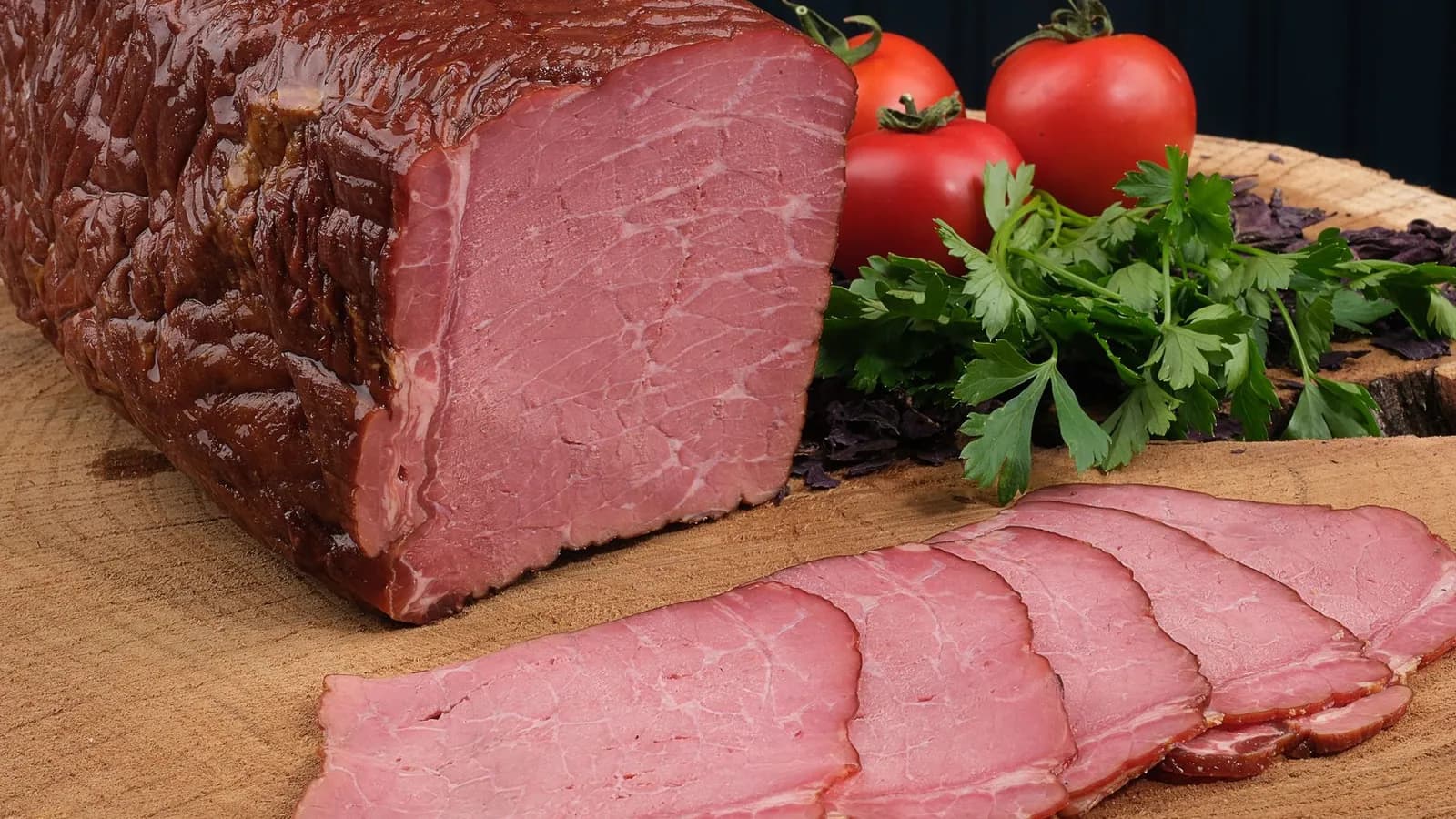
Beef brisket cured for five to seven days in a brine with curing salt, smoked over hickory at 110 °C and finished in steam until the probe slides in with no resistance. This is not a brisket with spices on it: it is a different dish.
Quick answer
Cure 2.5 kg of beef brisket for 5 to 7 days in the fridge, in a brining bag with salt, sugar, spices and curing salt at the manufacturer's dose. Coat it in crushed pepper and coriander and smoke on the kamado at 110 °C over hickory to 70 °C internal. Finish in steam in a pot with a rack to 93-96 °C, when the probe slides in with no resistance. Slice cold.
- Prep
- 60 min
- Cook
- 480 min
- Servings
- 12 servings
- Temperature
- 110 °C
Ingredients
- beef brisket (the flat; sold in Spain as "pecho" or "pecho de ternera", and as "brisket" at barbecue butchers), with a 5 mm fat cap2.5 kg
- water4 l
- coarse sea salt200 g
- brown sugar100 g
- nitrite curing salt, the exact amount the manufacturer specifies for this brine (0.6 % sal nitrificada replaces the sea salt; a concentrate such as Prague Powder #1 is added to it); do not substitute table salt1 dosis
- yellow mustard seeds, for the brine2 cda
- garlic cloves, crushed4 ud
- bay leaves3 ud
- whole allspice berries1 cdta
- black peppercorns, coarsely crushed, for the crust4 cda
- coriander seeds, coarsely crushed, for the crust4 cda

Method
- 01
Make the brine
Bring 1 litre of the water to the boil with the coarse salt (or the sal nitrificada that replaces it), the sugar, the mustard, the garlic, the bay and the allspice. After 5 minutes turn off the heat; if your product is a concentrate added to the salt, stir in the curing salt in the exact amount stated on its packet until it dissolves. Add the remaining 3 litres of cold water and chill in the fridge to 4 °C or below: the meat never touches warm brine.
- 02
Cure in the bag for 5-7 days
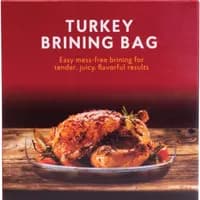
Trim the fat cap on the brisket to about 5 mm and remove the silverskin from the lean side. Put the joint into the HIC Kitchen brining bag, pour in the brine with its spices, squeeze out the air and seal. Lay the bag flat on a tray and keep it on the bottom shelf of the fridge, between 0 and 4 °C, for 5 days if the brisket is around 3 cm thick and up to 7 if it reaches 4 or 5 cm. Turn it once a day.
- 03
Desalt, dry and crust
Lift out the brisket, discard the brine and rinse the meat under the tap. Submerge it in clean cold water for 2 hours, changing the water after the first hour, to draw the salt off the surface. Pat it thoroughly dry with kitchen paper. Coarsely crush the pepper and coriander for the crust and coat the joint on every face, pressing it on by hand. Leave it uncovered on a rack in the fridge for 12 to 24 hours: the surface dries and the crust sets.
- 04
Build the Minion fire
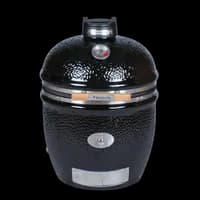
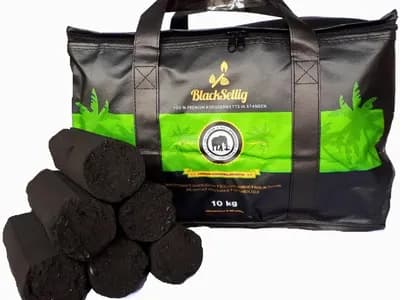
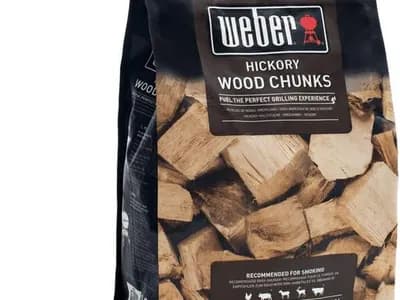
Empty the ash from the Monolith Classic Pro 2.0 and fill the firebox with BlackSellig coconut briquettes up to the rim of the fire ring, with a hollow in the centre. Scatter 3 or 4 Weber hickory chunks among the unlit briquettes. Set a firelighter in the hollow with 6 to 8 briquettes on top and light it. Fit deflector and drip tray, close the dome and settle at 110 °C with the vents almost closed before the meat goes in: the smoke should run thin and bluish, not white.
- 05
Smoke to 70 °C
Lay the brisket fat side up on the grate and push one Inkbird IBT-26S probe into the centre of the thickest part; rest a second one beside the meat to read the real temperature at grate level. Set the alarm to 70 °C and do not open the dome. At 110 °C this joint usually takes between 4 and 6 hours to get there, but the probe decides, not the clock. When the alarm sounds, take the brisket out.
- 06
Carry on or hold
At 70 °C the pastrami has taken all the smoke it is going to take. You can move straight on to the steam or let it cool for 30 minutes, wrap it in cling film and keep it in the fridge for up to 3 days to finish another day. This pause is an advantage over brisket: it splits the work across two afternoons and the result does not suffer.
- 07
Steam-finish to 93-96 °C
Put 3 or 4 cm of water in a wide pot with a rack and bring to the boil. Sit the brisket on the rack, lower the heat to a steady, gentle steam and cover. Top up with boiling water every 45 minutes. From the second hour check with the Inkbird probe, drying it afterwards: the cable joint is not watertight and must not sit in the steam. Carry on to 93-96 °C, when it slides in with no resistance; fridge-cold, the joint needs 2 to 3 hours.
- 08
Chill, slice and serve
Let the pastrami cool for 30 minutes, wrap it in cling film and keep it in the fridge for at least 12 hours: cold, the crust settles and the meat cuts into 2 mm slices without falling apart. Slice across the grain with a long, very sharp knife. To serve hot, warm only the slices you are about to eat for 2 or 3 minutes in the steam of the same pot. Rye bread, mustard and pickles.
About this recipe
Pastrami looks like smoked brisket in the photo and not much beyond that. The [low-and-slow smoked brisket](/recetas/brisket-ahumado-baja-temperatura) is a raw beef brisket, salted the night before and taken to 93-96 °C over a slow fire, with a stretch wrapped in butcher paper. Pastrami starts from the same cut, but before it ever sees smoke it spends five to seven days in a brine with curing salt, and it is not finished wrapped but in steam. Those two stages change the colour, the texture and the way you eat it: pink to the centre, dense and springy, in thin cold slices on rye bread. The long fire is already explained in the brisket recipe; here it is only summarised.
Brine in a bag: five to seven days in the fridge
The brine has to cover the joint completely for the best part of a week, and a 2.5 kg brisket with its four litres of liquid will not fit in an ordinary food container: the meat floats with one face out of the brine. The answer is a [brining bag](/accesorios/hic-kitchen-bolsa-salmuera-pavo-61x60) like the one from HIC Kitchen, designed for whole turkeys: it measures 61 × 60.7 cm and the manufacturer rates it for a 9 kg load, so a 2 to 3 kg brisket with its brine goes in with room to spare. Laid flat on a tray, it keeps liquid around the meat on every face, and turning the meat each day means turning the bag. Thickness sets the timing: a brisket around 3 cm thick cures in five days; one of 4 to 5 cm needs the full seven. A brine that has not reached the centre leaves a grey band in the slice.
Curing salt: the manufacturer sets the dose
The pink colour, the cured-meat flavour and the safety of a joint that spends a week in liquid all come from nitrite, which in Spain is sold as sal de curar (curing salt) or sal nitrificada. Its quantity is not just another ingredient in the recipe: every product has a different concentration and the packet states how many grams go per litre of brine or per kilo of meat. That is the figure you use, without rounding up "to be safe": too much nitrite is toxic and below the dose the cure does not protect. Two fixed rules: curing salt is never replaced with table salt or pink Himalayan salt, and it is kept well away from the salt cellar so the two are never confused. If the brisket turns out smaller than planned, you recalculate the whole brine. And check which product you have: sal nitrificada at 0.6 % nitrite, the usual one in Spain, goes in place of the salt, not on top of it; if that is yours, it takes the place of the 200 g of sea salt, in the amount its packet states. Only concentrates such as Prague Powder #1 (6.25 % nitrite) are added to ordinary salt.
Minion with coconut, hickory for aroma and steam to finish
The smoke runs for hours at 110 °C and that fire is built once, by the [Minion method](/guias/metodo-minion-snake-kamado-fuego-largo): the firebox of a large kamado such as the Monolith Classic Pro 2.0 is filled with BlackSellig coconut briquettes, which burn evenly and leave little ash, and only a handful are lit in the centre so the rest catch one from the next. The Weber hickory chunks are scattered among the unlit briquettes: they are aroma, not fuel, and three or four are enough for the whole cook. With the deflector in place, one Inkbird IBT-26S probe in the meat and another beside the grate, the [temperature is watched from your phone](/guias/termometro-y-sonda-para-kamado) without opening the dome. The target is 70 °C in the centre: by then the meat has all the smoke it needs and the crust has set.
What comes next is what makes pastrami pastrami. With a brisket, the joint is wrapped to get through the stall without losing its bark. Here there is no paper: the brisket goes into a pot with a rack over boiling water, covered, and keeps climbing in moist steam until the probe reads 93-96 °C and slides in with no resistance. The steam softens the crust until it clings to the meat, breaks down the collagen without drying the fibres and leaves the joint ready to cut into thin slices once it is cold. And the smoking can be done one day and the steaming another: cured and smoked, the brisket keeps for three days in the fridge.
In 30 seconds
A 2.5 kg beef brisket, 5-7 days in a brining bag with curing salt at the manufacturer's dose, a crust of pepper and coriander, smoked at 110 °C over coconut briquettes and hickory chunks to 70 °C internal, then finished in steam in a pot with a rack to 93-96 °C, when the probe slides in with no resistance. Chilled right through and sliced thin.
Editor's tips
- Choose a brisket of even thickness. A piece that runs from 2 to 5 cm cures at two speeds: the thin end comes out salty and the thick end reaches the centre raw. If the butcher only has the whole piece, cut off the thin tip and cure it separately for fewer days.
- Taste for salt before crusting: cut a sliver from the edge after the soak, give it 1 minute in a frying pan and taste it. If it tastes like salt cod, another hour in cold water; once smoked, it can no longer be corrected.
- The hickory chunks go on dry and spread out, never heaped on the lit coals: three or four give thin smoke for hours, and a handful more only adds bitterness to the crust.
- No rack for the pot? Three fist-sized balls of aluminium foil will hold the brisket out of the water; and if the joint will not fit whole with the lid on, cut it in two across before steaming: the cut disappears once sliced. What will not do is letting the meat boil: it turns into a stew and loses its crust.
Gear for this recipe
As an Amazon Associate, mikamado.es earns from qualifying purchases. At no extra cost to you.


FAQ
What is the difference between pastrami and smoked brisket?
The cut is the same, beef brisket, and so is the final temperature, 93-96 °C. Everything else changes. Brisket is salted the night before, smoked whole and wrapped in paper to finish. Pastrami is cured for five to seven days in a brine with nitrite, which gives it the pink colour and cured-meat flavour, wears a crust of pepper and coriander and is finished in steam, not in a wrap. It is served in thin slices, cold or rewarmed in steam, never in thick slabs like brisket.
Can you make pastrami without curing salt?
You can cook the brisket in the same brine without nitrite, but it will not be pastrami: it will come out grey, tasting of roast beef and without the protection nitrite gives a joint that spends a week in liquid. If you cannot get hold of curing salt, cut the soak to 24 hours, treat it as a brined brisket and smoke it the same way. What you must not do is extend the cure without nitrite or replace it with table salt or pink salt.
How long does pastrami take on the kamado?
It depends on the thickness of the joint and how steady the fire is, so the probe gives the answer. As a guide, a 2.5 kg brisket at 110 °C usually needs between 4 and 6 hours of smoking to reach 70 °C, and then 2 to 3 hours of steam to 93-96 °C if the joint comes cold from the fridge; less if it goes straight from the kamado. On top of that come the 5 to 7 days of curing and the overnight drying of the crust. It is a recipe for the calendar, not for an afternoon.
Why is pastrami finished in steam rather than wrapped in paper?
The butcher paper on a brisket protects the bark while the joint gets through the stall and keeps it dry. Pastrami wants the opposite: a soft pepper crust clinging to the meat, and fibres that pull apart into thin slices. Moist steam breaks down the collagen without drying the surface and rehydrates the crust. That is why the New York delis keep it in steam right up to the moment it is sliced.
Which cut should I ask the butcher for to make pastrami?
Beef brisket, the same joint as for smoked brisket. In Spain it is sold as pecho or pecho de ternera and, at barbecue butchers, under the English name. Ask for the flat, the part that in brisket terms is called the "flat": it is more even in thickness than the point and both cures and slices better. Have them leave the fat cap on; at home you trim it to 5 mm. A 2.5 kg piece fits in the brining bag and on the grate of a 46 cm kamado.
More kamado recipes
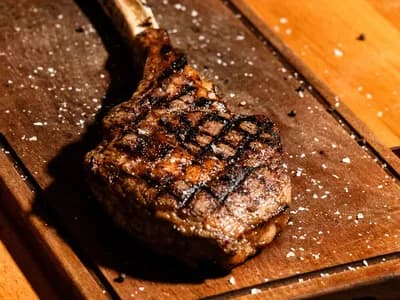
Reverse-sear tomahawk on the kamado
A 1.4 kg tomahawk, probe in the centre, ceramic at 110°C and a 90-second final sear. The Sunday centrepiece for when you want to impress without gambling on doneness.
Alicante-style baked rice on the kamado in a clay cazuela
Traditional Alicante baked rice —chickpeas, pork rib, blood sausage, potato and tomato, with a whole garlic head in the centre— baked in a clay cazuela at 220°C indirect.
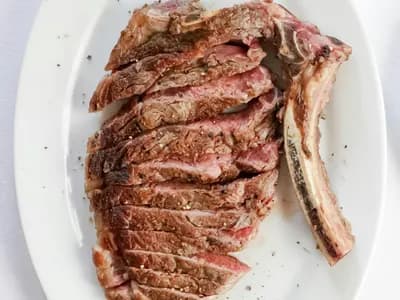
Galician ribeye on the kamado, direct sear
A one-kilo Galician ribeye, Maldon salt, embers at 350°C and not a thing more. The shortest recipe of the year and the hardest to mess up if you respect the timings.
KEEP READING
Go deeper on this dish
- Recommended kamado
Monolith Classic Pro 2.0
The German alternative to the Kamado Joe Classic III
- Editorial guide
How to light a kamado: the step-by-step method
No petrol, no weird tablets and no 45-minute waits. The cone method, airflow control and the mistakes that prevent 80% of the frustration.
- Glossary term
Hickory
Strong, sweet-smoke North American hardwood; the Texas and Kansas City BBQ standard.
- Related comparison
kamado joe classic iii vs monolith classic pro 2 cart
The comparison every European cook eventually makes: the Kamado Joe Classic III, the US reference with SlōRoller, again…