Recipe · Reverse-sear · Medium
Rabbit al Ajillo on the Kamado, Butterflied and Reverse-Seared
Farmed rabbit, butterflied, cooked indirect at 140 °C over a half-moon deflector and finished on cast iron with garlic and rosemary oil. Two zones at once in a 46 cm kamado, with nothing to move while it is hot.
Quick answer
Butterfly a 1.3-1.5 kg rabbit, salt it 2 hours ahead and cook it indirect at 140 °C over the half-moon deflector until the thigh reads 60-62 °C (35-45 minutes). Move it to the cast-iron grate over direct coals, 3-4 minutes a side, brush with garlic and rosemary oil in the last minute and pull it at 70-72 °C in the thigh. Rest 5 minutes.
- Prep
- 30 min
- Cook
- 55 min
- Servings
- 4 servings
- Temperature
- 140 °C
Ingredients
- whole farmed rabbit, 1.3-1.5 kg, head removed1 ud
- coarse salt15 g
- extra virgin olive oil100 ml
- garlic cloves, sliced6 ud
- sprigs of fresh rosemary2 ud
- sprigs of fresh thyme2 ud
- sweet pimentón de la Vera (smoked Spanish paprika)1 cdta
- freshly ground black pepper1 cdta
- lemon1 ud
- fresh parsley, chopped1 puñado


Method
- 01
Butterfly the rabbit
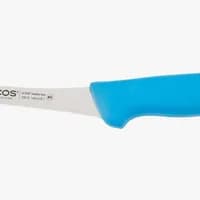
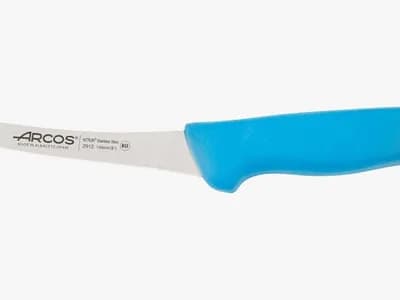
Lay the rabbit on its back. With the Arcos 2900 curved boning knife, cut along the belly down the breastbone and carry on through the rib cartilage as far as the front legs. Open it out with your hands and press the backbone with your palm until it gives and the piece lies flat. Cut a centimetre into the joint where each thigh meets the hip, without detaching them, so they open out. Remove the kidneys, liver and loose fat, and set them aside.
- 02
Dry-salt
Pat the piece dry with kitchen paper and spread the 15 g of coarse salt over both sides, a little more on the thighs. Set it on a rack with a tray underneath and leave it uncovered in the fridge for 2 hours, or up to 12 if you have the time. The salt works into the meat, the surface dries and browns better on the iron. Take it out 30 minutes before cooking.
- 03
Confit the garlic oil
Put the sliced garlic in a small saucepan with the 100 ml of oil, two sprigs of rosemary and the thyme. Lowest heat for 10-12 minutes: the garlic should soften without taking colour; if it sizzles, the heat is too high. Take it off, add the pimentón and the pepper away from the heat and leave to infuse. This oil is used at the end of the sear, never during the indirect phase.
- 04
Set up two zones and light
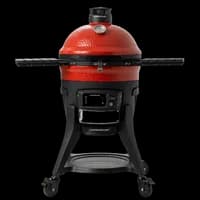
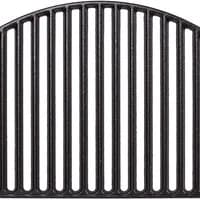
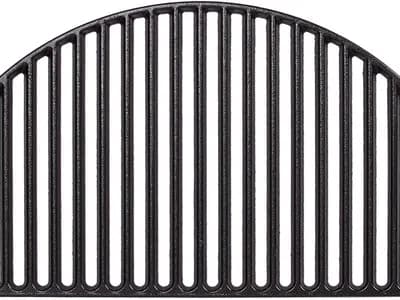
Load the Konnected Joe with the Jealous Devil quebracho banked towards the right half of the firebox. On the half-moon rack, place the half-moon deflector on the left at the lower level with a grate above it; on the right, no deflector, the half-moon cast-iron grate at the lower level. Light over the right half, close the dome and settle at 140 °C with the fan from the control panel or with the bottom vent open a finger's width.
- 05
Indirect with two probes
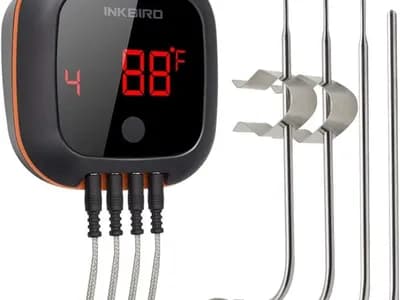
Push one Inkbird IBT-4XS probe into the centre of the thickest thigh, clear of bone, and another into the loin, next to the backbone. Lay the butterflied rabbit bone side down on the grate over the deflector half, thighs facing the centre of the kamado, which is the hottest part of that zone. Close it and leave it alone: at 140 °C the thigh takes 35 to 45 minutes to reach 60-62 °C.
- 06
Stoke the direct half
When the thigh reads 60-62 °C, lift the rabbit onto a tray with the probes still in: over the next few minutes thigh and loin even out instead of climbing further. Open the bottom and top vents fully, or raise the panel setpoint to 220 °C, and wait 5-8 minutes: the coals on the right half flare back up and the cast iron heats through. To open the dome again over live coals, burp it: open five centimetres, count three seconds and open fully. Never leave the lid ajar.
- 07
Sear with the garlic oil
Move the rabbit onto the cast-iron grate, meat side down, and close the dome. Give it 3-4 minutes a side, turning once. In the last minute on each side, brush with the garlic oil without drenching it; if it drips and flares, close the dome and wait a few seconds. The loin reaches 70-72 °C before the thighs: if it gets well ahead, lift the piece onto a board, cut it just in front of the hips with the boning knife and return only the thighs to the iron; ribs and loin wait on the platter.
- 08
Rest and serve
Pull the thighs when they read 70-72 °C and move everything to a warm platter. Rest for 5 minutes uncovered so the crust does not soften. Meanwhile, the liver and kidneys get 2 minutes on the iron with a drop of the oil. Portion with the boning knife: thighs, loin in two, rib section. Spoon over the rest of the oil with its confited garlic, the juice of half a lemon and the parsley.
About this recipe
Rabbit on the coals is Sunday food in the Levante, Spain's eastern coast: a fire of vine prunings at a country picnic spot and one shared platter. It is also one of the pieces that most often comes off a barbecue dry, and the reason is simple: farmed rabbit is lean meat with almost no marbling, and habit says sear it first over live coals. By the time the thigh is done, the loin has been overcooked for ten minutes. [Reverse-sear](/glosario#reverse-sear) turns the order round: gentle indirect cooking at 140 °C until the thigh reads 60-62 °C, and only then a short spell on cast iron with garlic and rosemary oil up to 70-72 °C. It is the technique of the chuletón (Spanish bone-in rib steak) applied to a piece weighing a kilo and a half.
Butterflying is half the job
A whole rabbit is an irregular cylinder: thick thighs, a thin loin along the backbone, an almost hollow rib cage, and each part wants a different time. Butterflied, it becomes a flat piece of even thickness with all the meat facing the heat. The cut runs along the belly, down the breastbone and the rib cartilage, and then you press the backbone with your palm until it gives. A curved semi-flexible boning knife such as the [Arcos 2900, 140 mm](/accesorios/arcos-2900-deshuesador-curvo-140) follows the bone without digging into the meat and opens each hip joint just enough. No bone is removed: the rabbit gains surface and loses height.
Two zones at once in a 46 cm kamado
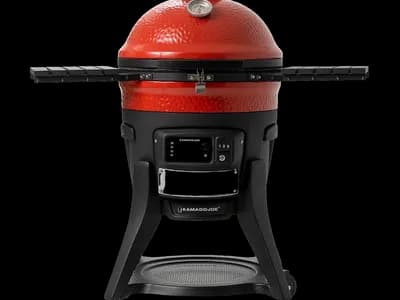
Reverse-sear has two phases and, on a kamado, the temptation is to lift out the hot [deflector](/glosario#deflector) to switch from indirect to direct. With the half-moon system that comes as standard on the [Kamado Joe Konnected Joe](/kamados/kamado-joe-konnected-joe), a 46 cm Classic, nothing needs touching. Left half: half-moon deflector on the lower level of the rack with a grate above it, the indirect zone. Right half, no deflector: the [Kamado Joe half-moon cast-iron grate](/accesorios/kamado-joe-half-moon-cast-iron-grate) on the lower level, a hand's width from the coals, the direct zone. The charcoal is banked to the right and the fire is lit over that half. The guide to [direct and indirect cooking](/guias/coccion-directa-vs-indirecta-kamado-deflector) explains each principle; here both are applied at once.
Fuel matters in a cook that runs at two speeds. A dense [lump charcoal](/glosario#lump-charcoal) such as [Jealous Devil's white quebracho](/accesorios/jealous-devil-quebracho-lump-charcoal) stays lit at low temperature through the indirect phase and answers when the vents open for the sear: hard wood, a compact bed and little ash to choke the airflow under the direct half. The Konnected Joe adds electric ignition and fan-driven temperature control, which holds the 140 °C of the long phase without touching the bottom vent.
Two probes for two parts that do not finish together
A rabbit's loin is thin and cooks before the thigh; that is why one of the two goes wrong in the traditional roast. With a multi-probe thermometer such as the [Inkbird IBT-4XS](/accesorios/inkbird-ibt-4xs), one probe goes into the centre of the thigh, clear of bone, and another into the loin, next to the backbone. The piece moves to the direct zone when the thigh reads 60-62 °C; the loin runs ahead and comes off the iron as soon as it hits 70-72 °C, even if the thighs need a couple of minutes more. The final target is 70-72 °C in the thigh: rabbit is not poultry and does not need chicken's 74 °C, but it is lean white meat and is not served pink either. The [guide to thermometers and probes](/guias/termometro-y-sonda-para-kamado) explains where to place each one.
The garlic oil goes in at the end, not the start
The sliced garlic and rosemary are confited separately over the lowest heat until the garlic is tender and the oil smells of it; that way there is no brushing during the indirect phase and no fighting flare-ups halfway through. The oil goes on in the last minute of each side of the sear, with the rabbit already on the iron, and whatever is left goes onto the platter. With the direct half on live coals, every time the dome opens it is worth [burping](/guias/kamado-temperatura-problemas-soluciones) it: open five centimetres, wait, then open fully. The lid is never left ajar to tame a flare from the oil; it is closed, and the flame dies on its own for lack of air.
In 30 seconds
Farmed rabbit of 1.3-1.5 kg, butterflied, salted 2 hours ahead, indirect at 140 °C over the half-moon deflector until 60-62 °C in the thigh (35-45 minutes), then 3-4 minutes a side on the cast iron of the direct half, garlic and rosemary oil in the last minute and 70-72 °C to finish in the thigh. The loin gets there first and comes off first. Five minutes' rest, lemon and parsley.
Editor's tips
- Ask your butcher for a farmed rabbit of 1.3-1.5 kg: any smaller and the loin is so thin it overcooks before the thigh reaches 60 °C; any larger and the butterflied piece will not fit on one half-moon of a 46 cm kamado without straying onto the direct side.
- If during the indirect phase the loin runs more than 8 °C ahead of the thigh, lay a piece of foil loosely over it, not wrapped: it slows the radiant heat on the thin part and leaves the rest of the piece as it is.
- The half-moon layout lets you cook a side dish at the same time: some peppers or spring onions on the indirect-side grate while the rabbit sears on the iron, without opening the dome more often than necessary.
- A whole farmed rabbit needs no marinade beforehand and no soaking in milk: those are game recipes for masking the taste of a wild animal. Here the dry salt and the garlic oil at the end do all the work.
Gear for this recipe
As an Amazon Associate, mikamado.es earns from qualifying purchases. At no extra cost to you.

FAQ
What internal temperature is barbecued rabbit done at?
Between 70 and 72 °C in the centre of the thigh, measured with a probe clear of bone. Rabbit is not poultry, so it does not need chicken's 74 °C, but it is lean white meat and below 70 °C it stays gelatinous next to the bone. The loin gets there first and should come off when it reaches the same figure. In a reverse-sear the piece moves to direct heat at 60-62 °C and the sear adds the last few degrees.
Why does barbecued rabbit come out dry?
Because it is lean meat with no marbling and it usually goes straight over live coals. The outside is working at 200 °C or more while the inside climbs slowly; by the time the thigh is done, the loin and ribs have already lost their moisture. Reverse-sear cooks it first at 140 °C indirect, with the whole piece rising together, and sears at the end for 6-8 minutes. Butterflying evens out the thickness, and salting two hours ahead helps it hold its juices.
Does reverse-sear work for small pieces like a rabbit?
Yes. The technique is associated with the chuletón (Spanish bone-in rib steak), but the principle does not depend on size: separate cooking the inside from browning the outside. In a small, lean piece the window between done and dry is narrower, which is why it helps more, not less. What changes is the time: 35-45 minutes of indirect at 140 °C instead of a good hour, and a sear of 3-4 minutes a side. Two probes give you the warning in time.
How do you set up two zones in a 46 cm kamado without removing the deflector while hot?
With a half-moon system: a half-moon deflector on the lower level of one side with a grate above it, and on the other side a grate, ideally cast iron, on the lower level with no deflector. The charcoal is banked towards the side without the deflector. The Konnected Joe includes that rack, and the Kamado Joe half-moon cast-iron grate fits the gap. Without half-moons, the alternative is lifting the deflector out with gloves at the end, with more risk.
Can you make this with the rabbit jointed rather than butterflied?
You can, but you lose the main advantage: the butterflied piece has a similar thickness across its whole surface and only one face to brown. Jointed, the small pieces (ribs, forelegs) overcook while the thighs climb, and each piece has to come off on its own. If you do joint it, at least separate thighs, loin and rib section, put the thighs on indirect first and sear everything together at the end, with the probe in the thigh.
More kamado recipes
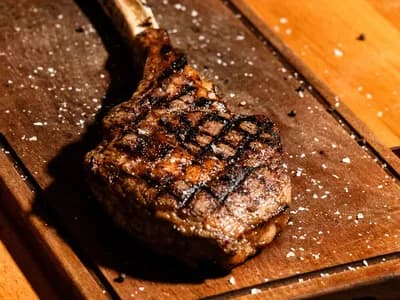
Reverse-sear tomahawk on the kamado
A 1.4 kg tomahawk, probe in the centre, ceramic at 110°C and a 90-second final sear. The Sunday centrepiece for when you want to impress without gambling on doneness.
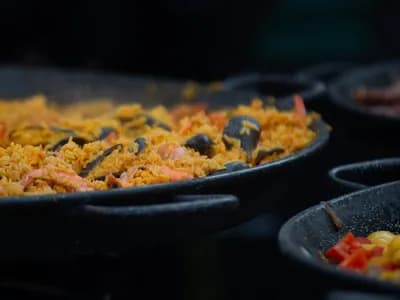
Alicante-style baked rice on the kamado in a clay cazuela
Traditional Alicante baked rice —chickpeas, pork rib, blood sausage, potato and tomato, with a whole garlic head in the centre— baked in a clay cazuela at 220°C indirect.
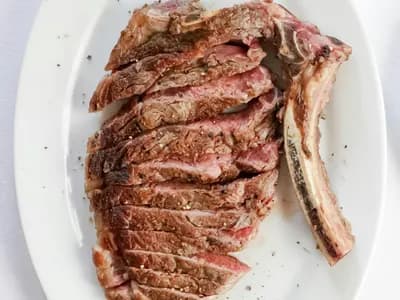
Galician ribeye on the kamado, direct sear
A one-kilo Galician ribeye, Maldon salt, embers at 350°C and not a thing more. The shortest recipe of the year and the hardest to mess up if you respect the timings.
KEEP READING
Go deeper on this dish
- Recommended kamado
Kamado Joe Konnected Joe
The first kamado that lights itself and runs from your sofa
- Editorial guide
How to light a kamado: the step-by-step method
No petrol, no weird tablets and no 45-minute waits. The cone method, airflow control and the mistakes that prevent 80% of the frustration.
- Glossary term
Heat deflector
Ceramic plate placed between the coals and the grate to turn direct fire into indirect cooking.
- Related comparison
kamado joe classic iii vs kamado joe konnected joe
Same Kamado Joe, two opposite philosophies. The Classic III is the classic kamado you light by hand and watch with your…