Recipe · Direct · Medium
Galician ribeye on the kamado, direct sear
A one-kilo Galician ribeye, Maldon salt, embers at 350°C and not a thing more. The shortest recipe of the year and the hardest to mess up if you respect the timings.
Quick answer
Galician bone-in ribeye on the kamado, 4-5 cm thick, comes to room temperature for 60 minutes, gets salted with Maldon 15 minutes ahead, and sears 4 minutes per side at 350 °C with the vents wide open. Pull it at 50-52 °C internal and rest it 5 minutes on a rack, never on a board, before slicing.

One big step at a time, screen kept on and built-in timers.
- Prep
- 60 min
- Cook
- 12 min
- Servings
- 4 servings
- Temperature
- 350 °C
What time do you want to eat?
Pick a time and we'll tell you when to start.
12:18
Start the prep
13:18
Light the kamado
13:38
Onto the kamado
14:00
Serve
Estimate: it includes lighting and settling the kamado plus a margin for large cuts. If the recipe asks you to marinate or salt ahead, add that time.
Fire setupDirect heat
- Dome
- 350 °C
- Grate
- Standard height
- Bottom vent
- Open
- Top vent
- Open
- Fuel
- Lump charcoal, basket filled to the brim
- Setup
- Probe thermometer
Temperature curve
0:37 h from lighting
Kamado domeInside the meat (probe)
| # | From | Phase | Dome | Internal |
|---|---|---|---|---|
| 1 | 0:00 | Light the charcoalFull basket, needle steady at 350 °C before loading | 20 → 350 °C | no probe |
| 2 | 0:20 | Sear4 min untouched, then turn 90° | 350 → 320 °C | 18 → 30 °C |
| 3 | 0:24 | SearFlip and 4 more minutes | 320 → 350 °C | 30 → 44 °C |
| 4 | 0:28 | CookProbe in the thickest part: 52 °C rare | 350 → 345 °C | 44 → 52 °C |
| 5 | 0:32 | RestOn a rack, rises 2-3 °C | 345 → 300 °C | 52 → 55 °C |
| 6 | 0:37 | Serve | off | no probe |
0:00 is the moment you light the charcoal. Internal temperatures are the ones the recipe gives; without a probe, go by the times. Turn these times into clock times with the planner
For this recipe
Ingredients
- Galician rubia ribeye (4-5 cm thick)1 kg
- Maldon flaky salt2 tbsp
- freshly ground black pepper1 tsp
- Padrón peppers300 g
- extra-virgin olive oil2 tbsp
- coarse salt for the peppersas needed
- probe thermometer (Inkbird, Meater or similar)1
Another cut
Got a different cut? Here is how the recipe changes
For 4 people the recipe uses 1.5 kg of bone-in ribeye: reverse sear at 160 °C, 1 h plus 10 min rest. If the shop had something else:
- Picanha (rump cap)Buy 1.25 kg
- Fire
- Reverse sear · 160 °C
- Time
- 40 min
- Rest
- 10 min
Light 20 min later
Same reverse sear, boneless. Dome at 160 °C fat side up, pull at 46-49 °C, sear the fat cap to 52 °C in the centre and slice against the grain.
- Beef tenderloinBuy 1 kg
- Fire
- Indirect · 190 °C
- Time
- 35 min
- Rest
- 10 min
Light 25 min later
No reverse sear: sear first. Tie it, mark it over direct heat, then move to indirect with the dome at 190 °C; pull at 52-54 °C in the centre, it rises while resting.
- Ibérico pork presaBuy 1.25 kg (in 2 pieces)
- Fire
- Reverse sear · 115 °C
- Time
- 53 min
- Rest
- 15 min
Same lighting time
A pork reverse sear, on a lower fire. Dome at 115 °C, pull at 55-58 °C, sear hard and let it climb to 63 °C while resting; it stays juicy and slightly pink.
Times are a guide, based on the How much to buy figures; follow the recipe first. Full fire plan for 4 people: Picanha (rump cap), Beef tenderloin, Ibérico pork presa.
Allergens
None of the 14 mandatory-declaration allergens in the ingredients.
Based on the recipe's ingredients. Always check the label of every product you buy.
The gear for this recipe
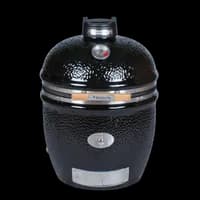 Monolith Classic Pro 2.0
 Jealous Devil 100% White Quebracho lump charcoal 15.8 kgIntense quebracho embers for the blast of direct heat.
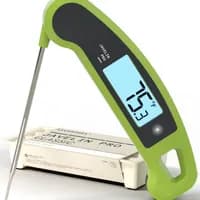 Lavatools Javelin PRO Duo instant-read thermometerInstant-read thermometer to nail the doneness as it comes off, at 50-52 °C.
 Weber Precision Tongs 46 cm (6760)Turn the one-kilo cut safely over the embers.
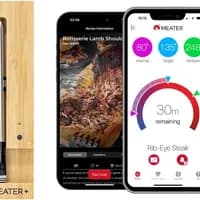 MEATER+ wireless WiFi thermometer
Method
- 01
Temper the steak
Pull the ribeye out of the fridge 60 minutes before cooking and rest it uncovered on a wire rack at room temperature. This ensures the core is not cold when it hits the kamado and the cook stays even.
- 02
Light the kamado
Pack the firebowl to the rim, lower vent wide open, top vent three quarters. It takes 15-20 minutes to light the kamado and settle at 350°C. Do not load the meat until the gauge stops climbing.
- 03
Salt 15 min ahead
Fifteen minutes before cooking, sprinkle Maldon generously on both faces. The salt pulls surface moisture out and it then reabsorbs — the payoff is a drier, crunchier crust.
- 04
Sear 4 min per side
Place the steak on the hot, clean grate. 4 minutes untouched. Rotate 90° if you want the crosshatch and flip. 4 more on the other side.
- 05
Probe 50-52°C
Probe the thickest spot, away from the bone. 50°C is very rare, 52°C is rare. For medium-rare push to 55°C, but you give up part of what you paid for.
- 06
Rest on a rack
Pull and rest 5 minutes on a wire rack (not a board). Carryover will lift the internal temperature another 2-3°C. Meanwhile, drop the peppers on the coals.
- 07
Slice and serve
Slice across the grain in thick pieces (~1.5 cm). Serve with the freshly salted Padrón peppers and a young Mencía. No table salt — the Maldon has done the job.
About this recipe
For a Galician kamado ribeye, temper the steak 60 minutes out of the fridge, salt it with Maldon 15 minutes ahead and sear 4 minutes a side at 350°C with vents wide open. Pull at 50-52°C internal and rest 5 minutes on a wire rack before slicing.
Why Galician ribeye changes the game
Galician rubia is a breed with fine intramuscular fat and yellow marbling from the pasture carotenes. On a kamado over direct fire that gives you a deep crust in under five minutes per side, with no overcook risk, because that fat renders at a higher temperature than industrial breeds. If your butcher does not carry it, a well-aged simmental (at least 30 days) is your second ticket. What you cannot do is bring a 2 cm cut: ribeye starts at 4 cm thick, ideally 4-5 cm.
The honest 350°C direct sear
Pack the kamado with charcoal, lower vent fully open, top vent three quarters. In 15-20 minutes you climb from zero to 350°C. The steak lands on a brushed-clean grate, 4 minutes one side, turn 90° if you want a cross pattern, 4 more on the other. Probe the thickest spot: 50°C for very rare, 52°C for rare. Pull and rest 5 minutes on a wire rack, never on a wooden board — the wood holds heat and keeps cooking the steak from below.
Padrón peppers without lifting the lid
While the meat rests, throw a handful of Padrón peppers straight on the same grate, still at 280-300°C. Three minutes, one flip, flaky salt off the heat. Pairing: a young Mencía from Ribeira Sacra, cellar-cold (14°C), never at room temperature. Best effort-to-payoff dinner you will cook this summer.
In 30 seconds
Galician ribeye 1 kg, 4-5 cm thick. Temper 60 min, salt with Maldon 15 min ahead, direct sear at 350°C, 4 min per side. Pull at 50-52°C internal, rest 5 min on a wire rack. Padrón peppers on the same coals. Young Mencía, cellar-cold.
Will it fit your kamado?
Small
33-40 cm · Joe Jr, MiniMax
Fits
The 1 kg steak fits; the peppers go on the coals while it rests.
Medium
46-51 cm · Classic, Large
Fits
Fits with room to spare; probably two steaks at once.
Large
56-61 cm · Big Joe, XL
Fits
Several steaks fit; you'll need more charcoal to hold 350 °C.
What to serve with it
- Wine
- Mencía red from Bierzo or Ribeira Sacra
- Beer
- Toasted lager or märzen
- Alcohol-free
- Dry kombucha or tonic with lemon
Leftovers and storage
- In the fridge
- Whole or sliced, airtight within 2 h: 3-4 days in the fridge.
- Freezing
- Freezes 2-3 months but loses juiciness; thaw in the fridge, never refreeze.
- Reheating
- Sliced, in a covered pan over medium heat to 74 °C in the centre; or eat cold, thinly sliced.
- Using them up
- Steak sandwich with peppers or a warm salad.
Cool and refrigerate within 2 hours. When in doubt, throw it out.
Leftover embers
You still have embers: what to do with the leftover heat
For 12 min at 350 °C in a classic kamado you load about 1.25 kg of charcoal and burn 900 g: when you serve, about 350 g of live embers remain. Before you shut the vents, that is still enough for:
Without touching the vents
350 °Cfull heat, direct
20 minof embers
- Iberian pork tenderloin grilled with Pedro Ximénez glaze8 min · 280 °C
- Sesame-Crusted Seared Bluefin Tuna on the Kamado (Tataki)4 min · 280 °C
- Red prawns over live fire on the kamado in 6 minutes6 min · 280 °C
No recipe needed
- Pita or naan from shop dough, on the grate (2 min each)
- Whole peppers until the skin blackens, for peeling (8 min)
- Pineapple or peach slices, char-marked (3 min)
Closing the vents a little and waiting for it to drop
210-270 °Cgrilled vegetables
20 minof embers
- Grilled Corn Mexican Elote Style on the Kamado15 min · 230 °C
- Kamado-Grilled Apricots with Honey and Rosemary10 min · 230 °C
- Blistered Padrón Peppers on the Kamado8 min · 260 °C
No recipe needed
- Strips of courgette and aubergine, char-marked (5 min)
- Pita or naan from shop dough, on the grate (3 min each)
- Halved tomatoes, cut side down, for a sauce (10 min)
Before opening the lid, crack it open for a few seconds first; if you raise the heat, stir the ash so the coals can breathe. And if you are not going to use them: once the food is out, close the bottom and top vents. The charcoal that does not burn (about 350 g) can be used next time. Different size of kamado? Work out your load for 1 h of fire, lighting included.
History of the dish
- Origin
- Galicia (Spain)
- Period
- Cattle raising since prehistory; beef exports from the 18th century
- Where it is cooked today
- Galicia: cow and ox beef under the Ternera Gallega and Vaca Gallega - Buey Gallego PGIs.
The beef sold today as a Galician chuleton comes from a livestock tradition rooted in Galicia. According to the PGI file, raising cows and oxen in the region goes back to prehistory, and the production system has rested on native beef breeds, most notably the Rubia Gallega.
From the twelfth century cows and oxen were gradually integrated into family farms, and from the eighteenth century their role was plain: they worked the fields and, at the end of their working life, were fattened for meat. In that century Galician cattle gained importance through beef exports to England, which lasted until the early twentieth century, and between the sixteenth and twentieth centuries a third of Spain's cattle were raised in Galicia.
Its culinary reputation is documented: in 1894 Ángel Muro described Galician cow or ox meat as dark red, "with veins as if it were marble". Today there are two protected geographical indications with a shared regulatory council, Ternera Gallega and Vaca Gallega - Buey Gallego; in the latter, an ox is a male castrated before one year of age and over 48 months old at slaughter.
No kamado?
How to make it without a kamado: oven, gas grill or pellets
The chuletón wants 350 °C coals and 4 minutes a side. Without that heat, use a reverse sear: gentle heat to 45 °C, then a smoking-hot iron.
Home oven
- Temp.
- 120 °C to 45 °C inside, then a smoking cast-iron pan
- Time
- 50-70 min in the oven plus 2 min a side in the pan
- Reverse sear: oven at 120 °C on a rack until 45 °C at the centre
- Cast-iron pan on your strongest burner, dry, until it smokes
- Sear the fat edge too, standing the steak on its bone
- Cook the Padrón peppers in the same pan afterwards
SmokeBarkJuicinessEven doneness edge to edge, no ember flavour
Gas grill
- Temp.
- 300-320 °C, all burners on high
- Time
- 5-6 min a side, about 12-14 min in total
- Preheat for 15 minutes with the lid shut so the grates store heat
- Better on a cast-iron griddle or grate; it sears harder than thin steel
- If the probe is under 50 °C at 12 minutes, move it to the unlit side, lid closed
SmokeBarkJuicinessGood crust, slightly less intense than over coals
Pellet grill or electric smoker
- Temp.
- 110-120 °C with smoke to 45 °C, then full heat or iron
- Time
- 60-80 min smoking plus 2 min a side to sear
- Reverse sear: smoke gently at 110-120 °C with the probe in until 45 °C
- To sear, use a cast-iron pan on the hob; a pellet grill will not reach 350 °C
- With an electric smoker, smoke only; always sear elsewhere
SmokeBarkJuicinessJuicy and smoky; the crust depends on the final sear
Temperatures and times are a guide; the original recipe is the kamado one. Tempted? which kamado to choose for what you cook
Editor's tips
- The grate must be genuinely hot and clean. If the steak sticks on contact, it was not ready — wait 2 more minutes.
- Without a probe this recipe is a gamble. A Meater Plus or an Inkbird IBT-2X changes your kamado life.
- Do not tent the meat with foil during the rest — the rack lets air circulate and keeps the crust crisp.
- For a subtle smoke note, throw one oak chip on the coals right before loading the steak. More wood masks the meat.
Gear for this recipe
As an Amazon Associate, mikamado.es earns from qualifying purchases. At no extra cost to you.

Monolith Classic Pro 2.0
€2,000

Jealous Devil 100% White Quebracho lump charcoal 15.8 kg
Intense quebracho embers for the blast of direct heat.
€206
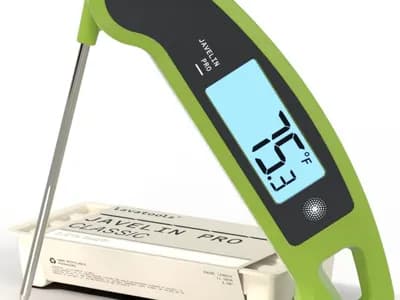
Lavatools Javelin PRO Duo instant-read thermometer
Instant-read thermometer to nail the doneness as it comes off, at 50-52 °C.
€65
Weber Precision Tongs 46 cm (6760)
Turn the one-kilo cut safely over the embers.
€28
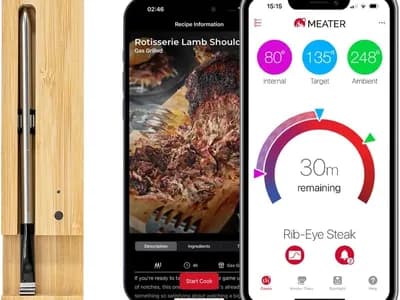
MEATER+ wireless WiFi thermometer
€99
Have you made it?
Tell us how it turned out on your kamado. We review every rating before publishing it.
No published ratings yet. Be the first!
FAQ
Galician rubia or simmental for ribeye?
Galician rubia wins on flavour and yellow marbling, thanks to the Cantabrian pasture. Well-aged simmental (30+ days) is the second-best ticket, easier to source and 25-30% cheaper. Any other industrial breed — pass. If your butcher does not stock rubia, ask for cow at least four years old, aged.
Is the probe thermometer really necessary?
Yes. A 4 cm cut is thick enough that the finger test fails: what feels rare to you can be 48°C or 56°C, a huge gap on the plate. A probe takes guesswork out. An Inkbird IGT-2X costs less than the steak itself.
Salt before or after cooking?
Before, with a rule: either 15 minutes ahead (salt pulls moisture and it reabsorbs) or straight out of the fridge (45 min ahead, same effect). Never salt 2 minutes before loading the kamado, because moisture exits but does not return and the sear becomes steam.
What is the minimum thickness for a kamado ribeye?
Four centimetres. Below that, a 350°C direct sear leaves the centre overcooked before a real crust forms. The sweet spot is 4-5 cm, which gives you margin for a deep crust while holding the core at 50-52°C. Above 6 cm switch to reverse-sear.
Can you cook a chuletón steak without a kamado?
Yes. In the oven or on a pellet grill, reverse-sear it: gentle heat to 45 °C inside, then a smoking cast-iron pan; on a gas grill, use all burners at 300-320 °C for 5-6 minutes a side.
Can I make this recipe with a different cut instead of bone-in ribeye?
Picanha keeps the reverse sear exactly as is, and Iberian pork presa does too with a cooler dome. Tenderloin moves to an indirect roast and is seared at the start. In all three the probe decides: pull a few degrees early, it rises while resting.
What do I do with the embers left after making Galician ribeye on the kamado, direct sear?
After 12 min at 350 °C in a classic kamado about 350 g of live embers remain: 20 min more at 350 °C without touching the vents or 20 min at 210-270 °C closing the vents. If you are not going to use them, close both vents and keep the charcoal for next time.
More kamado recipes
KEEP READING
Go deeper on this dish
- Recommended kamado
Monolith Classic Pro 2.0
The German alternative to the Kamado Joe Classic III
- Editorial guide
How to light a kamado: the step-by-step method
No petrol, no weird tablets and no 45-minute waits. The cone method, airflow control and the mistakes that prevent 80% of the frustration.
- Glossary term
Heat deflector
Ceramic plate placed between the coals and the grate to turn direct fire into indirect cooking.
- Related comparison
kamado joe classic iii vs monolith classic pro 2 cart
The comparison every European cook eventually makes: the Kamado Joe Classic III, the US reference with SlōRoller, again…