Recipe · Indirect · Medium
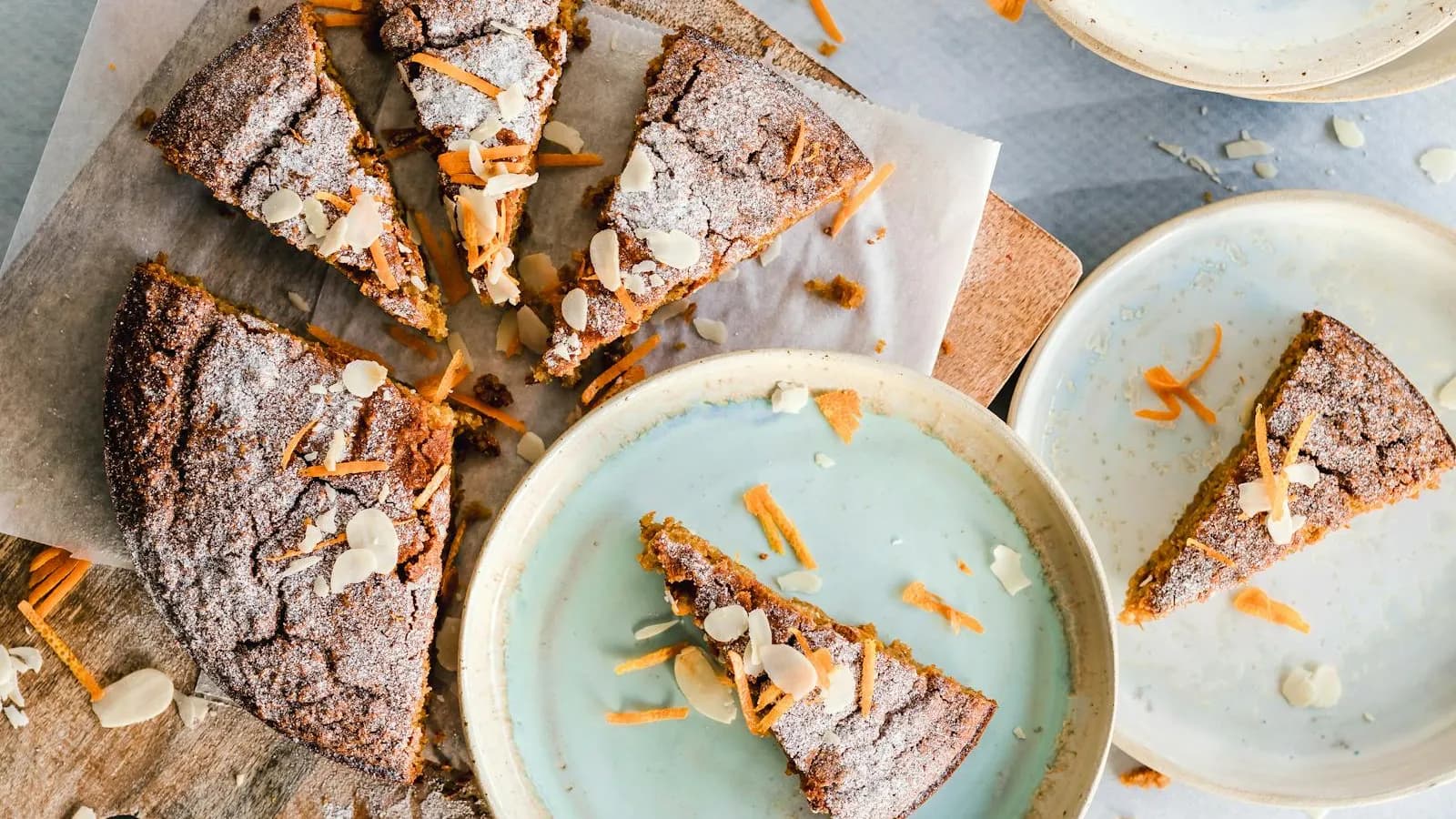
Tarta de Santiago on the kamado, deeply almond and flourless
Ground almond, egg, sugar and the Cross of Saint James in icing sugar. Flourless, coeliac-friendly. Indirect at 175°C in a dutch oven: dense, moist crumb, never dry.
Quick answer
Tarta de Santiago is 100% ground almond, flourless and gluten-free. It bakes indirect at 175 °C in a greased pot for 30-35 minutes, without lifting the lid, until a toothpick comes out with a moist crumb. Mark the cross of Santiago with icing sugar only once the cake is cold.
One big step at a time, screen kept on and built-in timers.
- Prep
- 20 min
- Cook
- 35 min
- Servings
- 8 servings
- Temperature
- 175 °C
What time do you want to eat?
Pick a time and we'll tell you when to start.
12:25
Start the prep
12:45
Light the kamado
13:15
Onto the kamado
14:00
Serve
Estimate: it includes lighting and settling the kamado plus a margin for large cuts. If the recipe asks you to marinate or salt ahead, add that time.
Fire setupIndirect
- Dome
- 175 °C
- Deflector
- Yes
- Grate
- Standard height
- Setup
- Deflector and enamelled cast-iron Dutch oven
Temperature curve
1:29 h from lighting
Kamado dome
| # | From | Phase | Dome |
|---|---|---|---|
| 1 | 0:00 | Light the charcoalDeflector in, 175 °C indirect | 20 → 175 °C |
| 2 | 0:30 | StabiliseDo not load the cake until 10 min dead steady | 175 °C |
| 3 | 0:40 | Put the food inGreased cocotte, uncovered, on the deflector | 175 → 165 °C |
| 4 | 0:42 | Bake30-35 min, no opening; toothpick clean or barely damp | 165 → 175 °C |
| 5 | 1:14 | RestCool in the cocotte before unmoulding | 175 → 90 °C |
| 6 | 1:29 | Serve | off |
0:00 is the moment you light the charcoal. Internal temperatures are the ones the recipe gives; without a probe, go by the times. Turn these times into clock times with the planner
For this recipe
Ingredients
- finely ground almond (Marcona or Valencia-region if you can find it)250 g
- white sugar200 g
- large eggs (at room temperature, they whip up more)3
- lemon (the zest; keep the juice for something else)1
- ground cinnamon1 tsp
- orange-blossom honey (optional, rounds it out without masking the almond)1 tbsp
- fine salt1 pinch
- soft butter to grease the dutch oven1 tbsp
- icing sugar for the Cross of Saint James (to finish)2 tbsp
Allergens
- Eggs
- Milk
- Tree nuts
Flourless, but check the ground almonds aren't processed alongside wheat if coeliac.
Based on the recipe's ingredients. Always check the label of every product you buy.
The gear for this recipe
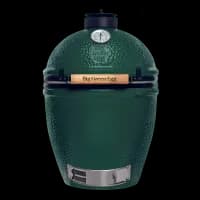 Big Green Egg Large
 Kamado Joe Big Block XL lump charcoal 9.1 kgClean lump charcoal: it burns without heavy smoke, ideal for a neutral sweet bake.
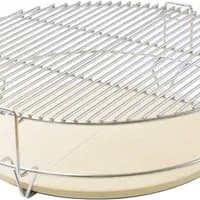 Onlyfire GCG-8552 Cooking System (2 grates + rack + 2 deflectors) for Large Kamado
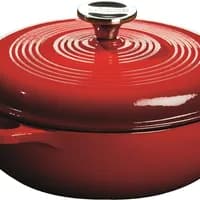 Lodge Enameled Cast Iron Dutch Oven 2.84 L (Red)Cast-iron casserole that spreads the heat and keeps the crumb dense and moist, never dry.
 Inkbird IBT-4XS Bluetooth thermometerMonitors and locks in the 175 °C dome heat throughout the bake.
Method
- 01
Set the deflector and stabilise 175°C
Light the kamado, set the deflector (plate-setter) and stabilise the chamber at 175°C indirect. It takes 20-25 minutes. Do not load the cake until the thermometer holds steady for 10 minutes: a flourless cake needs an already-stable oven, because it deflates if it loses heat midway through.
- 02
Grease the pot and zest the lemon
Grease the enamelled cast-iron pot well with soft butter, base and walls, so the cake turns out clean. Zest the lemon, avoiding the white pith, which is bitter. If you are using a card stencil for the cross, cut it out now while the kamado stabilises.
- 03
Whip the eggs with the sugar
Whip the eggs with the sugar, salt and honey (if using) at high speed for 4-5 minutes, until pale and almost tripled in volume. This foam is the cake's only structure: the more air you whip in now, the lighter it bakes. It is ready when, lifting the whisk, the batter falls in a ribbon and holds its mark for a moment.
- 04
Fold in the almond carefully
Add the ground almond, lemon zest and cinnamon. Fold it in with a spatula in gentle bottom-to-top strokes, never beating, until no dry lumps remain. Air is the boss here: stir hard and you knock the foam down and the cake bakes dense. A correct batter is thick but airy, not runny.
- 05
Pour and bake 30-35 min without lifting the lid
Pour the batter into the greased pot and level it. Set it uncovered on the grate over the deflector and close the kamado. Bake 30-35 minutes at 175°C without lifting the lid. It is ready when the top is golden, the centre springs back to the touch and a skewer comes out clean or barely moist, never with raw batter.
- 06
Cool and turn out
Pull the pot with gloves and let the cake settle inside for 15 minutes: still hot it is fragile and breaks when moved. Run a knife round the edge, set a plate on top and flip; then turn it back onto a rack so the good face is up. Let it cool completely before the cross: icing sugar melts on a warm cake.
- 07
Mark the Cross of Saint James
With the cake cold, centre the Cross of Saint James stencil on the surface. Dust icing sugar through a fine sieve in an even, generous layer, without piling it in one spot. Lift the stencil straight up, without dragging, and the cross stays crisp and white against the golden almond. Serve at room temperature.
About this recipe
A Tarta de Santiago on a wood —or charcoal— fire is one of the easiest desserts to nail on a kamado because it has no flour and no leavening, just ground almond, egg and sugar, which makes it naturally coeliac-friendly. It bakes at 175°C indirect with the deflector in, in an enamelled cast-iron dutch oven that spreads the heat evenly and keeps the edges from drying out while the centre sets. The result is a dense, moist, deeply almond crumb; you turn it out, mark the Cross of Saint James in icing sugar, and there it is: the classic Galician dessert, cooked over kamado fire.
Flourless: why it works and why it sets differently
A traditional Tarta de Santiago is not a flour sponge with almond added: the dry part is 100% almond, bound only by egg. The batter does not rise from leavening or gluten but from the air you whip into the eggs and sugar until pale and almost tripled in volume. That foam is the cake's only structure, so you treat it with care: the almond is folded in, never beaten, so as not to knock the air out. With no gluten, it cannot toughen from kneading or turn rubbery; the real risk is over-baking, because almond releases its oil and, overcooked, turns dry and sandy instead of moist. That is exactly why the kamado's temperature control matters so much.
The kamado as an oven: a pinned 175°C and the deflector
A flourless cake forgives temperature swings poorly. Stabilised at 175°C with the deflector, the kamado behaves like a gentle convection oven and does not lurch like a domestic one every time the element fires. The enamelled cast-iron pot adds thermal inertia: it shields the cake's edges from radiant heat and bakes them at the same pace as the centre, which is exactly what a Tarta de Santiago needs to come out even. The golden rule of kamado baking: do not lift the lid to peek. Every opening drops the chamber from 175°C to 140°C and adds ten minutes, and a dessert with no flour structure deflates if it loses heat halfway through.
A Costa Blanca accent and the Cross of Saint James
The classic Galician recipe calls for lemon zest and a pinch of cinnamon, and there I leave it: they are the soul of the dessert and I do not touch them. What I do, living in Torrevieja, is reach for Marcona almonds or ones from the Valencia region, which lend a more buttery sweetness. A spoonful of orange-blossom honey in the batter rounds it out without masking the almond. The Cross of Saint James goes on at the end, with the cake cold: a card or paper stencil on the surface and a generous veil of icing sugar through a sieve. Lift the stencil straight up, carefully, and the cross stays crisp and white against the golden almond. It is the dessert I bring out when I want to close a meal with something honest, unpretentious and loved by everyone.
In 30 seconds
Deflector in, kamado a stable 175°C indirect oven. Whip 3 eggs with 200 g sugar until pale (the foam is the entire structure). Fold in 250 g ground almond, lemon zest and a pinch of cinnamon. Pour into a greased dutch oven and bake 30-35 min without lifting the lid until a skewer comes out clean and the centre springs back. Cool, turn out, mark the Cross of Saint James with a stencil and icing sugar. Flourless, coeliac-friendly, serves 8.
Will it fit your kamado?
Small
33-40 cm · Joe Jr, MiniMax
Tight
A 2.8 L Dutch oven probably just fits; otherwise use a ~20 cm tin and watch the time.
Medium
46-51 cm · Classic, Large
Fits
The Dutch oven fits over the deflector: 8 servings in one batch.
Large
56-61 cm · Big Joe, XL
Fits
Fits with room to spare; less charcoal is enough to hold a steady 175 °C.
What to serve with it
Sides
- Espresso or a cortado
- Fresh figs or grapes
- Wine
- Moscatel from Málaga or a Jerez Pedro Ximénez
- Beer
- Toasty brown ale with nutty notes
- Alcohol-free
- Chilled almond milk with cinnamon
Leftovers and storage
- In the fridge
- 1-2 days at room temperature well covered, or 2-3 in the fridge in an airtight container.
- Freezing
- Freezes well without the icing sugar, wrapped, for 2-3 months; thaw in the fridge, never refreeze.
- Reheating
- No reheating needed: serve at room temperature and dust with icing sugar just before.
- Using them up
- Crumble it over ice cream or yogurt like an almond crumble.
Cool and refrigerate within 2 hours. When in doubt, throw it out.
Leftover embers
You still have embers: what to do with the leftover heat
For 35 min at 175 °C in a classic kamado you load about 800 g of charcoal and burn 400 g: when you serve, about 380 g of live embers remain. Before you shut the vents, that is still enough for:
Without touching the vents
175 °Cdessert while you eat
1 h 20 minof embers
- Reina Pepiada Arepas on a Budare in the Kamado, Crisp Outside1 h · 200 °C
- Kamado-Roasted Squash with Honey and Pimentón de la Vera45 min · 200 °C
- Apple tarte Tatin in a dutch oven on the kamado, golden caramel45 min · 190 °C
No recipe needed
- Yesterday's bread with oil and garlic, on the grate (10 min)
- Corn cobs in their husks (30 min)
- Whole apples with a slit in the skin (45 min)
Closing the vents almost fully and waiting for it to drop
100-130 °Ca short smoke
2 h 25 minof embers
- Hot-Smoked Whole Mackerel on the Kamado45 min · 120 °C
No recipe needed
- Coarse salt on a tray, with a wood chunk: smoked salt for months (1-2 h)
- Almonds or walnuts on a rack (45 min)
- Whole heads of garlic, for spreading (1 h)
Opening the vents almost fully
210-270 °Cgrilled vegetables
30 minof embers
- Olive Oil Ciabatta on the Kamado25 min · 245 °C
- Charred Wild Green Asparagus on the Kamado8 min · 240 °C
- Grilled Watermelon with Feta, Mint and Balsamic Reduction10 min · 250 °C
No recipe needed
- Strips of courgette and aubergine, char-marked (5 min)
- Pita or naan from shop dough, on the grate (3 min each)
- Halved tomatoes, cut side down, for a sauce (10 min)
Before opening the lid, crack it open for a few seconds first; if you raise the heat, stir the ash so the coals can breathe. And if you are not going to use them: once the food is out, close the bottom and top vents. The charcoal that does not burn (about 380 g) can be used next time. Different size of kamado? Work out your load for 1 h 30 min of fire, lighting included.
History of the dish
- Origin
- Santiago de Compostela and Galicia (Spain)
- Period
- Possible mention in 1577; first reliable recipe around 1838
- Where it is cooked today
- Made throughout Galicia, with EU PGI status since 2010; pilgrims on the Camino de Santiago have spread its fame across Spain and abroad.
Tarta de Santiago is an almond, sugar and egg sponge belonging to Galicia's high confectionery, tied to wealthy tables because almonds and sugar were costly ingredients. Its earliest possible mention dates from 1577: during an inspection of the University of Santiago, "tortas reales" served at graduation ceremonies were recorded, although the official specification warns that this evidence should be treated with caution.
The first reliable recipe appears in Luis Bartolomé de Leybar's confectionery notebook, compiled around 1838, and in 1893 Eduardo Merín published another version of this "almond tart" in Ferrol. It made its way gradually into recipe books from the rest of Spain over the course of the 20th century. In 1924 José Mora Soto, founder of the Casa Mora confectioner's in Santiago, decorated his tarts with the outline of the Cross of Saint James, an idea other bakers copied and that spread throughout Galicia.
Since 2010 it has been an EU protected geographical indication, with production permitted across Galicia. The ever more popular pilgrim routes to Santiago have made it known to Spanish and foreign visitors alike.
Sources
- Orden de 10 de febrero de 2010 por la que se aprueba el Reglamento de la IGP Tarta de Santiago y su pliego de condiciones — Diario Oficial de Galicia (Xunta de Galicia) (xunta.gal)
- Reglamento (UE) n.º 403/2010 de la Comisión, de 10 de mayo de 2010 [Tarta de Santiago (IGP)] — EUR-Lex, Unión Europea (eur-lex.europa.eu)
- Ficha técnica IXP Tarta de Santiago 2025 — AGACAL, Xunta de Galicia (agacal.xunta.gal)
Editor's tips
- An independent chamber probe at grate height is more reliable than the dome gauge, which reads the air under the lid, not next to the pot. A flourless cake punishes drift: tune the vents to that real number and hold it pinned at 175°C.
- Smoke has no place here. A Tarta de Santiago is almond, egg and sugar: the kamado's clean charcoal already lends a faint toasted backdrop. Do not add wood chunks; a delicate dessert with smoke tastes of barbecue, not almond.
- No cross stencil? Print or draw the Cross of Saint James (the lily-hilted sword) on card and cut it out with a craft knife. Baking paper works too. Reuse it: lifted carefully, it lasts several cakes.
Gear for this recipe
As an Amazon Associate, mikamado.es earns from qualifying purchases. At no extra cost to you.

Big Green Egg Large
€2,099

Kamado Joe Big Block XL lump charcoal 9.1 kg
Clean lump charcoal: it burns without heavy smoke, ideal for a neutral sweet bake.
€67
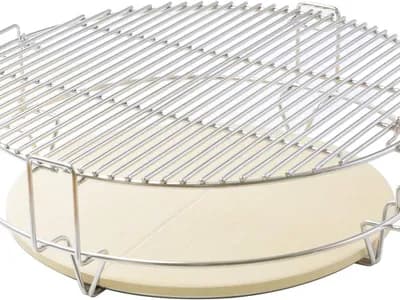
Onlyfire GCG-8552 Cooking System (2 grates + rack + 2 deflectors) for Large Kamado
€95
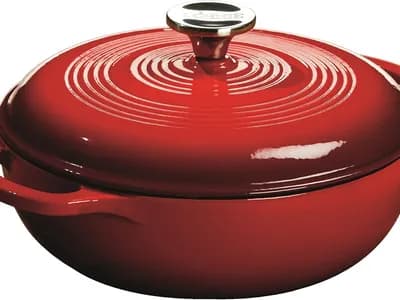
Lodge Enameled Cast Iron Dutch Oven 2.84 L (Red)
Cast-iron casserole that spreads the heat and keeps the crumb dense and moist, never dry.
€170

Inkbird IBT-4XS Bluetooth thermometer
Monitors and locks in the 175 °C dome heat throughout the bake.
€72
Have you made it?
Tell us how it turned out on your kamado. We review every rating before publishing it.
No published ratings yet. Be the first!
FAQ
Why is Tarta de Santiago flourless and coeliac-friendly?
Because the traditional Galician recipe never had flour: the dry part is 100% ground almond, bound only with egg and sugar. It is not a modern gluten-free adaptation, it is the historical formula, predating cheap, abundant wheat flour. With no wheat, barley, rye or oats anywhere in it, it is naturally coeliac-friendly as long as the ground almond is not cross-contaminated with traces (check the labelling if you buy loose). The almond provides all the structure along with the air whipped into the eggs, so you miss nothing: the crumb comes out dense and moist, not like a sponge but like what it is, an almond cake.
Which almond to use: finely ground or coarse, for the best texture?
For an even, moist crumb, use finely ground almond, the kind sold as blanched almond flour. It is the classic base and binds best with the whipped egg. That said, swapping 15-20% for coarse or roughly chopped almond adds a rustic edge, a bit of bite that reminds you this is real almond and not an industrial powder. What I would avoid is using only very coarse almond, because it is too heavy, knocks the egg foam down and the cake bakes low and compact. If you grind it at home, pulse in short bursts so you do not release the oil and end up with a paste: you want fine sand, not almond butter.
How do you make the Cross of Saint James stencil with icing sugar?
The Cross of Saint James is a sword with a lily-flowered hilt, not a plain cross. Draw or print it to the size of your cake and cut it from thin card or baking paper with a craft knife, leaving the sword silhouette as the gap that will keep the golden area exposed. With the cake fully cold, centre the stencil on the surface without pressing, dust icing sugar through a fine sieve in a generous, even layer covering everything, and lift the stencil straight up in one clean move, without dragging sideways. The sugar that lands outside the sword leaves a white background and the sword stays golden. If the cake is still warm the sugar dampens and melts, so be patient: cool first, decorate after.
Are the lemon zest and cinnamon really traditional?
Yes, they are the soul of an authentic Tarta de Santiago and appear in the recipes certified under the Galician Protected Geographical Indication. Lemon zest brings freshness and cuts the rich sweetness of the almond, keeping the cake from cloying; cinnamon adds warmth and depth, that aromatic backbone you recognise at first bite. The amounts are deliberately restrained: the zest of one lemon and half to one teaspoon of cinnamon for this batter, just enough to register without masking the almond, which is the real star. Too much cinnamon and it veers toward sweet bread; too little lemon and it falls flat. Some versions add a splash of aguardiente or anise, but lemon and cinnamon are non-negotiable.
How do you know when it is set inside without drying it out?
The window for a Tarta de Santiago is narrow because almond goes from moist to dry very fast. From minute 28, watch three signs without opening wide or poking around: the top should be evenly golden and lightly cracked in the centre; pressed gently with a finger, the centre should spring back and not sink; and a skewer in the middle should come out clean or with a few moist crumbs clinging, never with liquid or raw batter. Those moist crumbs are a good sign: it means you are pulling it right on time, not overdone. If you wait for the skewer to come out bone dry, you have already gone too far and the almond will have released its oil and turn sandy. Remember that residual heat keeps setting the centre for a couple of minutes after you pull it, so it is better to fall a touch short than long.
What do I do with the embers left after making Tarta de Santiago on the kamado, deeply almond and flourless?
After 35 min at 175 °C in a classic kamado about 380 g of live embers remain: 1 h 20 min more at 175 °C without touching the vents, 2 h 25 min at 100-130 °C closing the vents or 30 min at 210-270 °C opening the vents. If you are not going to use them, close both vents and keep the charcoal for next time.
More kamado recipes



KEEP READING
Go deeper on this dish
- Recommended kamado
Big Green Egg Large
The classic kamado that defined the category
- Editorial guide
How to light a kamado: the step-by-step method
No petrol, no weird tablets and no 45-minute waits. The cone method, airflow control and the mistakes that prevent 80% of the frustration.
- Glossary term
Heat deflector
Ceramic plate placed between the coals and the grate to turn direct fire into indirect cooking.
- Related comparison
big green egg large vs kamado joe classic iii
The classic kamado matchup: the Big Green Egg Large, the indestructible pioneer with the widest accessory network, agai…