Recipe · Pizza · Medium
Neapolitan pizza on the kamado
At 350°C the base puffs in 90 seconds and the cornicione comes out leopard-spotted and pillowy. One pizza, three minutes, zero margin for error.
Quick answer
Neapolitan pizza on the kamado bakes on a cordierite stone with the chamber at 350-380 °C, with the dough cold-fermented for 24-72 hours. It cooks in about three minutes: the base puffs up and the cornicione comes out leopard-spotted and elastic. The deflector and a stone preheated for at least 30-40 minutes are essential.

One big step at a time, screen kept on and built-in timers.
- Prep
- 1440 min
- Cook
- 3 min
- Servings
- 4 servings
- Temperature
- 350 °C
What time do you want to eat?
Pick a time and we'll tell you when to start.
13:02
the day before
Start the prep
13:02
Light the kamado
13:47
Onto the kamado
14:00
Serve
Estimate: it includes lighting and settling the kamado plus a margin for large cuts. If the recipe asks you to marinate or salt ahead, add that time.
Fire setupStone or steel
- Dome
- 350 °C
- Deflector
- Yes
- Fuel
- Plenty of lump charcoal
- Setup
- Deflector, pizza stone and pizza peel
Temperature curve
1:21 h from lighting
Kamado dome
| # | From | Phase | Dome |
|---|---|---|---|
| 1 | 0:00 | Light the charcoalPlenty of charcoal, deflector and refractory stone | 20 → 350 °C |
| 2 | 0:45 | StabiliseLet the stone soak for at least 30 min at 350-380 °C | 350 °C |
| 3 | 1:15 | Bake90-180 seconds, turn once with the peel | 345 → 300 °C |
| 4 | 1:18 | Recover temperatureRecover to 350 °C before the next pizza | 300 → 350 °C |
| 5 | 1:21 | Serve | off |
0:00 is the moment you light the charcoal. Internal temperatures are the ones the recipe gives; without a probe, go by the times. Turn these times into clock times with the planner
For this recipe
Ingredients
- Italian "00" flour (W 280-320)500 g
- cold water325 ml
- sea salt12 g
- fresh yeast1 g
- San Marzano DOP tomatoes400 g
- fior di latte (cow-milk mozzarella)250 g
- fresh basil20 leaves
- extra-virgin olive oilas needed
Allergens
- Gluten
- Milk
Based on the recipe's ingredients. Always check the label of every product you buy.
The gear for this recipe
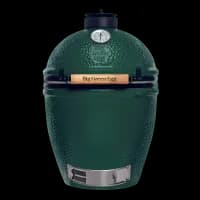 Big Green Egg LargeThe Large holds the 350 °C dome heat that a Neapolitan needs, one pizza at a time.
 Jealous Devil 100% White Quebracho lump charcoal 15.8 kg
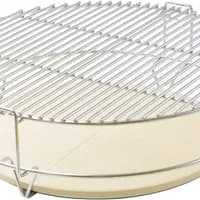 Onlyfire GCG-8552 Cooking System (2 grates + rack + 2 deflectors) for Large Kamado
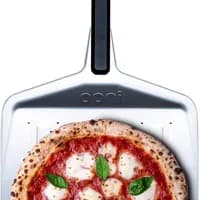 Ooni 14" Perforated Aluminium Pizza PeelPerforated 14" peel to load and turn the pizza without it sticking.
Method
- 01
Dough
Dissolve the yeast in water. Combine with flour until integrated, add salt and knead 10 minutes. Smooth ball, 30 min rest, fold, 30 min rest.
- 02
Cold ferment 24h
Divide into 250 g balls and store in oiled containers in the fridge for 24 hours. Bring to room temperature 2 hours before cooking.
- 03
Sauce
Crush the San Marzano tomatoes by hand in a bowl. Salt and a drizzle of oil. DO NOT cook them. The freshness of raw tomato is the point.
- 04
Stabilise at 350°C
Load the kamado with plenty of charcoal, deflector and a baking stone on top. Bring it to 350-380°C and let the stone saturate for at least 30 minutes.
- 05
Stretch
Hand-stretch on semola flour, no rolling pin, leaving the edge untouched so it keeps air. ~28 cm diameter.
- 06
Top
Thin layer of sauce in the centre, never to the edge. Drained mozzarella in chunks. Do not overload — Neapolitan pizzas carry little topping.
- 07
Bake
Slide the pizza onto the stone with a floured peel. Bake 90-180 seconds. Rotate once with the peel for even browning.
- 08
Finish
Pull it off with the peel. Add fresh basil leaves and a thread of raw olive oil. Serve immediately.
About this recipe
Slow-fermented dough (24h cold), uncooked San Marzano tomatoes, well-drained fior di latte and basil added off the heat. The kamado faithfully mimics a Neapolitan wood-fired oven.
Will it fit your kamado?
Small
33-40 cm · Joe Jr, MiniMax
Tight
A 28 cm pizza just fits a ~33 cm stone; one at a time, letting the stone recover.
Medium
46-51 cm · Classic, Large
Fits
A 28 cm pizza fits well; the 4 servings go in four short batches.
Large
56-61 cm · Big Joe, XL
Fits
Fits with room to spare; with a large stone two small pizzas may fit.
What to serve with it
Sides
- Green salad with olive oil
- Grilled Padrón peppers
- Wine
- Young Bierzo Mencía red or Navarra rosé
- Beer
- Cold pilsner-style lager
- Alcohol-free
- Sparkling water with lemon and basil
Leftovers and storage
- In the fridge
- Cool within 2 h; because of the mozzarella, keep well wrapped in the fridge, 1-2 days.
- Freezing
- Freeze by the slice for 2-3 months; fresh basil suffers. Never refreeze.
- Reheating
- Covered cast-iron pan over medium heat 4-5 min, or kamado at 250 °C on the stone 2-3 min.
Cool and refrigerate within 2 hours. When in doubt, throw it out.
Leftover embers
You still have embers: what to do with the leftover heat
For 3 min at 350 °C in a classic kamado you load about 1.25 kg of charcoal and burn 900 g: when you serve, about 350 g of live embers remain. Before you shut the vents, that is still enough for:
Without touching the vents
350 °Cfull heat, direct
20 minof embers
- Iberian pork tenderloin grilled with Pedro Ximénez glaze8 min · 280 °C
- Sesame-Crusted Seared Bluefin Tuna on the Kamado (Tataki)4 min · 280 °C
- Red prawns over live fire on the kamado in 6 minutes6 min · 280 °C
No recipe needed
- Pita or naan from shop dough, on the grate (2 min each)
- Whole peppers until the skin blackens, for peeling (8 min)
- Pineapple or peach slices, char-marked (3 min)
Closing the vents a little and waiting for it to drop
210-270 °Cgrilled vegetables
20 minof embers
- Saffron Milk Caps on a Steel Griddle with Garlic and Parsley10 min · 250 °C
- Rum-glazed grilled pineapple on the kamado14 min · 220 °C
- Grilled provolone on the kamado with tomato, oregano and olive oil, in a cast-iron skillet12 min · 230 °C
No recipe needed
- Strips of courgette and aubergine, char-marked (5 min)
- Pita or naan from shop dough, on the grate (3 min each)
- Halved tomatoes, cut side down, for a sauce (10 min)
Before opening the lid, crack it open for a few seconds first; if you raise the heat, stir the ash so the coals can breathe. And if you are not going to use them: once the food is out, close the bottom and top vents. The charcoal that does not burn (about 350 g) can be used next time. Different size of kamado? Work out your load for 1 h of fire, lighting included.
History of the dish
- Origin
- Naples, capital of Campania (Italy)
- Period
- Early 18th century (around 1715–1725)
- Where it is cooked today
- Naples, home to some 3,000 pizzaiuoli, remains its birthplace; pizza has spread worldwide, and the AVPN promotes the Neapolitan kind beyond Italy.
European legislation dates the first appearance of pizza napoletana to between 1715 and 1725, and by the 18th century Naples already had several shops known as "pizzerias". It was cheap street food: in the late 19th century the journalist Matilde Serao described it as humble fare that "turns yellow in the sun".
The marinara is dated to 1734 and the margherita to 1796–1810. Tradition holds that the latter was presented to the Queen of Italy during her visit to Naples in 1889, although the Royal Household letter said to prove it is now regarded as a forgery.
Italian emigrants took pizza to the United States in the early 20th century, and, according to the CNRS anthropologist Sylvie Sanchez, it was its spread around the world that saved it. The Associazione Verace Pizza Napoletana was founded in Naples in 1984; in 2010 the EU registered it as a traditional speciality guaranteed, baked in a wood-fired oven at about 485 °C, and in 2017 UNESCO inscribed the art of the Neapolitan pizzaiuolo on its intangible heritage list.
Sources
- Commission Regulation (EU) No 97/2010 — Pizza Napoletana (TSG) — EUR-Lex, European Union (eur-lex.europa.eu)
- Art of Neapolitan 'Pizzaiuolo' — UNESCO Intangible Cultural Heritage (ich.unesco.org)
- Pizza Margherita may be fit for a queen, but was it really named after one? — National Geographic (nationalgeographic.com)
- Chi siamo — Associazione Verace Pizza Napoletana (pizzanapoletana.org)
- Pizza: Globalization for Dinner? — CNRS News (news.cnrs.fr)
No kamado?
How to make it without a kamado: oven, gas grill or pellets
Neapolitan pizza wants 350-380 °C and 90-180 seconds. No home oven gets there: you get a good pizza, but a different style, crisper and less airy.
Home oven
- Temp.
- 275 °C (the maximum) with a stone or steel
- Time
- 6-8 min instead of 90-180 s
- Steel or stone on the upper rack, preheated 45-60 min at full heat
- Switch on the top grill for the last minute so the rim browns
- Drain the fior di latte well: over 7 min it releases water and floods the centre
SmokeBarkJuicinessGood pizza, different style: crisp, no leopard-spotted rim
Gas grill
- Temp.
- 300-320 °C with a stone and all burners on high
- Time
- 3-5 min, a bit longer than on the kamado
- Heat the stone 30-45 min lid down; the base will always run ahead of the topping
- When the pizza goes in, turn the burners under the stone down to medium
- Turn it every minute with the peel: gas grills have a much hotter side
SmokeBarkJuicinessClosest you get without a kamado, though the rim rises less
Pellet grill or electric smoker
- Temp.
- 260-290 °C with a stone; an electric smoker will not do
- Time
- 5-7 min instead of 90-180 s
- Stone on the grate and the grill at maximum for 45 min before the first pizza
- Leave 10 min between pizzas so the stone recovers its heat
- The dough picks up a faint pellet smoke aroma, which does not happen on the kamado
SmokeBarkJuicinessDecent pizza, closer to a home oven than to the kamado
Temperatures and times are a guide; the original recipe is the kamado one. Tempted? which kamado to choose for what you cook
Editor's tips
- The stone needs at least 30 min at 350°C. Loaded cold, the base will stay raw inside.
- For a hint of smoke on the cornicione, crack the lid for 10 seconds when loading — the oxygen flares the coals.
Gear for this recipe
As an Amazon Associate, mikamado.es earns from qualifying purchases. At no extra cost to you.
Big Green Egg Large
The Large holds the 350 °C dome heat that a Neapolitan needs, one pizza at a time.
€2,099

Jealous Devil 100% White Quebracho lump charcoal 15.8 kg
€206
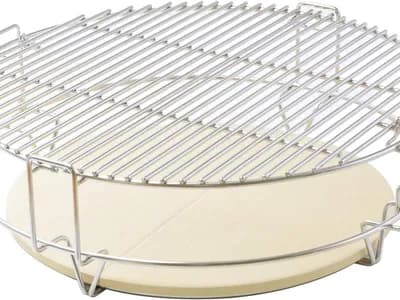
Onlyfire GCG-8552 Cooking System (2 grates + rack + 2 deflectors) for Large Kamado
€95
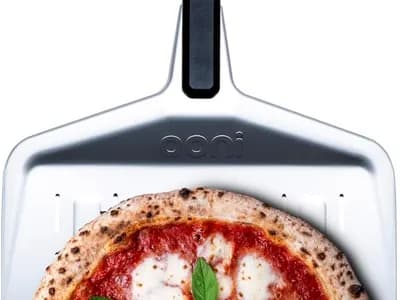
Ooni 14" Perforated Aluminium Pizza Peel
Perforated 14" peel to load and turn the pizza without it sticking.
€26
Have you made it?
Tell us how it turned out on your kamado. We review every rating before publishing it.
No published ratings yet. Be the first!
FAQ
What is the right temperature for Neapolitan?
The AVPN standard is written for a wood-fired oven, where Neapolitan pizza bakes in 60-90 seconds at temperatures a home kamado cannot sustain. In the kamado, the reference is a chamber at 350-380 °C with the lid closed, the vents open and the stone preheated for 30-40 minutes: the pizza is done in about three minutes. Lower (300-350 °C) also works, but the base comes out denser.
Can I use supermarket flour or do I need 00?
You need 00 flour at W250+ (medium-high strength) so the dough handles heat without tearing. Caputo Cuoco (blue) or Garofalo 00 work. Regular bread flour (W150-180) does not hold — pizza tears going into the kamado. With regular flour only, drop to 280-300°C and make home-style pizza, not Neapolitan.
How long does the dough need to ferment?
Minimum 24 hours cold for decent flavour, ideal 48-72 hours. A pizza fermented 6 hours at room temp is edible but flat. Long cold fermentation builds aroma, improves digestibility and makes the dough easier to handle without sticking.
Will a standard pizza stone work or do I need a kamado-specific one?
Any cordierite stone handles 500°C — a generic Amazon pizza stone (Pizzacraft, Lodge) is fine. What matters is round and fits through the lid. Kamado-specific stones are usually identical with a markup. Cordierite is cordierite.
Can you make Neapolitan pizza without a kamado?
Not quite: Neapolitan pizza needs 350 °C or more, and a home oven at 275 °C with a stone or steel gives a good but crisper pizza in 6-8 minutes. A gas grill with a stone at 300-320 °C comes closest; a pellet grill lands halfway.
What do I do with the embers left after making Neapolitan pizza on the kamado?
After 3 min at 350 °C in a classic kamado about 350 g of live embers remain: 20 min more at 350 °C without touching the vents or 20 min at 210-270 °C closing the vents. If you are not going to use them, close both vents and keep the charcoal for next time.
More kamado recipes



KEEP READING
Go deeper on this dish
- Recommended kamado
Big Green Egg Large
The Large holds the 350 °C dome heat that a Neapolitan needs, one pizza at a time.
- Editorial guide
Your first kamado: the complete pre-purchase guide
Size, materials, brand and budget. Everything you have to decide before clicking Buy, told by someone who has made enough mistakes.
- Glossary term
Heat deflector
Ceramic plate placed between the coals and the grate to turn direct fire into indirect cooking.
- Related comparison
big green egg large vs kamado joe classic iii
The classic kamado matchup: the Big Green Egg Large, the indestructible pioneer with the widest accessory network, agai…