TÉCNICA
Cold smoking in a kamado: cheese, salmon and butter
A switched-off kamado makes a good cold-smoke chamber. How to set it up with a generator, which months the Costa Blanca climate allows, and what food safety demands with fish.
Quick answer
Cold smoking is done with the kamado switched off: a sawdust generator or a pellet tube smoulders for hours while the chamber stays below 30 °C, ideally below 25 °C. It suits cured cheese, butter, salt or cured salmon. On the Costa Blanca it is a November-to-April job (October and May, nights only); salmon is frozen first: -20 °C, five days.
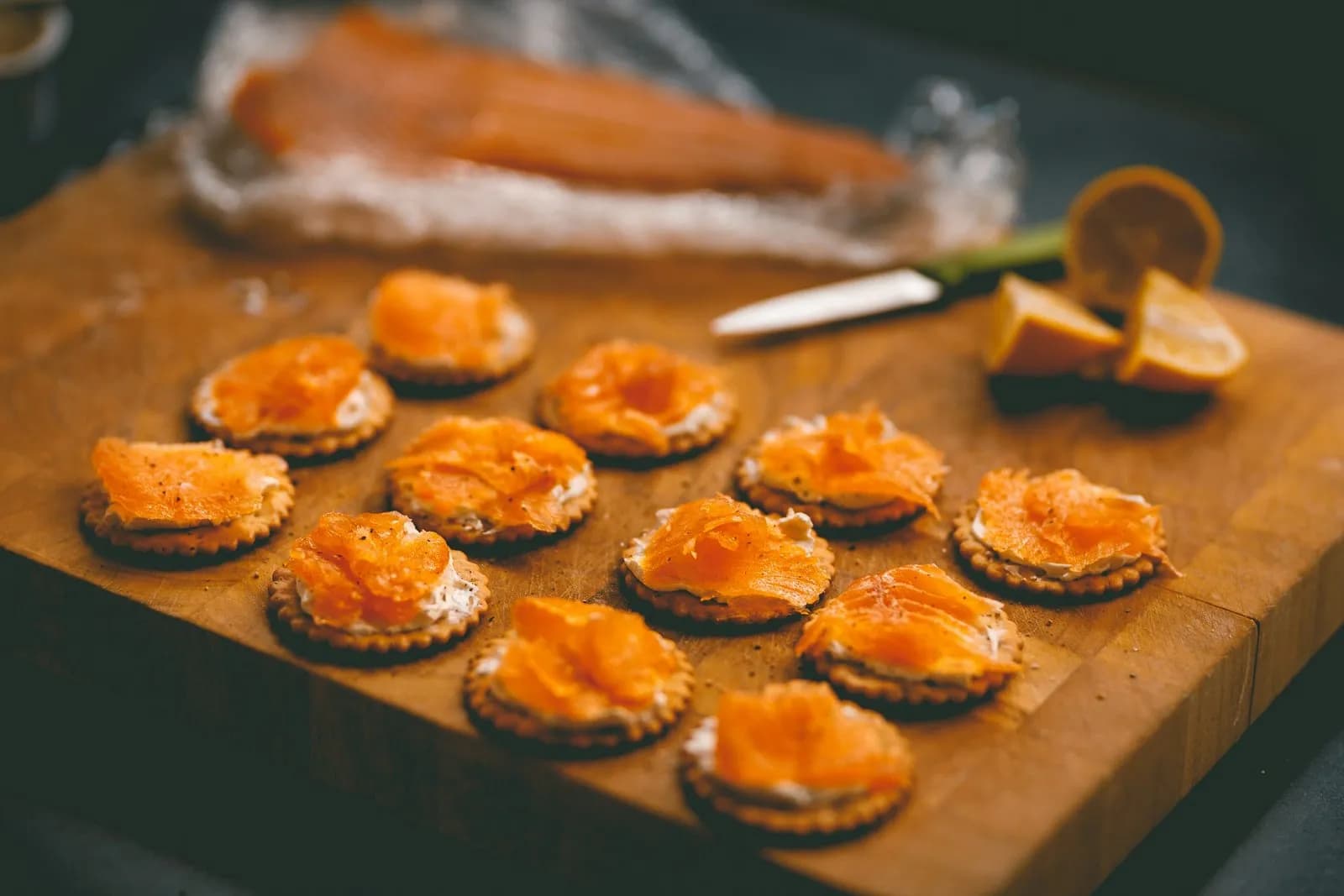
Cold smoking means exposing food to smoke without cooking it: the chamber stays below 30 °C and a small generator supplies the smoke. A kamado is built to hold heat, and cold smoking is precisely about not having any. It still works: the ceramic that holds 110 °C for hours is, switched off and cold, an airtight box with two adjustable vents, where the smoke circulates slowly. Cheese, butter or cured salmon come out tasting of smoke and uncooked.
The limit is not the kit, it is the thermometer outside. With a target of 25 °C in the chamber, summer on the Alicante coast is out. The good season, from November to April, takes in Christmas.
| Month | Average low | Average high | Window for cold smoking |
|---|---|---|---|
| October | 14.5 °C | 24.9 °C | Night and first thing; midday, no |
| November | 10.3 °C | 20.5 °C | Night and morning; afternoon in the shade, marginal |
| December | 7.4 °C | 17.7 °C | All day, in the shade |
| January | 6.3 °C | 17.0 °C | All day, in the shade |
| February | 7.1 °C | 17.6 °C | All day, in the shade |
| March | 8.9 °C | 19.6 °C | Most of the day; midday in the sun, keep watch |
| April | 10.9 °C | 21.3 °C | Night and morning; afternoon in the shade, marginal |
| May | 14.1 °C | 24.1 °C | Only night and dawn, marginal |
| June to September | 18.1-21.2 °C | 27.8-30.8 °C | Early hours only, and marginal; salmon, no |
Cold or hot: what really changes
In hot smoking, the smoke goes along with the cooking. The hot-smoked mackerel is made with the chamber at 105-130 °C until the loin reaches 62-65 °C, and the guajillo salmon is smoked at 130 °C until it reaches 60 °C in the centre.
In cold smoking there is no cooking. The food comes out as raw as it went in; what changes is its surface, where the smoke aromas settle, and its moisture, which drops a little. The FDA sets the ceiling for the chamber in industrial cold smokehouses at 32 °C, and the University of Alaska guide warns that around 35 °C the fish starts to cook.
That gives the most important idea in this guide: cold smoke does not pasteurise or kill anything, neither bacteria nor parasites. What protects a cold-smoked salmon is what comes before, freezing and salt curing, and what comes after, a cold fridge and a few days.
This guide works with two figures: 30 °C as the ceiling, the limit in the woods guide, and 25 °C as the target, the one in the cheese recipe. With cheese, the recipe opens the dome as soon as it passes 25 °C; with everything else, between 25 and 30 °C you carry on keeping watch, and above that you stop.
The switched-off kamado as a cold-smoke chamber
Two devices do the job, both with a small ember that advances slowly:
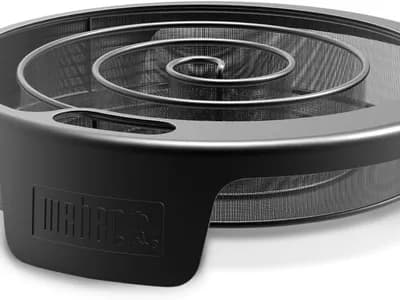
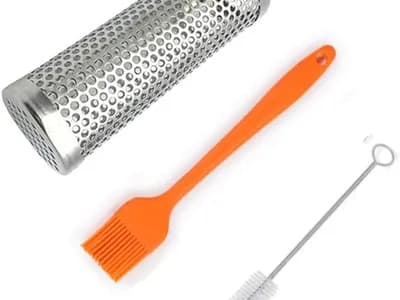
- Maze generator, such as the Weber 17636 base: a 20 x 20 cm tray with a spiral channel that you fill with sawdust and light at one end. It fits any kamado from 33 cm. - Pellet tube, such as the Naisfei 15 cm: a perforated 304 steel cylinder that you light with a blowtorch, leave to flame outside for a few minutes and then put in with the flame out, on ember alone; handle it with a glove or tongs, because the steel gets hot.
The device goes on the charcoal grate, empty and ash-free, to one side, and the food goes above, on the grid, with the pieces spaced apart. The vents are the opposite of cooking: bottom vent open one centimetre and top vent half open, as in the cheese recipe. If you close down as you would for low and slow, the ember suffocates. If the smoke comes out white and dense, open the bottom; the guide to bitter smoke explains why.
Two conditions: the kamado completely cold, because the ceramic stores heat for hours, and always outdoors, because a sawdust ember in a closed box produces carbon monoxide even if the charcoal is out.
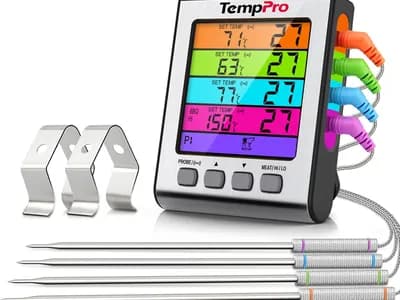
What decides things is a probe measuring ambient temperature at the height of the food, not the dome thermometer. A multi-probe wired thermometer such as the ThermoPro TP17H, with a stated range from -10 °C, measures the chamber and the air outside at the same time; the thermometer guide explains where to place it.
When it works on the Costa Blanca: the calendar
The table in this guide gives the normal climatological values of AEMET (the Spanish state meteorological agency) for the Alicante station, 1981-2010 period. The generator adds some heat, so working at 25 °C needs cooler air, and shade.
From December to February, with average highs of 17-18 °C, you can do it at any hour in the shade. March is good too: an average high of 19.6 °C, keeping an eye on the midday sun. November and April, at 20-21 °C, give you the night and the morning, and the afternoon in the shade is marginal. October and May are for night or first thing: their average highs are around 24-25 °C. May is slightly cooler than October but sunnier: 277 hours a month against 217, according to the same AEMET table, and a dome in the sun feels it. From June to September the average lows run from 18 to 21 °C: that leaves the early hours, and not for fish.
Four things move the figure:
- Shade. A dark dome in the sun heats up well above the air temperature. - Ice. A tray of ice on the grid, next to the food, takes heat out, but as it melts the humidity rises. - Humidity. The Alaska guide considers cold smoking not possible when relative humidity cannot be brought below 75%. According to AEMET, the Alicante average runs from 63% to 70%, but the sea wind pushes it up; the Levante wind has its own section in the guide to the kamado in winter. - Averages are averages. The table says which months; the probe says whether today is the day.
Above 30 °C cheese sweats fat and fish spends hours in the range where bacteria grow best: open the dome and, if it does not come down, stop and put everything in the fridge. Nor is anything below it a safe zone: according to the Alaska guide, the whole of cold smoking takes place in the danger zone, 4 to 60 °C, so the fish goes in cured and cold and back into the fridge as soon as it comes out.
Food safety, no beating about the bush
With raw fish there are four rules from official sources.
Anisakis: freeze first. AESAN (the Spanish food safety agency) lists "marine fish subjected to cold smoking" among the home preparations that must be frozen. At home, -20 °C or lower for at least five days, which only a three-star freezer or better guarantees; if yours is less than that, buy the fish already frozen. Industry follows Regulation (EC) 853/2004: -20 °C for 24 hours or -35 °C for 15 hours.
Listeria: who should not eat it. According to AESAN, smoked fish is among the foods most associated with listeriosis, because the bacterium grows even in the fridge. For pregnant women, children, older people and the immunocompromised, the official recommendation is to avoid smoked fish.
Botulism: beware of vacuum. According to the FDA's guidance for fishery products, Clostridium botulinum type E grows without oxygen from 3.3 °C. Industry holds it back with at least 3.5% salt in the water phase of the fish; at home you cannot measure that, so home-made vacuum-packed salmon goes in the freezer.
Cold and a few days. The Torry advisory note gives 5-6 days below 4 °C for commercial smoked salmon. A home-made salmon should not go beyond that.
And one red line: do not cold-smoke raw meat to eat it as it is. It gets cooked afterwards, like the home-made pastrami: brine, smoke and steam.
Cheese: which ones work, size, hours and resting
The cheeses that work are firm-textured, cured or semi-cured: semi-cured Manchego, Gouda or block mozzarella, the pizza kind, which are the ones in the recipe. Fresh and soft cheeses are not worth it: they deform with little heat, and AESAN cites soft-textured ones among the foods associated with listeria.
Cut blocks 3-4 cm thick: thinner ones get saturated, thicker ones leave the centre without smoke. Remove any paraffin or plastic rind. Take the cheese out of the fridge 30 to 60 minutes beforehand and pat it dry with kitchen paper, because an ice-cold cheese condenses water and that film makes the smoke bitter.
The cold-smoked cheese recipe gives 2 hours for mozzarella and 2.5 to 3 hours for Gouda and Manchego, with the chamber below 25 °C. There is no official figure; look for an even golden colour.
What people forget most is the resting time. Straight out of the smoke it tastes like an ashtray; wrapped and in the fridge, the smoke migrates inwards. The recipe asks for several days and no rule fixes the time: try one piece early and leave the rest for up to two weeks, always within the cheese's date.
Salmon: freeze, cure, dry and smoke
Salmon is the one that asks for the most steps:
- Freeze. Five days at -20 °C, as AESAN requires, or a loin bought already frozen. Thaw it in the fridge. - Cure in salt. The Torry note describes the industrial method: fillets covered in dry salt for about 12 hours for those from a 4 kg salmon and 24 hours for those from an 8 kg one. For a loin 3-4 cm thick, between 12 and 24 hours in the fridge is an indicative range. - Rinse and dry. Rinse, pat dry and leave the loin uncovered in the fridge, below 3.3 °C. The Alaska guide gives 2 to 24 hours of this rest for the salt to even out, 6 to 8 for a 2.5 cm fillet, and the surface starts to dry during it. The pellicle, a tacky, glossy layer, is finished with a little more warmth: the guide forms it in the smokehouse, over 30 minutes to 3 hours. - Smoke. In Torry's industrial kiln, at 27 °C, salmon has enough flavour and colour at around 5 hours. In the kamado, 4 to 6 hours of smoke is a starting point with the probe at 25 °C and never above 30 °C. The Alaska guide, written for home smokehouses, talks of 16 hours to 7 days depending on the product: treat all of it as a guide. - Slice. A few hours in the fridge settle it and it slices better. A long, flexible-bladed salmon slicing knife gives thin slices.
Keep it below 4 °C and for a few days; for longer, sliced and frozen, which the Alaska guide puts at 2-3 months at home. If that seems like a lot, the guajillo salmon is the shortcut: it reaches 60 °C, and AESAN considers that 60 °C for one minute throughout the piece destroys anisakis.
The easiest place to start: salt, butter and nuts
Do not start with salmon: learn on foods that are already stable before they meet any smoke.
Flaked salt is the safest: AESAN cites it, along with sugar and honey, among the foods in which listeria cannot grow. Cold butter, in a block, is the first to warn you if the chamber is heating up. Nuts, paprika and other dry spices have no free water to worry about. Oil takes smoke too; the risk comes if you then put garlic in it: AESAN cites home-made preserves in oil among the foods associated with botulism, so smoked garlic in oil goes in the fridge and is used up soon.
| Food | Preparation | Smoke (indicative) | Resting | Risk |
|---|---|---|---|---|
| Flaked salt | Thin layer, stir | 2-4 h | Closed jar | Very low |
| Butter | Cold, in a block | 1-2 h | Fridge, wrapped | Low |
| Nuts | One layer on a tray | 1-2 h | Closed jar | Very low |
| Paprika and dry spices | Thin layer on a tray | 1-2 h | Closed jar | Very low |
| Cured or semi-cured cheese | Blocks of 3-4 cm | 2-3 h | Fridge, several days | Low |
| Cured salmon | Frozen, cured, pellicle | 4-6 h | Fridge, a few days | High |
The hours for salt, butter, nuts and spices are indicative, with no official source: check every half hour.
Kit and fuel: what to buy and what does not work
Generator or tube. The Weber base is designed for sawdust: the channel is narrow and the fine dust burns evenly. The Naisfei tube runs on pellets. Neither spec sheet gives a burn time you can stand behind: Weber says smoke "for hours" and Naisfei gives no figure, because it depends on the fuel and the airflow.
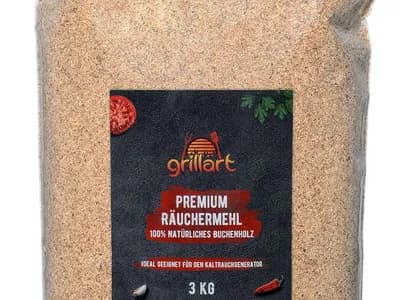
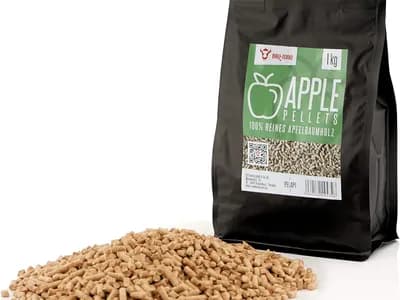
Sawdust or pellets. For the base, a beech flour for cold smoking, with a grain of 0.5 to 1.0 mm according to its spec sheet. For the tube, the 6 mm BBQ-Toro apple pellets, which are the ones in the cheese recipe, or the Weber alder pellets, the classic smoke for salmon. No heating pellets, which are not intended for food. Which woods are always off limits, and why, is covered in the guide to smoking woods.
What does not work. Wood chips and chunks are for hot smoke, over the embers. A smoker box like the La Cuisine one does not either: it needs embers underneath for the chips to smoulder.
The probe. Any probe thermometer whose range starts below 10 °C will do: in winter the chamber drops under that and, if yours starts higher, you will not see it warming.
The switched-off ceramic acts as the chamber, the generator supplies the smoke and the probe decides whether today is the day. A ceiling of 30 °C, a target of 25 °C. On the Costa Blanca, any hour in the shade from December to March, mornings and nights in November and April, and only nights or first thing in October and May.
Start with salt, butter and a semi-cured cheese, which are forgiving, and move on to salmon once you can read the smoke and the probe. With fish, four rules: freeze first, do not serve it to pregnant women, children, older people or the immunocompromised, keep it below 4 °C for a few days, and no vacuum packing outside the freezer.
Gear featured in this guide
Recipes to get started
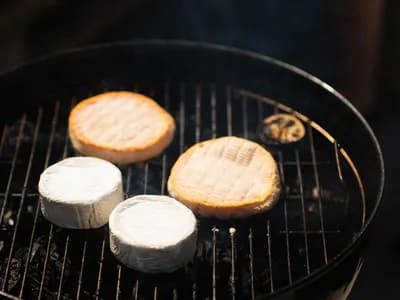
Cold-Smoked Cheese on the Kamado with a Pellet Tube, No Charcoal Lit
A closed kamado, cold and without a single charcoal ember: just a tube of apple pellets smouldering without flame and three cheeses taking on smoke for hours while the dome stays below 25 °C.
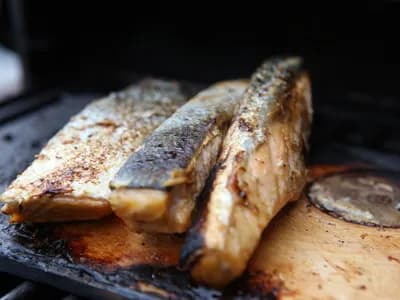
Guajillo-cured smoked salmon, low indirect
A 900 g salmon fillet, 24 hours dry-cured in Maldon salt, brown sugar, ground guajillo and dill. Smoked at 130°C with apple and cherry. Silky texture and a spicy crust.
GO DEEPER
Continue with these
- Related guide
Smoking woods for a kamado: which wood for which food
Olive, holm oak, apple or hickory: which aroma each cut asks for, how many chunks go into a sealed ceramic, when to add them and why soaking the wood does not help.
- Related guide
Bitter smoke in a kamado: creosote vs thin blue smoke
Why smoking sometimes leaves meat bitter, and how to get that clean, bluish wisp of smoke that perfumes instead of ruining. The truth about creosote.
- Related guide
Using your kamado in winter and Levante wind
Dense ceramic makes the kamado the best cold-weather grill there is, but Levante wind and damp air demand real adjustments. Here they are, drawn from our experience on the Torrevieja terrace and from the ceramic's specs.
- Related guide
Kamado thermometers and probes: which to buy and how to calibrate
Instant-read, wired or wireless: what each type actually measures, why the lid thermometer lies, where the probe goes in each cut and how to check at home that yours tells the truth.
- Recipe to practice
Cold-Smoked Cheese on the Kamado with a Pellet Tube, No Charcoal Lit
A closed kamado, cold and without a single charcoal ember: just a tube of apple pellets smouldering without flame and three cheeses taking on smoke for hours while the dome stays below 25 °C.
- Recipe to practice
Guajillo-cured smoked salmon, low indirect
A 900 g salmon fillet, 24 hours dry-cured in Maldon salt, brown sugar, ground guajillo and dill. Smoked at 130°C with apple and cherry. Silky texture and a spicy crust.
- Editorial comparison
big green egg large vs kamado joe classic iii
The classic kamado matchup: the Big Green Egg Large, the indestructible pioneer with the widest accessory network, again
- Glossary term
Top vent (damper)
Exhaust vent on top of the kamado that regulates draft and therefore cooking temperature.
- Glossary term
Bottom vent (damper)
Air-intake vent at the kamado's base; controls how much oxygen reaches the coals.
- Glossary term
Low & slow
Cooking at low temperature (95-130 °C) for many hours to tenderise tough cuts and develop deep smoke.
Frequently asked questions
What temperature do you cold smoke at?
Below 30 °C inside the chamber, and ideally below 25 °C. The FDA sets 32 °C as the ceiling for industrial cold-smoked fish smokehouses, and the University of Alaska guide warns that around 35 °C the fish starts to cook. With cheese, above 30 °C the fat sweats. Measure with an ambient probe at the height of the food.
How long do you cold smoke salmon for?
According to the Torry technical note, in the British industry salmon takes on enough flavour and colour at around 5 hours in a kiln at 27 °C. In a kamado with a generator, 4 to 6 hours of smoke is an indicative starting point, with the chamber below 25-30 °C. Before that come five days of freezing at -20 °C, a salt cure of 12 to 24 hours and drying in the fridge. The Alaska guide gives 16 hours to 7 days: it depends heavily on the method.
Do you have to freeze salmon before cold smoking it?
Yes. AESAN lists cold-smoked marine fish among the home preparations that must be frozen to eliminate anisakis, because cold smoke does not kill it. At home, -20 °C or lower for at least five days, which only a three-star freezer or better guarantees; if yours is less than that, buy the loin already frozen. Smoked salmon you buy ready-made already comes treated: frozen by the producer, as AESAN notes, or farmed under parasite-free conditions, the exception that Regulation (EC) 853/2004 allows.
Can you cold smoke in summer in Alicante?
Almost never. According to AEMET's normal values for Alicante, from June to September the average low runs from 18 to 21 °C and the average high exceeds 27 °C. With the heat the generator adds, only the early hours are left, and marginally. A cheese, with ice and shade, may work; salmon is not worth the risk. The good season runs from November to April.
Which cheeses can you cold smoke at home?
Firm-textured, cured or semi-cured ones: semi-cured Manchego, Gouda, Cheddar, provolone or block mozzarella, the pizza kind. They stand hours out of the fridge and take the smoke evenly. Cut them into blocks of 3-4 cm and remove any paraffin or plastic rind. Fresh and soft cheeses are not worth it: they deform with little heat and AESAN cites them among the foods associated with listeria. Afterwards, rest them wrapped in the fridge for several days.
Is smoked food healthy?
At occasional consumption, the risk EFSA describes is low. Smoke deposits polycyclic aromatic hydrocarbons (PAHs), and some are carcinogenic. EFSA concluded in 2008 that the concern is low at average European consumption, although the margin narrows for heavy consumers, and recommended monitoring four PAHs rather than one. Regulation (EU) 2023/915 sets maximum limits for smoked meat and fish. At home, treat smoked food, cheese included, as an occasional snack and bear in mind the salt from the cure.