BUYER'S GUIDE · BEGINNERS
Best kamado for beginners 2026: easy to light, control and maintain
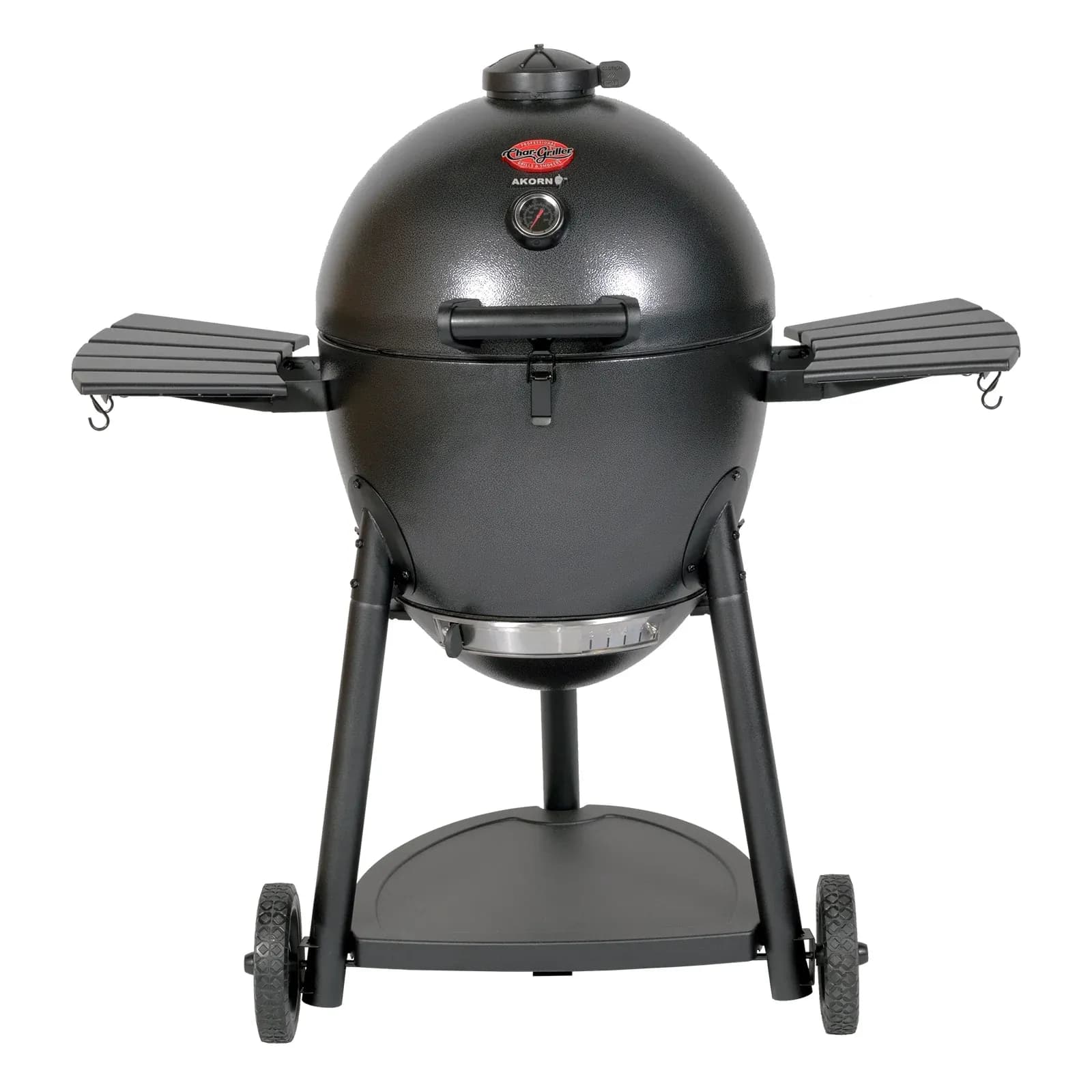
The Char-Griller Akorn is one of the fastest to come up to heat in its category —the manufacturer and the community put it at around 220 °C in roughly ten minutes— and, thanks to its casters, it rolls with almost one finger. To start without wrecking your wallet or your back, these are the five kamados we'd hand to anyone lighting their first grill.
QUICK PICK
If you only want to know which one to buy
Char-Griller Akorn E16620
The Char-Griller Akorn E16620 is our beginner winner: for around 549 € you get a 51 cm steel kamado that lights in ten minutes, weighs just 43 kg with cart and wheels, and won't hurt to sell on if you find the hobby isn't for you.
As an Amazon Associate, mikamado.es earns from qualifying purchases. At no extra cost to you.
Almost every beginner kamado guide lies by omission: it pushes you toward a 1,500 € premium ceramic "because it lasts a lifetime". The trouble is you don't yet know whether you'll light the grill three times a year or every weekend. Buying premium before you know is like buying 300 € hiking boots for your first walk.
Three things matter when you're starting, and none of them is peak temperature: how easy it is to light and stabilise (a beginner burns two dinners learning to tame the vents), how much weight you'll have to move around the terrace, and how much it hurts if the hobby doesn't stick. That's why we deliberately mix steel and ceramic here. Insulated steel — like the Akorn's — doesn't hold heat for 14 hours like dense ceramic, but it lights twice as fast, weighs half and costs a third. For learning indirect cooking, zone control and not overshooting, it's perfect.
We've analysed all five in depth from manufacturer specs and what the community reports, cross-checked against our own experience cooking on ceramic. We tell you straight when the jump to real ceramic is worth it and when steel is the smarter call. No brand pays to appear here; we rank by ease of learning and regret risk, not by margin.
The full ranking
#1
Char-Griller Akorn E16620
If you've never lit a charcoal grill and don't want to gamble 1,000 €, start here. The Akorn isn't ceramic and doesn't pretend to be: it's insulated triple-wall steel with a cast-iron grate. The trade-off is it sheds heat faster in wind and burns slightly more charcoal; the reward is it hits 220 °C in about ten minutes — per manufacturer and community — versus thirty for ceramic. It weighs 43 kg with the locking-caster cart already fitted, so you move it solo. The Easy Dump pan empties ash in seconds. At 549 € you learn zone control and indirect cooking with no fear of writing off a big investment.
Pros
- Hits target temperature in about ten minutes: half a ceramic's wait
- Just 43 kg with cart and locking casters fitted: you move it solo
- Full 51 cm size at 549 €: the cheapest full-size grill on this list
Cons
- Not ceramic: holds heat worse and burns more charcoal in wind
- 350 °C ceiling: it does NY-style pizza, not 450 °C Neapolitan
#2
Klarstein Princesize Pro 33 cm
If what draws you is the ceramic itself — that enveloping, stable heat you learn to master — but you won't pay 1,000 € to find out, the Princesize Pro is the lowest ticket into real ceramic. It's 33 cm and 40 kg of genuine glazed ceramic, not painted steel, with a bamboo side table included. It cooks for 2-4, so it's a couple's or balcony grill, not a party machine. The ceramic is thinner than a Joe Jr's and the warranty is 2 years, not lifetime: it's not for 20 years of heavy use, it's for learning vent control with a real kamado's thermal inertia before the big jump.
Pros
- Real glazed ceramic under 500 €: you learn genuine thermal inertia
- Just 40 kg and 33 cm: fits and moves on a small balcony
- Bamboo side table included: a work surface from day one
Cons
- Cooks for 2-4 max: too tight for groups
- Thinner ceramic and only a 2-year warranty, not lifetime
#3
Kamado Joe KettleJoe
For the beginner already coming from a Weber kettle who wants to genuinely smoke without moving to a 100 kg kamado, the KettleJoe is the perfect bridge. It's Kamado Joe's hybrid play: a kettle-style steel chamber with a SlōRoller ceramic insert for convection, a hinged lid you open one-handed and an integrated ash drawer. It weighs just 30 kg — the lightest of the five — and reaches target temperature in ten minutes. Two honest warnings: the ceiling is 260 °C, fine for smoking and roasting but short of an aggressive sear, and Amazon ES stock is very intermittent. If you find it at 659 €, it's the gentlest learning curve with a prestige surname.
Pros
- SlōRoller insert: genuinely long smokes despite no dense ceramic
- Just 30 kg and a one-handed hinged lid: the easiest to handle
- Heats in ten minutes and the ash drawer makes cleanup trivial
Cons
- 260 °C ceiling: not enough for an aggressive sear or traditional pizza
- Very intermittent Amazon ES stock: often shows as unavailable
#4
Pit Boss K24 24"
If you already know you'll be cooking for family and friends — 8 to 10 regulars — and would rather not run short, the Pit Boss K24 is the most far-sighted beginner pick. It's honest 61 cm glazed ceramic from a brand Spanish BBQ fans know through its pellet grills, with a thermometer and cart as standard at a price clearly below the Big Joe III. Don't expect Kamado Joe tricks (no SlōRoller, no Divide & Conquer): it's a plain classic kamado, easy to understand. The catch for a novice is the 110 kg: you place it once with help and never move it again. If you have the fixed space, it's a lot of kamado for the money.
Pros
- 61 cm of real ceramic: cooks for 8-10 without crowding
- Brand known in Spanish BBQ with dealer support
- Analog thermometer, cart and folding side table as standard
Cons
- 110 kg: you place it once with help and don't move it again
- No multi-tier system and less dense ceramic than Kamado Joe or BGE
#5
Kamado Bono Grande Limited 64 cm
For the beginner who's sure the hobby will stick and wants maximum kamado per euro, the Bono Grande Limited is the riskiest but the best feature-to-price ratio here. It's 64 cm — the largest diameter on the list — of real ceramic with a Dual Zone half-grid as standard, plus a cart and two side tables, all for 1,184.59 €. It's a lot of kamado: cooks for 10-12 effortlessly. You pay for the savings in factory consistency (some units arrive with cosmetic defects), a 2-year-only warranty and low resale. That's exactly why it isn't our number one to start with: if you're unsure you'll keep going, go back to the Akorn. If you're certain, there's a serious grill here.
Pros
- 64 cm of real ceramic: the largest diameter here, for 10-12
- Dual Zone half-grid as standard: two heat zones to learn on
- Cart and two side tables included: a full rig for 1,184.59 €
Cons
- Inconsistent factory QC: some units arrive with cosmetic defects
- Only a 2-year warranty and low resale: a penalty if you don't carry on
How to choose between these models
How to choose between the five? Start with an honest question: how likely are you, really, to still be cooking a year from now?
If you're unsure, or if you've never touched charcoal, the Char-Griller Akorn is the answer, no debate: 549 €, 43 kg, lights in ten minutes and resells without tears. If it's the ceramic itself you love and you cook for few, the Klarstein Princesize Pro gives you that real thermal inertia under 500 €. Coming from a Weber kettle and want to genuinely smoke without the weight? KettleJoe, if it's in stock.
If you already know you'll cook for groups and have a fixed spot on the terrace, jump to large ceramic: Pit Boss K24 for brand and support, or Kamado Bono Grande Limited for maximum size and features, accepting the QC risk. Golden rule for novices: prioritise easy lighting and light weight over peak temperature. You'll level up when the hobby sticks.
The ones we dismissed (and why)
We analysed these in depth for this list too. They missed the cut for specific reasons — and one of them might still be the right fit for you:
- Kamado Joe Classic III 18" — It's the best kamado in our catalog, but spending close to €1,900 to find out whether charcoal is your thing is putting the roof on first — come back for it once the kamado bug has bitten.
- Big Green Egg Large — Magnificent and everlasting, but the cart, plate setter and nearly everything else are sold separately, and that spending staircase isn't the learning curve a beginner needs.
- BBQ-Toro Haiiro 32 cm — It's the lowest entry price in the catalog, which makes it tempting as a first kamado, but its 32 cm and a house brand with barely any spares tend to end in frustration and a second purchase within months.
- Landmann Kamado Mini 27 cm — Cheap and manageable, but with 27 cm you'll never learn what a kamado can really do beyond a couple of steaks.
- Monolith LeChef Pro 2.0 XL — At 175 kg, with freight-company installation and a 56 cm chamber, nobody should learn charcoal on a flagship like this.
Frequently asked questions
Steel or ceramic to start with a kamado?
To start, insulated steel (like the Char-Griller Akorn) is the sensible choice if you're unsure the hobby will stick: it reaches temperature in about ten minutes versus thirty for ceramic, weighs half and costs a third. Ceramic holds heat better on long smoking sessions and reaches higher temperatures for Neapolitan pizza, but a beginner won't exploit that edge in their first dinners. If it's the ceramic's thermal inertia that draws you, the Klarstein Princesize Pro is the cheapest entry into real ceramic under 500 €.
Is it hard to control a kamado's temperature as a beginner?
It's easier than it looks, but it takes patience the first few times. A kamado is controlled with just two vents (the bottom air intake and the top exhaust): more open, more heat. The classic novice mistake is opening them too far, overshooting 300 °C and then being unable to cool down fast because the ceramic is already hot. The rule is to climb slowly and close the vents as you approach your target, anticipating it. On steel like the Akorn this is more forgiving because it cools faster; on dense ceramic you need to anticipate further ahead.
How much does a decent starter kamado cost?
There's an honest entry at around 549 €: the steel Char-Griller Akorn, full size and with a cart. If you want real ceramic, the lowest ticket is around 449 € with the 33 cm Klarstein Princesize Pro. From there it climbs with size: a large ceramic for groups (61-64 cm) runs 999 to 1,185 € from brands like Kamado Bono or Pit Boss. Our advice for beginners is not to exceed 800 € until you know the hobby sticks; you'll jump to a for-life premium once you're sure.
What maintenance does a kamado need for beginners?
Far less than you fear. After each session, just empty the ash (the Akorn and KettleJoe have a quick-empty pan or drawer) and close the vents to snuff the coals without consuming them. Every few cooks it's worth a high-heat burn-off to carbonise grease on the grate, then a brush. The part to watch most is the fibre gasket that seals the lid: on premium ceramic it lasts years, on budget models it may need replacing sooner. Don't wash the inner ceramic with soap or a pressure washer; charcoal self-cleans with heat.
Can I make pizza and smoke with a beginner kamado?
Yes, with caveats depending on the material. For low-and-slow smoking (110-130 °C for hours) any of the five works; ceramic sustains longer sessions on a single charcoal load, but the KettleJoe does it well thanks to its SlōRoller convection insert. For pizza it depends on the temperature ceiling: steel models like the Akorn (350 °C) and KettleJoe (260 °C) make American-style or thin-crust pizza, but true Neapolitan needs 430-450 °C that only premium ceramics with a stone deliver. As a beginner you'll make very respectable pizza on any of them; competition Neapolitan is another league.
Other buying guides
Best kamado 2026: the 5 ceramic grills we recommend without reservations
Editorial comparison of the 5 best kamados of 2026. Kamado Joe Classic III, Big Green Egg Large, Big Joe III, Monolith Classic Pro 2 and Primo Oval XL. No pay-for-coverage.
Best kamado under 1,000 €: 4 honest options that actually cook
Kamado Bono Grande, Klarstein Princesize Pro, Pit Boss K24 and Vision Grills Diamant: the 4 best kamados under 1,000 € reviewed without marketing filters.
Best Value Kamado 2026: the most grill per euro
We analyse the kamados that give the most grill per euro: thick ceramic, long warranties and accessories. Our honest verdict on the mid-range sweet spot.
Best kamado for a couple: 3 small options for 2 (with room for guests)
The 3 best kamados for a childless couple: Kamado Joe Jr, BGE MiniMax and Monolith Icon. 32-38 cm diameter, under 50 kg, enough for 2 with room for 4 guests.