Recipe · Pizza · Medium
Quattro formaggi pizza on the kamado
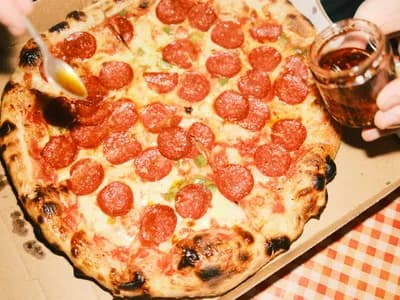
White, no tomato, no safety net: mozzarella, gorgonzola, taleggio and Parmesan melting in layers over thin dough. With a few pear slices to finish, it borders on illegal.
Quick answer
Quattro formaggi is a white pizza, no tomato, and bakes at 320 °C (not 350) in 3-4 minutes so the rich cheeses don't release oil. Build it in layers: a fior di latte base, taleggio, parmesan and the gorgonzola last in small islands. Pear, walnuts and pepper as it comes off the kamado.

One big step at a time, screen kept on and built-in timers.
- Prep
- 1470 min
- Cook
- 4 min
- Servings
- 4 servings
- Temperature
- 320 °C
What time do you want to eat?
Pick a time and we'll tell you when to start.
12:31
the day before
Start the prep
13:01
Light the kamado
13:46
Onto the kamado
14:00
Serve
Estimate: it includes lighting and settling the kamado plus a margin for large cuts. If the recipe asks you to marinate or salt ahead, add that time.
Fire setupStone or steel
- Dome
- 320 °C
- Grate
- Raised
- Bottom vent
- Half open
- Setup
- Raised stone
Temperature curve
1:03 h from lighting
Kamado dome
| # | From | Phase | Dome |
|---|---|---|---|
| 1 | 0:00 | Light the charcoalRaised stone and a long preheat | 20 → 320 °C |
| 2 | 0:45 | StabiliseBottom vent halfway if you come from 350 °C | 320 °C |
| 3 | 0:55 | Bake3-4 min with a 180° turn halfway | 320 → 280 °C |
| 4 | 0:59 | Recover temperatureWait for the dome to return to 320 °C | 280 → 320 °C |
| 5 | 1:03 | Serve | off |
0:00 is the moment you light the charcoal. Internal temperatures are the ones the recipe gives; without a probe, go by the times. Turn these times into clock times with the planner
For this recipe
Ingredients
- "00" flour, W 260-300 (100% baker's)500 g
- cold water (62% hydration)310 ml
- fine sea salt (2.8%)14 g
- fresh yeast (0.2%)1 g
- fior di latte, very well drained (the base)200 g
- gorgonzola dolce80 g
- taleggio, rind removed100 g
- coarsely grated Parmesan40 g
- ripe Conference pear (optional, thinly sliced)1
- chopped walnuts (optional)1 handful
- freshly ground black pepper1 pinch
Allergens
- Gluten
- Milk
- Tree nuts
The walnuts are optional: without them the pizza has no tree nuts.
Based on the recipe's ingredients. Always check the label of every product you buy.
The gear for this recipe
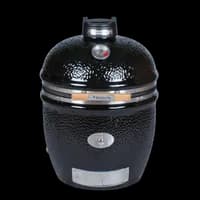 Monolith Classic Pro 2.0Fine vent control to pin the 320°C the cheeses demand without splitting.
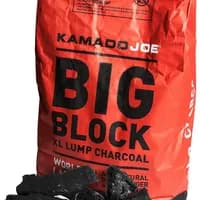 Kamado Joe Big Block XL lump charcoal 9.1 kgA stable, long-lasting bed for a medium-high temperature session.
 Navaris Cordierite Pizza Stone Rectangular XL (38×30×1.5 cm)Rectangular and roomy: space to shift the pizza to cooler zones if the cheese runs hot.
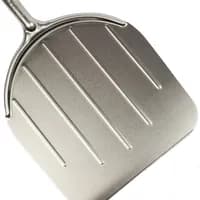 Falci Aluminium Pizza Peel 32 × 34 cmA wide Italian peel: a loaded quattro formaggi forgives no hesitant launches.
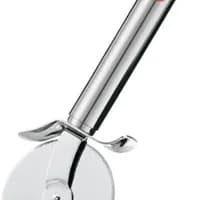 Rösle Pizza Wheel CutterA clean cut through four molten cheeses without dragging them.
Method
- 01
24h dough and tempered cheeses
Standard slow-ferment dough in 200 g balls. Take the cheeses out of the fridge an hour ahead: cold gorgonzola and taleggio neither spread well nor melt on time, forcing you to overbake the base.
- 02
Stabilise the kamado at 320°C
Stone raised and a long preheat, but with the vents a notch more closed than for Neapolitan: we want a stable 320°C. If you are coming down from 350°C, half-close the bottom vent and give the dome 10 minutes to drop and settle.
- 03
Layer the cheeses, blue last
Stretch to 28-30 cm. First the fior di latte as an even base, then the taleggio in blobs, the Parmesan in a shower, and finally the gorgonzola in small, separate hazelnut-sized dots: it is the most invasive and must remain islands, not a sea.
- 04
Bake 3-4 minutes at medium-high
At 320°C a white pizza needs longer than a red one: 3-4 minutes with a 180° turn halfway. Look for cheese bubbling across the whole surface with golden flecks only at the taleggio edges. If you see oil pooling, the oven is running too hot.
- 05
Pear, walnuts and pepper to finish
Off the kamado, lay on the thin pear slices, the walnuts and a crack of black pepper. Cold pear over molten cheese is the contrast that upgrades this pizza from "nice" to "who needs dessert".
About this recipe
A textbook quattro formaggi is not a dumping ground for cheese-drawer leftovers: it is architecture. Each cheese plays a role — mozzarella for body, gorgonzola for the punch, taleggio for cream and Parmesan for salt — and the proportions matter as much as in a cocktail. The golden rule: the blue never exceeds 20% of the total or it devours the other three.
A white pizza demands a different oven
With no tomato shielding the surface, the cheese takes the dome's full heat, so we bring the kamado down to 320°C, thirty degrees below a Neapolitan: enough to puff the rim, gentle enough for the four cheeses to melt into creamy lava without splitting into oil or over-browning. Pear slices added after the bake — gorgonzola's classic abbinamento — cut the fat and refresh every bite.
Will it fit your kamado?
Small
33-40 cm · Joe Jr, MiniMax
Tight
The 38 × 30 cm stone won't fit; with a ~30 cm round one, make ~25 cm pizzas.
Medium
46-51 cm · Classic, Large
Tight
A 38 × 30 cm stone (~48 cm diagonal) probably won't fit a 46 cm grate; a ~35 cm round one takes 28-30 cm pizzas.
Large
56-61 cm · Big Joe, XL
Fits
Fits with room; a larger stone takes pizzas up to ~35 cm.
What to serve with it
Sides
- Bitter leaf salad with pear
- Grilled wild asparagus
- Wine
- Lees-aged Verdejo from Rueda or a brut nature Cava
- Beer
- Belgian blonde or saison
- Alcohol-free
- Apple kombucha
Leftovers and storage
- In the fridge
- 1-2 days in the fridge, airtight, without the pear, chilled within 2 h.
- Freezing
- Slices without pear or walnuts, wrapped, 2-3 months; thaw in the fridge, never refreeze.
- Reheating
- Covered cast-iron pan over medium-low heat 4-5 min to melt the cheese without burning the base.
Cool and refrigerate within 2 hours. When in doubt, throw it out.
Leftover embers
You still have embers: what to do with the leftover heat
For 4 min at 320 °C in a classic kamado you load about 1.25 kg of charcoal and burn 900 g: when you serve, about 350 g of live embers remain. Before you shut the vents, that is still enough for:
Without touching the vents
320 °Cfull heat, direct
20 minof embers
- Iberian pork tenderloin grilled with Pedro Ximénez glaze8 min · 280 °C
- Red prawns over live fire on the kamado in 6 minutes6 min · 280 °C
- Sesame-Crusted Seared Bluefin Tuna on the Kamado (Tataki)4 min · 280 °C
No recipe needed
- Pita or naan from shop dough, on the grate (2 min each)
- Whole peppers until the skin blackens, for peeling (8 min)
- Pineapple or peach slices, char-marked (3 min)
Closing the vents a little and waiting for it to drop
210-270 °Cgrilled vegetables
20 minof embers
- Charred Wild Green Asparagus on the Kamado8 min · 240 °C
- Rum-glazed grilled pineapple on the kamado14 min · 220 °C
- Grilled provolone on the kamado with tomato, oregano and olive oil, in a cast-iron skillet12 min · 230 °C
No recipe needed
- Strips of courgette and aubergine, char-marked (5 min)
- Pita or naan from shop dough, on the grate (3 min each)
- Halved tomatoes, cut side down, for a sauce (10 min)
Before opening the lid, crack it open for a few seconds first; if you raise the heat, stir the ash so the coals can breathe. And if you are not going to use them: once the food is out, close the bottom and top vents. The charcoal that does not burn (about 350 g) can be used next time. Different size of kamado? Work out your load for 1 h of fire, lighting included.
Editor's tips
- Spanish substitutions that work: Picón de Tresviso for the gorgonzola (half the amount, it bites harder) and Torta del Casar for the taleggio.
- No bagged "pizza shred": it carries anti-caking starch that turns the melt grainy.
- This pizza calls for wine over beer: an acidic white (Godello, Riesling) acts as the fifth ingredient.
Gear for this recipe
As an Amazon Associate, mikamado.es earns from qualifying purchases. At no extra cost to you.

Monolith Classic Pro 2.0
Fine vent control to pin the 320°C the cheeses demand without splitting.
€2,000
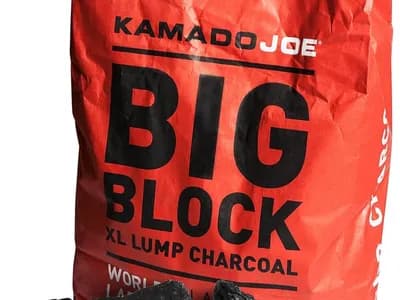
Kamado Joe Big Block XL lump charcoal 9.1 kg
A stable, long-lasting bed for a medium-high temperature session.
€67

Navaris Cordierite Pizza Stone Rectangular XL (38×30×1.5 cm)
Rectangular and roomy: space to shift the pizza to cooler zones if the cheese runs hot.
€24

Falci Aluminium Pizza Peel 32 × 34 cm
A wide Italian peel: a loaded quattro formaggi forgives no hesitant launches.
€40
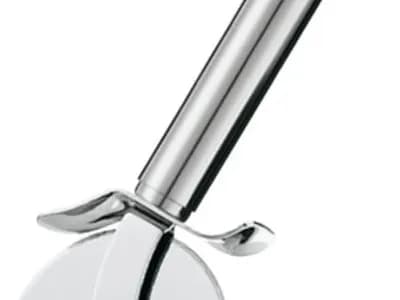
Rösle Pizza Wheel Cutter
A clean cut through four molten cheeses without dragging them.
€15
Have you made it?
Tell us how it turned out on your kamado. We review every rating before publishing it.
No published ratings yet. Be the first!
FAQ
Which four cheeses go on a quattro formaggi pizza?
There is no single dogma, but the canonical Italian line-up is mozzarella (neutral lactic base), gorgonzola (the blue, the character), taleggio or fontina (creaminess and washed-rind notes) and Parmesan or grana (salt and umami). The system is what matters: one body cheese, one blue, one creamy mid-flavour and one hard finisher. With Spanish cheeses: mozzarella, a careful hand of Picón or Cabrales, Torta del Casar and a grated cured sheep's cheese.
Why does my cheese pizza split into oil in the oven?
Because cheese fat splits when it takes too much heat too fast — fatty cheeses like taleggio and gorgonzola break sooner than mozzarella. That is why a quattro formaggi bakes at 320°C rather than 350°C, and why the cheeses must go in tempered: from fridge-cold to dome-blast, the thermal shock breaks the emulsion. If it still splits, distribute the cheese in smaller pieces and launch the pizza just before the kamado reaches its peak.
Does a four-cheese pizza take tomato?
The classic Italian version is "bianca": no tomato, so the dairy speaks without interference. A "rossa" variant exists with a thin layer of tomato under the cheeses, common in southern Italy, perfectly legitimate and somewhat lighter on the palate. If you try it, cut back the Parmesan: tomato acidity plus aged-cheese salt unbalances things. On the kamado the bianca is also easier — one fewer wet ingredient to manage at high heat.
What do I do with the embers left after making Quattro formaggi pizza on the kamado?
After 4 min at 320 °C in a classic kamado about 350 g of live embers remain: 20 min more at 320 °C without touching the vents or 20 min at 210-270 °C closing the vents. If you are not going to use them, close both vents and keep the charcoal for next time.
More kamado recipes


KEEP READING
Go deeper on this dish
- Recommended kamado
Monolith Classic Pro 2.0
Fine vent control to pin the 320°C the cheeses demand without splitting.
- Editorial guide
Your first kamado: the complete pre-purchase guide
Size, materials, brand and budget. Everything you have to decide before clicking Buy, told by someone who has made enough mistakes.
- Glossary term
Heat deflector
Ceramic plate placed between the coals and the grate to turn direct fire into indirect cooking.
- Related comparison
kamado joe classic iii vs monolith classic pro 2 cart
The comparison every European cook eventually makes: the Kamado Joe Classic III, the US reference with SlōRoller, again…