BUYER'S GUIDE · TERRACE AND BALCONY
Best kamado for a terrace: 4 compact options that fit in a flat
Four square metres of terrace, a smoke-sensitive neighbour and the doubt of whether you can cook seriously without yelling from the floor above. These four kamados are the only ones we recommend for flats: small, efficient and with controlled smoke.
QUICK PICK
If you only want to know which one to buy
Monolith Icon 13"
The Monolith Icon wins for terraces: 33 cm diameter, 47 kg, and the only serious sub-50 kg ceramic that handles a real Neapolitan pizza without recalibration.
As an Amazon Associate, mikamado.es earns from qualifying purchases. At no extra cost to you.
Cooking with a kamado in a flat has three constraints that completely change the choice. First, space: a 46 cm unit with cart is 75-90 cm deep, which on a standard 1.5 m terrace leaves very little margin to open the lid without hitting the railing. Second, weight: if you live on a fifth floor with no goods lift, carrying 108 kg of kamado (127 with the cart) up the stairs is a full-day project (and two kidneys). Third, smoke: your upstairs neighbour will smell exactly what you're cooking. That forces using clean charcoal without chemicals and understanding which cooks aren't acceptable on a balcony (smoked fish, for example).
The four options on this list satisfy all three. All weigh under 50 kg, all have 32-38 cm diameter — enough for 2-4 people — and all are decent ceramic, not the painted-aluminium Chinese plates you see in big-box stores. The difference between them is budget and whether you want a brand with European aftersales.
Important note: if your terrace is communal, check the regulations before buying. Many communities in Costa Blanca and Costa del Sol ban embers on balconies above the first floor. Kamados fall under "electric/gas barbecue equivalent" when there's interpretive doubt, but ask first.
The full ranking
#1
Monolith Icon 13"
The Monolith Icon is the most serious small kamado you can buy. 33 cm of usable diameter, 47 kg with the folding cart, and the ceramic is the exact same formula as the larger Classic Pro 2, not a "lite" version. That matters because in a small kamado thermal inertia is the main problem: thin ceramic lets a gust of wind drop you 50 °C in 30 seconds. The Icon holds temperature as steadily as a Big Green Egg Large. The drawback is that the small-format accessory ecosystem in Spain is narrow — deflectors, pizza stone — and you'll likely order them direct from the German site.
Pros
- Same ceramic as the larger Classic Pro 2
- 47 kg with folding cart: fits in a lift
- Exceptional heat retention for its size
Cons
- Small-format accessories scarce in Spain
- Slower aftersales than Kamado Joe
#2
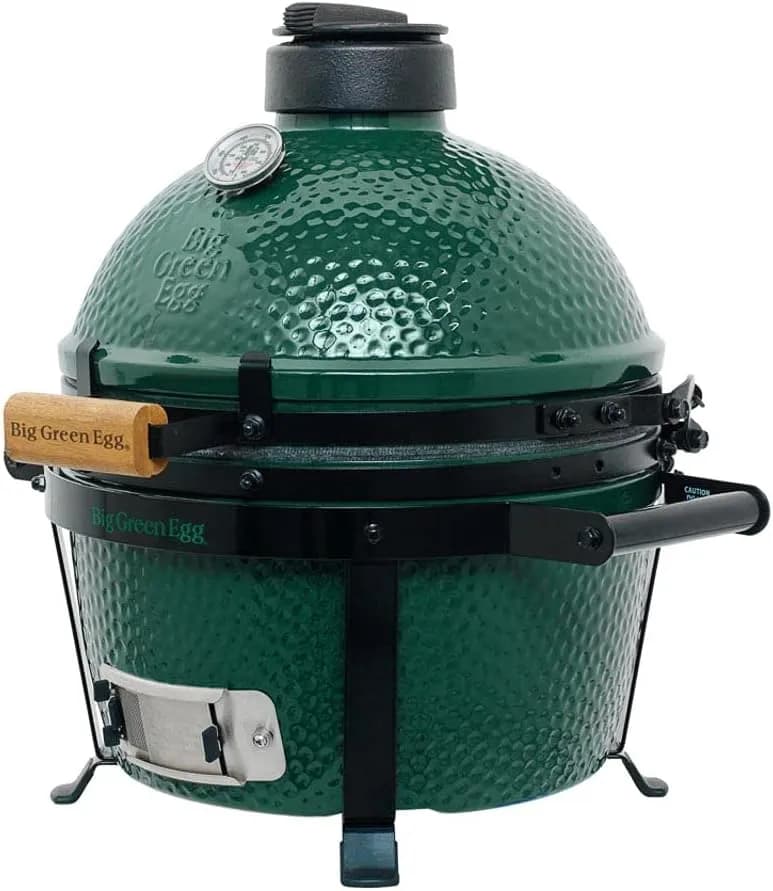
Big Green Egg MiniMax
The BGE MiniMax is the most portable option in the Big Green Egg catalogue and the only one shipping with factory transport handles. 35 kg without a cart — put it on a sturdy table and you're done — and the ceramic is the same space-grade high-density formula as the Large. Cooks very well for 2-3 people: thick steak, whole chicken, individual pizza. The reason to pick it over the Monolith Icon is the accessory network: if you want a MiniMax-specific pizza stone or extra stainless grate, there's a BGE dealer in Madrid and another in Barcelona with stock. The drawback: the standard fibre gasket lasts 5-6 years in heavy use and needs replacing.
Pros
- 35 kg with factory transport handles
- Same space-grade high-density ceramic as the BGE Large
- BGE dealer network in Madrid and Barcelona
Cons
- No factory cart: needs a sturdy table
- Fibre gasket lasts 5-6 years in heavy use
#3
Kamado Joe Joe Jr 13.5"
The Joe Jr is the smallest in the Kamado Joe catalogue: 33 cm usable, 37 kg with its cast-iron stand. The key difference versus the MiniMax is that it ships with a dual-sided cast-iron grate (smooth + ridged) stock, which on small cooks is very useful for searing steaks without swapping accessories. The ceramic is the same quality as the Classic III, no clipped version. Important drawback: the analogue dome thermometer is less accurate than on the larger models — we recommend dropping in a digital dual-probe from day 1.
Pros
- Dual-sided cast-iron grate included
- Same ceramic as the Kamado Joe Classic III
- 37 kg with stand: transportable
Cons
- Analogue dome thermometer not very accurate
- No cart: need to buy a table or stand
#4
Klarstein Princesize Pro 33 cm
The Klarstein Princesize Pro is the budget wildcard. For around 450 € you get a 38 cm kamado with cart and steel grate — literally a third the price of the Monolith Icon. Ceramic is thinner (38 mm vs 50 on the Monolith), so it loses temperature faster in wind and the stock gasket leaks more heat. Worth it? If your use is "a couple of grills a month, no ambition to smoke for 12 hours", absolutely yes. If you want serious smoking or weekend cooking, step up to the Joe Jr or MiniMax: the price gap pays back in 2-3 years.
Pros
- Aggressive price: around 450 €
- 38 cm diameter with cart and grate included
- Perfect for occasional weekend use
Cons
- Thin ceramic: loses temperature in wind
- No lifetime warranty: standard 2 years
How to choose between these models
How to choose between the four? Start with budget. If you have 1,000 € or more to spend and want European quality for a decade, the Monolith Icon is the clean answer. If accessory network and Spanish service matter more, the BGE MiniMax with a local dealer.
If your main use is steaks and red meat, the Joe Jr wins on the factory cast-iron grate, which on the other three is an aftermarket buy. If you only want to test the kamado format without committing 1,200 €, the Klarstein Princesize is honest: it cooks, it's not premium, but it doesn't lie.
Final tip: measure your terrace's usable depth with the lid open before buying. A small kamado's lid lifts 45-50 cm above the body; on a 1.2 m terrace with a 1 m railing you can end up colliding.
The ones we dismissed (and why)
We analysed these in depth for this list too. They missed the cut for specific reasons — and one of them might still be the right fit for you:
- Kamado Joe Classic III 18" — It's our best overall kamado, but its 113 kg and cart footprint demand solid flooring and room that a small terrace rarely offers — if yours is generous, go right back to it.
- The Bastard Compact — At 45 kg it's the heaviest of the 33 cm kamados and ships without a deflector, so indirect cooking costs extra — the Icon or MiniMax do the same terrace job with far fewer kilos.
- Monolith Junior Pro 2.0 — Its Pro 2.0 ceramic is excellent, but it costs notably more than Monolith's own Icon for the same 33 cm grate — on a tight terrace, the Icon is the rational buy.
- Landmann Kamado Mini 27 cm — It fits on any balcony, but its 27 cm grate barely takes two steaks at a time — it works as a ceramic tabletop hibachi, not as a terrace's main grill.
- BBQ-Toro Haiiro 32 cm — Its entry price is tempting for a balcony, but it's a distributor house brand with next to no community or spare parts — fine as an occasional treat, not a years-long purchase.
Frequently asked questions
Can I use a kamado on a high-floor balcony?
Technically yes, legally it depends. Check your community rules first: many ban embers on balconies above the first floor. Kamados generate less smoke than an open barbecue because the lid is closed and smoke exits only through the chimney, but the smell is the same. Put a fireproof mat underneath, keep the clearance your model's manual sets (2 to 3 metres from walls, railings and combustible material in the ones we checked, which many balconies cannot give; the figures are here), never use it under an awning or a roof, and warn the upstairs neighbour the first time. If there's a complaint, you'll lose.
What's the max weight a standard terrace takes?
Spanish code (CTE DB-SE-AE) sets 200 kg/m² for private residential use. A 50 kg kamado over a 0.5 m² footprint is 100 kg/m² — within margin. If your terrace is post-2006 build, no issue. If it's 1960s-70s, avoid placing it dead centre and pick a zone near a structural wall.
Does kamado smoke bother the neighbour?
Much less than an open barbecue, but not zero. A properly lit kamado puts out white smoke only for the first 5 minutes; after that, lid closed, the chimney emits almost transparent smoke. The smell is the same as grilling over embers, so the neighbour does smell it. Polite rule: warn the first time, don't cook fish on a high floor, and halve the wood chunk you'd use in a garden.
Worth buying the Klarstein if I have budget for more?
No. If your budget reaches 1,000 €, jump straight to the Monolith Icon or BGE MiniMax. The difference in dense ceramic, quality gasket and accurate thermometer shows every time you cook, not just on long sessions. Klarstein is a good entry for people unsure about the format; once you're sure, you'll want to upgrade.
Can I leave the kamado outside all winter on the coast?
Yes, with a cover. The ceramic resists rain, salt and sub-zero temps fine — Big Green Egg has tested down to -25 °C. The problem isn't ceramic but metal parts: steel bands, hardware and hinge. A reinforced PVC cover at 40-60 € protects them. On Costa Blanca, where it doesn't freeze, a cover is enough. In hard-frost zones (Madrid, interior), bring the unit under cover in January-February.
Other buying guides
Best kamado for a couple: 3 small options for 2 (with room for guests)
The 3 best kamados for a childless couple: Kamado Joe Jr, BGE MiniMax and Monolith Icon. 32-38 cm diameter, under 50 kg, enough for 2 with room for 4 guests.
Best portable kamado: 2 units to take in the van, camping or to a second home
Kamado Joe Joe Jr and BGE MiniMax: the only two quality portable kamados. Under 35 kg, real handles, cook for 2-4 anywhere.
Best kamado under 1,000 €: 4 honest options that actually cook
Kamado Bono Grande, Klarstein Princesize Pro, Pit Boss K24 and Vision Grills Diamant: the 4 best kamados under 1,000 € reviewed without marketing filters.