Analysis by Valery Grin · · updated September 12, 2026
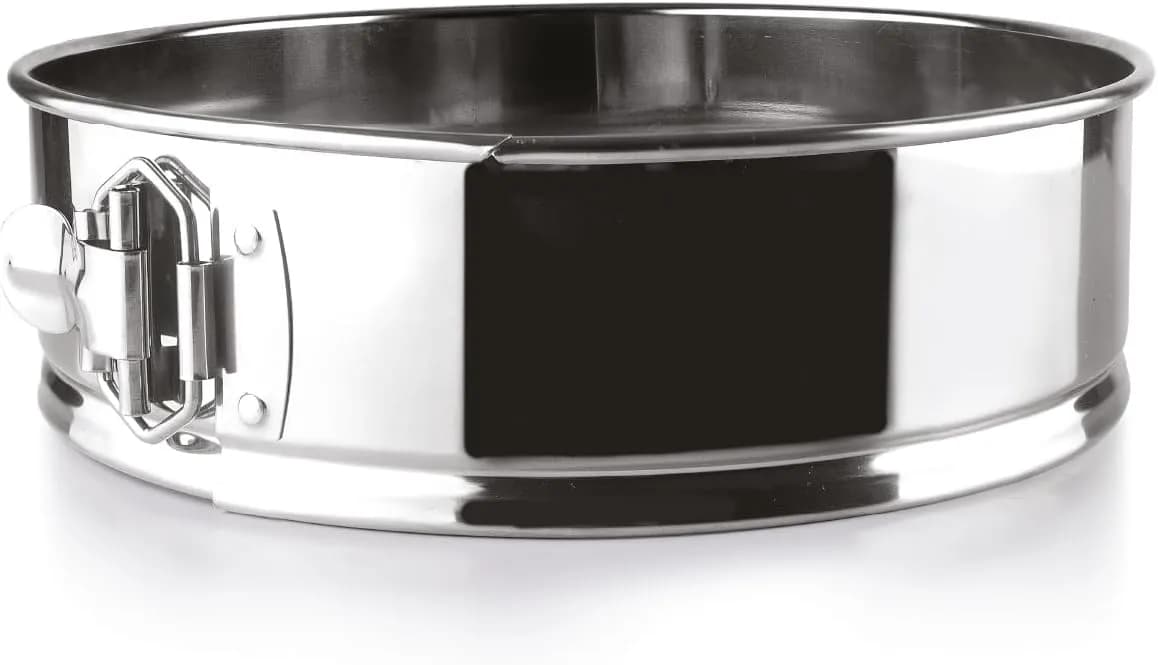
IBILI 650223 Stainless Steel Springform Cake Tin, 23 cm
Bare 18/10 stainless with no non-stick: the tin that survives scorching a Basque cheesecake at 210 °C
From€11
Price verified on Amazon on September 12, 2026 · may change
As an Amazon Associate, mikamado.es earns from qualifying purchases. At no extra cost to you.
- Diameter
- 23 cm
- Material
- Uncoated 18/10 stainless steel
Quick answer
The right tin for a Basque cheesecake on a kamado: bare 18/10 stainless, 23 cm, with no coating to cap it at 210-220 °C. It fits an 18" kamado with room to spare. Its 6.5 cm is standard depth, so the baking paper standing proud of the rim is not decoration: it is what contains the rise.
Springform tin in bare 18/10 stainless, 23 cm across and 6.5 cm deep. No non-stick to cap the heat: exactly what a scorched Basque cheesecake at 210 °C needs. Standard depth, not extra-tall.
What I like about this tin is that it declares the things that matter itself, with nothing left to infer: the listing says "18/10 stainless steel", "23 cm diameter" and "6.5 cm height". Three figures, all three relevant, none invented. In a category where half the listings are fighting with their own units, that alone counts for something.
Why bare stainless rather than a non-stick. The [Basque cheesecake](/recetas/cheesecake-vasco-quemado-kamado) bakes at 210 °C [indirect](/glosario#indirect-cooking) with the [deflector](/guias/coccion-directa-vs-indirecta-kamado-deflector) in, aiming precisely at scorching the surface to dark mahogany. That number sits right against the declared ceiling of almost any coated tin, which usually stops at 220 °C, and in a ceramic the recipe's number is not the real number: the dome radiates, the chamber swings and an overshoot is routine. Bare 18/10 stainless has nothing to degrade up there, and that absence of a coating is the whole reason this tin is on the list.
The 6.5 cm needs explaining. This is not an "extra-tall" tin: it is the standard depth of a springform. The Basque cheesecake rises enormously in the oven and then sinks as it cools, and poured straight into 6.5 cm it would spill over. What holds it is the paper: two sheets crumpled, wetted and wrung out, lining the base and walls and standing five or six centimetres proud of the ring. That paper acts as a false wall, prints the rustic crust the cake is named for and, incidentally, solves the other weak point of every springform: the joint between ring and base is not watertight, and a batter this loose would find the seam and drip onto the deflector.
In the kamado it sits comfortably. Twenty-three centimetres fit without argument in a [Kamado Joe Classic](/kamados/kamado-joe-classic-iii) or a [Big Green Egg Large](/kamados/big-green-egg-large), on the grate above the deflector, with room around it for air to move — which is exactly what the 40 × 30 trays in this same batch lack. On the small kamados (Joe Jr, MiniMax) measure the headroom under the dome first: the tin goes in, but paper standing six centimetres proud eats into clearance that is scarce there.
Two usage warnings. First: bare stainless is not non-stick, so greasing or lining is not optional in any recipe. Second, and more substantial: the listing declares no maximum temperature. The heat tolerance rests on the material — uncoated steel — and not on a manufacturer's figure, and I would rather say so than credit it with a specification it has never published.
For the rest of kamado baking it works just as well at the low end: a sponge at 175-180 °C, an almond cake. We bake the [tarta de Santiago](/recetas/tarta-de-santiago-kamado-almendra) in a cocotte, but it is one of those that take a 23 cm springform perfectly well if you would rather turn it out clean. And to know what temperature you are actually at, use a [chamber probe at grate height](/accesorios/inkbird-ibt-26s-wifi): the lid thermometer reads dome air, not the air around the tin.
Bare 18/10 stainless and three figures the listing declares itself: the right tin for a scorched Basque cheesecake at 210 °C in a ceramic. Its depth is the standard one, and you should know that.
Editorial rating from spec sheet, measurements and kamado fit · not a hands-on test
Pros
- Bare 18/10 stainless: no coating imposing a 220 °C ceiling
- The listing itself declares material, diameter (23 cm) and height (6.5 cm), nothing inferred
- 23 cm fits comfortably in an 18" kamado, with air all around the tin
- A single piece, not a set: you buy the diameter the recipe asks for and nothing else
- A Biscay baking brand, fitting for the cake it is going to bake
Cons
- 6.5 cm is the standard springform depth, not the "tall" tin the recipe asks for: without paper standing proud, the cheesecake overflows
- The ring-to-base joint is not watertight: with a loose batter, baking paper is compulsory or it drips onto the deflector
- The listing declares no maximum temperature: heat tolerance rests on the material, not on a maker's figure
- Bare stainless, nothing non-stick: you have to grease or line it in every recipe
Who it's for
For anyone baking Basque cheesecake on a kamado who wants an uncoated tin that does not fall short when the chamber spikes past 220 °C.
Not for
It is not the tall tin the generic name suggests: 6.5 cm, the usual depth. And not for baking without lining either: bare stainless grips, and the ring joint is not watertight.
Specifications
- Diameter
- 23 cm
- Material
- Uncoated 18/10 stainless steel
As an Amazon Associate, mikamado.es earns from qualifying purchases. At no extra cost to you.
Goes well with
FAQ
Does it survive the 210 °C of a Basque cheesecake?
Yes, and that is why this tin and not another. It is bare 18/10 stainless steel: no non-stick, no lacquer, so there is no layer to degrade when the chamber overshoots. That matters because in a ceramic the recipe's 210 °C is an average, not a guarantee: the dome radiates and spikes are routine. Let us be exact, though: the listing publishes no maximum temperature. The tolerance rests on the material, not on a figure signed by IBILI. The reverse is precisely what ruled out a same-size competitor, which declares 220 °C and falls short.
At 6.5 cm deep, will the cheesecake overflow?
Not if you line it the way the recipe says, and this is the tin's honest drawback: 6.5 cm is the standard springform depth, not a tall tin. The Basque cheesecake rises a great deal while baking and then sinks as it cools, so what contains it is not the ring but the paper. Crumple two large sheets of baking paper, wet them and wring them out so they mould to the shape, and line base and walls leaving them standing five or six centimetres above the rim. That paper wall is what holds the rise and, along the way, prints the cake's characteristic crumpled crust.
Will the batter leak through the ring joint?
It can, which is why the paper is not optional. The closure on any springform is mechanical, not watertight: the ring clamps against the edge of the base and leaves a seam that a runny batter eventually finds. The Basque cheesecake batter is among the loosest anyone bakes, so unlined you would get drips onto the deflector and a burnt smell for the rest of the session. Lined with crumpled paper, the problem disappears entirely. If you ever bake something liquid without paper, wrap the outside of the tin in foil.
Will it fit my kamado?
In an 18" kamado — Kamado Joe Classic, Big Green Egg Large — it fits easily: 23 cm across on a grate of about 46 leaves plenty of margin for air to rise up the sides, which is exactly what an indirect bake needs. On small kamados such as the Joe Jr or MiniMax the diameter also goes in, but measure the clearance between grate and dome first: baking paper standing six centimetres proud takes up space that is very tight on those models.
What else is it good for on the kamado?
For any indirect baking you want to turn out cleanly. At 175-180 °C with the deflector in it handles sponges, almond cakes and apple tarts without trouble; we bake the tarta de Santiago in a cocotte, but it takes a 23 cm springform perfectly well if you prefer unmoulding to serving from the pot. What I would not ask of it is griddling or direct fire: it is a baking tin, not a piece to set over live coals on an open grate.
YOU MIGHT ALSO LIKE