BUYING GUIDE · BIG GREEN EGG
Which Big Green Egg to Buy: MiniMax vs Large vs XL
Three eggs, the same legendary ceramic, and hundreds of euros between them. We tell you which one fits your terrace, your family and the way you actually cook — no marketing smoke.
QUICK PICK
If you only want to know which one to buy
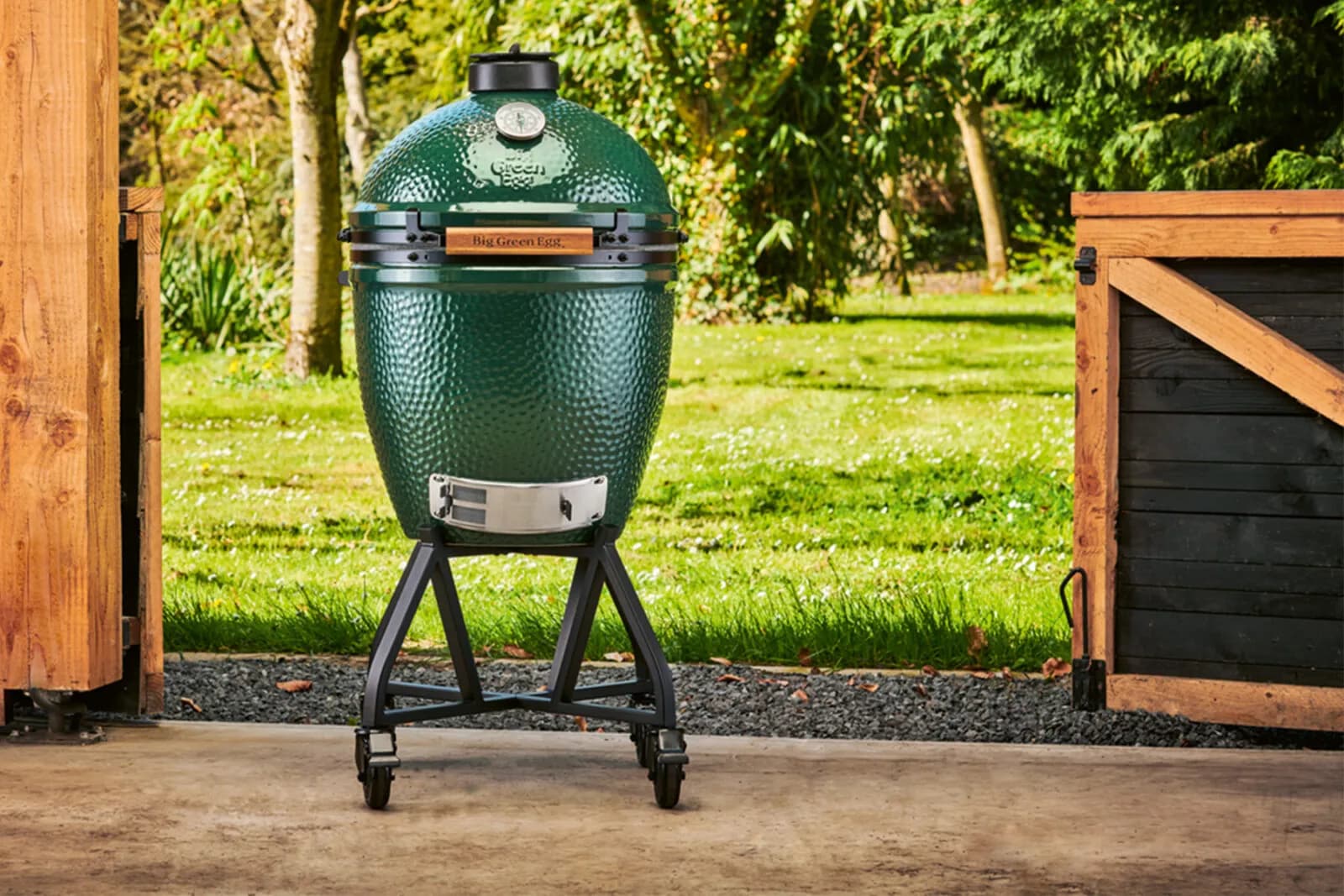
Big Green Egg Large
For most households the **Large** is the sweet spot: it fits a whole chicken or six burgers with room to spare, without taking over your terrace or costing what the XL does. It is the size the brand treats as standard, and the one with the widest accessory range.
As an Amazon Associate, mikamado.es earns from qualifying purchases. At no extra cost to you.
Big Green Egg did not invent the kamado, but it did turn thick, high-fire ceramic into a durability benchmark the rest of the market has chased for decades. Let us clear up a myth right away: there is no "space-grade" ceramic or NASA material inside an Egg. What there is is a dense, thick-walled, high-temperature ceramic that retains heat exceptionally and survives cycles from 100 °C to 350 °C without cracking — backed by a lifetime warranty on the ceramic body. That, not the marketing, is what justifies the price.
The real decision is not "Egg or no Egg?" but which size. And here almost everyone over-buys: they get the XL dreaming of big parties that happen three times a year, then waste charcoal heating 61 cm of grill for two steaks. In this guide we rank the three live sizes in the catalogue by real-world use, not by showroom appeal.
If you are still choosing between brands rather than sizes, start with our Large vs Kamado Joe Classic III comparison and the Big Green Egg brand page. To master lighting, temperature control and maintenance, the complete Big Green Egg guide is your next stop. And if you are not yet sure a kamado is for you, begin with the best kamado of 2026.
Comparison at a glance
| Model | Diameter | Diners | Weight | Warranty | Approx. price |
|---|---|---|---|---|---|
| Big Green Egg MiniMax | 33 cm | 2-4 | ≈34 kg | Lifetime (ceramic) | ≈1.349 € |
| Big Green Egg Large | 46 cm | 6-8 | ≈73 kg | Lifetime (ceramic) | ≈2.099 € |
| Big Green Egg XL | 61 cm | 12-20 | ≈99 kg | Lifetime (ceramic) | ≈3.299 € |
The full ranking
#1
Big Green Egg Large
The Large is the Egg we would recommend without hesitation to nine out of ten buyers, and we say so from experience — it is the one our author owns. Its 46 cm grate handles everything from dinner for two to a meal for six without stress, and it is the size with the widest accessory range (plates, two-tier grids, pizza setups). It holds heat with a stability that makes 110 °C easy for a twelve-hour brisket or 300 °C for Neapolitan pizza. If you will only ever own one kamado, make it this one.
Pros
- Balanced capacity (6-8 diners) that covers 90 % of real-world occasions
- The size with the largest accessory and spare-part catalogue in the Egg ecosystem
- Excellent heat retention: stable both for low-and-slow and high-heat cooking
Cons
- Heavy (≈73 kg with nest): designed to stay put, not to move often
- For couples who always cook for two, it may be more than you need
#2
Big Green Egg MiniMax
The MiniMax is the Egg for tight spaces or genuine portability. It weighs around 34 kg and ships with a carrying handle (the Carrier), so it fits a small terrace, a balcony, or even the boot of a car for a weekend away. Do not be fooled by the size: same thick ceramic and the same ability to hold low temperatures for hours as its bigger siblings. It is the logical pick for a couple, for a travelling second Egg, or for anyone who almost always cooks for two or three. Its limit is obvious: forget hosting a table of eight.
Pros
- Genuinely portable (≈34 kg + Carrier handle): small terrace, balcony or car boot
- Same high-fire ceramic and temperature control as the bigger Eggs
- The most charcoal-efficient when cooking for two or three
Cons
- Limited capacity (2-4): falls short as soon as you invite more people
- Low working height; many users set it on a table or extra stand
#3
Big Green Egg XL
The XL exists for one specific reason: big gatherings and whole cuts. With a 61 cm grate you can roast two turkeys, several rib racks or a whole suckling pig in one go — impossible on the Large. If you regularly host twelve or more, or cook for a small catering operation, this is your Egg. But let us be honest: for an average family it is too much. Heating and holding that much ceramic burns more charcoal and more time, and most buyers who pick the XL "just in case" end up cooking on a quarter of the grate every time. Buy it only if that volume is your norm, not your exception.
Pros
- Largest surface in the range (61 cm): turkeys, rib racks or whole cuts at once
- Ideal for anyone who regularly hosts 12-20 people
- Same lifetime ceramic warranty as the rest of the range
Cons
- Oversized for family use: burns more charcoal and takes longer to stabilise
- Very heavy (≈99 kg) and bulky: needs a fixed, generous space
How to choose between these models
Choose by your usual number of diners, not by the maximum you sometimes imagine.
If you almost always cook for two or three, or space and portability rule, the MiniMax is enough and more efficient. If your typical table is four to eight and you want one kamado that does it all — pizza, brisket, Sunday roasts — the Large is the right answer for the vast majority: capacity, accessories and resale value. Reserve the XL only if hosting twelve or more is your routine, not your once-a-year exception.
One last tip: when torn between two sizes, only size up if you have a concrete, recurring reason. It is easier to cook a little on a big Egg than a lot on a small one, but you pay that margin in charcoal, time and space every single time you light it.
The ones we dismissed (and why)
We analysed these in depth for this list too. They missed the cut for specific reasons — and one of them might still be the right fit for you:
- Klarstein Kingsize Kamado — Budget ceramic clone without the Egg's lifetime warranty or spare-part ecosystem; the upfront saving evaporates the moment a gasket or hinge fails and no part is available.
- BBQ-Toro Haiiro 32 cm — Thinner ceramic and basic hardware that cost you temperature stability on long cooks; fine as an entry point, but not the decade-long kamado an Egg is.
- Landmann Kamado Mini 27 cm — A general-brand mini built for a tight budget: very limited capacity and none of the MiniMax accessory network, which offers the same portability with far better ceramic and support.
Frequently asked questions
Is Big Green Egg ceramic really "NASA material"?
No. It is a marketing myth repeated for years. The Egg uses a dense, thick-walled, high-fire ceramic with no aerospace components or NASA patents. What makes it special is real and verifiable: it retains heat exceptionally, tolerates sharp temperature swings and is covered by a lifetime warranty on the ceramic body. It needs no myths to justify itself.
Can the Large do both pizza and low-and-slow?
Yes, and that is exactly its strength. With the stone and a deflector you can reach 300 °C or more for a Neapolitan pizza in minutes, and with the deflector and the air intake nearly closed hold a stable 110 °C for 12 hours for a brisket. The Large's ceramic mass makes that stability easy even for a beginner. That is why we recommend it as a single, do-it-all kamado.
Is the XL worth it for a normal family?
For most, no. The XL shines when you regularly host 12-20 people or roast whole cuts (turkeys, suckling pig). For a family cooking for four to six it means more charcoal, longer heat-up and a sizeable footprint in exchange for a surface you will rarely fill. When in doubt, the Large is almost always the smarter choice.
Can I move the MiniMax, or does it stay put like the big ones?
It is the only Egg designed to move. At around 34 kg with its integrated Carrier handle, you can take it from terrace to garden, store it in winter or load it into the boot for a getaway. Note its low working height, though: most people use it on a sturdy table or stand. It is the ideal kamado for couples or as a travelling second Egg.
Why pay for a Big Green Egg instead of a cheap ceramic kamado?
For three concrete things: the lifetime warranty on the ceramic, a huge ecosystem of accessories and spare parts available for years, and very fine temperature control thanks to well-fitted hardware and dampers. Cheap clones copy the shape but tend to fail at gaskets, hinges and parts availability. If you want a kamado for a decade, the Egg's premium is, in practice, insurance. Compare for yourself in the best kamado 2026 guide.
Other buying guides
Best kamado 2026: the 5 ceramic grills we recommend without reservations
Editorial comparison of the 5 best kamados of 2026. Kamado Joe Classic III, Big Green Egg Large, Big Joe III, Monolith Classic Pro 2 and Primo Oval XL. No pay-for-coverage.
Best premium kamado: 4 top units to buy once in a lifetime
Kamado Joe Classic III, Big Joe III, BGE Large and Monolith Classic Pro 2: the 4 best premium kamados reviewed without pay-for-coverage. Lifetime warranty, complete ecosystem.
Best kamado for a couple: 3 small options for 2 (with room for guests)
The 3 best kamados for a childless couple: Kamado Joe Jr, BGE MiniMax and Monolith Icon. 32-38 cm diameter, under 50 kg, enough for 2 with room for 4 guests.