EDITORIAL COMPARISON · 1 VS 1
Kamado Joe Big Joe III 24" vs Weber Summit Kamado E6 24": which one should you choose?
Comparison by Valery Grin ·
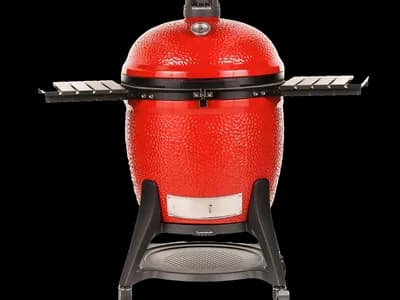
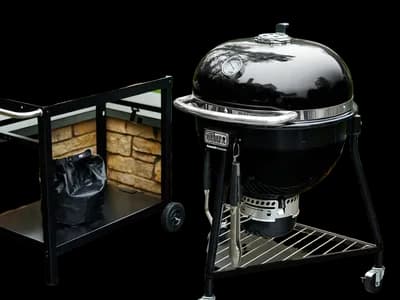
Two grills Amazon lists together under "XL kamado", but only one really is. The Big Joe III is dense ceramic, 184 kg with its cart; the Weber Summit Kamado E6 is double-walled insulated porcelain steel — a hybrid Weber calls a kamado for marketing reasons. The matchup matters because the choice changes how you cook.
Quick answer
The Kamado Joe Big Joe III clearly beats the Weber Summit Kamado E6: its dense ceramic holds a 14-hour smoke on a quarter of the charcoal, while the Weber's insulated steel leaks heat and burns more fuel. The Weber Summit Kamado E6 only wins on weight (66 kg versus 184 kg, both on their stands) and the quick heat-up Weber credits to the lid damper.
Specs side by side
| Specification | Kamado Joe Big Joe III 24" | Weber Summit Kamado E6 24" |
|---|---|---|
| Diameter | 61 cm | 61 cm |
| Diners | 8-10 | 8-10 |
| Weight | 184 kg | 66 kg |
| Material | Glazed ceramic | Double-wall porcelain-enamelled steel (NOT ceramic) |
| Temperature range | 107°C – 398°C | 90°C – 370°C |
| Warranty | Vitalicia (cerámica) | 10 años (caja de combustión y tapa) |
| Current price | €3,199 | €1,499 |
Verdict by use case
Five real cooking scenarios. For each one we pick a winner with a concrete reason — no diplomatic ties.
For low & slow smoking
Winner: Kamado Joe Big Joe III 24"
The Big Joe's dense ceramic holds thermal mass across 14 hours on a quarter of the charcoal. The Weber's steel leaks heat through the walls — more fuel, more swing.
For pizza and oven bread
Winner: Kamado Joe Big Joe III 24"
At 400 °C the Big Joe's ceramic thermal mass crisps the bottom crust; the Weber tops out at around 370 °C according to our spec sheet (Weber does not publish a range) and the pizza base never fully toasts.
For big families or parties
Winner: Weber Summit Kamado E6 24"
Weber states that the lid damper creates a chimney effect that brings the temperature up fast, and at 66 kg on its wheeled stand it moves around the terrace more easily. (The Snap-Jet and side tables belong to the S6, not the E6.)
For balconies or tight spaces
Winner: Weber Summit Kamado E6 24"
The Weber weighs 66 kg vs the Big Joe's 184 kg, little more than a third. If your terrace is up high or the floor is floating, this spares you structural reinforcement.
For a tight budget
Winner: Weber Summit Kamado E6 24"
The Weber lands roughly €1,700 below the Big Joe III (€1,499 vs €3,199). It comes with an integrated wheeled stand, but you pay in long-term charcoal.
Best and worst of each
Kamado Joe Big Joe III 24"
Best
- 61 cm grate — full brisket or two rib racks side by side
- SlōRoller hyperbolic chamber: true convection for long smokes
- Three-tier Divide & Conquer, two-temperature cooking at once
Worst
- 184 kg with the cart, per the brand — you need two people for the install
- Heating 61 cm of ceramic burns more charcoal and takes longer than a Classic III
Weber Summit Kamado E6 24"
Best
- Weber build quality and robust warranty
- Lighter than a ceramic of its size: 66 kg according to Weber, against 184 kg for the Big Joe III with the cart
- Extensive Weber Spain service network
Worst
- Not pure ceramic — loses more heat than a traditional kamado
- Lower thermal mass: long smokes need more fuel
Kamado Joe vs Weber: the brands head to head
Here the brand clash is almost philosophical, because the two don't play in the same material. Kamado Joe (USA, 2009) is a pure specialist: it makes only dense-ceramic kamados, and all its engineering — SlōRoller, Divide & Conquer, Air Lift Hinge — exists to squeeze the thermal mass of that material. Weber (USA, 1952) is the historic giant that invented the modern barbecue with the Kettle and today dominates the European market in gas, charcoal and accessories; its service, spares and in-store presence in Spain are unrivalled. But its Summit Kamado E6 isn't ceramic: it's double-walled insulated porcelain steel, a hybrid Weber labels a "kamado" for marketing. That changes how it cooks — it lights with gas in seconds and weighs half as much, but burns more charcoal and swings more on long smokes. The brand choice is really a material choice. We recommend Kamado Joe to anyone who wants a true kamado for ceramic thermal mass and low-charcoal smokes; Weber to anyone who values the brand with the best support in Spain, the convenience of gas ignition and a more manageable terrace weight.
Our pick: Kamado Joe Big Joe III 24"
The Big Joe III, no caveats. The Weber Summit Kamado E6 isn't a traditional kamado — it's an insulated-steel grill that behaves between kamado and premium BBQ. That isn't a flaw, but if you're buying a kamado for ceramic thermal mass, low-charcoal long smokes and multi-decade durability, the Weber doesn't deliver. Buy it only if you trust the Weber brand more than the material — and accept the fuel/behavior trade-off.
KEEP READING
Take this decision further
- Editorial guide
Your first kamado: the complete pre-purchase guide
Size, materials, brand and budget. Everything you have to decide before clicking Buy, told by someone who has made enough mistakes.
- Recipe to try
Low-and-slow smoked brisket
The kamado acid test. Ten hours at 110°C, a deep bark, a pink smoke ring and a texture that gives way under the weight of a fork.
- Recipe to try
St. Louis-style ribs on the kamado
St. Louis-cut ribs (no rib tips), cooked reverse-sear: four hours at 130°C with light smoke, then a final blast of direct heat to caramelise the glaze.
- Glossary term
Low & slow
Cooking at low temperature (95-130 °C) for many hours to tenderise tough cuts and develop deep smoke.